
Homework Answers
Add Answer to:
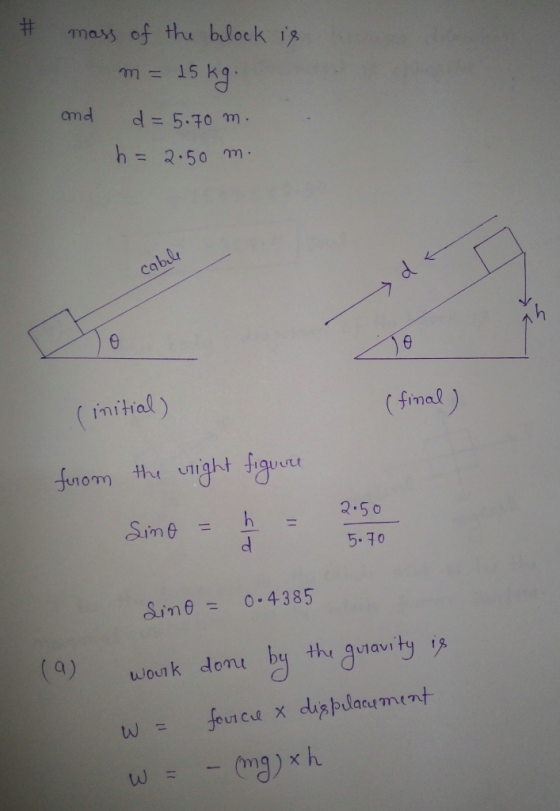
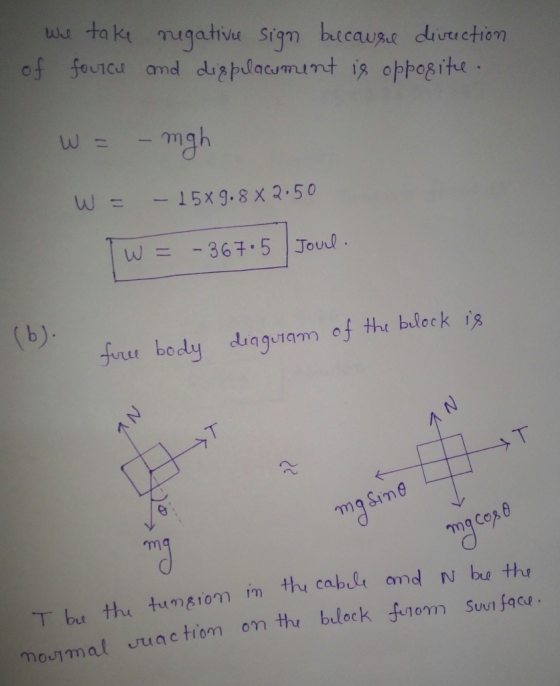
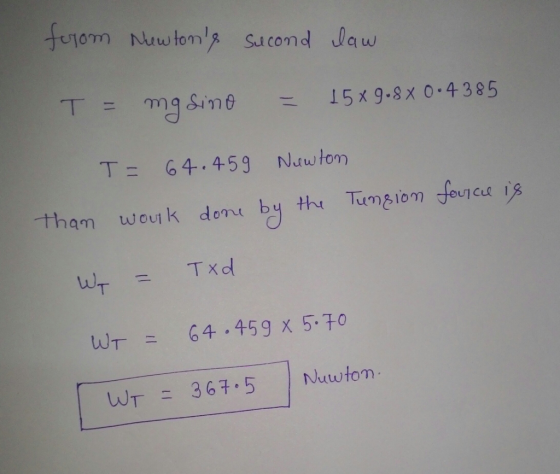
A box initially at rest of 15kg is lifted with a cable a distance d 570m...
Q1) A dockworker loading crates on a ship finds that a 15kg crate, initially at rest...
Q1) A dockworker loading crates on a ship finds that a 15kg crate, initially at rest on a horizontal surface, requires a 85N horizontal force to set it in motion. Find the coefficient of static friction between crate and floor. Q2) A crate is pushed 5.32m along a frictionless horizontal floor by a constant 18N force directed 45 degree below the horizontal. What is the work done by force? Q3) If both mass and velocity of a ball are tripled,...
3. A box having a mass equal to 10.0 kg is initially at rest on a...
 3. A box having a mass equal to 10.0 kg is initially at rest on a horizontal, frictionless floor. A pulling force having a magnitude of 5.00 N is applied at an angle of 30.0° above the horizontal. The box is pulled a distance of 15.0 m. 7 ] = 5.00 N 30.0° (a) What is the work done by the pulling force? (b) What is the work done by gravity? (c) What is the work done by the normal...
A box with mass m = 1.2kg on an inclined frictionless surface is released from rest...
 A box with mass m = 1.2kg on an inclined frictionless surface is released from rest from a height h = 1.75 m. After reaching the bottom of the incline the box slides with friction (uk = 0.25) along a horizontal surface until coming to a rest after a distance d. 1. Draw a free body diagram for the box while it is on the incline. Clearly label all forces with standard names. 2. Draw a free body diagram for...
A 1500-kg air conditioning unit is being lifted by a crane onto the roof of a...
A 1500-kg air conditioning unit is being lifted by a crane onto the roof of a building. The unit starts on the ground and is raised straight up to a height of 12.0 m by a cable attached to the crane. The tension in the cable during the lift is 1.54 × 10⁴ N. (Reminders: a free body diagram will probably be helpful, and work can be positive or negative.) (a) How much work is done on the air conditioning...
Suppose a 1350-kg elevator car is lifted a distance 41 m by its cable at a...
Suppose a 1350-kg elevator car is lifted a distance 41 m by its cable at a constant speed, assuming the frictional force on the elevator has a constant value of 1575 N. Calculate the work done on the elevator by its cable, in joules. Calculate the work done by the gravitational force on the elevator, in joules, during this process. Calculate the total work done on the elevator, in joules.
A rescue helicopter lifts a 77.2-kg person straight up by means of a cable. The person...
A rescue helicopter lifts a 77.2-kg person straight up by means of a cable. The person has an upward acceleration of 0.816 m/s2 and is lifted from rest through a distance of 14.9 m. (a) What is the tension in the cable? How much work is done by (b) the tension in the cable and (c) the person's weight? (d) Use the work-energy theorem and find the final speed of the person.
A 3.0 kg box is raised from rest a distance of 5.0 m by a vertical...
 A 3.0 kg box is raised from rest a distance of 5.0 m by a vertical force of 90 N (a) Find the work done by the force. b) Find the work done by gravity (c) Find the final kinetic energy of the box. eBook
help with part 5 1. A 125-kg load is lifted 12.0 m vertically with an acceleration...
 help with part 5
1. A 125-kg load is lifted 12.0 m vertically with an acceleration a -0.32g by a single cable. Determine: (a) the tension in the cable, (b) the net work done on the load, (c) the work done by the cable on the load, (d) the work done by gravity on the load, and (e) the final speed of the load assuming it started from rest. 2. A 1.60-m tall person lifts a 2.10-kg book from the...
help with part 5
1. A 125-kg load is lifted 12.0 m vertically with an acceleration a -0.32g by a single cable. Determine: (a) the tension in the cable, (b) the net work done on the load, (c) the work done by the cable on the load, (d) the work done by gravity on the load, and (e) the final speed of the load assuming it started from rest. 2. A 1.60-m tall person lifts a 2.10-kg book from the...
A 265-kg load is lifted 24.0 m vertically with an acceleration a=0.110 g by a single cable. A: Determine the tension in...
A 265-kg load is lifted 24.0 m vertically with an acceleration a=0.110 g by a single cable. A: Determine the tension in the cable. Express your answer to three significant figures and include the appropriate units. B:Determine the net work done on the load. Express your answer to three significant figures and include the appropriate units. C:Determine the work done by the cable on the load. Express your answer to three significant figures and include the appropriate units. D:Determine the...
As shown in the figure below, a box of mass m = 51.0 kg (initially at...
 As shown in the figure below, a box of mass m = 51.0 kg
(initially at rest) is pushed a distance d = 98.0 m across a rough
warehouse floor by an applied force of FA = 200 N directed at an
angle of 30.0° below the horizontal. The coefficient of kinetic
friction between the floor and the box is 0.100. Determine the
following. (For parts (a) through (d), give your answer to the
nearest multiple of 10.)
(a) work...
As shown in the figure below, a box of mass m = 51.0 kg
(initially at rest) is pushed a distance d = 98.0 m across a rough
warehouse floor by an applied force of FA = 200 N directed at an
angle of 30.0° below the horizontal. The coefficient of kinetic
friction between the floor and the box is 0.100. Determine the
following. (For parts (a) through (d), give your answer to the
nearest multiple of 10.)
(a) work...
 3. A box having a mass equal to 10.0 kg is initially at rest on a horizontal, frictionless floor. A pulling force having a magnitude of 5.00 N is applied at an angle of 30.0° above the horizontal. The box is pulled a distance of 15.0 m. 7 ] = 5.00 N 30.0° (a) What is the work done by the pulling force? (b) What is the work done by gravity? (c) What is the work done by the normal...
 A box with mass m = 1.2kg on an inclined frictionless surface is released from rest from a height h = 1.75 m. After reaching the bottom of the incline the box slides with friction (uk = 0.25) along a horizontal surface until coming to a rest after a distance d. 1. Draw a free body diagram for the box while it is on the incline. Clearly label all forces with standard names. 2. Draw a free body diagram for...
 A 3.0 kg box is raised from rest a distance of 5.0 m by a vertical force of 90 N (a) Find the work done by the force. b) Find the work done by gravity (c) Find the final kinetic energy of the box. eBook
 help with part 5
1. A 125-kg load is lifted 12.0 m vertically with an acceleration a -0.32g by a single cable. Determine: (a) the tension in the cable, (b) the net work done on the load, (c) the work done by the cable on the load, (d) the work done by gravity on the load, and (e) the final speed of the load assuming it started from rest. 2. A 1.60-m tall person lifts a 2.10-kg book from the...
help with part 5
1. A 125-kg load is lifted 12.0 m vertically with an acceleration a -0.32g by a single cable. Determine: (a) the tension in the cable, (b) the net work done on the load, (c) the work done by the cable on the load, (d) the work done by gravity on the load, and (e) the final speed of the load assuming it started from rest. 2. A 1.60-m tall person lifts a 2.10-kg book from the...
 As shown in the figure below, a box of mass m = 51.0 kg
(initially at rest) is pushed a distance d = 98.0 m across a rough
warehouse floor by an applied force of FA = 200 N directed at an
angle of 30.0° below the horizontal. The coefficient of kinetic
friction between the floor and the box is 0.100. Determine the
following. (For parts (a) through (d), give your answer to the
nearest multiple of 10.)
(a) work...
As shown in the figure below, a box of mass m = 51.0 kg
(initially at rest) is pushed a distance d = 98.0 m across a rough
warehouse floor by an applied force of FA = 200 N directed at an
angle of 30.0° below the horizontal. The coefficient of kinetic
friction between the floor and the box is 0.100. Determine the
following. (For parts (a) through (d), give your answer to the
nearest multiple of 10.)
(a) work...
Most questions answered within 3 hours.
-
Where is the error in this code sequence?
String s1 = "Hello";
String s2 = "ello";...
asked 11 months ago -
Financial data for Joel de Paris, Inc., for last year
follow:
Joel de Paris, Inc.
Balance...
asked 11 months ago -
Consider this reaction:
Al2(SO4)3 (aq)+ BaCl3
(aq) Al2Cl6 (aq)- +
3BaSO4(s) . What is the...
asked 11 months ago -
Suppose that Savneet is considering increasing her
recent random sample from 20 car rentals to 40...
asked 11 months ago -
Trucks arrive at an unloading terminal at an average rate of 120
per hour.
Trucks arrive...
asked 11 months ago -
Why are methanol and ethanol completely soluble in water while
octanol is not very little soluble....
asked 11 months ago -
A facilities manager at a university reads in a research report
that the mean amount of...
asked 11 months ago -
When the CuSO4 is rehydrated by adding water to the anhydrous
compound, is this an endothermic...
asked 11 months ago -
A ray of sunlight is passing from diamond into crown glass; the
angle of incidence is...
asked 11 months ago -
A block of mass 0.249 kg is placed on top of a light, vertical
spring of...
asked 11 months ago -
how do the kidneys compensate in the presences of acidosis
a) trigger hyperventilate
b) reserve acid...
asked 11 months ago -
Question 501 pts
The rental rate of capital to the firm increases. Which of the
following...
asked 11 months ago