
Homework Answers
Add Answer to:
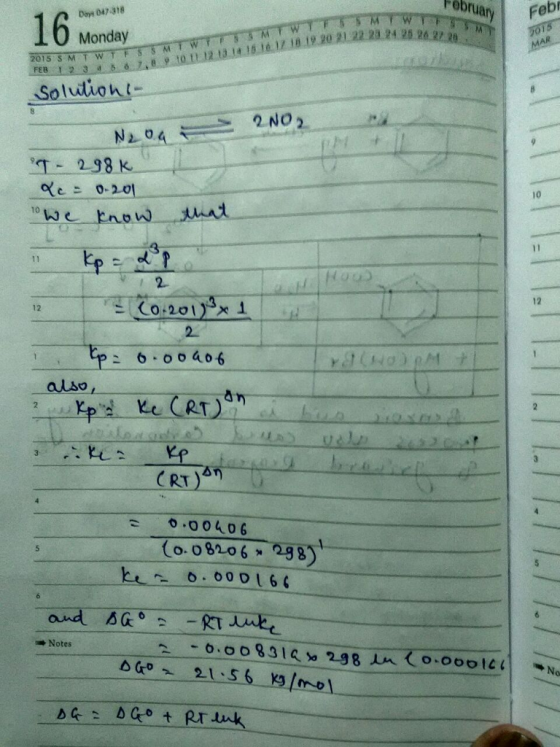
For the equilibrium N_2O_4(g) 2 NO_2(g), the degree of dissociation, alpha_c, at 298 K is 0.201...
Consider the reaction 2NO_2(g) rightarrow N_2O_4 (g). Using the following data, calculate Delta G degree at...
 Consider the reaction 2NO_2(g) rightarrow N_2O_4 (g). Using the following data, calculate Delta G degree at 298 K. Delta G degree (NO_2(g)) = 51.84 kJ/mol, Delta G degree (N_2 O_4 (g)) = 98.28 kJ/mol. Calculate Delta G at 298 K if the partial pressures of NO_2 and N_2O_4 are 0.37 atm and 1.62 atm, respectively. Express your answer using one significant figure.
2. For the isomerization reaction, N204(g) + 2NO2(g), the degree of dissociation (a) is 0.201 at...
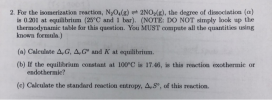 2. For the isomerization reaction, N204(g) + 2NO2(g), the degree of dissociation (a) is 0.201 at equilibrium (25°C and 1 bar). (NOTE: DO NOT simply look up the thermodynamic table for this question. You MUST compute all the quantities using known formula.) (a) Calculate A,G,A,Gº and K at equilibrium. (b) If the equilibrium constant at 100°C is 17.46, is this reaction exothermic or endothermic? (c) Calculate the standard reaction entropy, A. Sº, of this reaction.
Find the equilibrium concentration of N_2O_4(g) [Nitrogen nitroxide] due to the chemical reaction at 25 degree...
 Find the equilibrium concentration of N_2O_4(g) [Nitrogen nitroxide] due to the chemical reaction at 25 degree C and 1 atm. N_2O_4(g) doubleheadarrow 2NO_2(g) Using the available data: (a) N_2O_4 (g) doubleheadarrow N_2(g) + 2O_2 (g), Delta G degree_rxn, 1 = Delta G degree_f, N_2O_4 = -23.41 kcal/mol (b) 0.5N_2(g) + O_2(g) doubleheadarrow NO_2(g), Delta G degree_rxn, 2 = -Delta G degree_f, NO_2 = -12.24kcal/mol
Calculate the equilibrium constants K and Kc, the degree of dissociation, alpha for the dissociation...
Calculate the equilibrium constants K and Kc, the degree of dissociation, alpha for the dissociation of hydrogen gas at 3000 K and 1 bar. The standard molar Gibbs energies of formation of H2(g) and H(g) at 3000 K and 1 bar are 0 and 46.0 kJ/mol, respectively. Assume ideal gas behavior. H2(g) 2 H(g)
Calculate the value of K, at 298 K, for each value of delta G degree. delta...
 Calculate the value of K, at 298 K, for each value of delta G degree. delta G degree = 7.5 kJ/mol delta G degree = -9.0 kJ/mol
At 248 ºC and a total pressure of 1.00 atm the degree of dissociation of SbCl5(g)...
At 248 ºC and a total pressure of 1.00 atm the degree of dissociation of SbCl5(g) is alpha = 0.718 for the reaction SbCl5(g) ↔ SbCl3(g) + Cl2(g) . The degree of dissociation alpha is defined as: alpha = (number of moles of SbCl5 dissociated at equilibrium) / (original number of moles of SbCl5) . (a) What is the value of the equilibrium constant K(T) at 248 ºC and 1.00 atm? (b) What is the value of Kx (the equilibrium...
At 248 ºC and a total pressure of 1.00 atm the degree of dissociation of SbCl5(g)...
At 248 ºC and a total pressure of 1.00 atm the degree of dissociation of SbCl5(g) is alpha = 0.718 for the reaction SbCl5(g) ↔ SbCl3(g) + Cl2(g) . The degree of dissociation alpha is defined as: alpha = (number of moles of SbCl5 dissociated at equilibrium) / (original number of moles of SbCl5) . (a) What is the value of the equilibrium constant K(T) at 248 ºC and 1.00 atm? (b) What is the value of Kx (the equilibrium...
The equilibrium constant, Kp, for the following reaction is 0.110 at 298 K: NH4HS(s) ->NH3(g) +...
The equilibrium constant, Kp, for the following reaction is 0.110 at 298 K: NH4HS(s) ->NH3(g) + H2S(g) Calculate the partial pressure of each gas and the total pressure at equilibrium when 0.581 moles of NH4HS(s) is introduced into a 1.00 L vessel at 298 K. Assume that the volume occupied by the solid is negligible. PNH3 = atm PH2S = atm Ptotal = atm
Having problem in solving 3 (iii) Consider the following reaction at equilibrium at 298 K 2Ag(s) 2HC(g)2AgCl(s) Hag Given the following data at 298 K 4 92.21 95 18 126 90 AHkmole) (i) Calculate Δ....
 Having problem in solving 3 (iii)
Consider the following reaction at equilibrium at 298 K 2Ag(s) 2HC(g)2AgCl(s) Hag Given the following data at 298 K 4 92.21 95 18 126 90 AHkmole) (i) Calculate Δ. ΔΗ , AS and Kp for the reaction at 298 K () Calculate Kp at 500 K w)If no moles of HCI are present initially, caloulate the partial pressure of H2 at equilibrium at 298 K taking α to be the fraction of dissociation and...
Having problem in solving 3 (iii)
Consider the following reaction at equilibrium at 298 K 2Ag(s) 2HC(g)2AgCl(s) Hag Given the following data at 298 K 4 92.21 95 18 126 90 AHkmole) (i) Calculate Δ. ΔΗ , AS and Kp for the reaction at 298 K () Calculate Kp at 500 K w)If no moles of HCI are present initially, caloulate the partial pressure of H2 at equilibrium at 298 K taking α to be the fraction of dissociation and...
Consider the dissociation of chlorine at 2000 K: Cl2(g) 2 Cl(g) AG 10.162 k mol-1 An...
 Consider the dissociation of chlorine at 2000 K: Cl2(g) 2 Cl(g) AG 10.162 k mol-1 An equilibrium mixture of both gases has a total pressure of 5.00 bar Determine the partial pressure of both gases in the mixture.
 Consider the reaction 2NO_2(g) rightarrow N_2O_4 (g). Using the following data, calculate Delta G degree at 298 K. Delta G degree (NO_2(g)) = 51.84 kJ/mol, Delta G degree (N_2 O_4 (g)) = 98.28 kJ/mol. Calculate Delta G at 298 K if the partial pressures of NO_2 and N_2O_4 are 0.37 atm and 1.62 atm, respectively. Express your answer using one significant figure.
 2. For the isomerization reaction, N204(g) + 2NO2(g), the degree of dissociation (a) is 0.201 at equilibrium (25°C and 1 bar). (NOTE: DO NOT simply look up the thermodynamic table for this question. You MUST compute all the quantities using known formula.) (a) Calculate A,G,A,Gº and K at equilibrium. (b) If the equilibrium constant at 100°C is 17.46, is this reaction exothermic or endothermic? (c) Calculate the standard reaction entropy, A. Sº, of this reaction.
 Find the equilibrium concentration of N_2O_4(g) [Nitrogen nitroxide] due to the chemical reaction at 25 degree C and 1 atm. N_2O_4(g) doubleheadarrow 2NO_2(g) Using the available data: (a) N_2O_4 (g) doubleheadarrow N_2(g) + 2O_2 (g), Delta G degree_rxn, 1 = Delta G degree_f, N_2O_4 = -23.41 kcal/mol (b) 0.5N_2(g) + O_2(g) doubleheadarrow NO_2(g), Delta G degree_rxn, 2 = -Delta G degree_f, NO_2 = -12.24kcal/mol
 Calculate the value of K, at 298 K, for each value of delta G degree. delta G degree = 7.5 kJ/mol delta G degree = -9.0 kJ/mol
 Having problem in solving 3 (iii)
Consider the following reaction at equilibrium at 298 K 2Ag(s) 2HC(g)2AgCl(s) Hag Given the following data at 298 K 4 92.21 95 18 126 90 AHkmole) (i) Calculate Δ. ΔΗ , AS and Kp for the reaction at 298 K () Calculate Kp at 500 K w)If no moles of HCI are present initially, caloulate the partial pressure of H2 at equilibrium at 298 K taking α to be the fraction of dissociation and...
Having problem in solving 3 (iii)
Consider the following reaction at equilibrium at 298 K 2Ag(s) 2HC(g)2AgCl(s) Hag Given the following data at 298 K 4 92.21 95 18 126 90 AHkmole) (i) Calculate Δ. ΔΗ , AS and Kp for the reaction at 298 K () Calculate Kp at 500 K w)If no moles of HCI are present initially, caloulate the partial pressure of H2 at equilibrium at 298 K taking α to be the fraction of dissociation and...
 Consider the dissociation of chlorine at 2000 K: Cl2(g) 2 Cl(g) AG 10.162 k mol-1 An equilibrium mixture of both gases has a total pressure of 5.00 bar Determine the partial pressure of both gases in the mixture.
Most questions answered within 3 hours.
-
Where is the error in this code sequence?
String s1 = "Hello";
String s2 = "ello";...
asked 11 months ago -
Financial data for Joel de Paris, Inc., for last year
follow:
Joel de Paris, Inc.
Balance...
asked 11 months ago -
Consider this reaction:
Al2(SO4)3 (aq)+ BaCl3
(aq) Al2Cl6 (aq)- +
3BaSO4(s) . What is the...
asked 11 months ago -
Suppose that Savneet is considering increasing her
recent random sample from 20 car rentals to 40...
asked 11 months ago -
Trucks arrive at an unloading terminal at an average rate of 120
per hour.
Trucks arrive...
asked 11 months ago -
Why are methanol and ethanol completely soluble in water while
octanol is not very little soluble....
asked 11 months ago -
A facilities manager at a university reads in a research report
that the mean amount of...
asked 11 months ago -
When the CuSO4 is rehydrated by adding water to the anhydrous
compound, is this an endothermic...
asked 11 months ago -
A ray of sunlight is passing from diamond into crown glass; the
angle of incidence is...
asked 11 months ago -
A block of mass 0.249 kg is placed on top of a light, vertical
spring of...
asked 11 months ago -
how do the kidneys compensate in the presences of acidosis
a) trigger hyperventilate
b) reserve acid...
asked 11 months ago -
Question 501 pts
The rental rate of capital to the firm increases. Which of the
following...
asked 11 months ago