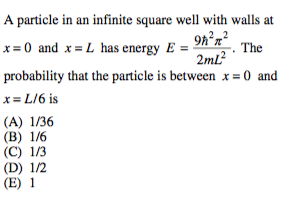
The answer is B but not sure why
Homework Answers
Request Answer!
We need at least 10 more requests to produce the answer.
0 / 10 have requested this problem solution
The more requests, the faster the answer.
Add Answer to:
The answer is B but not sure why
A particle in an infinite square well with...
4) A particle in an infinite square well 0 for 0
 4) A particle in an infinite square well 0 for 0
A NON stationary state A particle of mass m is in an infinite square well potential of width L, a...
 A NON stationary state A particle of mass m is in an infinite square well potential of width L, as in McIntyre's section 5.4. Suppose we have an initial state vector lv(t -0) results from Mclntrye without re-deriving them, and you may use a computer for your math as long as you include your code in your solution A(3E1) 4iE2)). You may use E. (4 pts) Use a computer to plot this probability density at 4 times: t 0, t2...
please explain all, thanks! 4. (60 pts) A particle in an infinite square well of width...
 please explain all, thanks!
4. (60 pts) A particle in an infinite square well of width L has an initial wave function (x,t = 0) = Ax(L - x)2, OSX SL a) Find y(x, t) fort > 0. You first have to normalize the wave function. Hint: this is best expressed an infinite series: show that the wave function coefficients are on = * 31% (12 – n?)(1-(-1)") → (n = 87315 (12 - nºre?); n odd. b) Which energy...
please explain all, thanks!
4. (60 pts) A particle in an infinite square well of width L has an initial wave function (x,t = 0) = Ax(L - x)2, OSX SL a) Find y(x, t) fort > 0. You first have to normalize the wave function. Hint: this is best expressed an infinite series: show that the wave function coefficients are on = * 31% (12 – n?)(1-(-1)") → (n = 87315 (12 - nºre?); n odd. b) Which energy...
1. A particle in an infinite square well has an initial wave function Alsin sin 4 0 < x < L other...
 help on all a), b), and c) please!!
1. A particle in an infinite square well has an initial wave function Alsin sin 4 0 < x < L otherwise s(x, t = 0) 0 (a) Find A so that the wavefunction is normalized. (b) Find '(z,t). (c) Find the expectation value(E) of the energy of ψ(x,t = 0). You may use the result mx n 2 0
1. A particle in an infinite square well has an initial wave...
help on all a), b), and c) please!!
1. A particle in an infinite square well has an initial wave function Alsin sin 4 0 < x < L otherwise s(x, t = 0) 0 (a) Find A so that the wavefunction is normalized. (b) Find '(z,t). (c) Find the expectation value(E) of the energy of ψ(x,t = 0). You may use the result mx n 2 0
1. A particle in an infinite square well has an initial wave...
5) A particle of mass m is in the ground state of the infinite square well...
 5) A particle of mass m is in the ground state of the infinite square well 0 < x < a At t-0 the right hand wall suddenly moves to x = 2a, doubling the size of the well. Assume that this expansion happens on a time scale so fast that the initial wave function (at t0+) is the same as just before the expansion (at t-0-) (This is called the "sudden" approximation.) a) What is the probability that a...
An infinite square well and a finite square well in 1D with equal width. The potential...
 An infinite square well and a finite square well in 1D with
equal width. The potential energies of these wells are
Infinite square well: V(x)=0, from 0 < x < a, also V(x) =
, elsewhere
Finite square well: V(x)= 0, from 0 < x < a, also V(x) =
,
elsewhere
The ground state of both systems have identical particles.
Without solving the energies of ground states, determine which
particle has the higher energy and explain why?
An infinite square well and a finite square well in 1D with
equal width. The potential energies of these wells are
Infinite square well: V(x)=0, from 0 < x < a, also V(x) =
, elsewhere
Finite square well: V(x)= 0, from 0 < x < a, also V(x) =
,
elsewhere
The ground state of both systems have identical particles.
Without solving the energies of ground states, determine which
particle has the higher energy and explain why?
2. A particle of mass m in the infinite square well of width a (located at...
 2. A particle of mass m in the infinite square well of width a (located at 0 SSa) has as its initial wave function a mixture of two stationary states: v(x,0)Avi(x) +2s (x). (a) Find the probability density of finding the particle at the center of the well, as a function of time. (b) Find the average momentum of the particle at time t.
A particle is in the ground state of a symmetric infinite square well with Vx) O...
 A particle is in the ground state of a symmetric infinite square well with Vx) O for -a/2<x<+a/2, and infinite elsewhere. (a) The well then undergoes an instantaneous symmetric expansion to -a <<< ta. Calculate the probabilities of the particle being found in each of the three lowest energy states of the larger well. (b) Instead, suppose that the well expansion takes place adiabatically. Again, calculate the probabilities of the particle being found in each of the three lowest energy...
A particle is trapped in an infinite one-dimensional well of width L. If the particle is...
A particle is trapped in an infinite one-dimensional well of width L. If the particle is in it's ground state, evaluate the probability to find the particle: a) between x = 0 and x = L/3 b) between x = L/3 and x = 2L/3 c) between x = 2L/3 and x = L
Quantum Mechanics question about an infinite square well. A particle in an infinite square well potential...
 Quantum Mechanics question about an infinite square
well.
A particle in an infinite square well potential has an initial state vector 14() = E1) - %|E2) where E) is the n'th eigenfunctions of the Hamiltonian operator. (a) Find the time evolution of the state vector. (b) Find the expectation value of the position as a function of time.
Quantum Mechanics question about an infinite square
well.
A particle in an infinite square well potential has an initial state vector 14() = E1) - %|E2) where E) is the n'th eigenfunctions of the Hamiltonian operator. (a) Find the time evolution of the state vector. (b) Find the expectation value of the position as a function of time.
 4) A particle in an infinite square well 0 for 0
 A NON stationary state A particle of mass m is in an infinite square well potential of width L, as in McIntyre's section 5.4. Suppose we have an initial state vector lv(t -0) results from Mclntrye without re-deriving them, and you may use a computer for your math as long as you include your code in your solution A(3E1) 4iE2)). You may use E. (4 pts) Use a computer to plot this probability density at 4 times: t 0, t2...
 please explain all, thanks!
4. (60 pts) A particle in an infinite square well of width L has an initial wave function (x,t = 0) = Ax(L - x)2, OSX SL a) Find y(x, t) fort > 0. You first have to normalize the wave function. Hint: this is best expressed an infinite series: show that the wave function coefficients are on = * 31% (12 – n?)(1-(-1)") → (n = 87315 (12 - nºre?); n odd. b) Which energy...
please explain all, thanks!
4. (60 pts) A particle in an infinite square well of width L has an initial wave function (x,t = 0) = Ax(L - x)2, OSX SL a) Find y(x, t) fort > 0. You first have to normalize the wave function. Hint: this is best expressed an infinite series: show that the wave function coefficients are on = * 31% (12 – n?)(1-(-1)") → (n = 87315 (12 - nºre?); n odd. b) Which energy...
 help on all a), b), and c) please!!
1. A particle in an infinite square well has an initial wave function Alsin sin 4 0 < x < L otherwise s(x, t = 0) 0 (a) Find A so that the wavefunction is normalized. (b) Find '(z,t). (c) Find the expectation value(E) of the energy of ψ(x,t = 0). You may use the result mx n 2 0
1. A particle in an infinite square well has an initial wave...
help on all a), b), and c) please!!
1. A particle in an infinite square well has an initial wave function Alsin sin 4 0 < x < L otherwise s(x, t = 0) 0 (a) Find A so that the wavefunction is normalized. (b) Find '(z,t). (c) Find the expectation value(E) of the energy of ψ(x,t = 0). You may use the result mx n 2 0
1. A particle in an infinite square well has an initial wave...
 5) A particle of mass m is in the ground state of the infinite square well 0 < x < a At t-0 the right hand wall suddenly moves to x = 2a, doubling the size of the well. Assume that this expansion happens on a time scale so fast that the initial wave function (at t0+) is the same as just before the expansion (at t-0-) (This is called the "sudden" approximation.) a) What is the probability that a...
 An infinite square well and a finite square well in 1D with
equal width. The potential energies of these wells are
Infinite square well: V(x)=0, from 0 < x < a, also V(x) =
, elsewhere
Finite square well: V(x)= 0, from 0 < x < a, also V(x) =
,
elsewhere
The ground state of both systems have identical particles.
Without solving the energies of ground states, determine which
particle has the higher energy and explain why?
An infinite square well and a finite square well in 1D with
equal width. The potential energies of these wells are
Infinite square well: V(x)=0, from 0 < x < a, also V(x) =
, elsewhere
Finite square well: V(x)= 0, from 0 < x < a, also V(x) =
,
elsewhere
The ground state of both systems have identical particles.
Without solving the energies of ground states, determine which
particle has the higher energy and explain why?
 2. A particle of mass m in the infinite square well of width a (located at 0 SSa) has as its initial wave function a mixture of two stationary states: v(x,0)Avi(x) +2s (x). (a) Find the probability density of finding the particle at the center of the well, as a function of time. (b) Find the average momentum of the particle at time t.
 A particle is in the ground state of a symmetric infinite square well with Vx) O for -a/2<x<+a/2, and infinite elsewhere. (a) The well then undergoes an instantaneous symmetric expansion to -a <<< ta. Calculate the probabilities of the particle being found in each of the three lowest energy states of the larger well. (b) Instead, suppose that the well expansion takes place adiabatically. Again, calculate the probabilities of the particle being found in each of the three lowest energy...
 Quantum Mechanics question about an infinite square
well.
A particle in an infinite square well potential has an initial state vector 14() = E1) - %|E2) where E) is the n'th eigenfunctions of the Hamiltonian operator. (a) Find the time evolution of the state vector. (b) Find the expectation value of the position as a function of time.
Quantum Mechanics question about an infinite square
well.
A particle in an infinite square well potential has an initial state vector 14() = E1) - %|E2) where E) is the n'th eigenfunctions of the Hamiltonian operator. (a) Find the time evolution of the state vector. (b) Find the expectation value of the position as a function of time.
Most questions answered within 3 hours.
-
Where is the error in this code sequence?
String s1 = "Hello";
String s2 = "ello";...
asked 10 months ago -
Financial data for Joel de Paris, Inc., for last year
follow:
Joel de Paris, Inc.
Balance...
asked 10 months ago -
Consider this reaction:
Al2(SO4)3 (aq)+ BaCl3
(aq) Al2Cl6 (aq)- +
3BaSO4(s) . What is the...
asked 10 months ago -
Suppose that Savneet is considering increasing her
recent random sample from 20 car rentals to 40...
asked 10 months ago -
Trucks arrive at an unloading terminal at an average rate of 120
per hour.
Trucks arrive...
asked 10 months ago -
Why are methanol and ethanol completely soluble in water while
octanol is not very little soluble....
asked 10 months ago -
A facilities manager at a university reads in a research report
that the mean amount of...
asked 10 months ago -
When the CuSO4 is rehydrated by adding water to the anhydrous
compound, is this an endothermic...
asked 10 months ago -
A ray of sunlight is passing from diamond into crown glass; the
angle of incidence is...
asked 10 months ago -
A block of mass 0.249 kg is placed on top of a light, vertical
spring of...
asked 10 months ago -
how do the kidneys compensate in the presences of acidosis
a) trigger hyperventilate
b) reserve acid...
asked 10 months ago -
Question 501 pts
The rental rate of capital to the firm increases. Which of the
following...
asked 10 months ago