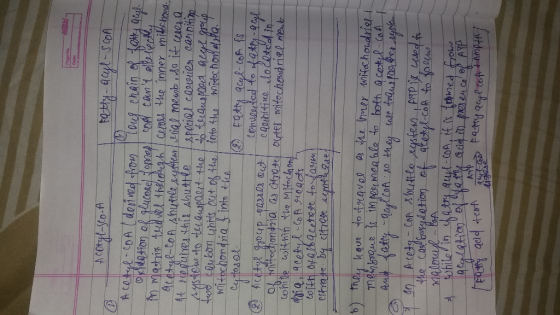
Compare and contrast how acetyl-SCoA and fattyacyl-SCoA travel into and/or out of mitochondria, why they have...
Homework Answers
Add Answer to:
Compare and contrast how acetyl-SCoA and fattyacyl-SCoA travel into
and/or out of mitochondria, why they have...
Compare and contrast electron transport and ATP synthesis in mitochondria and chloroplasts. Start with the electron donor and end with the final electron acceptor. Detail the arrangement in the membra...
Compare and contrast electron transport and ATP synthesis in mitochondria and chloroplasts. Start with the electron donor and end with the final electron acceptor. Detail the arrangement in the membrane and redox chemistry of the electron transporters, orientation and function of ATP synthase, membrane properties, etc., etc. How are these electron transport systems related to metabolic processes occurring in the mitochondria and chloroplasts?
ol. 1. Explain why professions have organizations and associations. 2. Compare and contrast the differences between...
 ol. 1. Explain why professions have organizations and associations. 2. Compare and contrast the differences between major professional nursing organizations, specialty nursing organizations, and small grassroots organizations in their focus and membership requirements. 3. Recognize the opportunities that professional associations offer to nurses. 4. Explain how organized nursing is involved in political activities designed to strengthen professional nursing and influence health policy. 5. Evaluate why it is important for nurses to understand and become involved in the political process.
How many NET ATPs would theoretically need to be used to store excess glucose as laurate...
How many NET ATPs would theoretically need to be used to store excess glucose as laurate (C12:0) (i.e., catabolize the glucose to acetyl-CoA and then anabolize to laurate)? Since there are 12 carbons in laurate and each glucose can be converted to two acetyl-CoAs, assume that you'll begin with 3 glucoses. Also, assume you already have sufficient oxaloacetate in the mitochondria to pair with the acetyl-CoA. Show the basic outline of the process. Indicate where each ATP, NADH, etc. is made or used. (For simplicity,...
8. The movement of protons out of the mitochondrial matrix establishes an electrochemical H gradient across...
 8. The movement of protons out of the mitochondrial matrix establishes an electrochemical H gradient across the inner mitochondrial membrane. The electrochemical potential of this gradient is harnessed to synthesize ATP. This is known as the (A) Hydrophobic effect IqChemiosmotic theory (B) Acid catalysis (0) Michaelis-Menten mechanism _9. Which of the following statements about mitochondria and their lon and metabolite transporters is FALSE? (A) Controlled impermeability of the inner mitochondrial membrane to most ions and metabolites allows for the generation...
-Which complex of electron transport chain does not have enough energy to pump protons out of...
-Which complex of electron transport chain does not have enough energy to pump protons out of the mitochondria? Complex 1, Complex 2, Complex 3, Complex 4 -Besides pyruvate, _______ from glycolysis is needed in a later stage of aerobic respiration. NADH, FADH2, COENZYME A, COENZYME Q -How much ATP is directly made from fermentation? 32, 0, 4, 2 -which enzyme of the citric acid cycle has the same 5 coenzymes as pyruvate dehydrogenase complex? succinate dehydrogenase, alpha ketoglutarate dehydrogenase, malate...
How many membranes does the chloroplast have? 30. How many membranes doos the mitochondria have? 31....
 How many membranes does the chloroplast have? 30. How many membranes doos the mitochondria have? 31. A stack of thylakoids are known as d, 4 e, 3 a. Thylakoid dises b, c. thy lakoid lumen 32. The products produced in the light independent reaction are used to drive the light dependent reac a. True b, False 33. The ATP and NADPH produces in the light reaction are used to drive the synthesis of sugars from CO2 a. True b. False...
19. How many membranes does the chloroplast have 50. How many membranes does the mitochondria have?...
 19. How many membranes does the chloroplast have 50. How many membranes does the mitochondria have? 0.4 C3 31 A stack of this lakoids are known as: granum Thylakoid dises Grama ethylakid lumen 32. The products produced in the light independent reaction are used to drive the light dependent reaction . Stroma Trie h. False 33. The Aland NADPI pride in the light reaction are used to drive the synthesis of gars from CO2 True 34. Photosystem II in photosynthesis,...
Cellular Respiration Worksheet 1.Where does each reaction take place? -Glycolysis -Fermentation -Acetyl CoA formation -Krebs Cycle...
Cellular Respiration Worksheet 1.Where does each reaction take place? -Glycolysis -Fermentation -Acetyl CoA formation -Krebs Cycle -ETC 2.What goes in/comes out of each reaction/name of each reaction? -Glycolysis -Fermentation -Acetyl CoA formation -Krebs Cycle -ETC 3.What are the electron carriers? Where are the electrons actually located? 4.What are the energy carrying molecules? Where is the energy actually located? 5.Where is oxygen used? Where’s CO2 released in cellular respiration? 6.Where is most of the ATP made? 7.What is the point/purpose of...
please answer all. thanks. 67. * Nor involved here respiration SO or 72.> ATĚ when glucose...
 please answer all. thanks.
67. * Nor involved here respiration SO or 72.> ATĚ when glucose is coinpletely oxidited to CO2H2O? The major purpose of Ozg) in aerobie respiration lor of reducing pyruvate* in anaerobie respiration is a) to phosphorylate the maximum number of ATP molecules b) regenerate NAD so the processes may Continue (c) allow for the replacement of Ho molecules that are split (d) mobilize succeeding glucose molewles glycolysis can continue 68. Carbon dioxide during which one or...
please answer all. thanks.
67. * Nor involved here respiration SO or 72.> ATĚ when glucose is coinpletely oxidited to CO2H2O? The major purpose of Ozg) in aerobie respiration lor of reducing pyruvate* in anaerobie respiration is a) to phosphorylate the maximum number of ATP molecules b) regenerate NAD so the processes may Continue (c) allow for the replacement of Ho molecules that are split (d) mobilize succeeding glucose molewles glycolysis can continue 68. Carbon dioxide during which one or...
YOU MUST ANSWER THE FOLLOWING QUESTIONS ON YOUR OWN PRIOR TO CLASS REVIEW! 1. Label the...
 YOU MUST ANSWER THE FOLLOWING QUESTIONS ON YOUR OWN PRIOR TO CLASS REVIEW! 1. Label the path of electrons through the light reactions of photosynthesis using the illustration below. A. Include PSII and PSI and label all the complexes involved i. Which complex pushes H* across the membrane? ii. Where do these electrons end up? iii. What is the purpose of splitting H2O? iv. Where do the light reactions take place? 2H2D Ot ENR NAOD ADP photolyetemi photosyetemi wlochtone be-...
 ol. 1. Explain why professions have organizations and associations. 2. Compare and contrast the differences between major professional nursing organizations, specialty nursing organizations, and small grassroots organizations in their focus and membership requirements. 3. Recognize the opportunities that professional associations offer to nurses. 4. Explain how organized nursing is involved in political activities designed to strengthen professional nursing and influence health policy. 5. Evaluate why it is important for nurses to understand and become involved in the political process.
 8. The movement of protons out of the mitochondrial matrix establishes an electrochemical H gradient across the inner mitochondrial membrane. The electrochemical potential of this gradient is harnessed to synthesize ATP. This is known as the (A) Hydrophobic effect IqChemiosmotic theory (B) Acid catalysis (0) Michaelis-Menten mechanism _9. Which of the following statements about mitochondria and their lon and metabolite transporters is FALSE? (A) Controlled impermeability of the inner mitochondrial membrane to most ions and metabolites allows for the generation...
 How many membranes does the chloroplast have? 30. How many membranes doos the mitochondria have? 31. A stack of thylakoids are known as d, 4 e, 3 a. Thylakoid dises b, c. thy lakoid lumen 32. The products produced in the light independent reaction are used to drive the light dependent reac a. True b, False 33. The ATP and NADPH produces in the light reaction are used to drive the synthesis of sugars from CO2 a. True b. False...
 19. How many membranes does the chloroplast have 50. How many membranes does the mitochondria have? 0.4 C3 31 A stack of this lakoids are known as: granum Thylakoid dises Grama ethylakid lumen 32. The products produced in the light independent reaction are used to drive the light dependent reaction . Stroma Trie h. False 33. The Aland NADPI pride in the light reaction are used to drive the synthesis of gars from CO2 True 34. Photosystem II in photosynthesis,...
 please answer all. thanks.
67. * Nor involved here respiration SO or 72.> ATĚ when glucose is coinpletely oxidited to CO2H2O? The major purpose of Ozg) in aerobie respiration lor of reducing pyruvate* in anaerobie respiration is a) to phosphorylate the maximum number of ATP molecules b) regenerate NAD so the processes may Continue (c) allow for the replacement of Ho molecules that are split (d) mobilize succeeding glucose molewles glycolysis can continue 68. Carbon dioxide during which one or...
please answer all. thanks.
67. * Nor involved here respiration SO or 72.> ATĚ when glucose is coinpletely oxidited to CO2H2O? The major purpose of Ozg) in aerobie respiration lor of reducing pyruvate* in anaerobie respiration is a) to phosphorylate the maximum number of ATP molecules b) regenerate NAD so the processes may Continue (c) allow for the replacement of Ho molecules that are split (d) mobilize succeeding glucose molewles glycolysis can continue 68. Carbon dioxide during which one or...
 YOU MUST ANSWER THE FOLLOWING QUESTIONS ON YOUR OWN PRIOR TO CLASS REVIEW! 1. Label the path of electrons through the light reactions of photosynthesis using the illustration below. A. Include PSII and PSI and label all the complexes involved i. Which complex pushes H* across the membrane? ii. Where do these electrons end up? iii. What is the purpose of splitting H2O? iv. Where do the light reactions take place? 2H2D Ot ENR NAOD ADP photolyetemi photosyetemi wlochtone be-...
Most questions answered within 3 hours.
-
Where is the error in this code sequence?
String s1 = "Hello";
String s2 = "ello";...
asked 10 months ago -
Financial data for Joel de Paris, Inc., for last year
follow:
Joel de Paris, Inc.
Balance...
asked 10 months ago -
Consider this reaction:
Al2(SO4)3 (aq)+ BaCl3
(aq) Al2Cl6 (aq)- +
3BaSO4(s) . What is the...
asked 10 months ago -
Suppose that Savneet is considering increasing her
recent random sample from 20 car rentals to 40...
asked 10 months ago -
Trucks arrive at an unloading terminal at an average rate of 120
per hour.
Trucks arrive...
asked 10 months ago -
Why are methanol and ethanol completely soluble in water while
octanol is not very little soluble....
asked 10 months ago -
A facilities manager at a university reads in a research report
that the mean amount of...
asked 10 months ago -
When the CuSO4 is rehydrated by adding water to the anhydrous
compound, is this an endothermic...
asked 10 months ago -
A ray of sunlight is passing from diamond into crown glass; the
angle of incidence is...
asked 10 months ago -
A block of mass 0.249 kg is placed on top of a light, vertical
spring of...
asked 10 months ago -
how do the kidneys compensate in the presences of acidosis
a) trigger hyperventilate
b) reserve acid...
asked 10 months ago -
Question 501 pts
The rental rate of capital to the firm increases. Which of the
following...
asked 10 months ago