
Homework Answers
Let the statement P(n): The area enclosed by a
polygon with n vertices is given by  where
where  .
.
We have to prove P(n) for all natural numbers greater than or equal to 3.
For n=3, let us see the following
diagram of the triangle 
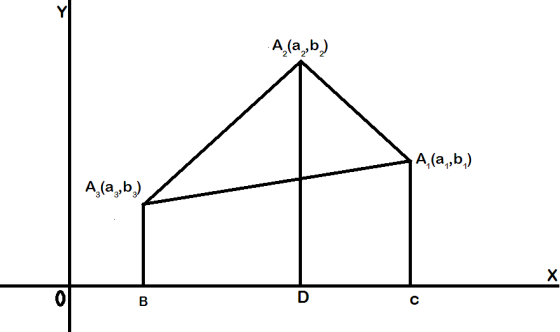
 are perpendicular to the x-axis.
 .
.
The area of the trapezium  is
is  .
.
The area of the trapezium  is
is  .
.
The area of the trapezium  is
is  .
.
From the diagram,
Area of  area of
+area of
-area of
area of
+area of
-area of
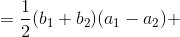
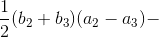
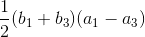

So, P(3) holds true.
Let us suppose that P(m) is true for
some  .
.
Then, for any polygon with m vertices,
its area is  .
.
Now, let us consider a polygon with (m+1) vertices. Let us see the following diagram:
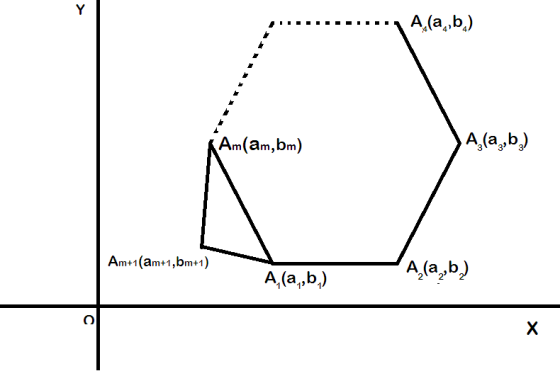
Then, the area of the polygon  is the sum of the areas of polygon
  and the area of the triangle
  .
.
Area of  area of
  area of

where  in the first term but not in the second term,
and
in the first term but not in the second term,
and  in the 2nd term.

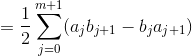
Thus, if P(m) is true, then P(m+1) is true.
Therefore, by principle of mathematical induction, for
all  , the area enclosed by a polygon with n vertices
is given by
, the area enclosed by a polygon with n vertices
is given by
,
where
.
Add Answer to:
2. Consider a polygon with n-vertices for some n > 3. We label the vertices as...
Problem 3 i) Let D be the polygon in R2 with vertices, in a counter-clockwise order, given by (zı, y), (x2,U2), , (Tm%)...
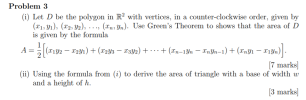 Problem 3 i) Let D be the polygon in R2 with vertices, in a counter-clockwise order, given by (zı, y), (x2,U2), , (Tm%). Use Green's Theorem to shows that the area of D is given by the formula nyn-1 7 marks (i) Using the formula from (i) to derive the area of triangle with a base of width w 1 and a height of h 3 marks]
Problem 3 i) Let D be the polygon in R2 with vertices, in...
Problem 3 i) Let D be the polygon in R2 with vertices, in a counter-clockwise order, given by (zı, y), (x2,U2), , (Tm%). Use Green's Theorem to shows that the area of D is given by the formula nyn-1 7 marks (i) Using the formula from (i) to derive the area of triangle with a base of width w 1 and a height of h 3 marks]
Problem 3 i) Let D be the polygon in R2 with vertices, in...
Problem 3 i) Let D be the polygon in R2 with vertices, in a counter-clockwise order, given by (zı, y), (x2,U2), , (Tm%). Use Green's Theorem to shows that the area of D is given by the formula ny...
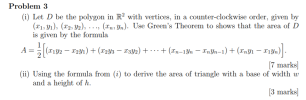 Problem 3 i) Let D be the polygon in R2 with vertices, in a counter-clockwise order, given by (zı, y), (x2,U2), , (Tm%). Use Green's Theorem to shows that the area of D is given by the formula nyn-1 7 marks (i) Using the formula from (i) to derive the area of triangle with a base of width w 1 and a height of h 3 marks]
Problem 3 i) Let D be the polygon in R2 with vertices, in...
Problem 3 i) Let D be the polygon in R2 with vertices, in a counter-clockwise order, given by (zı, y), (x2,U2), , (Tm%). Use Green's Theorem to shows that the area of D is given by the formula nyn-1 7 marks (i) Using the formula from (i) to derive the area of triangle with a base of width w 1 and a height of h 3 marks]
Problem 3 i) Let D be the polygon in R2 with vertices, in...
6. Consider a triangle with vertices at 1, 2 + 2i, 3-i oriented clockwise. (a) Draw...
 6. Consider a triangle with vertices at 1, 2 + 2i, 3-i oriented clockwise. (a) Draw the triangle and mark the orientation on its edges. (b) Find a parametrization for each of its edges 6. Note that parametrization of a straight path from ะเ to 22 is:(t)- + t(22-a), 0 1. t
Long paths we show that for every n ≥ 3 if deg(v) ≥ n/2 for every...
Long paths we show that for every n ≥ 3 if deg(v) ≥ n/2 for every v ∈ V then the graph contains a simple cycle (no vertex appears twice) that contains all vertices. Such a path is called an Hamiltonian path. From now on we assume that deg(v) ≥ n/2 for every v. 1. Show that the graph is connected (namely the distance between every two vertices is finite) 2. Consider the longest simple path x0, x1, . ....
2. We distribute n points uniformly and independently on the circumference of a circle, and want...
 2. We distribute n points uniformly and independently on the circumference of a circle, and want to compute the probability that there is a semicircle that contain all of them. (In other words, the probability that there is a line through the center of the circle such that all n points lie on the same side of this line.) Let E be the event that such a semicircle exists. Denote by Pi, P2, ..., Pn the random points, and by...
Each of n people (whom we label 1, 2, . . . , n) are randomly...
Each of n people (whom we label 1, 2, . . . , n) are randomly and independently assigned a number from the set {1, 2, 3, . . . , 365} according to the uniform distribution. We will call this number their birthday. Let j and k be distinct labels (between 1 and n) and let Ajk denote the event that the corresponding people share a birthday. Let Xjk denote the indicator random variable associated to Ajk. (1) Are...
Consider n indivisible objects with distinct types i = 1, 2, 3,…, n. We are given...
Consider n indivisible objects with distinct types i = 1, 2, 3,…, n. We are given positive integer weights W = {w1,w2...wn} and positive integer prices V = {v1,v2...vn} for the objects and a knapsack of weight capacity (m). Our problem is to find the maximum profit possible by including a subset of the objects into the knapsack with total weight of at most m. This form of the 0/1 Knapsack Problem can be solved by a Decrease and Conquer...
ANSWER 2 & 3 please. Show work for my understanding and upvote. THANK YOU!! 2. Given a regular n-gon, let r be a rotation of it by 2π/n radians. This time, assume that we are not allowed to flip...
 ANSWER 2 & 3 please. Show work for my understanding and
upvote. THANK YOU!!
2. Given a regular n-gon, let r be a rotation of it by 2π/n radians. This time, assume that we are not allowed to flip over the n-gon. These n actions form a group denotecd (a) Draw a Cayley diagram for Cn for n-4, n-5, and n-6 (b) For n 4, 5, 6, find all minimal generating sets of C.· [Note: There are minimal generating sets...
ANSWER 2 & 3 please. Show work for my understanding and
upvote. THANK YOU!!
2. Given a regular n-gon, let r be a rotation of it by 2π/n radians. This time, assume that we are not allowed to flip over the n-gon. These n actions form a group denotecd (a) Draw a Cayley diagram for Cn for n-4, n-5, and n-6 (b) For n 4, 5, 6, find all minimal generating sets of C.· [Note: There are minimal generating sets...
(Sperner's lemma in dimension 3) (a) *Consider a tetrahedron T- A1A2A3A4 in the 3-dimensional space and some subdivision of T into small tetrahedra, such that each face of each small tetrahedron...
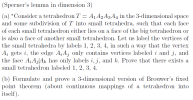 (Sperner's lemma in dimension 3) (a) *Consider a tetrahedron T- A1A2A3A4 in the 3-dimensional space and some subdivision of T into small tetrahedra, such that each face of each small tetrahedron either lies on a face of the big tetrahedron or is also a face of another small tetrahedron. Let us label the vertices of the small tetrahedra by labels 1, 2, 3, 4, in such a way that the vertex Ai gets i, the edge AiAj only contains vertices...
Exercise 2: Finite element method We are interested in computing numerically the solution to a 2D...
 Exercise 2: Finite element method We are interested in computing numerically the solution to a 2D Laplace equation u 0, The triangulated domain is given in the file mesh.mat on Blackboard. which contains the V × 2 nnatrix vertices storing the two coordinates of the vertices and a F × 3 matrix triangles in which each ro w J contains the indices in {1,····V) of the three vertices of the j-th triangle. a) Using for example MATLAB's triplot or trimesh...
 Problem 3 i) Let D be the polygon in R2 with vertices, in a counter-clockwise order, given by (zı, y), (x2,U2), , (Tm%). Use Green's Theorem to shows that the area of D is given by the formula nyn-1 7 marks (i) Using the formula from (i) to derive the area of triangle with a base of width w 1 and a height of h 3 marks]
Problem 3 i) Let D be the polygon in R2 with vertices, in...
Problem 3 i) Let D be the polygon in R2 with vertices, in a counter-clockwise order, given by (zı, y), (x2,U2), , (Tm%). Use Green's Theorem to shows that the area of D is given by the formula nyn-1 7 marks (i) Using the formula from (i) to derive the area of triangle with a base of width w 1 and a height of h 3 marks]
Problem 3 i) Let D be the polygon in R2 with vertices, in...
 Problem 3 i) Let D be the polygon in R2 with vertices, in a counter-clockwise order, given by (zı, y), (x2,U2), , (Tm%). Use Green's Theorem to shows that the area of D is given by the formula nyn-1 7 marks (i) Using the formula from (i) to derive the area of triangle with a base of width w 1 and a height of h 3 marks]
Problem 3 i) Let D be the polygon in R2 with vertices, in...
Problem 3 i) Let D be the polygon in R2 with vertices, in a counter-clockwise order, given by (zı, y), (x2,U2), , (Tm%). Use Green's Theorem to shows that the area of D is given by the formula nyn-1 7 marks (i) Using the formula from (i) to derive the area of triangle with a base of width w 1 and a height of h 3 marks]
Problem 3 i) Let D be the polygon in R2 with vertices, in...
 6. Consider a triangle with vertices at 1, 2 + 2i, 3-i oriented clockwise. (a) Draw the triangle and mark the orientation on its edges. (b) Find a parametrization for each of its edges 6. Note that parametrization of a straight path from ะเ to 22 is:(t)- + t(22-a), 0 1. t
 2. We distribute n points uniformly and independently on the circumference of a circle, and want to compute the probability that there is a semicircle that contain all of them. (In other words, the probability that there is a line through the center of the circle such that all n points lie on the same side of this line.) Let E be the event that such a semicircle exists. Denote by Pi, P2, ..., Pn the random points, and by...
 ANSWER 2 & 3 please. Show work for my understanding and
upvote. THANK YOU!!
2. Given a regular n-gon, let r be a rotation of it by 2π/n radians. This time, assume that we are not allowed to flip over the n-gon. These n actions form a group denotecd (a) Draw a Cayley diagram for Cn for n-4, n-5, and n-6 (b) For n 4, 5, 6, find all minimal generating sets of C.· [Note: There are minimal generating sets...
ANSWER 2 & 3 please. Show work for my understanding and
upvote. THANK YOU!!
2. Given a regular n-gon, let r be a rotation of it by 2π/n radians. This time, assume that we are not allowed to flip over the n-gon. These n actions form a group denotecd (a) Draw a Cayley diagram for Cn for n-4, n-5, and n-6 (b) For n 4, 5, 6, find all minimal generating sets of C.· [Note: There are minimal generating sets...
 (Sperner's lemma in dimension 3) (a) *Consider a tetrahedron T- A1A2A3A4 in the 3-dimensional space and some subdivision of T into small tetrahedra, such that each face of each small tetrahedron either lies on a face of the big tetrahedron or is also a face of another small tetrahedron. Let us label the vertices of the small tetrahedra by labels 1, 2, 3, 4, in such a way that the vertex Ai gets i, the edge AiAj only contains vertices...
 Exercise 2: Finite element method We are interested in computing numerically the solution to a 2D Laplace equation u 0, The triangulated domain is given in the file mesh.mat on Blackboard. which contains the V × 2 nnatrix vertices storing the two coordinates of the vertices and a F × 3 matrix triangles in which each ro w J contains the indices in {1,····V) of the three vertices of the j-th triangle. a) Using for example MATLAB's triplot or trimesh...
Most questions answered within 3 hours.
-
Where is the error in this code sequence?
String s1 = "Hello";
String s2 = "ello";...
asked 10 months ago -
Financial data for Joel de Paris, Inc., for last year
follow:
Joel de Paris, Inc.
Balance...
asked 10 months ago -
Consider this reaction:
Al2(SO4)3 (aq)+ BaCl3
(aq) Al2Cl6 (aq)- +
3BaSO4(s) . What is the...
asked 10 months ago -
Suppose that Savneet is considering increasing her
recent random sample from 20 car rentals to 40...
asked 10 months ago -
Trucks arrive at an unloading terminal at an average rate of 120
per hour.
Trucks arrive...
asked 10 months ago -
Why are methanol and ethanol completely soluble in water while
octanol is not very little soluble....
asked 10 months ago -
A facilities manager at a university reads in a research report
that the mean amount of...
asked 10 months ago -
When the CuSO4 is rehydrated by adding water to the anhydrous
compound, is this an endothermic...
asked 10 months ago -
A ray of sunlight is passing from diamond into crown glass; the
angle of incidence is...
asked 10 months ago -
A block of mass 0.249 kg is placed on top of a light, vertical
spring of...
asked 10 months ago -
how do the kidneys compensate in the presences of acidosis
a) trigger hyperventilate
b) reserve acid...
asked 10 months ago -
Question 501 pts
The rental rate of capital to the firm increases. Which of the
following...
asked 10 months ago