Each of n people (whom we label 1, 2, . . . , n) are randomly...
Each of n people (whom we label 1, 2, . . . , n) are randomly and independently assigned a number from the set {1, 2, 3, . . . , 365} according to the uniform distribution. We will call this number their birthday.
Let j and k be distinct labels (between 1 and n) and let Ajk denote the event that the corresponding people share a birthday. Let Xjk denote the indicator random variable associated to Ajk.
(1) Are A12 and A34 independent? Are they independent conditioned on A13?
(2) Are A12 and A13 independent? Are they independent conditioned on A23?
(3) Compute the expected number of pairs of people who share a birthday (hint:write this number as a sum of Xjk’s).
(4) Compute the second moment and variance of the number of pairs of people who share a birthday.
Homework Answers


We have seen that the probability that at least two people in a group of 23...
We have seen that the probability that at least two people in a group of 23 people share the same birthday is approximately 0.5. In this question we are interested in the probability that at least three people in a group of 23 people share the same birthday. Draw 23 numbers independently from the integers {1, 2, . . . , 365} with each number equally likely to be drawn. Let E be the event that at least one of...
Random variables and expected value Shared Birthday Height Arrangements Example: How many pairs of people in...
 Random variables and expected value
Shared Birthday Height Arrangements Example: How many pairs of people in this room do we expect to share a birthday? Example: If we randomly arrange n people in a line, what is the expected number of people who are taller than all adjacent people? Assume each person's height is different (no ties). If there are 30 people in the room, how many pairs of people are there? What is the probability that two particular people...
Random variables and expected value
Shared Birthday Height Arrangements Example: How many pairs of people in this room do we expect to share a birthday? Example: If we randomly arrange n people in a line, what is the expected number of people who are taller than all adjacent people? Assume each person's height is different (no ties). If there are 30 people in the room, how many pairs of people are there? What is the probability that two particular people...
please help me understand this problem. k people in a room. We would like to find...
 please help me understand this problem.
k people in a room. We would like to find the probability that any two people 5. Suppose that there are have birthdays within a day of each other (which we'll call "near-day birthdays"). The number of pairs and the probability that any two people are born within a day of each other is of people would be S4Therefore, we would expect the average number of near-day birthday pairs to be be a Poisson...
please help me understand this problem.
k people in a room. We would like to find the probability that any two people 5. Suppose that there are have birthdays within a day of each other (which we'll call "near-day birthdays"). The number of pairs and the probability that any two people are born within a day of each other is of people would be S4Therefore, we would expect the average number of near-day birthday pairs to be be a Poisson...
(1 point) For a group of 80 people, assuming that each person is equally likely to...
(1 point) For a group of 80 people, assuming that each person is equally likely to have a birthday on each of 365 days in the year, compute (a) The expected number of days of the year that are birthdays of exactly 4 people: E[days with 4 birthdays]=E[days with 4 birthdays]= (b) The expected number of distinct birthdays: E[distinct birthdays]=E[distinct birthdays]=
15. We flip a fair coin three times; these flips are independent of each other. These...
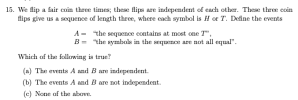 15. We flip a fair coin three times; these flips are independent of each other. These three coin flips give us a sequence of length three, where each symbol is H or T. Define the events A- B = "the sequence contains at most one T. "the symbols in the sequence are not all equal" Which of the following is true? (a) The events A and B are independent. (b) The events A and B are not independent (c) None...
Problem 1. Suppose that we take a random sequence of numbers modulo n. The proba- bility...
 Problem 1. Suppose that we take a random sequence of numbers modulo n. The proba- bility that the first k terms are all distinct is n - 1 п 2 n - (k – 1) P(n, k) = 2 п п п as we saw in class. For this problem, you will want to write a (very short) program to compute this number, but you do not need to submit it this time. (For both parts, you can submit a...
Birthday problem). Assume that a host invites n guests and that days of all n+1 people...
 Birthday problem). Assume that a host invites n guests and that days of all n+1 people are independent and uniformly distributed acros Exercise 1.10 ( the birth all the 365 days of the year 1. Prove the following: The probability that two of the guests share the same birth- day is larger than one-half if and only if n 2 23. 2. How large should n be so that the probability that at least one of the guests has the...
Problem 1. Stanislaw is collecting coupons. Each day he receives randomly one of n distinct coupons...
 Problem 1. Stanislaw is collecting coupons. Each day he receives randomly one of n distinct coupons with equal probabilities (independently of other days (a) Let T be the number of days it takes Stanislaw to obtain a complete set. Explain why T can be written as a sum of n independent Geometric random variables and say what their parameters are (b) Compute the expected value of T. (Use the fact that the expectation of a sum of random variables is...
6. Finding a Healthy Subring A group of n people po, ..., Pn-1 are standing around...
 6. Finding a Healthy Subring A group of n people po, ..., Pn-1 are standing around in a circle holding hands. When we talk about these people, we take indices modulo n so that, for example Pn+5 = 25.s of these people are sick, the rest are healthy. 1. Let k < 100 be an integer. Pick a uniformly random ie {0,...,n - 1} and let X denote the number of sick people among the k people pi, pi+1, ......
Consider a group ofn 4 people, numbered from l to n. For each pair (i, j)...
 Consider a group ofn 4 people, numbered from l to n. For each pair (i, j) with ǐ关į person i and person J are friends, with probability p. Friendships are independent for different pairs. These n people are seated around a round table. For convenience, assume that the chairs are numbered from 1 to n, clockwise, with n located next to 1, and that person i seated in chair i. In particular, person 1 and person n are seatec next...
 Random variables and expected value
Shared Birthday Height Arrangements Example: How many pairs of people in this room do we expect to share a birthday? Example: If we randomly arrange n people in a line, what is the expected number of people who are taller than all adjacent people? Assume each person's height is different (no ties). If there are 30 people in the room, how many pairs of people are there? What is the probability that two particular people...
Random variables and expected value
Shared Birthday Height Arrangements Example: How many pairs of people in this room do we expect to share a birthday? Example: If we randomly arrange n people in a line, what is the expected number of people who are taller than all adjacent people? Assume each person's height is different (no ties). If there are 30 people in the room, how many pairs of people are there? What is the probability that two particular people...
 please help me understand this problem.
k people in a room. We would like to find the probability that any two people 5. Suppose that there are have birthdays within a day of each other (which we'll call "near-day birthdays"). The number of pairs and the probability that any two people are born within a day of each other is of people would be S4Therefore, we would expect the average number of near-day birthday pairs to be be a Poisson...
please help me understand this problem.
k people in a room. We would like to find the probability that any two people 5. Suppose that there are have birthdays within a day of each other (which we'll call "near-day birthdays"). The number of pairs and the probability that any two people are born within a day of each other is of people would be S4Therefore, we would expect the average number of near-day birthday pairs to be be a Poisson...
 15. We flip a fair coin three times; these flips are independent of each other. These three coin flips give us a sequence of length three, where each symbol is H or T. Define the events A- B = "the sequence contains at most one T. "the symbols in the sequence are not all equal" Which of the following is true? (a) The events A and B are independent. (b) The events A and B are not independent (c) None...
 Problem 1. Suppose that we take a random sequence of numbers modulo n. The proba- bility that the first k terms are all distinct is n - 1 п 2 n - (k – 1) P(n, k) = 2 п п п as we saw in class. For this problem, you will want to write a (very short) program to compute this number, but you do not need to submit it this time. (For both parts, you can submit a...
 Birthday problem). Assume that a host invites n guests and that days of all n+1 people are independent and uniformly distributed acros Exercise 1.10 ( the birth all the 365 days of the year 1. Prove the following: The probability that two of the guests share the same birth- day is larger than one-half if and only if n 2 23. 2. How large should n be so that the probability that at least one of the guests has the...
 Problem 1. Stanislaw is collecting coupons. Each day he receives randomly one of n distinct coupons with equal probabilities (independently of other days (a) Let T be the number of days it takes Stanislaw to obtain a complete set. Explain why T can be written as a sum of n independent Geometric random variables and say what their parameters are (b) Compute the expected value of T. (Use the fact that the expectation of a sum of random variables is...
 6. Finding a Healthy Subring A group of n people po, ..., Pn-1 are standing around in a circle holding hands. When we talk about these people, we take indices modulo n so that, for example Pn+5 = 25.s of these people are sick, the rest are healthy. 1. Let k < 100 be an integer. Pick a uniformly random ie {0,...,n - 1} and let X denote the number of sick people among the k people pi, pi+1, ......
 Consider a group ofn 4 people, numbered from l to n. For each pair (i, j) with ǐ关į person i and person J are friends, with probability p. Friendships are independent for different pairs. These n people are seated around a round table. For convenience, assume that the chairs are numbered from 1 to n, clockwise, with n located next to 1, and that person i seated in chair i. In particular, person 1 and person n are seatec next...
Most questions answered within 3 hours.
-
Where is the error in this code sequence?
String s1 = "Hello";
String s2 = "ello";...
asked 11 months ago -
Financial data for Joel de Paris, Inc., for last year
follow:
Joel de Paris, Inc.
Balance...
asked 11 months ago -
Consider this reaction:
Al2(SO4)3 (aq)+ BaCl3
(aq) Al2Cl6 (aq)- +
3BaSO4(s) . What is the...
asked 11 months ago -
Suppose that Savneet is considering increasing her
recent random sample from 20 car rentals to 40...
asked 11 months ago -
Trucks arrive at an unloading terminal at an average rate of 120
per hour.
Trucks arrive...
asked 11 months ago -
Why are methanol and ethanol completely soluble in water while
octanol is not very little soluble....
asked 11 months ago -
A facilities manager at a university reads in a research report
that the mean amount of...
asked 11 months ago -
When the CuSO4 is rehydrated by adding water to the anhydrous
compound, is this an endothermic...
asked 11 months ago -
A ray of sunlight is passing from diamond into crown glass; the
angle of incidence is...
asked 11 months ago -
A block of mass 0.249 kg is placed on top of a light, vertical
spring of...
asked 11 months ago -
how do the kidneys compensate in the presences of acidosis
a) trigger hyperventilate
b) reserve acid...
asked 11 months ago -
Question 501 pts
The rental rate of capital to the firm increases. Which of the
following...
asked 11 months ago