Which MO would be expected to yield the greatest bonding interaction? A) σ2s B) σ*2s C)...
Which MO would be expected to yield the greatest bonding interaction?
A) σ2s
B) σ*2s
C) π2p
D) σ2p
E) π*2p
Homework Answers
 2P
2PAdd Answer to:
Which MO would be expected to yield the greatest bonding
interaction?
A) σ2s
B) σ*2s
C)...
1. The valence molecular orbital sequence for O2, F2, Ne2 is: σ2s < σ*2s < σ2p...
1. The valence molecular orbital sequence for O2, F2, Ne2 is: σ2s < σ*2s < σ2p <π2p = π2p <π*2p = π*2p <σ*2p What is the bond order for O2? [ Select ] ["0", "0.5", "1", "1.5", "2", "2.5", "3"] What is the bond order for O2-? [ Select ] ...
The valence molecular orbital sequence for CN is: σ2s < σ*2s <π2p = π2p < σ2p...
The valence molecular orbital sequence for CN is: σ2s < σ*2s <π2p = π2p < σ2p <π*2p = π*2p <σ*2p What is the bond order for CN? [ Select ] ["0", "0.5", "1", "1.5", "2", "2.5", "3"] What is the bond order for CN-? [ Select ] ["0",...
1.The valence molecular orbital sequence for Ne2 is: σ2s < σ*2s < σ2p <π2p = π2p...
1.The valence molecular orbital sequence for Ne2 is: σ2s < σ*2s < σ2p <π2p = π2p <π*2p = π*2p <σ*2p What is the bond order for Ne22+? [ Select ] ["0", "0.5", "1", "1.5", "2", "2.5", "3"] Is Ne22+ diamagnetic or paramagnetic? [ Select ] ["diamagnetic", "paramagnetic"] ...
Q) Using VSEPR theory predict the arrangement of electron pairs for OF2. a)Trigonal Bipyrimidal b)Square Planar...
Q) Using VSEPR theory predict the arrangement of electron pairs for OF2. a)Trigonal Bipyrimidal b)Square Planar c)Tetrahedral d)Octahedral e)T-shaped Q) Does OF2 have a permanent dipole moment? a)No b)Yes Q)Using VSEPR theory predict the arrangement of electron pairs for XeCl2. a)T-shaped b)Linear c)Trigonal Bipyrimidal d)Octahedral e)Square Planar Q)Does XeCl2 have a permanent dipole moment? a)Yes b)No Q)Using VSEPR theory predict the arrangement of electron pairs for BrF3. a)Square Planar b)Bent c)Trigonal Bipyrimidal d)Trigonal Pyrimidal e)Octahedral Q)Does BrF3 have a permanent...
A species has the following MO configuration: (σ1s)2(σ1s*)2(σ2s)2(σ2s*)2(σ2p)2(π2p)2 The substance is: A. Paramagnetic with one unpaired...
A species has the following MO configuration: (σ1s)2(σ1s*)2(σ2s)2(σ2s*)2(σ2p)2(π2p)2 The substance is: A. Paramagnetic with one unpaired electron B. Two unpaired electrons C. Three unpaired electrons D. Four unpaired electrons E. Diamagnetic
Use Molecular Orbital (MO) diagrams to rank N22, N2, and N2 in order of increasing bond...
 Use Molecular Orbital (MO) diagrams to rank N22, N2, and N2 in order of increasing bond order, bond energy, and bond length. Fill order for M0:02s, σ.2s, π2p-π2p, σ2p , π2p-π.2p. σ.2p Bond order: N22 N2N2:Bond energy: N22 < N2 N2:Bond length: N2 N2N22 Bond order: N2<N2N22Bond energy: N22N2N2: Bond length: N2 < N2N2 Bond order: N2<N2N22 Bond energy: N2 N2 N2Bond length: N2<N2N2 Bond order: N2< N2N22Bond energy: N2 < N22 N2Bond length: N22 N2 N2 O Bond order:...
38. Calculate the bond order for an ion with this configuration: (σ2s)2(σ*2s)2(σ2px )2(π2py ,π2pz)4(π*2py, π*2pz)3 40....
38. Calculate the bond order for an ion with this configuration: (σ2s)2(σ*2s)2(σ2px )2(π2py ,π2pz)4(π*2py, π*2pz)3 40. Predict the valence electron molecular orbital configurations for the following, and state whether they will be stable or unstable ions. (a) Na22+ (b) Mg22+ (c) Al22+ (d) Si22+ (e) P22+ (f) S22+ (g) F22+ (h) Ar22+ 42. For the first ionization energy for an N2 molecule, what molecular orbital is the electron removed from?
Which element has the electron configuration 1s 2s²2p@3s 3p 4s'3ds? A) V B) Cr C) Mo...
 Which element has the electron configuration 1s 2s²2p@3s 3p 4s'3ds? A) V B) Cr C) Mo D) Mn E) No element has this configuration
Look at the MO diagram for NH3 shown below. Which property does each of the e...
 Look at the MO diagram for NH3 shown below. Which property does each of the e orbitals possess? Energy node LGO(2) LGO(3) 2p, (a)= 2p, 2p, (e) Representation of the HOMO (a) LGO(1) 2s (a) # Representation of one of the e MOs NH Representation of the lowest lying a, MO Select one: o a. N-H bonding character b. Two nodal planes O C. Lone pair character O d. No contribution from the H is orbitals Save response
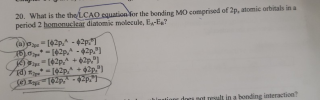
Written explanation please DIPIO 20. What is the the/LCAO equation for the bonding MO comprised of...
 Written explanation please
DIPIO 20. What is the the/LCAO equation for the bonding MO comprised of 2p, atomic orbitals in a period 2 homonuclear diatomic molecule, EA-Eg? (a) 2pz = [02p2A - $2pz'] TO) 2pz* = [02p24 - 02p2B] (C) 2pz = [02p24 +02pB] d) T2pz* = [02p24 + $2p28] (e) 12pz = [02p2 - 02p2B] hinntinne does not result in a bonding interaction?
Written explanation please
DIPIO 20. What is the the/LCAO equation for the bonding MO comprised of 2p, atomic orbitals in a period 2 homonuclear diatomic molecule, EA-Eg? (a) 2pz = [02p2A - $2pz'] TO) 2pz* = [02p24 - 02p2B] (C) 2pz = [02p24 +02pB] d) T2pz* = [02p24 + $2p28] (e) 12pz = [02p2 - 02p2B] hinntinne does not result in a bonding interaction?
 Use Molecular Orbital (MO) diagrams to rank N22, N2, and N2 in order of increasing bond order, bond energy, and bond length. Fill order for M0:02s, σ.2s, π2p-π2p, σ2p , π2p-π.2p. σ.2p Bond order: N22 N2N2:Bond energy: N22 < N2 N2:Bond length: N2 N2N22 Bond order: N2<N2N22Bond energy: N22N2N2: Bond length: N2 < N2N2 Bond order: N2<N2N22 Bond energy: N2 N2 N2Bond length: N2<N2N2 Bond order: N2< N2N22Bond energy: N2 < N22 N2Bond length: N22 N2 N2 O Bond order:...
 Which element has the electron configuration 1s 2s²2p@3s 3p 4s'3ds? A) V B) Cr C) Mo D) Mn E) No element has this configuration
 Look at the MO diagram for NH3 shown below. Which property does each of the e orbitals possess? Energy node LGO(2) LGO(3) 2p, (a)= 2p, 2p, (e) Representation of the HOMO (a) LGO(1) 2s (a) # Representation of one of the e MOs NH Representation of the lowest lying a, MO Select one: o a. N-H bonding character b. Two nodal planes O C. Lone pair character O d. No contribution from the H is orbitals Save response
 Written explanation please
DIPIO 20. What is the the/LCAO equation for the bonding MO comprised of 2p, atomic orbitals in a period 2 homonuclear diatomic molecule, EA-Eg? (a) 2pz = [02p2A - $2pz'] TO) 2pz* = [02p24 - 02p2B] (C) 2pz = [02p24 +02pB] d) T2pz* = [02p24 + $2p28] (e) 12pz = [02p2 - 02p2B] hinntinne does not result in a bonding interaction?
Written explanation please
DIPIO 20. What is the the/LCAO equation for the bonding MO comprised of 2p, atomic orbitals in a period 2 homonuclear diatomic molecule, EA-Eg? (a) 2pz = [02p2A - $2pz'] TO) 2pz* = [02p24 - 02p2B] (C) 2pz = [02p24 +02pB] d) T2pz* = [02p24 + $2p28] (e) 12pz = [02p2 - 02p2B] hinntinne does not result in a bonding interaction?
Most questions answered within 3 hours.
-
Where is the error in this code sequence?
String s1 = "Hello";
String s2 = "ello";...
asked 10 months ago -
Financial data for Joel de Paris, Inc., for last year
follow:
Joel de Paris, Inc.
Balance...
asked 10 months ago -
Consider this reaction:
Al2(SO4)3 (aq)+ BaCl3
(aq) Al2Cl6 (aq)- +
3BaSO4(s) . What is the...
asked 10 months ago -
Suppose that Savneet is considering increasing her
recent random sample from 20 car rentals to 40...
asked 10 months ago -
Trucks arrive at an unloading terminal at an average rate of 120
per hour.
Trucks arrive...
asked 10 months ago -
Why are methanol and ethanol completely soluble in water while
octanol is not very little soluble....
asked 10 months ago -
A facilities manager at a university reads in a research report
that the mean amount of...
asked 10 months ago -
When the CuSO4 is rehydrated by adding water to the anhydrous
compound, is this an endothermic...
asked 10 months ago -
A ray of sunlight is passing from diamond into crown glass; the
angle of incidence is...
asked 10 months ago -
A block of mass 0.249 kg is placed on top of a light, vertical
spring of...
asked 10 months ago -
how do the kidneys compensate in the presences of acidosis
a) trigger hyperventilate
b) reserve acid...
asked 10 months ago -
Question 501 pts
The rental rate of capital to the firm increases. Which of the
following...
asked 10 months ago