Potassium carbonate can neutralize hydrobromic acid by the reaction 2 HBr + K2CO3 --> 2 KBr...
Potassium carbonate can neutralize hydrobromic acid by the reaction
2 HBr + K2CO3 --> 2 KBr + H2O + CO2
Is 27.1 grams of potassium
carbonate enough to neutralize a solution that contains
38.0 grams of hydrobromic acid?
_____YesNo
How many grams of carbon dioxide will be released in the
reaction? g
Homework Answers

Add Answer to:
Potassium carbonate can neutralize
hydrobromic acid by the reaction
2 HBr +
K2CO3 -->
2 KBr...
For the following reaction, if i start this reaction with 153.0 grams of hydrobromic acid and...
For the following reaction, if i start this reaction with 153.0 grams of hydrobromic acid and an excess of potassium bi sulfate, a) how many grams of sulfur dioxide gas will I produce? b) if 98.75 g are actually achieved, what is the % yield of the reaction? HBr(aq) + KHSO3(aq) --> KBr(aq)+SO2(g)+H2O(I)
8. Sodium carbonate reacts with hydrobromic acid as follows: Na2CO3(aq) + 2 HBr(aq) -H2O(l) + CO2(g)...
 8. Sodium carbonate reacts with hydrobromic acid as follows: Na2CO3(aq) + 2 HBr(aq) -H2O(l) + CO2(g) +2 NaBr(aq) a. (10 points) Write complete ionic and net ionic equations for the reaction above. b. (8 points) Based on the equation above, what volume of carbon dioxide, measured at 815 torr and 455 K, is produced from the complete reaction of 115 mL of 1.25 M hydrobromic acid? Assume excess sodium carbonate.
Excess hydrochloric acid is reacted with a sample of potassium carbonate. After drying, the potassium chloride...
Excess hydrochloric acid is reacted with a sample of potassium carbonate. After drying, the potassium chloride weighs 2.31 g. What is the volume of carbon dioxide gas produced if the reaction occurs at 21 C and 746 mmHg? K2CO3 (s) + 2HCI (aq) --------> 2KCI (aq) + H2O (I) + CO2 (g) A. 0.381 L B. 0.192 L C. 1.52 L D. 0.757 L
1.An aqueous solution of hydrobromic acid is standardized by titration with a 0.113 M solution of...
1.An aqueous solution of hydrobromic acid is standardized by titration with a 0.113 M solution of barium hydroxide. If 20.6 mL of base are required to neutralize 19.9 mL of the acid, what is the molarity of the hydrobromic acid solution? ____M hydrobromic acid 2. An aqueous solution of barium hydroxide is standardized by titration with a 0.196 M solution of nitric acid. If 27.0 mL of base are required to neutralize 15.3 mL of the acid, what is the...
Fundamentals of Chemistry 1030 07 – Mole Concept Pre-Lab Assignment 1. Write the BALANCED equation for...
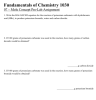 Fundamentals of Chemistry 1030 07 – Mole Concept Pre-Lab Assignment 1. Write the BALANCED equation for the reaction of potassium carbonate with hydrobromic acid (HBr), to produce potassium bromide, water and carbon dioxide. 2. If 9.00 grams of potassium carbonate was used in the reaction, how many grams of carbon dioxide would be obtained? g carbon dioxide 3. If 9.00 grams of potassium carbonate was used in the reaction, how many grams of potassium bromide would be obtained? g potassium...
1) A flask containing 450.0 mL of 0.500 M HBr was spilled on the floor. How...
 1) A flask containing 450.0 mL of 0.500 M HBr was spilled on
the floor. How many grams of K2CO3 would you need to put on the
spill to neutralize the acid according to the following
reaction?
2 HBr (aq) + K2CO3 (s) => 2KBr (aq) + H2O (l)
2) Determine the molarity of an unknown NaOH solution if 25.00
mL of sodium hydroxide was titrated with 15.00 mL of a 1.500 M
sulfiric acid solution (H2SO4). (aOH= 40.00 g/mol...
1) A flask containing 450.0 mL of 0.500 M HBr was spilled on
the floor. How many grams of K2CO3 would you need to put on the
spill to neutralize the acid according to the following
reaction?
2 HBr (aq) + K2CO3 (s) => 2KBr (aq) + H2O (l)
2) Determine the molarity of an unknown NaOH solution if 25.00
mL of sodium hydroxide was titrated with 15.00 mL of a 1.500 M
sulfiric acid solution (H2SO4). (aOH= 40.00 g/mol...
According to the following reaction, how many grams of potassium carbonate will be formed upon the...
According to the following reaction, how many grams of potassium carbonate will be formed upon the complete reaction of 32.8 grams of potassium hydroxide with excess carbon dioxide? carbon dioxide (g) + potassium hydroxide>>>>> (aq) potassium carbonate (aq) + water (l)
QUESTION 7 What is the correct full, balanced chemical equation for the reaction between hydrobromic acid...
 QUESTION 7 What is the correct full, balanced chemical equation for the reaction between hydrobromic acid (HBr) and lithium carbonate (Li2CO3)2 LI2CO3(s) + HBr(aq) + Liz Br(aq) + H2O(l) + CO2(g) OLI2CO3(s) + 2 HBr(aq) + 2 Li Br(aq) + H2O(l) + CO2(g) Li(aq) + Br(aq) LiBr(aq) OLI2CO3(s) + 2 HBr(aq) → H2O(l) + CO2(g) OLI2CO3(s) + 2 HBr(aq) + 2LiBr(aq) + H2O(1)
Capturing CO2 Carbon dioxide can be removed from a gas stream by reacting it with potassium...
Capturing CO2 Carbon dioxide can be removed from a gas stream by reacting it with potassium carbonate in the presence of water: CO2(g) + K2CO3(s) + H2O(ℓ) → 2 KHCO3(s) If a resting human exhales 36 mg CO2 in one breath, then how much potassium carbonate would be required to capture it all? Also would the final answer need to be in mg as it started with 36 mg CO2?
How many grams of potassium carbonate, K2CO3, must be dissolved to prepare 400. mL of a...
How many grams of potassium carbonate, K2CO3, must be dissolved to prepare 400. mL of a 0.127 M aqueous solution of the salt? Answer: ____ g
 8. Sodium carbonate reacts with hydrobromic acid as follows: Na2CO3(aq) + 2 HBr(aq) -H2O(l) + CO2(g) +2 NaBr(aq) a. (10 points) Write complete ionic and net ionic equations for the reaction above. b. (8 points) Based on the equation above, what volume of carbon dioxide, measured at 815 torr and 455 K, is produced from the complete reaction of 115 mL of 1.25 M hydrobromic acid? Assume excess sodium carbonate.
 Fundamentals of Chemistry 1030 07 – Mole Concept Pre-Lab Assignment 1. Write the BALANCED equation for the reaction of potassium carbonate with hydrobromic acid (HBr), to produce potassium bromide, water and carbon dioxide. 2. If 9.00 grams of potassium carbonate was used in the reaction, how many grams of carbon dioxide would be obtained? g carbon dioxide 3. If 9.00 grams of potassium carbonate was used in the reaction, how many grams of potassium bromide would be obtained? g potassium...
 1) A flask containing 450.0 mL of 0.500 M HBr was spilled on
the floor. How many grams of K2CO3 would you need to put on the
spill to neutralize the acid according to the following
reaction?
2 HBr (aq) + K2CO3 (s) => 2KBr (aq) + H2O (l)
2) Determine the molarity of an unknown NaOH solution if 25.00
mL of sodium hydroxide was titrated with 15.00 mL of a 1.500 M
sulfiric acid solution (H2SO4). (aOH= 40.00 g/mol...
1) A flask containing 450.0 mL of 0.500 M HBr was spilled on
the floor. How many grams of K2CO3 would you need to put on the
spill to neutralize the acid according to the following
reaction?
2 HBr (aq) + K2CO3 (s) => 2KBr (aq) + H2O (l)
2) Determine the molarity of an unknown NaOH solution if 25.00
mL of sodium hydroxide was titrated with 15.00 mL of a 1.500 M
sulfiric acid solution (H2SO4). (aOH= 40.00 g/mol...
 QUESTION 7 What is the correct full, balanced chemical equation for the reaction between hydrobromic acid (HBr) and lithium carbonate (Li2CO3)2 LI2CO3(s) + HBr(aq) + Liz Br(aq) + H2O(l) + CO2(g) OLI2CO3(s) + 2 HBr(aq) + 2 Li Br(aq) + H2O(l) + CO2(g) Li(aq) + Br(aq) LiBr(aq) OLI2CO3(s) + 2 HBr(aq) → H2O(l) + CO2(g) OLI2CO3(s) + 2 HBr(aq) + 2LiBr(aq) + H2O(1)
Most questions answered within 3 hours.
-
Where is the error in this code sequence?
String s1 = "Hello";
String s2 = "ello";...
asked 10 months ago -
Financial data for Joel de Paris, Inc., for last year
follow:
Joel de Paris, Inc.
Balance...
asked 10 months ago -
Consider this reaction:
Al2(SO4)3 (aq)+ BaCl3
(aq) Al2Cl6 (aq)- +
3BaSO4(s) . What is the...
asked 10 months ago -
Suppose that Savneet is considering increasing her
recent random sample from 20 car rentals to 40...
asked 10 months ago -
Trucks arrive at an unloading terminal at an average rate of 120
per hour.
Trucks arrive...
asked 10 months ago -
Why are methanol and ethanol completely soluble in water while
octanol is not very little soluble....
asked 10 months ago -
A facilities manager at a university reads in a research report
that the mean amount of...
asked 10 months ago -
When the CuSO4 is rehydrated by adding water to the anhydrous
compound, is this an endothermic...
asked 10 months ago -
A ray of sunlight is passing from diamond into crown glass; the
angle of incidence is...
asked 10 months ago -
A block of mass 0.249 kg is placed on top of a light, vertical
spring of...
asked 10 months ago -
how do the kidneys compensate in the presences of acidosis
a) trigger hyperventilate
b) reserve acid...
asked 10 months ago -
Question 501 pts
The rental rate of capital to the firm increases. Which of the
following...
asked 10 months ago