The Common Ion Effect Reaction: Fe3+ + SCN <> Fe(SCN)2+ 1. After the addition of 0.1...
The Common Ion Effect Reaction: Fe3+ + SCN <> Fe(SCN)2+ 1. After the addition of 0.1 M KSCN to test tube 2, what is the color of the solution? How does the addition of KSCN affect the equilibrium of the reaction above? How does this relate to the change, if any, in the color of the solution? Include equations for reactions in your explanation. Color: dark red After the addition of 0.1 M Fe(NO3)3 to test tube 2, what is the color of the solution? How does the addition of Fe(NO3)3 affect the equilibrium of the reaction above? How does this relate to the change, if any, in the color of the solution? Include equations for reactions in your explanation. Color:dark red 3.After the addition of 6 M NaOH to test tube 2, what is the color of the solution? How does the addition of NaOH affect the equilibrium of the reaction above? How does this relate to the change, if any, in the color of the solution? Include equations for reactions in your explanation. yelolw w/ red percipitate
Homework Answers
- Addition of 0.1 M KSCN ,the concentration of reactant (i.e.
 ions)
increases which,according to Le-Chatelier's principle drive the
reaction to RIGHT i.e the rate of Forward reaction will increase
and the color of the solution intensifies.
ions)
increases which,according to Le-Chatelier's principle drive the
reaction to RIGHT i.e the rate of Forward reaction will increase
and the color of the solution intensifies.
 ions)
increases which,according to Le-Chatelier's principle drive the
reaction to RIGHT i.e the rate of Forward reaction will increase
and the color of the solution intensifies.
ions)
increases which,according to Le-Chatelier's principle drive the
reaction to RIGHT i.e the rate of Forward reaction will increase
and the color of the solution intensifies. ---1
---1
- Addition of 0.1 M
 increases the concentration of iron(III) (shown in the reaction
below) in the medium which drives the reaction to RIGHT in
accordance with Le-Chatelier's principle and the rate of Forward
reaction increases with more intense color of Fe(II)
thiocyanate.
increases the concentration of iron(III) (shown in the reaction
below) in the medium which drives the reaction to RIGHT in
accordance with Le-Chatelier's principle and the rate of Forward
reaction increases with more intense color of Fe(II)
thiocyanate.
 increases the concentration of iron(III) (shown in the reaction
below) in the medium which drives the reaction to RIGHT in
accordance with Le-Chatelier's principle and the rate of Forward
reaction increases with more intense color of Fe(II)
thiocyanate.
increases the concentration of iron(III) (shown in the reaction
below) in the medium which drives the reaction to RIGHT in
accordance with Le-Chatelier's principle and the rate of Forward
reaction increases with more intense color of Fe(II)
thiocyanate. ...2
...2
 ...1
...1
- Introducing 6 M NaOH in the test tube causes the iron (III) to form yellow iron hydroxide precipitate
 ...3
...3
due to which the supply of iron (III) in equilibrium 1 is
hindered and to prevent this, dissociates back to give the reactants by driving the reaction to
LEFT.Here ,the rate of forward reaction decreases and the dark red
color fades slowly.
dissociates back to give the reactants by driving the reaction to
LEFT.Here ,the rate of forward reaction decreases and the dark red
color fades slowly.
Add Answer to:
The Common Ion Effect Reaction: Fe3+ + SCN <> Fe(SCN)2+ 1.
After the addition of 0.1...
2. The stock solution at equilibrium used in test tube # 4 contains Fe3 (aq), SCN-(aq)...
 2. The stock solution at equilibrium used in test tube # 4 contains Fe3 (aq), SCN-(aq) and [FESCNP2 (aq). When NaOH was added to test tube #4 a shift in the equilibrium was observed. What chemical species in the stock solution reacted with NAOH? Write the balanced chemical reaction associated with the change observed from the addition of NaOH to test tube #4? Explain in terms of LeChatelier's Principle the observed results from the addition of 0.1 M KSCN to...
The equilibrium of Co and CF with CoCl- 5 Initial Color: blue Color after addition of...
 The equilibrium of Co and CF with CoCl- 5 Initial Color: blue Color after addition of HCI: Piuk bue/Paxle Color after addition of HCI: Color after heating: Pak Color after cooling: Questions Chatelier's Principle to explain the different colors found in the following equilibria. Write balance chemical equations for all chemical reactions. Write net ionic equations for the reaction between Fe(NO3)2(aq) and KSCN(aq) a Explain the color change when Fe(NO3)2 is added to the reaction at equilibrium. b Write net...
number 2 please 2. The stock solution at equilibrium used in teat tuba #4 contains Fe"(aq),...
 number 2 please
2. The stock solution at equilibrium used in teat tuba #4 contains Fe"(aq), SCN-(aq) and FeSCNPtaq). When NaOH was added to test iube #4 a slaft in the equilibrium was observed. What chemical species in the stock solution reacted with NEOH Vilite the balanced chemical reaction associated with the change observed from the addition NaOH to iest tube #4? Explain in terms of LeChatelier's Principle the observed results from the addition of 0.1 M KSCN to test...
number 2 please
2. The stock solution at equilibrium used in teat tuba #4 contains Fe"(aq), SCN-(aq) and FeSCNPtaq). When NaOH was added to test iube #4 a slaft in the equilibrium was observed. What chemical species in the stock solution reacted with NEOH Vilite the balanced chemical reaction associated with the change observed from the addition NaOH to iest tube #4? Explain in terms of LeChatelier's Principle the observed results from the addition of 0.1 M KSCN to test...
In a dilute nitric acid solution, Fe3+ reacts with thiocyanate ion (SCN−) to form a dark...
In a dilute nitric acid solution, Fe3+ reacts with thiocyanate ion (SCN−) to form a dark red complex: [Fe(H2O)6]3+ + SCN− ⇌ H2O + [Fe(H2O)5NCS]2+ The equilibrium concentration of [Fe(H2O)5NCS]2+ may be determined by how dark the colored solution is (measured by a spectrometer). In one such experiment, 1.0 mL of 0.20 M Fe(NO3)3 was mixed with 1.0 mL of 9.2 ×10⁻³M KSCN and 8.0 mL of dilute HNO3. The color of the solution quantitively indicated that the [Fe(H2O)5NCS]2+ concentration was...
My question is #2 for the reaction Fe3+ (aq) + SCN- (aq) FeSCN2+ (aq). The goal...
 My question is #2 for the reaction Fe3+ (aq) + SCN- (aq)
FeSCN2+ (aq). The goal is to predict the color change (darker or
lighter) for test tubes 2-8. I have attached the supplemental
sheets given to help with the problem. The test tubes 2-8 are being
manipulated either by temperature or things being added which can
be seen by one of the pictures.
2. For reaction "UCTIONS are increased by the same amount. Fe3+ (aq) + SCN (aq) $...
My question is #2 for the reaction Fe3+ (aq) + SCN- (aq)
FeSCN2+ (aq). The goal is to predict the color change (darker or
lighter) for test tubes 2-8. I have attached the supplemental
sheets given to help with the problem. The test tubes 2-8 are being
manipulated either by temperature or things being added which can
be seen by one of the pictures.
2. For reaction "UCTIONS are increased by the same amount. Fe3+ (aq) + SCN (aq) $...
are theses correct? please correct me if they are not. Results Fe Test Tube 2: FeSCN...
 are
theses correct?
please correct me if they are not.
Results Fe Test Tube 2: FeSCN (aa) SCN () Fe Chemical equation: Explanation: The equilibrium shifted toward the increased the due to the addition of Fe(NO,)) because it of the Test Tube 3: FESCN 0) SCN () (as Chemical equation: Fe(ag) Explanation: Test Tube 4: Chemical equation: Fe(agk FeSCN( (aq)h Explanation: Test Tube 5: Chemical equation: Fe"( SCN () FESCN 3+ + (sq) Explanation: Test Tube 6 Chemical equation: Fe(a...
are
theses correct?
please correct me if they are not.
Results Fe Test Tube 2: FeSCN (aa) SCN () Fe Chemical equation: Explanation: The equilibrium shifted toward the increased the due to the addition of Fe(NO,)) because it of the Test Tube 3: FESCN 0) SCN () (as Chemical equation: Fe(ag) Explanation: Test Tube 4: Chemical equation: Fe(agk FeSCN( (aq)h Explanation: Test Tube 5: Chemical equation: Fe"( SCN () FESCN 3+ + (sq) Explanation: Test Tube 6 Chemical equation: Fe(a...
can you please check me and tell me how i write thermal equation ?! We were...
 can
you please check me and tell me how i write thermal equation
?!
We were unable to transcribe this image** Juurs. Effect of Concentration Changes and Temperature Changes on Equilibrium Involving Fe". SCN, and Fe(SCN)" 9. Add 5 drops of 0.1 M Fe(NO3), solution into test tube 2 and mix. Record in the report sheet the ion, if any, from the above equilibrium that is present in this added reagent. 10. Record the color change, if any, compared to...
can
you please check me and tell me how i write thermal equation
?!
We were unable to transcribe this image** Juurs. Effect of Concentration Changes and Temperature Changes on Equilibrium Involving Fe". SCN, and Fe(SCN)" 9. Add 5 drops of 0.1 M Fe(NO3), solution into test tube 2 and mix. Record in the report sheet the ion, if any, from the above equilibrium that is present in this added reagent. 10. Record the color change, if any, compared to...
Equilibrium Concentrations for a Simple Addition Reaction At a certain temperature K = 1.10x10³ for the reaction: Fe3+(...
 Equilibrium Concentrations for a Simple Addition Reaction At a certain temperature K = 1.10x10³ for the reaction: Fe3+(aq)SCN"(aq) FeSCN2+(aq) 5.00x10² mol of Fe(NO3)3 is added to 8.70x 10⁻¹ L of 1.84 x 10⁻¹ M KSCN. Neglecting any volume change and assuming that all species remain in solution--: Calculate the equilibrium concentration of Fe3+ (in mol/L) mol/L 1 pts 提交答案 Tries 0/8 Calculate the equilibrium concentration of SCN (in mol/L). mol/L 1 pts [提交答案 Tries 0/8 Calculate the equilibrium concentration of...
Hi there Im having trouble with the last question on my lab report sheet. Would both...
 Hi there
Im having trouble with the last question on my lab report sheet.
Would both equations be considered correct because they share the
common ion effect? Please explain; thank you in advance!!
Section E: Thiocyano-iron III Complex Ion: Fe + SCN = FeSCN2+ Yellow red Stress to system Observation Shift CIE or Chem Rx Add 0.2M Fe(NO3)3 Solution fums right Fe3+ + 3NO₂ darker red CIE Add 0.1M KSCN solution turns K + SON darker red right CIE Add...
Hi there
Im having trouble with the last question on my lab report sheet.
Would both equations be considered correct because they share the
common ion effect? Please explain; thank you in advance!!
Section E: Thiocyano-iron III Complex Ion: Fe + SCN = FeSCN2+ Yellow red Stress to system Observation Shift CIE or Chem Rx Add 0.2M Fe(NO3)3 Solution fums right Fe3+ + 3NO₂ darker red CIE Add 0.1M KSCN solution turns K + SON darker red right CIE Add...
2. The reaction Fe3+ (aq) + SCN (aq) → FeSCN2+ (aq) produces a dark red color...
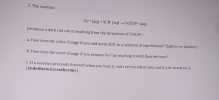 2. The reaction Fe3+ (aq) + SCN (aq) → FeSCN2+ (aq) produces a dark red color resulting from the formation of FeSCN2+. a. How does the color change if you add more SCN to a solution at equilibrium? (lighter or darker) b. How does the color change if you remove Fe3+ by reacting it with fluoride ions? c. If a reaction proceeds forward when you heat it, and reverse when you cool it, the reaction is [endothermic exothermic).
 2. The stock solution at equilibrium used in test tube # 4 contains Fe3 (aq), SCN-(aq) and [FESCNP2 (aq). When NaOH was added to test tube #4 a shift in the equilibrium was observed. What chemical species in the stock solution reacted with NAOH? Write the balanced chemical reaction associated with the change observed from the addition of NaOH to test tube #4? Explain in terms of LeChatelier's Principle the observed results from the addition of 0.1 M KSCN to...
 The equilibrium of Co and CF with CoCl- 5 Initial Color: blue Color after addition of HCI: Piuk bue/Paxle Color after addition of HCI: Color after heating: Pak Color after cooling: Questions Chatelier's Principle to explain the different colors found in the following equilibria. Write balance chemical equations for all chemical reactions. Write net ionic equations for the reaction between Fe(NO3)2(aq) and KSCN(aq) a Explain the color change when Fe(NO3)2 is added to the reaction at equilibrium. b Write net...
 number 2 please
2. The stock solution at equilibrium used in teat tuba #4 contains Fe"(aq), SCN-(aq) and FeSCNPtaq). When NaOH was added to test iube #4 a slaft in the equilibrium was observed. What chemical species in the stock solution reacted with NEOH Vilite the balanced chemical reaction associated with the change observed from the addition NaOH to iest tube #4? Explain in terms of LeChatelier's Principle the observed results from the addition of 0.1 M KSCN to test...
number 2 please
2. The stock solution at equilibrium used in teat tuba #4 contains Fe"(aq), SCN-(aq) and FeSCNPtaq). When NaOH was added to test iube #4 a slaft in the equilibrium was observed. What chemical species in the stock solution reacted with NEOH Vilite the balanced chemical reaction associated with the change observed from the addition NaOH to iest tube #4? Explain in terms of LeChatelier's Principle the observed results from the addition of 0.1 M KSCN to test...
 My question is #2 for the reaction Fe3+ (aq) + SCN- (aq)
FeSCN2+ (aq). The goal is to predict the color change (darker or
lighter) for test tubes 2-8. I have attached the supplemental
sheets given to help with the problem. The test tubes 2-8 are being
manipulated either by temperature or things being added which can
be seen by one of the pictures.
2. For reaction "UCTIONS are increased by the same amount. Fe3+ (aq) + SCN (aq) $...
My question is #2 for the reaction Fe3+ (aq) + SCN- (aq)
FeSCN2+ (aq). The goal is to predict the color change (darker or
lighter) for test tubes 2-8. I have attached the supplemental
sheets given to help with the problem. The test tubes 2-8 are being
manipulated either by temperature or things being added which can
be seen by one of the pictures.
2. For reaction "UCTIONS are increased by the same amount. Fe3+ (aq) + SCN (aq) $...
 are
theses correct?
please correct me if they are not.
Results Fe Test Tube 2: FeSCN (aa) SCN () Fe Chemical equation: Explanation: The equilibrium shifted toward the increased the due to the addition of Fe(NO,)) because it of the Test Tube 3: FESCN 0) SCN () (as Chemical equation: Fe(ag) Explanation: Test Tube 4: Chemical equation: Fe(agk FeSCN( (aq)h Explanation: Test Tube 5: Chemical equation: Fe"( SCN () FESCN 3+ + (sq) Explanation: Test Tube 6 Chemical equation: Fe(a...
are
theses correct?
please correct me if they are not.
Results Fe Test Tube 2: FeSCN (aa) SCN () Fe Chemical equation: Explanation: The equilibrium shifted toward the increased the due to the addition of Fe(NO,)) because it of the Test Tube 3: FESCN 0) SCN () (as Chemical equation: Fe(ag) Explanation: Test Tube 4: Chemical equation: Fe(agk FeSCN( (aq)h Explanation: Test Tube 5: Chemical equation: Fe"( SCN () FESCN 3+ + (sq) Explanation: Test Tube 6 Chemical equation: Fe(a...
 can
you please check me and tell me how i write thermal equation
?!
We were unable to transcribe this image** Juurs. Effect of Concentration Changes and Temperature Changes on Equilibrium Involving Fe". SCN, and Fe(SCN)" 9. Add 5 drops of 0.1 M Fe(NO3), solution into test tube 2 and mix. Record in the report sheet the ion, if any, from the above equilibrium that is present in this added reagent. 10. Record the color change, if any, compared to...
can
you please check me and tell me how i write thermal equation
?!
We were unable to transcribe this image** Juurs. Effect of Concentration Changes and Temperature Changes on Equilibrium Involving Fe". SCN, and Fe(SCN)" 9. Add 5 drops of 0.1 M Fe(NO3), solution into test tube 2 and mix. Record in the report sheet the ion, if any, from the above equilibrium that is present in this added reagent. 10. Record the color change, if any, compared to...
 Equilibrium Concentrations for a Simple Addition Reaction At a certain temperature K = 1.10x10³ for the reaction: Fe3+(aq)SCN"(aq) FeSCN2+(aq) 5.00x10² mol of Fe(NO3)3 is added to 8.70x 10⁻¹ L of 1.84 x 10⁻¹ M KSCN. Neglecting any volume change and assuming that all species remain in solution--: Calculate the equilibrium concentration of Fe3+ (in mol/L) mol/L 1 pts 提交答案 Tries 0/8 Calculate the equilibrium concentration of SCN (in mol/L). mol/L 1 pts [提交答案 Tries 0/8 Calculate the equilibrium concentration of...
 Hi there
Im having trouble with the last question on my lab report sheet.
Would both equations be considered correct because they share the
common ion effect? Please explain; thank you in advance!!
Section E: Thiocyano-iron III Complex Ion: Fe + SCN = FeSCN2+ Yellow red Stress to system Observation Shift CIE or Chem Rx Add 0.2M Fe(NO3)3 Solution fums right Fe3+ + 3NO₂ darker red CIE Add 0.1M KSCN solution turns K + SON darker red right CIE Add...
Hi there
Im having trouble with the last question on my lab report sheet.
Would both equations be considered correct because they share the
common ion effect? Please explain; thank you in advance!!
Section E: Thiocyano-iron III Complex Ion: Fe + SCN = FeSCN2+ Yellow red Stress to system Observation Shift CIE or Chem Rx Add 0.2M Fe(NO3)3 Solution fums right Fe3+ + 3NO₂ darker red CIE Add 0.1M KSCN solution turns K + SON darker red right CIE Add...
 2. The reaction Fe3+ (aq) + SCN (aq) → FeSCN2+ (aq) produces a dark red color resulting from the formation of FeSCN2+. a. How does the color change if you add more SCN to a solution at equilibrium? (lighter or darker) b. How does the color change if you remove Fe3+ by reacting it with fluoride ions? c. If a reaction proceeds forward when you heat it, and reverse when you cool it, the reaction is [endothermic exothermic).
Most questions answered within 3 hours.
-
Where is the error in this code sequence?
String s1 = "Hello";
String s2 = "ello";...
asked 10 months ago -
Financial data for Joel de Paris, Inc., for last year
follow:
Joel de Paris, Inc.
Balance...
asked 10 months ago -
Consider this reaction:
Al2(SO4)3 (aq)+ BaCl3
(aq) Al2Cl6 (aq)- +
3BaSO4(s) . What is the...
asked 10 months ago -
Suppose that Savneet is considering increasing her
recent random sample from 20 car rentals to 40...
asked 10 months ago -
Trucks arrive at an unloading terminal at an average rate of 120
per hour.
Trucks arrive...
asked 10 months ago -
Why are methanol and ethanol completely soluble in water while
octanol is not very little soluble....
asked 10 months ago -
A facilities manager at a university reads in a research report
that the mean amount of...
asked 10 months ago -
When the CuSO4 is rehydrated by adding water to the anhydrous
compound, is this an endothermic...
asked 10 months ago -
A ray of sunlight is passing from diamond into crown glass; the
angle of incidence is...
asked 10 months ago -
A block of mass 0.249 kg is placed on top of a light, vertical
spring of...
asked 10 months ago -
how do the kidneys compensate in the presences of acidosis
a) trigger hyperventilate
b) reserve acid...
asked 10 months ago -
Question 501 pts
The rental rate of capital to the firm increases. Which of the
following...
asked 10 months ago