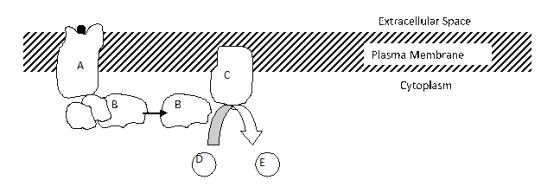
Use the following diagram to answer the questions. The diagram illustrates a member of the β-adrenergic family of receptors (that bind adrenaline) and the molecules involved in its signaling pathway. Binding of adrenaline to its receptor results in the formation of cAMP. Each shape is a protein or nucleotide.
A G protein-coupled receptor
Select shape from A-E
A subunit in a heterotrimeric G protein
Select shape from A-E
An enzyme whose physiological substrate is ATP
Select shape from A-E
ATP
Select shape from A-E
Adenyly cyclase
Select shape from A-E
A protein that may be modified by cholera toxin
Select shape from A-E
Homework Answers
The given image represents Beta-adrenergic receptor signalling
cascade.
The black dot = Epinephrine
A = Beta adrenergic receptor
B = Alpha subunit of hetero trimeric G-protein
C = Adenylate cyclase
D = ATP
E = cAMP
Add Answer to:
Use the following diagram to answer the questions. The diagram
illustrates a member of the β-adrenergic...
Epinephrine B-Adrenergic receptor Adenylate cyclase GDP ATP Cyclic AMP ✓ Protein kinase A Protein kinase A...
 Epinephrine B-Adrenergic receptor Adenylate cyclase GDP ATP Cyclic AMP ✓ Protein kinase A Protein kinase A Describe the steps by which epinephrine causes cAMP production. [Choose ] Epinephrine binds to the extracellular portion of the beta-adrenergic receptor [Choose] The binding of epinephrine causes dimerization of its receptor. Choose] On the intracellular side, this change propagates to membrane-bound heterotrimeric G proteins. This causes them to hydrolyze GTP. [Choose ] < [Choose ] The G-proteins then dissociate into their alpha and beta/gamma...
or each of the following sentences, select the best word or phrase from the list below to fill in the blanks ot all words or phrases will be used; each word or phrase should be used only once 38....
 or each of the following sentences, select the best word or phrase from the list below to fill in the blanks ot all words or phrases will be used; each word or phrase should be used only once 38. (3) An extracellular signal molecule can act to change a cell's behavior by acting through cell that control intracellular signaling proteins. These intracellular proteins that bring surface signaling proteins ultimately change the activity of about cell responses. Intracellular signaling proteins can...
A. B. C. D. E. F. Thank you receptors induce activation of adenlyate cyclase, which creates...
 A. B. C. D. E. F. Thank you
receptors induce activation of adenlyate cyclase, which creates the second messenger(s) O G-Protein Coupled, CAMP O Tyrosine Kinase, CAMP OTyrosine Kinase, IP3 and DAG G-Protein Coupled, IP3 and DAG Which of the following is most likely to be activated by a small hydrophobic signal? OIntracellular receptor Receptor Tyrosine Kinase O G-Protein Coupled Receptor Ligand-Gated lon Channel Which of the following types of receptors require dimerization for activation? (Select any/all that apply) OLigand-gated...
A. B. C. D. E. F. Thank you
receptors induce activation of adenlyate cyclase, which creates the second messenger(s) O G-Protein Coupled, CAMP O Tyrosine Kinase, CAMP OTyrosine Kinase, IP3 and DAG G-Protein Coupled, IP3 and DAG Which of the following is most likely to be activated by a small hydrophobic signal? OIntracellular receptor Receptor Tyrosine Kinase O G-Protein Coupled Receptor Ligand-Gated lon Channel Which of the following types of receptors require dimerization for activation? (Select any/all that apply) OLigand-gated...
2. The cell line of S49 lymphomas is commonly used to study adenylate cyclase. There Are cells wi...
 2. The cell line of S49 lymphomas is commonly used to study adenylate cyclase. There Are cells with mutations in some of the system components. The Wild variant of S49 expresses receptors for the hormone epinephrine. The following graph illustrates measurements made using membranes from a S49 mutant line. The data in the graph on the left represent wild cells incubated only with GTP (with) with epinephrine and GTP (EPI) or treated 1 hour earlier with the cholera toxin, GTP...
open to look at all pictures Multiple Choice Which of the following are true of G...
 open to look at all pictures
Multiple Choice Which of the following are true of G protein coupled receptors (GPCRs) A) peripheral membrane protein B) Activates G proteins on cytoplasmic side C) Receptors to lipid soluble hormones D) Binds ligands on cytoplasmic side Submit CASTILLO NAVA Invoice Soon Multiple Choice Which of the following are true of G proteins A) Are integral membrane proteins B) Works with G protein coupled receptors C) dimer D) On the exoplasmic side of membrane...
open to look at all pictures
Multiple Choice Which of the following are true of G protein coupled receptors (GPCRs) A) peripheral membrane protein B) Activates G proteins on cytoplasmic side C) Receptors to lipid soluble hormones D) Binds ligands on cytoplasmic side Submit CASTILLO NAVA Invoice Soon Multiple Choice Which of the following are true of G proteins A) Are integral membrane proteins B) Works with G protein coupled receptors C) dimer D) On the exoplasmic side of membrane...
Question 1 (1 point) Vasoconstriction occurs when epinephrine (adrenaline) binds to the a-adrenergic receptor on vascular...
 Question 1 (1 point) Vasoconstriction occurs when epinephrine (adrenaline) binds to the a-adrenergic receptor on vascular smooth muscle cells. One way to treat high blood pressure is to administer competitive inhibitors that bind to this receptor. The Kd for binding of epinephrine to this receptor is ~UM. Based on the measured affinity (Kd) of the following drugs for the a-adrenergic receptor, which might be good candidates for high blood pressure medication? Drug A: Kd = 0.6 M; Drug B: Kd...
Question 10-12 10. During the mating process, yeast cells respond to pheromones secreted by other yeast...
 Question 10-12
10. During the mating process, yeast cells respond to pheromones secreted by other yeast cells. These pheromones bind GPCRs on the surface of the responding cell and lead to the activation of proteins inside the cell. When a wild-type yeast cell senses the pheromone, its physiology changes in preparation for mating: the cell stops growing until it finds a mating partner. If yeast cells do not undergo the appropriate response after sensing a pheromone, they are considered sterile....
Question 10-12
10. During the mating process, yeast cells respond to pheromones secreted by other yeast cells. These pheromones bind GPCRs on the surface of the responding cell and lead to the activation of proteins inside the cell. When a wild-type yeast cell senses the pheromone, its physiology changes in preparation for mating: the cell stops growing until it finds a mating partner. If yeast cells do not undergo the appropriate response after sensing a pheromone, they are considered sterile....
Acetylcholine binds to a GPCR on heart muscle, making the heart beat more slowly. The activated r...
 Acetylcholine binds to a GPCR on heart muscle, making the heart beat more slowly. The activated receptor stimulates a G protein, which opens a K channel in the plasma membrane, as shown in the figure below. Which of the following would enhance this effect of the acetylcholine? plasma membrane closed K' channel GTP Pr complex activated α subunit K CHANNEL open K'channel OPENING EXTRACELLULAR SPACE CYTOSOL GTP G-PROTEIN INACTIVATION K" CHANNEL CLOSING closed K' channel rt inactive G protein GOP...
8.) which of the following statements does not describe heterotrimeric g proteins involved in the adenylate...
8.) which of the following statements does not describe heterotrimeric g proteins involved in the adenylate cyclase signaling pathway? a. binding to adenylate cyclase triggers the hydrolysis of PIP2 b. consist of three subunits, Galpha, Gbeta, and Ggamma c. can function as a mediator to adenylate cyclase activity d. are anchored to the cytoplasmic side of the membrane e. activates adenylate cyclase by binding to its C2a subunit 9.) which of the following is not associated with the cAMP binding...
INFORMATION ABOUT IMAGE G FOR QUESTIONS 12-15: GABAB receptors (GABABRs) are G-protein-coupled receptors that can be...
 INFORMATION ABOUT IMAGE G FOR QUESTIONS 12-15:
GABAB receptors (GABABRs) are
G-protein-coupled receptors that can be found on both pre- and
postsynaptic neurons. When they are activated by GABA, they can
have a range of effects. For the synapse you are studying in the
following questions, the effects of GABABRs are
indicated in IMAGE G.
You are doing a series of experiments in which you are recording
from the pre- and postsynaptic cell at a synapse. The experiments
described below...
INFORMATION ABOUT IMAGE G FOR QUESTIONS 12-15:
GABAB receptors (GABABRs) are
G-protein-coupled receptors that can be found on both pre- and
postsynaptic neurons. When they are activated by GABA, they can
have a range of effects. For the synapse you are studying in the
following questions, the effects of GABABRs are
indicated in IMAGE G.
You are doing a series of experiments in which you are recording
from the pre- and postsynaptic cell at a synapse. The experiments
described below...
 Epinephrine B-Adrenergic receptor Adenylate cyclase GDP ATP Cyclic AMP ✓ Protein kinase A Protein kinase A Describe the steps by which epinephrine causes cAMP production. [Choose ] Epinephrine binds to the extracellular portion of the beta-adrenergic receptor [Choose] The binding of epinephrine causes dimerization of its receptor. Choose] On the intracellular side, this change propagates to membrane-bound heterotrimeric G proteins. This causes them to hydrolyze GTP. [Choose ] < [Choose ] The G-proteins then dissociate into their alpha and beta/gamma...
 or each of the following sentences, select the best word or phrase from the list below to fill in the blanks ot all words or phrases will be used; each word or phrase should be used only once 38. (3) An extracellular signal molecule can act to change a cell's behavior by acting through cell that control intracellular signaling proteins. These intracellular proteins that bring surface signaling proteins ultimately change the activity of about cell responses. Intracellular signaling proteins can...
 A. B. C. D. E. F. Thank you
receptors induce activation of adenlyate cyclase, which creates the second messenger(s) O G-Protein Coupled, CAMP O Tyrosine Kinase, CAMP OTyrosine Kinase, IP3 and DAG G-Protein Coupled, IP3 and DAG Which of the following is most likely to be activated by a small hydrophobic signal? OIntracellular receptor Receptor Tyrosine Kinase O G-Protein Coupled Receptor Ligand-Gated lon Channel Which of the following types of receptors require dimerization for activation? (Select any/all that apply) OLigand-gated...
A. B. C. D. E. F. Thank you
receptors induce activation of adenlyate cyclase, which creates the second messenger(s) O G-Protein Coupled, CAMP O Tyrosine Kinase, CAMP OTyrosine Kinase, IP3 and DAG G-Protein Coupled, IP3 and DAG Which of the following is most likely to be activated by a small hydrophobic signal? OIntracellular receptor Receptor Tyrosine Kinase O G-Protein Coupled Receptor Ligand-Gated lon Channel Which of the following types of receptors require dimerization for activation? (Select any/all that apply) OLigand-gated...
 2. The cell line of S49 lymphomas is commonly used to study adenylate cyclase. There Are cells with mutations in some of the system components. The Wild variant of S49 expresses receptors for the hormone epinephrine. The following graph illustrates measurements made using membranes from a S49 mutant line. The data in the graph on the left represent wild cells incubated only with GTP (with) with epinephrine and GTP (EPI) or treated 1 hour earlier with the cholera toxin, GTP...
 open to look at all pictures
Multiple Choice Which of the following are true of G protein coupled receptors (GPCRs) A) peripheral membrane protein B) Activates G proteins on cytoplasmic side C) Receptors to lipid soluble hormones D) Binds ligands on cytoplasmic side Submit CASTILLO NAVA Invoice Soon Multiple Choice Which of the following are true of G proteins A) Are integral membrane proteins B) Works with G protein coupled receptors C) dimer D) On the exoplasmic side of membrane...
open to look at all pictures
Multiple Choice Which of the following are true of G protein coupled receptors (GPCRs) A) peripheral membrane protein B) Activates G proteins on cytoplasmic side C) Receptors to lipid soluble hormones D) Binds ligands on cytoplasmic side Submit CASTILLO NAVA Invoice Soon Multiple Choice Which of the following are true of G proteins A) Are integral membrane proteins B) Works with G protein coupled receptors C) dimer D) On the exoplasmic side of membrane...
 Question 1 (1 point) Vasoconstriction occurs when epinephrine (adrenaline) binds to the a-adrenergic receptor on vascular smooth muscle cells. One way to treat high blood pressure is to administer competitive inhibitors that bind to this receptor. The Kd for binding of epinephrine to this receptor is ~UM. Based on the measured affinity (Kd) of the following drugs for the a-adrenergic receptor, which might be good candidates for high blood pressure medication? Drug A: Kd = 0.6 M; Drug B: Kd...
 Question 10-12
10. During the mating process, yeast cells respond to pheromones secreted by other yeast cells. These pheromones bind GPCRs on the surface of the responding cell and lead to the activation of proteins inside the cell. When a wild-type yeast cell senses the pheromone, its physiology changes in preparation for mating: the cell stops growing until it finds a mating partner. If yeast cells do not undergo the appropriate response after sensing a pheromone, they are considered sterile....
Question 10-12
10. During the mating process, yeast cells respond to pheromones secreted by other yeast cells. These pheromones bind GPCRs on the surface of the responding cell and lead to the activation of proteins inside the cell. When a wild-type yeast cell senses the pheromone, its physiology changes in preparation for mating: the cell stops growing until it finds a mating partner. If yeast cells do not undergo the appropriate response after sensing a pheromone, they are considered sterile....
 Acetylcholine binds to a GPCR on heart muscle, making the heart beat more slowly. The activated receptor stimulates a G protein, which opens a K channel in the plasma membrane, as shown in the figure below. Which of the following would enhance this effect of the acetylcholine? plasma membrane closed K' channel GTP Pr complex activated α subunit K CHANNEL open K'channel OPENING EXTRACELLULAR SPACE CYTOSOL GTP G-PROTEIN INACTIVATION K" CHANNEL CLOSING closed K' channel rt inactive G protein GOP...
 INFORMATION ABOUT IMAGE G FOR QUESTIONS 12-15:
GABAB receptors (GABABRs) are
G-protein-coupled receptors that can be found on both pre- and
postsynaptic neurons. When they are activated by GABA, they can
have a range of effects. For the synapse you are studying in the
following questions, the effects of GABABRs are
indicated in IMAGE G.
You are doing a series of experiments in which you are recording
from the pre- and postsynaptic cell at a synapse. The experiments
described below...
INFORMATION ABOUT IMAGE G FOR QUESTIONS 12-15:
GABAB receptors (GABABRs) are
G-protein-coupled receptors that can be found on both pre- and
postsynaptic neurons. When they are activated by GABA, they can
have a range of effects. For the synapse you are studying in the
following questions, the effects of GABABRs are
indicated in IMAGE G.
You are doing a series of experiments in which you are recording
from the pre- and postsynaptic cell at a synapse. The experiments
described below...
Most questions answered within 3 hours.
-
Where is the error in this code sequence?
String s1 = "Hello";
String s2 = "ello";...
asked 11 months ago -
Financial data for Joel de Paris, Inc., for last year
follow:
Joel de Paris, Inc.
Balance...
asked 11 months ago -
Consider this reaction:
Al2(SO4)3 (aq)+ BaCl3
(aq) Al2Cl6 (aq)- +
3BaSO4(s) . What is the...
asked 11 months ago -
Suppose that Savneet is considering increasing her
recent random sample from 20 car rentals to 40...
asked 11 months ago -
Trucks arrive at an unloading terminal at an average rate of 120
per hour.
Trucks arrive...
asked 11 months ago -
Why are methanol and ethanol completely soluble in water while
octanol is not very little soluble....
asked 11 months ago -
A facilities manager at a university reads in a research report
that the mean amount of...
asked 11 months ago -
When the CuSO4 is rehydrated by adding water to the anhydrous
compound, is this an endothermic...
asked 11 months ago -
A ray of sunlight is passing from diamond into crown glass; the
angle of incidence is...
asked 11 months ago -
A block of mass 0.249 kg is placed on top of a light, vertical
spring of...
asked 11 months ago -
how do the kidneys compensate in the presences of acidosis
a) trigger hyperventilate
b) reserve acid...
asked 11 months ago -
Question 501 pts
The rental rate of capital to the firm increases. Which of the
following...
asked 11 months ago