For the following graph: BFS (a) Perform BFS on the following graph starting at vertex m...
For the following graph: BFS
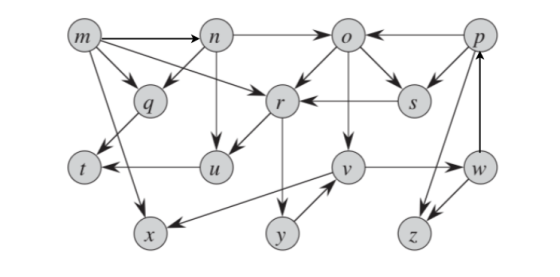
(a) Perform BFS on the following graph starting at vertex m show v.d and v.π for each vertex.
(b) Draw the Breadth first predecessor tree resulting from running the algorithm in part (a).
Homework Answers


Add Answer to:
For the following graph: BFS
(a) Perform BFS on the following graph starting at vertex m...
BFS Given an undirected graph below (a) Show the shortest distance to each vertex from source ver...
 Solve (a) and (b) using BFS and DFS diagram
BFS Given an undirected graph below (a) Show the shortest distance to each vertex from source vertex H and predecessor tree on the graph that result from running breadth-finst search (BFS).Choose adjacen vertices in al phabetical order b) Show the start and finsh time for each vertex, starting from source vertex H, that result from running depth-first search (DFS)Choose aljacent vertices in alphabet- ical order DFS
BFS Given an undirected graph...
Solve (a) and (b) using BFS and DFS diagram
BFS Given an undirected graph below (a) Show the shortest distance to each vertex from source vertex H and predecessor tree on the graph that result from running breadth-finst search (BFS).Choose adjacen vertices in al phabetical order b) Show the start and finsh time for each vertex, starting from source vertex H, that result from running depth-first search (DFS)Choose aljacent vertices in alphabet- ical order DFS
BFS Given an undirected graph...
BFS Given an undirected graph below (a) Show the shortest distance to each vertex from source ver...
 BFS Given an undirected graph below (a) Show the shortest distance to each vertex from source vertex H and predecessor tree on the graph that result from running breadth-finst search (BFS).Choose adjacen vertices in al phabetical order b) Show the start and finsh time for each vertex, starting from source vertex H, that result from running depth-first search (DFS)Choose aljacent vertices in alphabet- ical order DFS
BFS Given an undirected graph below (a) Show the shortest distance to each vertex...
BFS Given an undirected graph below (a) Show the shortest distance to each vertex from source vertex H and predecessor tree on the graph that result from running breadth-finst search (BFS).Choose adjacen vertices in al phabetical order b) Show the start and finsh time for each vertex, starting from source vertex H, that result from running depth-first search (DFS)Choose aljacent vertices in alphabet- ical order DFS
BFS Given an undirected graph below (a) Show the shortest distance to each vertex...
Show the operation of depth-first search (DFS) on the graph of Figure 1 starting from vertex...
 Show the operation of depth-first search (DFS) on the graph of Figure 1 starting from vertex q. Always process vertices in alphabetical order. Show the discovery and finish times for each vertex, and the classification of each edge. (b) A depth-first forest classifies the edges of a graph into tree, back, forward, and cross edges. A breadth-first search (BFS) tree can also be used to classify the edges reachable from the source of the search into the same four categories....
1. Startingatvertex000, perform a BFSof Q3.Assume all adjacency lists are in numericalorder.For example, (000,001) occurs before...
 1. Startingatvertex000, perform a BFSof Q3.Assume all adjacency lists are in numericalorder.For example, (000,001) occurs before (000, 010). Showthe resulting spanningtrees. Draw the directed graphs and perform a. 2. Breadth-First Search (BFS)algorithm: VTo determine the shortest paths starting at vertex a to everyother node. Show the resulting spanning tree. b. Depth-First Search (DFS) to explore the whole graph: Record the start/end time for all the vertices. show the resulting spanning forest Label the name°fthe edges. V Writethetopologicalorderofthevertices(ifnocycle-nobackedge) (Showthestate of the...
Question II - Graph Traversal and Minimum Spanning Trees [40 Points] Consider the following graph: B...
 Question II - Graph Traversal and Minimum Spanning Trees [40 Points] Consider the following graph: B 10 1 4 1 H 9 4 a) Traverse the graph starting from vertex A, and using the Breadth-First Search algorithm. Show the traversal result and the data structure you are using. [10 Points] b) Traverse the graph starting from vertex A, and using the Depth-First Search (Post-order) algorithm. Show the traversal result and the data structure you are using. [10 Points] c) Apply...
Draw the DFS search tree with starting vertex E and break ties alphabetically. Assuming unit edge...
 Draw the DFS search tree with starting vertex E and break ties alphabetically. Assuming unit edge length (i.e., ignore edge weight), draw the BFS search tree with starting vertex E and break ties alphabetically. Suppose the Dijkstras algorithm is run on the graph with starting vertex E: (i) draw a table showing the intermediate distance values of all vertices at each iteration of the algorithm; (ii) show the final shortest-path tree.
Consider the following directed graph for each of the problems: 1. Perform a breadth-first search on...
 Consider the following directed graph for each of the
problems:
1. Perform a breadth-first search on the graph assuming that the
vertices and adjacency lists
are listed in alphabetical order. Show the breadth-first search
tree that is generated.
2. Perform a depth-first search on the graph assuming that the
vertices and adjacency lists
are listed in alphabetical order. Classify each edge as tree, back
or cross edge. Label each
vertex with its start and finish time.
3. Remove all the...
Consider the following directed graph for each of the
problems:
1. Perform a breadth-first search on the graph assuming that the
vertices and adjacency lists
are listed in alphabetical order. Show the breadth-first search
tree that is generated.
2. Perform a depth-first search on the graph assuming that the
vertices and adjacency lists
are listed in alphabetical order. Classify each edge as tree, back
or cross edge. Label each
vertex with its start and finish time.
3. Remove all the...
Show that the breadth-first tree computed by BFS can depend on the ordering within adjacency lists...
 Show that the breadth-first tree computed by BFS can depend on the ordering within adjacency lists using the following tree. Using A as the starting vertex, show both possible BFS trees along with d and pi values.
You're running Dijkstra's algorithm to find all shortest paths starting with vertex A in the graph...
 You're running Dijkstra's algorithm to find all shortest paths
starting with vertex A in the graph below, but you pause after
vertex E has been added to the solution (and the relaxation step
for vertex E has been performed). Annotate the graph as follows:
(1) label each node with its current dist value, (2)
darken the edges that are part of the current spanning tree (i.e.,
the parent links), (3) draw a dotted circle around the
"cloud'' of vertices that...
You're running Dijkstra's algorithm to find all shortest paths
starting with vertex A in the graph below, but you pause after
vertex E has been added to the solution (and the relaxation step
for vertex E has been performed). Annotate the graph as follows:
(1) label each node with its current dist value, (2)
darken the edges that are part of the current spanning tree (i.e.,
the parent links), (3) draw a dotted circle around the
"cloud'' of vertices that...
please I need it urgent thanks algorithms second picture is the graph 2.3 Graphs and BFS-DFS...
 please I need it urgent thanks algorithms second
picture is the graph
2.3 Graphs and BFS-DFS 5 points each I. Draw the adjacency matrix for the graph A on the last page. 2. Show the order in which a breadth first traversal will print out the vertices? Assume that if the algorithm has a choice of which vertex to visit, it visits the vertex with the lower number. 3. Find a topological ordering for the graph B on the last...
please I need it urgent thanks algorithms second
picture is the graph
2.3 Graphs and BFS-DFS 5 points each I. Draw the adjacency matrix for the graph A on the last page. 2. Show the order in which a breadth first traversal will print out the vertices? Assume that if the algorithm has a choice of which vertex to visit, it visits the vertex with the lower number. 3. Find a topological ordering for the graph B on the last...
 Solve (a) and (b) using BFS and DFS diagram
BFS Given an undirected graph below (a) Show the shortest distance to each vertex from source vertex H and predecessor tree on the graph that result from running breadth-finst search (BFS).Choose adjacen vertices in al phabetical order b) Show the start and finsh time for each vertex, starting from source vertex H, that result from running depth-first search (DFS)Choose aljacent vertices in alphabet- ical order DFS
BFS Given an undirected graph...
Solve (a) and (b) using BFS and DFS diagram
BFS Given an undirected graph below (a) Show the shortest distance to each vertex from source vertex H and predecessor tree on the graph that result from running breadth-finst search (BFS).Choose adjacen vertices in al phabetical order b) Show the start and finsh time for each vertex, starting from source vertex H, that result from running depth-first search (DFS)Choose aljacent vertices in alphabet- ical order DFS
BFS Given an undirected graph...
 BFS Given an undirected graph below (a) Show the shortest distance to each vertex from source vertex H and predecessor tree on the graph that result from running breadth-finst search (BFS).Choose adjacen vertices in al phabetical order b) Show the start and finsh time for each vertex, starting from source vertex H, that result from running depth-first search (DFS)Choose aljacent vertices in alphabet- ical order DFS
BFS Given an undirected graph below (a) Show the shortest distance to each vertex...
BFS Given an undirected graph below (a) Show the shortest distance to each vertex from source vertex H and predecessor tree on the graph that result from running breadth-finst search (BFS).Choose adjacen vertices in al phabetical order b) Show the start and finsh time for each vertex, starting from source vertex H, that result from running depth-first search (DFS)Choose aljacent vertices in alphabet- ical order DFS
BFS Given an undirected graph below (a) Show the shortest distance to each vertex...
 Show the operation of depth-first search (DFS) on the graph of Figure 1 starting from vertex q. Always process vertices in alphabetical order. Show the discovery and finish times for each vertex, and the classification of each edge. (b) A depth-first forest classifies the edges of a graph into tree, back, forward, and cross edges. A breadth-first search (BFS) tree can also be used to classify the edges reachable from the source of the search into the same four categories....
 1. Startingatvertex000, perform a BFSof Q3.Assume all adjacency lists are in numericalorder.For example, (000,001) occurs before (000, 010). Showthe resulting spanningtrees. Draw the directed graphs and perform a. 2. Breadth-First Search (BFS)algorithm: VTo determine the shortest paths starting at vertex a to everyother node. Show the resulting spanning tree. b. Depth-First Search (DFS) to explore the whole graph: Record the start/end time for all the vertices. show the resulting spanning forest Label the name°fthe edges. V Writethetopologicalorderofthevertices(ifnocycle-nobackedge) (Showthestate of the...
 Question II - Graph Traversal and Minimum Spanning Trees [40 Points] Consider the following graph: B 10 1 4 1 H 9 4 a) Traverse the graph starting from vertex A, and using the Breadth-First Search algorithm. Show the traversal result and the data structure you are using. [10 Points] b) Traverse the graph starting from vertex A, and using the Depth-First Search (Post-order) algorithm. Show the traversal result and the data structure you are using. [10 Points] c) Apply...
 Draw the DFS search tree with starting vertex E and break ties alphabetically. Assuming unit edge length (i.e., ignore edge weight), draw the BFS search tree with starting vertex E and break ties alphabetically. Suppose the Dijkstras algorithm is run on the graph with starting vertex E: (i) draw a table showing the intermediate distance values of all vertices at each iteration of the algorithm; (ii) show the final shortest-path tree.
 Consider the following directed graph for each of the
problems:
1. Perform a breadth-first search on the graph assuming that the
vertices and adjacency lists
are listed in alphabetical order. Show the breadth-first search
tree that is generated.
2. Perform a depth-first search on the graph assuming that the
vertices and adjacency lists
are listed in alphabetical order. Classify each edge as tree, back
or cross edge. Label each
vertex with its start and finish time.
3. Remove all the...
Consider the following directed graph for each of the
problems:
1. Perform a breadth-first search on the graph assuming that the
vertices and adjacency lists
are listed in alphabetical order. Show the breadth-first search
tree that is generated.
2. Perform a depth-first search on the graph assuming that the
vertices and adjacency lists
are listed in alphabetical order. Classify each edge as tree, back
or cross edge. Label each
vertex with its start and finish time.
3. Remove all the...
 Show that the breadth-first tree computed by BFS can depend on the ordering within adjacency lists using the following tree. Using A as the starting vertex, show both possible BFS trees along with d and pi values.
 You're running Dijkstra's algorithm to find all shortest paths
starting with vertex A in the graph below, but you pause after
vertex E has been added to the solution (and the relaxation step
for vertex E has been performed). Annotate the graph as follows:
(1) label each node with its current dist value, (2)
darken the edges that are part of the current spanning tree (i.e.,
the parent links), (3) draw a dotted circle around the
"cloud'' of vertices that...
You're running Dijkstra's algorithm to find all shortest paths
starting with vertex A in the graph below, but you pause after
vertex E has been added to the solution (and the relaxation step
for vertex E has been performed). Annotate the graph as follows:
(1) label each node with its current dist value, (2)
darken the edges that are part of the current spanning tree (i.e.,
the parent links), (3) draw a dotted circle around the
"cloud'' of vertices that...
 please I need it urgent thanks algorithms second
picture is the graph
2.3 Graphs and BFS-DFS 5 points each I. Draw the adjacency matrix for the graph A on the last page. 2. Show the order in which a breadth first traversal will print out the vertices? Assume that if the algorithm has a choice of which vertex to visit, it visits the vertex with the lower number. 3. Find a topological ordering for the graph B on the last...
please I need it urgent thanks algorithms second
picture is the graph
2.3 Graphs and BFS-DFS 5 points each I. Draw the adjacency matrix for the graph A on the last page. 2. Show the order in which a breadth first traversal will print out the vertices? Assume that if the algorithm has a choice of which vertex to visit, it visits the vertex with the lower number. 3. Find a topological ordering for the graph B on the last...
Most questions answered within 3 hours.
-
Where is the error in this code sequence?
String s1 = "Hello";
String s2 = "ello";...
asked 10 months ago -
Financial data for Joel de Paris, Inc., for last year
follow:
Joel de Paris, Inc.
Balance...
asked 10 months ago -
Consider this reaction:
Al2(SO4)3 (aq)+ BaCl3
(aq) Al2Cl6 (aq)- +
3BaSO4(s) . What is the...
asked 10 months ago -
Suppose that Savneet is considering increasing her
recent random sample from 20 car rentals to 40...
asked 10 months ago -
Trucks arrive at an unloading terminal at an average rate of 120
per hour.
Trucks arrive...
asked 10 months ago -
Why are methanol and ethanol completely soluble in water while
octanol is not very little soluble....
asked 10 months ago -
A facilities manager at a university reads in a research report
that the mean amount of...
asked 10 months ago -
When the CuSO4 is rehydrated by adding water to the anhydrous
compound, is this an endothermic...
asked 10 months ago -
A ray of sunlight is passing from diamond into crown glass; the
angle of incidence is...
asked 10 months ago -
A block of mass 0.249 kg is placed on top of a light, vertical
spring of...
asked 10 months ago -
how do the kidneys compensate in the presences of acidosis
a) trigger hyperventilate
b) reserve acid...
asked 10 months ago -
Question 501 pts
The rental rate of capital to the firm increases. Which of the
following...
asked 10 months ago