Many proteins include an acetyl group at the N-terminus. How would this affect the Edman degradation...
Many proteins include an acetyl group at the N-terminus. How would this affect the Edman degradation process? Please show any relevant reaction mechanisms.
Homework Answers
Since the Edman corruption continues from the N-end of the protein, it won't work if the N-terminal amino corrosive has been synthetically changed or on the off chance that it is disguised inside the body of the protein. It likewise requires the utilization of either mystery or a different methodology to decide the positions of disulfide scaffolds.
A second Aabo-acetyl gathering was appended to the N-terminal buildups after the combination of the peptide library. This adjustment shields the N-terminal amino gatherings from ninhydrin response in peptides impervious to chymotrypsin, and gives an altered charge tag permitting delicate location and recognizable proof of parts in the supernatant got after enzymatic absorption performed even on single sap dot
acetyl bunch builds ionization proficiency and diminishes as far as possible.
Add Answer to:
Many proteins include an acetyl group at the N-terminus. How
would this affect the Edman degradation...
Question 3 As discussed in class, the initial step of Edman degradation involves a reaction between...
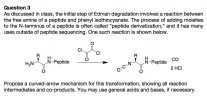 Question 3 As discussed in class, the initial step of Edman degradation involves a reaction between the free amine of a peptide and phenyl isothiocyanate. The process of adding moieties to the N-terminus of a peptide is often called "peptide derivatization," and it has many uses outside of peptide sequencing. One such reaction is shown below. CI Cl H2N N-Peptide C) Peptide CQ C) C) 2 HCI C) Propose a curved-arrow mechanism for this transformation, showing all reaction intermediates and...
Question 9: How does the addition of an acetyl group to a histone protein affect nucleosome...
Question 9: How does the addition of an acetyl group to a histone protein affect nucleosome structure, and why? How would the actions of a histone acetyltransferase or a histone deacetylase affect the rates of transcription, respectively? (Keep in mind that DNA that is easier to access is more robustly transcribed.)
E. Review of Proteins and Enzymes wollenboom 10. Using the three-letter code provide all possible peptides...
 E. Review of Proteins and Enzymes wollenboom 10. Using the three-letter code provide all possible peptides between Phe, Ala, Met and Cys; where Phe is at the N-terminus (not the structure). After this, answer the following questions: moto mons IDEN norto peptide (include the prefix, e.g. dipeptide). a) These amino acids will form a b) Indicate which amino acid(s) in the polypeptide can form a disulfide bond = c) Indicate which amino acid(s) in the polypeptide are polar neutral =...
s smı peptdes and ultimately proteins through a condensation fatt similar to the reactions that form...
 s smı peptdes and ultimately proteins through a condensation fatt similar to the reactions that form a triglyceride from glycerol Amino acids combine to form peptides an protonated aater molecule is removed when a carboxylate and and three fatty acids. One and thretis amine react. Figure 1: o- HI Carboxylate reacts with Protonated Amide forming amine 2. Consider the two amino acids, tryptophan and serine bonds can be formed between these acids? How many different peptide 3. Draw each of...
Can someone please help I cannot understand this at all. Question EN NHL Many antibiotics are inactivated by bacteri...
 Can someone please help I cannot understand this at all.
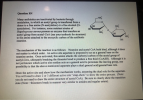
Question EN NHL Many antibiotics are inactivated by bacteria through acetylation, in which an acetyl group is transferred from a donor to a free amine (N-acetylation) or a free alcohol (O- acetylation). For instance, some resistant strains of Stapylococcus aureus possess an enzyme that transfers an acetyl group from acetyl-CoA (see your textbook for structure) to the amine attached to the exocyclic carbon of the antibiotic neamine. NH, OH OH...
Can someone please help I cannot understand this at all.
Question EN NHL Many antibiotics are inactivated by bacteria through acetylation, in which an acetyl group is transferred from a donor to a free amine (N-acetylation) or a free alcohol (O- acetylation). For instance, some resistant strains of Stapylococcus aureus possess an enzyme that transfers an acetyl group from acetyl-CoA (see your textbook for structure) to the amine attached to the exocyclic carbon of the antibiotic neamine. NH, OH OH...
How many NET ATPs would theoretically need to be used to store excess glucose as laurate...
How many NET ATPs would theoretically need to be used to store excess glucose as laurate (C12:0) (i.e., catabolize the glucose to acetyl-CoA and then anabolize to laurate)? Since there are 12 carbons in laurate and each glucose can be converted to two acetyl-CoAs, assume that you'll begin with 3 glucoses. Also, assume you already have sufficient oxaloacetate in the mitochondria to pair with the acetyl-CoA. Show the basic outline of the process. Indicate where each ATP, NADH, etc. is made or used. (For simplicity,...
2-2 Chemoautotrophic bacteria are responsible for the oxidation of NH:-N to NO -N in many biologi...
 please help
2-2 Chemoautotrophic bacteria are responsible for the oxidation of NH:-N to NO -N in many biological wastewater treatment processes. These bacteria, collectively called nitrifiers, consist of the genera Nitrosomonar and Ntro- bacter. The oxidation of ammonia to nitrate is considered a two-step sequen- tial reaction as follows: overall reaction NIHI 2oNO- 2r -H,O Considering the overall reaction, use stoichiornetric calculations to show how many mg t of alkalinity as CaCos are destroyed and how many mgć of oa...
please help
2-2 Chemoautotrophic bacteria are responsible for the oxidation of NH:-N to NO -N in many biological wastewater treatment processes. These bacteria, collectively called nitrifiers, consist of the genera Nitrosomonar and Ntro- bacter. The oxidation of ammonia to nitrate is considered a two-step sequen- tial reaction as follows: overall reaction NIHI 2oNO- 2r -H,O Considering the overall reaction, use stoichiornetric calculations to show how many mg t of alkalinity as CaCos are destroyed and how many mgć of oa...
How many products would you expect from the reaction of (S)-2-methylcyclohexanone with methyl magnesium bromide (include...
 How many products would you expect from the reaction of (S)-2-methylcyclohexanone with methyl magnesium bromide (include the stereoisomers)? Draw the stereoisomers of the product and specify the relationship between them. Following is a cyclic acetal formed from cyclohexanone. What are the reagents required for this reaction? Also write a stepwise mechanism for the formation of this acetal from cyclohexanone. Show how to synthesize the following compounds using a Wittig reaction. Design the synthesis of compound A (5-(1-hydroxycyclohexyl)pentan-2-one) starting from cyclohexanone...
2 Points Question 13 of 50 . How many of the following compounds would yield an...
 2 Points Question 13 of 50 . How many of the following compounds would yield an alcohol, upon reduction with lithium aluminum hydride? • Acetyl chloride • Benzoic anhydride Acetamide N,N-dimethylacetamide • Butanenitrile Ethyl acetate • Pentanoic acid . O A Seven B. Five OC. Two OD. Four Reset Selection What would be the structure of the polyamide, generated upon reaction of fumaric acid and 1.2-ethylenediamine? COOH HOOC NH2 H2N 1,2-ethylenediamine fumaric acid OA 'N 'N H H n B...
6. Vinegar is 5.00% (m/v) acetic acid (CH3COOH). How many milliliters of vinegar would you need...
 6. Vinegar is 5.00% (m/v) acetic acid (CH3COOH). How many milliliters of vinegar would you need to react with an excess of baking soda (NaHCO3) in order to generate 10.0 L of carbon dioxide gas at 1.05 atm and a temperature of 25.0°C? 7. Shown below is the aqueous reaction of KNOX, HCl, and SnCl2. 2 KNO2 (aq) + 6 HCl(aq) + 2 SnCl2 (aq) → 2 SnCla (aq) + N20 (g) + 3 H20 (1) + 2 KCl (aq)...
 Question 3 As discussed in class, the initial step of Edman degradation involves a reaction between the free amine of a peptide and phenyl isothiocyanate. The process of adding moieties to the N-terminus of a peptide is often called "peptide derivatization," and it has many uses outside of peptide sequencing. One such reaction is shown below. CI Cl H2N N-Peptide C) Peptide CQ C) C) 2 HCI C) Propose a curved-arrow mechanism for this transformation, showing all reaction intermediates and...
 E. Review of Proteins and Enzymes wollenboom 10. Using the three-letter code provide all possible peptides between Phe, Ala, Met and Cys; where Phe is at the N-terminus (not the structure). After this, answer the following questions: moto mons IDEN norto peptide (include the prefix, e.g. dipeptide). a) These amino acids will form a b) Indicate which amino acid(s) in the polypeptide can form a disulfide bond = c) Indicate which amino acid(s) in the polypeptide are polar neutral =...
 s smı peptdes and ultimately proteins through a condensation fatt similar to the reactions that form a triglyceride from glycerol Amino acids combine to form peptides an protonated aater molecule is removed when a carboxylate and and three fatty acids. One and thretis amine react. Figure 1: o- HI Carboxylate reacts with Protonated Amide forming amine 2. Consider the two amino acids, tryptophan and serine bonds can be formed between these acids? How many different peptide 3. Draw each of...
 Can someone please help I cannot understand this at all.
Question EN NHL Many antibiotics are inactivated by bacteria through acetylation, in which an acetyl group is transferred from a donor to a free amine (N-acetylation) or a free alcohol (O- acetylation). For instance, some resistant strains of Stapylococcus aureus possess an enzyme that transfers an acetyl group from acetyl-CoA (see your textbook for structure) to the amine attached to the exocyclic carbon of the antibiotic neamine. NH, OH OH...
Can someone please help I cannot understand this at all.
Question EN NHL Many antibiotics are inactivated by bacteria through acetylation, in which an acetyl group is transferred from a donor to a free amine (N-acetylation) or a free alcohol (O- acetylation). For instance, some resistant strains of Stapylococcus aureus possess an enzyme that transfers an acetyl group from acetyl-CoA (see your textbook for structure) to the amine attached to the exocyclic carbon of the antibiotic neamine. NH, OH OH...
 please help
2-2 Chemoautotrophic bacteria are responsible for the oxidation of NH:-N to NO -N in many biological wastewater treatment processes. These bacteria, collectively called nitrifiers, consist of the genera Nitrosomonar and Ntro- bacter. The oxidation of ammonia to nitrate is considered a two-step sequen- tial reaction as follows: overall reaction NIHI 2oNO- 2r -H,O Considering the overall reaction, use stoichiornetric calculations to show how many mg t of alkalinity as CaCos are destroyed and how many mgć of oa...
please help
2-2 Chemoautotrophic bacteria are responsible for the oxidation of NH:-N to NO -N in many biological wastewater treatment processes. These bacteria, collectively called nitrifiers, consist of the genera Nitrosomonar and Ntro- bacter. The oxidation of ammonia to nitrate is considered a two-step sequen- tial reaction as follows: overall reaction NIHI 2oNO- 2r -H,O Considering the overall reaction, use stoichiornetric calculations to show how many mg t of alkalinity as CaCos are destroyed and how many mgć of oa...
 How many products would you expect from the reaction of (S)-2-methylcyclohexanone with methyl magnesium bromide (include the stereoisomers)? Draw the stereoisomers of the product and specify the relationship between them. Following is a cyclic acetal formed from cyclohexanone. What are the reagents required for this reaction? Also write a stepwise mechanism for the formation of this acetal from cyclohexanone. Show how to synthesize the following compounds using a Wittig reaction. Design the synthesis of compound A (5-(1-hydroxycyclohexyl)pentan-2-one) starting from cyclohexanone...
 2 Points Question 13 of 50 . How many of the following compounds would yield an alcohol, upon reduction with lithium aluminum hydride? • Acetyl chloride • Benzoic anhydride Acetamide N,N-dimethylacetamide • Butanenitrile Ethyl acetate • Pentanoic acid . O A Seven B. Five OC. Two OD. Four Reset Selection What would be the structure of the polyamide, generated upon reaction of fumaric acid and 1.2-ethylenediamine? COOH HOOC NH2 H2N 1,2-ethylenediamine fumaric acid OA 'N 'N H H n B...
 6. Vinegar is 5.00% (m/v) acetic acid (CH3COOH). How many milliliters of vinegar would you need to react with an excess of baking soda (NaHCO3) in order to generate 10.0 L of carbon dioxide gas at 1.05 atm and a temperature of 25.0°C? 7. Shown below is the aqueous reaction of KNOX, HCl, and SnCl2. 2 KNO2 (aq) + 6 HCl(aq) + 2 SnCl2 (aq) → 2 SnCla (aq) + N20 (g) + 3 H20 (1) + 2 KCl (aq)...
Most questions answered within 3 hours.
-
Where is the error in this code sequence?
String s1 = "Hello";
String s2 = "ello";...
asked 10 months ago -
Financial data for Joel de Paris, Inc., for last year
follow:
Joel de Paris, Inc.
Balance...
asked 10 months ago -
Consider this reaction:
Al2(SO4)3 (aq)+ BaCl3
(aq) Al2Cl6 (aq)- +
3BaSO4(s) . What is the...
asked 10 months ago -
Suppose that Savneet is considering increasing her
recent random sample from 20 car rentals to 40...
asked 10 months ago -
Trucks arrive at an unloading terminal at an average rate of 120
per hour.
Trucks arrive...
asked 10 months ago -
Why are methanol and ethanol completely soluble in water while
octanol is not very little soluble....
asked 10 months ago -
A facilities manager at a university reads in a research report
that the mean amount of...
asked 10 months ago -
When the CuSO4 is rehydrated by adding water to the anhydrous
compound, is this an endothermic...
asked 10 months ago -
A ray of sunlight is passing from diamond into crown glass; the
angle of incidence is...
asked 10 months ago -
A block of mass 0.249 kg is placed on top of a light, vertical
spring of...
asked 10 months ago -
how do the kidneys compensate in the presences of acidosis
a) trigger hyperventilate
b) reserve acid...
asked 10 months ago -
Question 501 pts
The rental rate of capital to the firm increases. Which of the
following...
asked 10 months ago