
Homework Answers


Add Answer to:
5. (20 points) Using the same information given for the previous exercise, for every job using...
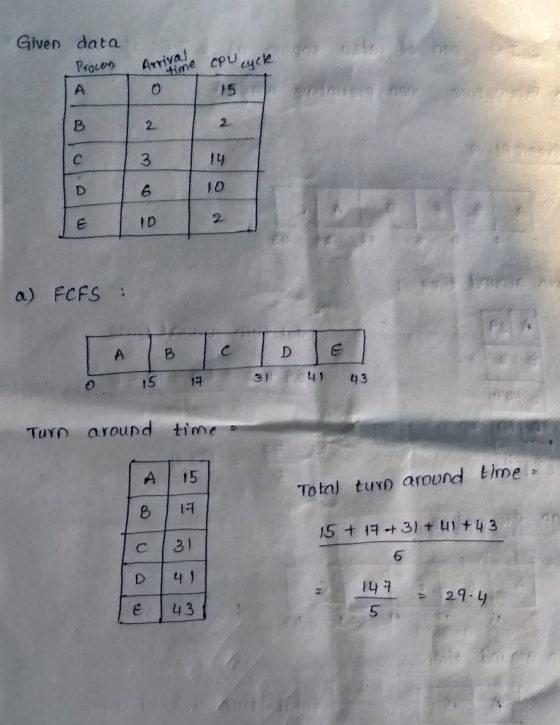
5. [27pts.] Given the following set of processes, with arrival times, priorities, and the length of...
 5. [27pts.] Given the following set of processes, with arrival times, priorities, and the length of the CPU burst in ms: Priority Burst time Arrival Time Process 3 P1 4 P2 2 10 P3 P4 (Note: a lower number means higher priority) Draw a Gantt chart showing a FCFS scheduling algorithm. a. b. Draw a Gantt chart showing a non-preemptive Priority scheduling algorithm. c. Draw a Gantt chart showing a Round Robin Scheduling algorithm with quantum of 4ms d. Compute...
Opearting system 5. [27pts.] Given the following set of processes, with arrival times, priorities, and the...
 Opearting
system
5. [27pts.] Given the following set of processes, with arrival times, priorities, and the length of the CPU burst in ms: Process Arrival Time Burst time Priority P1 P2 P3 2 10 P4 (Note: a lower number means higher priority; processes P2- P4 arrive at the same time, in the given order) a. Draw a Gantt chart showing a FCFS scheduling algorithm. b. Draw a Gantt chart showing a non-preemptive Priority scheduling algorithm. Draw a Gantt chart showing...
Opearting
system
5. [27pts.] Given the following set of processes, with arrival times, priorities, and the length of the CPU burst in ms: Process Arrival Time Burst time Priority P1 P2 P3 2 10 P4 (Note: a lower number means higher priority; processes P2- P4 arrive at the same time, in the given order) a. Draw a Gantt chart showing a FCFS scheduling algorithm. b. Draw a Gantt chart showing a non-preemptive Priority scheduling algorithm. Draw a Gantt chart showing...
Please answer the following question in C++ language Consider the following set of processes, with the...
Please answer the following question in C++ language Consider the following set of processes, with the length of the CPU burst time given in milliseconds: Process Burst Time Priority P1. 7 5 P2 2 4 P3 11 3 P4 9 1 P5 5 3 The processes are assumed to have arrived in the order P1,P2, P3, P4, P5, all at time 0. a. Draw four Gantt charts that illustrate the execution of these processes using the following scheduling algorithms: FCFS, SJF, nonpreemptive...
Consider the following set of processes, with the length of the CPU-burst time given in milliseconds:
Consider the following set of processes, with the length of the CPU-burst time given in milliseconds:Processburst TimePriorityP1103P211P323P414P552For each of the scheduling algorithms, FCFS, Shortest-Job-First (SJF, non-preemptive), Priority (smaller priority number implies higher scheduling priority), and RR (quantum = 1) do the following.Draw a Gantt chart to show how these processes would be scheduled.Give the turnaround time (total time from the first arrival into ready state until CPU-burst is completed) of each process.Give the waiting time (total time spent in the Ready state) of each process.Give...
Consider the following set of processes, with the length of the CPU burst time given in...
Consider the following set of processes, with the length of the CPU burst time given in milliseconds: Process Burst Time Priority P1 7 5 P2 2 4 P3 11 3 P4 9 1 P5 5 3 The processes are assumed to have arrived in the order P1,P2, P3, P4, P5, all at time 0. Draw four Gantt charts that illustrate the execution of these processes using the following scheduling algorithms: FCFS, SJF, nonpreemptive priority (a smaller priority number implies a higher priority), and RR (quantum = 2). * Please provide a chart...
(30 points) Assume you have three processes with the following attributes running on a single CPU...
 (30 points) Assume you have three processes with the following attributes running on a single CPU (uniprocessor system): Process 1/0 Burst Total CPU Time Arrival Time CPU Burst | 05 22 12 B 7 10 C D Create three scheduling simulations for these processes using the following algorithms: a. First Come First Served (FCFS) b. Round Robin, Time Slice = 2 c. Shortest Job (CPU Burst Time) First with NO Preemption Use the simulation format we covered in class to...
The question is this. there is nothing given [8 What is the waiting time of each...
 The
question is this. there is nothing given
[8 What is the waiting time of each process for each of the scheduling algorithms? Marks] Job Arrival Time Size (msec) P1 0 9 Priority 3 (Silver) 1 (Diamond) 3 (Silver) P2 3 P3 3 3 P4 6 5 4 (Bronze) 2 (Gold) P5 7 4 (a) First-Come-First-Served (FCFS) scheduling (b) Preemptive PRIORITY scheduling (c) Non-preemptive PRIORITY scheduling (d) Round Robin (RR) (quantum = 3) scheduling
The
question is this. there is nothing given
[8 What is the waiting time of each process for each of the scheduling algorithms? Marks] Job Arrival Time Size (msec) P1 0 9 Priority 3 (Silver) 1 (Diamond) 3 (Silver) P2 3 P3 3 3 P4 6 5 4 (Bronze) 2 (Gold) P5 7 4 (a) First-Come-First-Served (FCFS) scheduling (b) Preemptive PRIORITY scheduling (c) Non-preemptive PRIORITY scheduling (d) Round Robin (RR) (quantum = 3) scheduling
Consider a system running 200 I/O-bound jobs and 10 CPU-bound job. Assume that the I/O-bound jobs...
Consider a system running 200 I/O-bound jobs and 10 CPU-bound job. Assume that the I/O-bound jobs issue an I/O operation once for every millisecond of CPU computing and that each I/O operation takes 10 milliseconds to complete. Also assume that the context switching overhead is 0.1millisecond and that all processes are long-running tasks. What percentage of CPU time is wasted in context switch for a round-robin scheduler when: (a) The time quantum is 1 milliseconds (b) The time quantum is...
a-) Draw the gantt chart and computecpu waiting time using preeptive-priority algorithm for the cpu I/O...
 a-) Draw the gantt chart and
computecpu waiting time using preeptive-priority algorithm for the
cpu I/O device is using FCFS. Compute cpu utilization as well.
b-) Draw the gantt chart and compute cpu waiting time using
round-robin algorithm for the cpu where quantum is 3 milli seconds.
Compute cpu utilization as well.
comp 214 2019/2020 Summer School Assignment 1 Priority Arrival Time 4 cpu 12 cpu 6. 3 3 P2 2 4 2 4 loane P3 4 ㅋ 8 6...
a-) Draw the gantt chart and
computecpu waiting time using preeptive-priority algorithm for the
cpu I/O device is using FCFS. Compute cpu utilization as well.
b-) Draw the gantt chart and compute cpu waiting time using
round-robin algorithm for the cpu where quantum is 3 milli seconds.
Compute cpu utilization as well.
comp 214 2019/2020 Summer School Assignment 1 Priority Arrival Time 4 cpu 12 cpu 6. 3 3 P2 2 4 2 4 loane P3 4 ㅋ 8 6...
Given the following set of processes with corresponding execution times (in ms), arrival times and priority...
Given the following set of processes with corresponding execution times (in ms), arrival times and priority (1 – highest). For each scheduling algorithm: Construct a table showing which process is active and for how long until all processes are completely serviced (as done in class). Calculate the average waiting time and turnaround time. Process ID Burst (ms) Arrival time P1 9 0 P2 12 0 P3 3 0 P4 30 0 P5 20 0 P6 10 0 First Come First Serve...
 5. [27pts.] Given the following set of processes, with arrival times, priorities, and the length of the CPU burst in ms: Priority Burst time Arrival Time Process 3 P1 4 P2 2 10 P3 P4 (Note: a lower number means higher priority) Draw a Gantt chart showing a FCFS scheduling algorithm. a. b. Draw a Gantt chart showing a non-preemptive Priority scheduling algorithm. c. Draw a Gantt chart showing a Round Robin Scheduling algorithm with quantum of 4ms d. Compute...
 Opearting
system
5. [27pts.] Given the following set of processes, with arrival times, priorities, and the length of the CPU burst in ms: Process Arrival Time Burst time Priority P1 P2 P3 2 10 P4 (Note: a lower number means higher priority; processes P2- P4 arrive at the same time, in the given order) a. Draw a Gantt chart showing a FCFS scheduling algorithm. b. Draw a Gantt chart showing a non-preemptive Priority scheduling algorithm. Draw a Gantt chart showing...
Opearting
system
5. [27pts.] Given the following set of processes, with arrival times, priorities, and the length of the CPU burst in ms: Process Arrival Time Burst time Priority P1 P2 P3 2 10 P4 (Note: a lower number means higher priority; processes P2- P4 arrive at the same time, in the given order) a. Draw a Gantt chart showing a FCFS scheduling algorithm. b. Draw a Gantt chart showing a non-preemptive Priority scheduling algorithm. Draw a Gantt chart showing...
 (30 points) Assume you have three processes with the following attributes running on a single CPU (uniprocessor system): Process 1/0 Burst Total CPU Time Arrival Time CPU Burst | 05 22 12 B 7 10 C D Create three scheduling simulations for these processes using the following algorithms: a. First Come First Served (FCFS) b. Round Robin, Time Slice = 2 c. Shortest Job (CPU Burst Time) First with NO Preemption Use the simulation format we covered in class to...
 The
question is this. there is nothing given
[8 What is the waiting time of each process for each of the scheduling algorithms? Marks] Job Arrival Time Size (msec) P1 0 9 Priority 3 (Silver) 1 (Diamond) 3 (Silver) P2 3 P3 3 3 P4 6 5 4 (Bronze) 2 (Gold) P5 7 4 (a) First-Come-First-Served (FCFS) scheduling (b) Preemptive PRIORITY scheduling (c) Non-preemptive PRIORITY scheduling (d) Round Robin (RR) (quantum = 3) scheduling
The
question is this. there is nothing given
[8 What is the waiting time of each process for each of the scheduling algorithms? Marks] Job Arrival Time Size (msec) P1 0 9 Priority 3 (Silver) 1 (Diamond) 3 (Silver) P2 3 P3 3 3 P4 6 5 4 (Bronze) 2 (Gold) P5 7 4 (a) First-Come-First-Served (FCFS) scheduling (b) Preemptive PRIORITY scheduling (c) Non-preemptive PRIORITY scheduling (d) Round Robin (RR) (quantum = 3) scheduling
 a-) Draw the gantt chart and
computecpu waiting time using preeptive-priority algorithm for the
cpu I/O device is using FCFS. Compute cpu utilization as well.
b-) Draw the gantt chart and compute cpu waiting time using
round-robin algorithm for the cpu where quantum is 3 milli seconds.
Compute cpu utilization as well.
comp 214 2019/2020 Summer School Assignment 1 Priority Arrival Time 4 cpu 12 cpu 6. 3 3 P2 2 4 2 4 loane P3 4 ㅋ 8 6...
a-) Draw the gantt chart and
computecpu waiting time using preeptive-priority algorithm for the
cpu I/O device is using FCFS. Compute cpu utilization as well.
b-) Draw the gantt chart and compute cpu waiting time using
round-robin algorithm for the cpu where quantum is 3 milli seconds.
Compute cpu utilization as well.
comp 214 2019/2020 Summer School Assignment 1 Priority Arrival Time 4 cpu 12 cpu 6. 3 3 P2 2 4 2 4 loane P3 4 ㅋ 8 6...
Most questions answered within 3 hours.
-
Where is the error in this code sequence?
String s1 = "Hello";
String s2 = "ello";...
asked 10 months ago -
Financial data for Joel de Paris, Inc., for last year
follow:
Joel de Paris, Inc.
Balance...
asked 10 months ago -
Consider this reaction:
Al2(SO4)3 (aq)+ BaCl3
(aq) Al2Cl6 (aq)- +
3BaSO4(s) . What is the...
asked 10 months ago -
Suppose that Savneet is considering increasing her
recent random sample from 20 car rentals to 40...
asked 10 months ago -
Trucks arrive at an unloading terminal at an average rate of 120
per hour.
Trucks arrive...
asked 10 months ago -
Why are methanol and ethanol completely soluble in water while
octanol is not very little soluble....
asked 10 months ago -
A facilities manager at a university reads in a research report
that the mean amount of...
asked 10 months ago -
When the CuSO4 is rehydrated by adding water to the anhydrous
compound, is this an endothermic...
asked 10 months ago -
A ray of sunlight is passing from diamond into crown glass; the
angle of incidence is...
asked 10 months ago -
A block of mass 0.249 kg is placed on top of a light, vertical
spring of...
asked 10 months ago -
how do the kidneys compensate in the presences of acidosis
a) trigger hyperventilate
b) reserve acid...
asked 10 months ago -
Question 501 pts
The rental rate of capital to the firm increases. Which of the
following...
asked 10 months ago