how is it possible to obtain a major enantiomer and a minor enantiomer from a reaction...
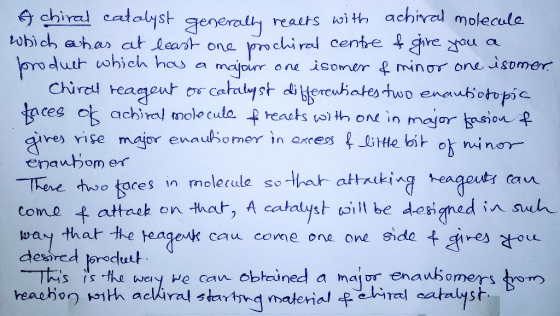
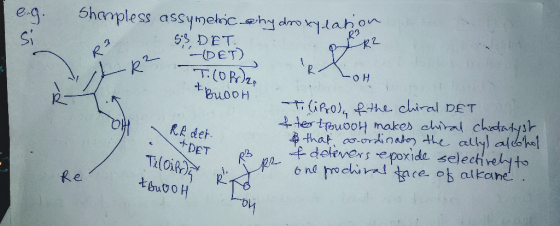
how is it possible to obtain a major enantiomer and a minor enantiomer from a reaction with an achiral starting material and a chiral catalyst?
Homework Answers
Add Answer to:
how is it possible to obtain a major enantiomer and a
minor enantiomer from a reaction...
1. Draw the two stereoisomeric products from the following reaction, which uses a single enantiomer (i.e....
 1. Draw the two stereoisomeric products from the following
reaction, which uses a single enantiomer (i.e. optically active
compound) as the starting material.
2. Write a detailed reaction mechanism for the reaction.
3. Determine the R/S configuration for the original chiral
center and any new chiral centers formed in the reaction.
4. Comment upon whether a 1:1 mixture of the two compounds in
part 1 would be optically active.
CIH HBr
1. Draw the two stereoisomeric products from the following
reaction, which uses a single enantiomer (i.e. optically active
compound) as the starting material.
2. Write a detailed reaction mechanism for the reaction.
3. Determine the R/S configuration for the original chiral
center and any new chiral centers formed in the reaction.
4. Comment upon whether a 1:1 mixture of the two compounds in
part 1 would be optically active.
CIH HBr
Please explain how you got the answers as well. Name 3. Reactions a) Three isomers with...
 Please explain how you got the answers as well.
Name 3. Reactions a) Three isomers with the formula CsHnBr are found in bottles labeled A, B, C. How many degrees of unsaturation are in a molecule with the formula CsHnBr Degrees of unsaturation b) The compounds in bottle A, B and C rotate the plane of polarized light (are chiral). Use the following reactions to identify A-C and the products formed in the rxns. Note: There are 11 isomers including...
Please explain how you got the answers as well.
Name 3. Reactions a) Three isomers with the formula CsHnBr are found in bottles labeled A, B, C. How many degrees of unsaturation are in a molecule with the formula CsHnBr Degrees of unsaturation b) The compounds in bottle A, B and C rotate the plane of polarized light (are chiral). Use the following reactions to identify A-C and the products formed in the rxns. Note: There are 11 isomers including...
please explain why this is achiral and not chiral. 1 (4 pts). Draw the expected major...
 please explain why this is achiral and not chiral.
1 (4 pts). Draw the expected major product from the following reaction by placing appropriate groups (H, Br, CH3 on the scaffold). Circle whether the product is achiral or chiral. CH3 CH3 Br2 Br H₃C CH3 Br chiral or achiral a How is it achiral?
please explain why this is achiral and not chiral.
1 (4 pts). Draw the expected major product from the following reaction by placing appropriate groups (H, Br, CH3 on the scaffold). Circle whether the product is achiral or chiral. CH3 CH3 Br2 Br H₃C CH3 Br chiral or achiral a How is it achiral?
which ones are major and minor? In the given reaction, predict the major and minor products. CH,CH, OH major and min...
 which ones are major and minor?
In the given reaction, predict the major and minor products. CH,CH, OH major and minor products
which ones are major and minor?
In the given reaction, predict the major and minor products. CH,CH, OH major and minor products
Draw the major and minor product(s) that are expected for the following reaction
 Question 32 Draw the major and minor product(s) that are expected for the following reaction. If only one product is formed, draw it as the major product, and select no reaction for the minor product. Draw all of the minor products if more than one will form in the following reaction. Draw the major product:Draw the minor product(s):Question 31 Draw the major and minor product(s) that are expected for the following reaction. If only one product is formed, draw it as the major...
UCLEIC VIIICILIUUULLIS IULICU UUII LIUIUNTA LIUIUISLIUCIC. PLS a. Four possible products from the bromination of trans-stilbene...
 UCLEIC VIIICILIUUULLIS IULICU UUII LIUIUNTA LIUIUISLIUCIC. PLS a. Four possible products from the bromination of trans-stilbene are shown below. Label the chiral centers as Sor R. Ph HBr Br Ph phir H Br Ph Br Phuph Br Ph BrH b. The enantiomer of structure A is: C. The enantiomer of structure Dis: d. List the letters corresponding to the meso structures, if any:_ e. Which structures, if any, are chiral molecules:___ f. Which structures, if any, are achiral molecules:
How do you find the major and minor product of a reaction? Please provide examples
How do you find the major and minor product of a reaction? Please provide examples
For the following reaction, the major product will be different based on the solvent (CCla or...
 For the following reaction, the major product will be different based on the solvent (CCla or CH OH). Draw the major product (only draw one enantiomer) for each reaction below. Be sure to show stereochemistry Br2 CCl Br2 CH3OH Part 1 (1 point) Please draw all four bonds at chiral centers Draw the product of the reaction when CCl4 is the solvent. Draw only one enantiomer dai See Periodi Part 2 (1 point) Please draw all four bonds at chiral...
Draw the structure of the major aldol product (prior to possible dehydration) of the following reaction....
 Draw the structure of the major aldol product (prior to possible dehydration) of the following reaction. You do not have to consider stereochemistry. If no reaction occurs, draw the organic starting material.
4. Chiral catalysts can be designed to favor the formation of one enantiomer over another in...
 4. Chiral catalysts can be designed to favor the formation of one enantiomer over another in reactions where a new chiral center is formed. The example shown below was recently reported in the chemical literature (J. Am. Chem. Soc. 2012, 134, 8054-8057) where a new type of chiral copper (Cu) catalyst was developed. When the Cu' catalyst was used, the (S)-enantiomer of the product predominated, and the (R)-enantiomer of the product was selectively formed when Cu" catalyst was used instead....
 1. Draw the two stereoisomeric products from the following
reaction, which uses a single enantiomer (i.e. optically active
compound) as the starting material.
2. Write a detailed reaction mechanism for the reaction.
3. Determine the R/S configuration for the original chiral
center and any new chiral centers formed in the reaction.
4. Comment upon whether a 1:1 mixture of the two compounds in
part 1 would be optically active.
CIH HBr
1. Draw the two stereoisomeric products from the following
reaction, which uses a single enantiomer (i.e. optically active
compound) as the starting material.
2. Write a detailed reaction mechanism for the reaction.
3. Determine the R/S configuration for the original chiral
center and any new chiral centers formed in the reaction.
4. Comment upon whether a 1:1 mixture of the two compounds in
part 1 would be optically active.
CIH HBr
 Please explain how you got the answers as well.
Name 3. Reactions a) Three isomers with the formula CsHnBr are found in bottles labeled A, B, C. How many degrees of unsaturation are in a molecule with the formula CsHnBr Degrees of unsaturation b) The compounds in bottle A, B and C rotate the plane of polarized light (are chiral). Use the following reactions to identify A-C and the products formed in the rxns. Note: There are 11 isomers including...
Please explain how you got the answers as well.
Name 3. Reactions a) Three isomers with the formula CsHnBr are found in bottles labeled A, B, C. How many degrees of unsaturation are in a molecule with the formula CsHnBr Degrees of unsaturation b) The compounds in bottle A, B and C rotate the plane of polarized light (are chiral). Use the following reactions to identify A-C and the products formed in the rxns. Note: There are 11 isomers including...
 please explain why this is achiral and not chiral.
1 (4 pts). Draw the expected major product from the following reaction by placing appropriate groups (H, Br, CH3 on the scaffold). Circle whether the product is achiral or chiral. CH3 CH3 Br2 Br H₃C CH3 Br chiral or achiral a How is it achiral?
please explain why this is achiral and not chiral.
1 (4 pts). Draw the expected major product from the following reaction by placing appropriate groups (H, Br, CH3 on the scaffold). Circle whether the product is achiral or chiral. CH3 CH3 Br2 Br H₃C CH3 Br chiral or achiral a How is it achiral?
 which ones are major and minor?
In the given reaction, predict the major and minor products. CH,CH, OH major and minor products
which ones are major and minor?
In the given reaction, predict the major and minor products. CH,CH, OH major and minor products
 UCLEIC VIIICILIUUULLIS IULICU UUII LIUIUNTA LIUIUISLIUCIC. PLS a. Four possible products from the bromination of trans-stilbene are shown below. Label the chiral centers as Sor R. Ph HBr Br Ph phir H Br Ph Br Phuph Br Ph BrH b. The enantiomer of structure A is: C. The enantiomer of structure Dis: d. List the letters corresponding to the meso structures, if any:_ e. Which structures, if any, are chiral molecules:___ f. Which structures, if any, are achiral molecules:
 For the following reaction, the major product will be different based on the solvent (CCla or CH OH). Draw the major product (only draw one enantiomer) for each reaction below. Be sure to show stereochemistry Br2 CCl Br2 CH3OH Part 1 (1 point) Please draw all four bonds at chiral centers Draw the product of the reaction when CCl4 is the solvent. Draw only one enantiomer dai See Periodi Part 2 (1 point) Please draw all four bonds at chiral...
 Draw the structure of the major aldol product (prior to possible dehydration) of the following reaction. You do not have to consider stereochemistry. If no reaction occurs, draw the organic starting material.
 4. Chiral catalysts can be designed to favor the formation of one enantiomer over another in reactions where a new chiral center is formed. The example shown below was recently reported in the chemical literature (J. Am. Chem. Soc. 2012, 134, 8054-8057) where a new type of chiral copper (Cu) catalyst was developed. When the Cu' catalyst was used, the (S)-enantiomer of the product predominated, and the (R)-enantiomer of the product was selectively formed when Cu" catalyst was used instead....
Most questions answered within 3 hours.
-
Where is the error in this code sequence?
String s1 = "Hello";
String s2 = "ello";...
asked 11 months ago -
Financial data for Joel de Paris, Inc., for last year
follow:
Joel de Paris, Inc.
Balance...
asked 11 months ago -
Consider this reaction:
Al2(SO4)3 (aq)+ BaCl3
(aq) Al2Cl6 (aq)- +
3BaSO4(s) . What is the...
asked 11 months ago -
Suppose that Savneet is considering increasing her
recent random sample from 20 car rentals to 40...
asked 11 months ago -
Trucks arrive at an unloading terminal at an average rate of 120
per hour.
Trucks arrive...
asked 11 months ago -
Why are methanol and ethanol completely soluble in water while
octanol is not very little soluble....
asked 11 months ago -
A facilities manager at a university reads in a research report
that the mean amount of...
asked 11 months ago -
When the CuSO4 is rehydrated by adding water to the anhydrous
compound, is this an endothermic...
asked 11 months ago -
A ray of sunlight is passing from diamond into crown glass; the
angle of incidence is...
asked 11 months ago -
A block of mass 0.249 kg is placed on top of a light, vertical
spring of...
asked 11 months ago -
how do the kidneys compensate in the presences of acidosis
a) trigger hyperventilate
b) reserve acid...
asked 11 months ago -
Question 501 pts
The rental rate of capital to the firm increases. Which of the
following...
asked 11 months ago