

Homework Answers
(a)
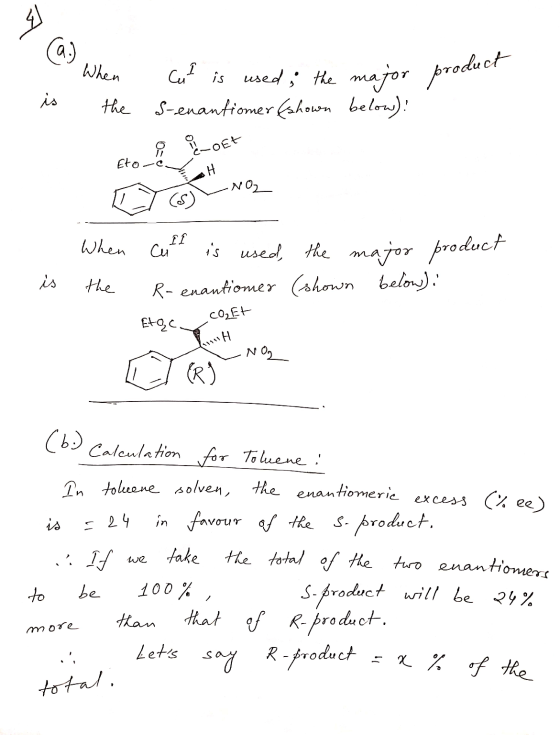
 Therfore,
% R = x = 38 % (See picture above)
% S = (100-38) % = 62 %
Similar calculations for the other solvent would yield the following data (shown in table):
| Solvent | % ee of (S)-product | % Yield of total product | % S | % R |
| Toluene | 24 | 55 | 62 | 38 |
| THF | 48 | 33 | 74 | 26 |
| Acetonitrile | 72 | 55 | 86 | 14 |
| Chloroform | 30 | 40 | 65 | 35 |
| Dichloromethane | 46 | 44 | 73 | 27 |
| Hexane | 51 | 30 | 75.5 | 24.5 |
# The solvent, Acetonitrile, gives the optimal results in terms both the enantiselectivity (highest percentage of S-product formed= 86%) and overall product yield (highest % of total product = 55%).
Note: Here, toluene has the same % yield of total product but its enantioselectivity is very poor at just 62% (least among the solvents).
# The solvent that performed the worst is hexane because if we take 75.5 % of the total yield of just 30 % which is 22.65% S-product. This is the least among all the solvents. Therefore, both the enantioselectivity towards the S-product and the overall yield is the poorest in hexane.
Add Answer to:
4. Chiral catalysts can be designed to favor the formation of one enantiomer over another in...
Chiral catalysts can be designed to favor the formation of one enantiomer over another in reactions...
 Chiral catalysts can be designed to favor the formation of one enantiomer over another in reactions where a new chiral center is formed. The example shown below was recently reported in the chemical literature (J. Am. Chem. Soc. 2012. 134, 8054 8057) where a new type of chiral copper (Cu) catalyst was developed. When the Cul catalyst was used, the (S)-enantiomer of the product predominated, and the (R)-enantiomer of the product was selectively formed when Cu" catalyst was used instead....
Please help with pre-lab questions. Pre-Lab Questions: 1. A sample of 2-butanol has a specific rotation...
 Please help with pre-lab questions.
Pre-Lab Questions: 1. A sample of 2-butanol has a specific rotation of +3.25. Determine the optical purity (%ee) and percent composition of this sample (see Mohrig section 17.4). The specific rotation of pure (+)-2-butanol is +13.0°. 2. The equation for the formation of the diastereomeric salts is shown in the background information (performed in Part A of the procedure). Write this chemical equation in your notebook, then ALSO write a balanced equation for the formation...
Please help with pre-lab questions.
Pre-Lab Questions: 1. A sample of 2-butanol has a specific rotation of +3.25. Determine the optical purity (%ee) and percent composition of this sample (see Mohrig section 17.4). The specific rotation of pure (+)-2-butanol is +13.0°. 2. The equation for the formation of the diastereomeric salts is shown in the background information (performed in Part A of the procedure). Write this chemical equation in your notebook, then ALSO write a balanced equation for the formation...
with the information and tables provided, can you help me answer questions 2,3,4,and 5? thank you!...
 with the information and tables provided, can you help me
answer questions 2,3,4,and 5? thank you!
DATA ANALYSIS - ONLINE SIMULATION DATA Record your collected data here. Black Red E (V) Cu Zn -1.10 Cu Sn -0.48 Cu Mg -2.71 Cu Ag 0.46 QUALITY OF DATA This section awards marks based on the quality of your Ell values. Quality of data Your standard cell potentials are in the expected order. EXPECTED DATA The expected data is given below. Use the...
with the information and tables provided, can you help me
answer questions 2,3,4,and 5? thank you!
DATA ANALYSIS - ONLINE SIMULATION DATA Record your collected data here. Black Red E (V) Cu Zn -1.10 Cu Sn -0.48 Cu Mg -2.71 Cu Ag 0.46 QUALITY OF DATA This section awards marks based on the quality of your Ell values. Quality of data Your standard cell potentials are in the expected order. EXPECTED DATA The expected data is given below. Use the...
Based on the Wittig Reaction exp. below, please answer a) and b). In b) you can...
 Based on the Wittig Reaction exp. below, please answer a) and
b). In b) you can disregard the part about the IR, just please
interpret and assign protons, shift values, which protons are for
which groups, etc on the HNMR. The % yield was 34%, and MP was
lower than expected (to assist with answering part a). This should
be all the information you need to answer the question.
HNMR
Discuss the percentage yield of the reaction. Explain and provide...
Based on the Wittig Reaction exp. below, please answer a) and
b). In b) you can disregard the part about the IR, just please
interpret and assign protons, shift values, which protons are for
which groups, etc on the HNMR. The % yield was 34%, and MP was
lower than expected (to assist with answering part a). This should
be all the information you need to answer the question.
HNMR
Discuss the percentage yield of the reaction. Explain and provide...
please help me with questions from 3-10! and the bonus. thank you so much Directions: Place...
 please help me with questions from 3-10! and the bonus.
thank you so much
Directions: Place your answers to the following questions in the provided spaces. (12 PTS) 1. What is the hybridization of the carbon atoms numbered 1 and 2 respectively in the following structure? -CU CECH A. B sp,sp? sp, sp sp, sp sp', sp sp, sp Ans. 2. What is the IUPAC name for the molecule shown below? os B. C. D. E. (E)-5-methyl-5-hepten-1-yne (2)-5-methyl-5-hepten-1-yne (E)-3-methyl-2-hepten-6-yne (2)-3-methyl-2-hepten-6-yne...
please help me with questions from 3-10! and the bonus.
thank you so much
Directions: Place your answers to the following questions in the provided spaces. (12 PTS) 1. What is the hybridization of the carbon atoms numbered 1 and 2 respectively in the following structure? -CU CECH A. B sp,sp? sp, sp sp, sp sp', sp sp, sp Ans. 2. What is the IUPAC name for the molecule shown below? os B. C. D. E. (E)-5-methyl-5-hepten-1-yne (2)-5-methyl-5-hepten-1-yne (E)-3-methyl-2-hepten-6-yne (2)-3-methyl-2-hepten-6-yne...
5) Rationalizing the stereochemical outc ome of this reaction requires an understanding of the f borohydride...
 5) Rationalizing the stereochemical outc ome of this reaction
requires an understanding of the f borohydride borohydride lcohol.
An three-dimensional structure of benzoin and the general reaction
mechanism o reductions. As shown previously (10-1), the usual mode
of activation tor reduction occurs via an intermolecular H-bond
between the carbonyl group and an a intramolecular H-bond can
stabilize the lowest-energy conformation of benzoin (pre and serve
to activate the carbonyl for reduction, thus generating the
lowest-energyt state. a) Draw the lowest-energy,...
5) Rationalizing the stereochemical outc ome of this reaction
requires an understanding of the f borohydride borohydride lcohol.
An three-dimensional structure of benzoin and the general reaction
mechanism o reductions. As shown previously (10-1), the usual mode
of activation tor reduction occurs via an intermolecular H-bond
between the carbonyl group and an a intramolecular H-bond can
stabilize the lowest-energy conformation of benzoin (pre and serve
to activate the carbonyl for reduction, thus generating the
lowest-energyt state. a) Draw the lowest-energy,...
please help me with Organic Chemistry/Alkynes. Thank you! Directions: Place your answers to the following questio...
 please help me with Organic Chemistry/Alkynes. Thank you!
Directions: Place your answers to the following questions in the provided spaces. (12 PTS) 1. What is the hybridization of the carbon atoms numbered 1 and 2 respectively in the following structure? -CI CECH A. B sp,sp? sp?sp? sp, sp sp, sp sp, sp E. Ans. - 2. What is the IUPAC name for the molecule shown below? 6b А. B. (E)-5-methyl-5-hepten-1-yne (2)-5-methyl-5-hepten-1-yne (E)-3-methyl-2-hepten-6-yne (2)-3-methyl-2-hepten-6-yne (E)-2-butynyl-2-butene E. Ans. Select the best explanation...
please help me with Organic Chemistry/Alkynes. Thank you!
Directions: Place your answers to the following questions in the provided spaces. (12 PTS) 1. What is the hybridization of the carbon atoms numbered 1 and 2 respectively in the following structure? -CI CECH A. B sp,sp? sp?sp? sp, sp sp, sp sp, sp E. Ans. - 2. What is the IUPAC name for the molecule shown below? 6b А. B. (E)-5-methyl-5-hepten-1-yne (2)-5-methyl-5-hepten-1-yne (E)-3-methyl-2-hepten-6-yne (2)-3-methyl-2-hepten-6-yne (E)-2-butynyl-2-butene E. Ans. Select the best explanation...
Experiment Write Up Proposal You will write up a synthesis procedure for one reaction that could...
 Experiment Write Up Proposal You will write up a synthesis procedure for one reaction that could be potentially run in a face- to-face Chem 2321 lab session. Your proposal will include an introduction and procedure. The procedure will include step-by-step instructions for running the reaction (including reaction monitoring), work-up. (product isolation and purification), and analysis (characterization). You will need to include sample calculations for percent yield and provide sample spectra analysis. You must upload your proposal as a single document...
Need help, numbers 3-6 please show work. and fill out table of chemicals for all chemical...
 Need help, numbers 3-6 please show work. and fill out table of
chemicals for all chemical used.
calculate mmol in the table as well show work please
and each of these must be listed in its own row. There are 10 column headings: IUPAC name OR common name, structure, CAS number (Chemical Abstract Service number) molecular mass, melting point (if applicable), boiling point (if applicable), solubility (in water, if applicable), density, amounts to be used in the experiment, and the...
Need help, numbers 3-6 please show work. and fill out table of
chemicals for all chemical used.
calculate mmol in the table as well show work please
and each of these must be listed in its own row. There are 10 column headings: IUPAC name OR common name, structure, CAS number (Chemical Abstract Service number) molecular mass, melting point (if applicable), boiling point (if applicable), solubility (in water, if applicable), density, amounts to be used in the experiment, and the...
please help answer question 4, a-f please using the data below from chart 1 objectives from...
 please help answer question 4, a-f please
using the data below from chart 1
objectives from lab, thank you
DATA:CA y 3 Ay No3 Part I: Cell Potential of voltaic cells under standard conditions: cell CU CND2 #27 14.0m Give the half Half cell reaction at Combinations Oxidation Reduction E the anode and with [ion] takes place Theoretical takes place cathode. Write in M here here (V) above the arrow E c (V) if it is oxidation or reduction. |-0.340...
please help answer question 4, a-f please
using the data below from chart 1
objectives from lab, thank you
DATA:CA y 3 Ay No3 Part I: Cell Potential of voltaic cells under standard conditions: cell CU CND2 #27 14.0m Give the half Half cell reaction at Combinations Oxidation Reduction E the anode and with [ion] takes place Theoretical takes place cathode. Write in M here here (V) above the arrow E c (V) if it is oxidation or reduction. |-0.340...
 Chiral catalysts can be designed to favor the formation of one enantiomer over another in reactions where a new chiral center is formed. The example shown below was recently reported in the chemical literature (J. Am. Chem. Soc. 2012. 134, 8054 8057) where a new type of chiral copper (Cu) catalyst was developed. When the Cul catalyst was used, the (S)-enantiomer of the product predominated, and the (R)-enantiomer of the product was selectively formed when Cu" catalyst was used instead....
 Please help with pre-lab questions.
Pre-Lab Questions: 1. A sample of 2-butanol has a specific rotation of +3.25. Determine the optical purity (%ee) and percent composition of this sample (see Mohrig section 17.4). The specific rotation of pure (+)-2-butanol is +13.0°. 2. The equation for the formation of the diastereomeric salts is shown in the background information (performed in Part A of the procedure). Write this chemical equation in your notebook, then ALSO write a balanced equation for the formation...
Please help with pre-lab questions.
Pre-Lab Questions: 1. A sample of 2-butanol has a specific rotation of +3.25. Determine the optical purity (%ee) and percent composition of this sample (see Mohrig section 17.4). The specific rotation of pure (+)-2-butanol is +13.0°. 2. The equation for the formation of the diastereomeric salts is shown in the background information (performed in Part A of the procedure). Write this chemical equation in your notebook, then ALSO write a balanced equation for the formation...
 with the information and tables provided, can you help me
answer questions 2,3,4,and 5? thank you!
DATA ANALYSIS - ONLINE SIMULATION DATA Record your collected data here. Black Red E (V) Cu Zn -1.10 Cu Sn -0.48 Cu Mg -2.71 Cu Ag 0.46 QUALITY OF DATA This section awards marks based on the quality of your Ell values. Quality of data Your standard cell potentials are in the expected order. EXPECTED DATA The expected data is given below. Use the...
with the information and tables provided, can you help me
answer questions 2,3,4,and 5? thank you!
DATA ANALYSIS - ONLINE SIMULATION DATA Record your collected data here. Black Red E (V) Cu Zn -1.10 Cu Sn -0.48 Cu Mg -2.71 Cu Ag 0.46 QUALITY OF DATA This section awards marks based on the quality of your Ell values. Quality of data Your standard cell potentials are in the expected order. EXPECTED DATA The expected data is given below. Use the...
 Based on the Wittig Reaction exp. below, please answer a) and
b). In b) you can disregard the part about the IR, just please
interpret and assign protons, shift values, which protons are for
which groups, etc on the HNMR. The % yield was 34%, and MP was
lower than expected (to assist with answering part a). This should
be all the information you need to answer the question.
HNMR
Discuss the percentage yield of the reaction. Explain and provide...
Based on the Wittig Reaction exp. below, please answer a) and
b). In b) you can disregard the part about the IR, just please
interpret and assign protons, shift values, which protons are for
which groups, etc on the HNMR. The % yield was 34%, and MP was
lower than expected (to assist with answering part a). This should
be all the information you need to answer the question.
HNMR
Discuss the percentage yield of the reaction. Explain and provide...
 please help me with questions from 3-10! and the bonus.
thank you so much
Directions: Place your answers to the following questions in the provided spaces. (12 PTS) 1. What is the hybridization of the carbon atoms numbered 1 and 2 respectively in the following structure? -CU CECH A. B sp,sp? sp, sp sp, sp sp', sp sp, sp Ans. 2. What is the IUPAC name for the molecule shown below? os B. C. D. E. (E)-5-methyl-5-hepten-1-yne (2)-5-methyl-5-hepten-1-yne (E)-3-methyl-2-hepten-6-yne (2)-3-methyl-2-hepten-6-yne...
please help me with questions from 3-10! and the bonus.
thank you so much
Directions: Place your answers to the following questions in the provided spaces. (12 PTS) 1. What is the hybridization of the carbon atoms numbered 1 and 2 respectively in the following structure? -CU CECH A. B sp,sp? sp, sp sp, sp sp', sp sp, sp Ans. 2. What is the IUPAC name for the molecule shown below? os B. C. D. E. (E)-5-methyl-5-hepten-1-yne (2)-5-methyl-5-hepten-1-yne (E)-3-methyl-2-hepten-6-yne (2)-3-methyl-2-hepten-6-yne...
 5) Rationalizing the stereochemical outc ome of this reaction
requires an understanding of the f borohydride borohydride lcohol.
An three-dimensional structure of benzoin and the general reaction
mechanism o reductions. As shown previously (10-1), the usual mode
of activation tor reduction occurs via an intermolecular H-bond
between the carbonyl group and an a intramolecular H-bond can
stabilize the lowest-energy conformation of benzoin (pre and serve
to activate the carbonyl for reduction, thus generating the
lowest-energyt state. a) Draw the lowest-energy,...
5) Rationalizing the stereochemical outc ome of this reaction
requires an understanding of the f borohydride borohydride lcohol.
An three-dimensional structure of benzoin and the general reaction
mechanism o reductions. As shown previously (10-1), the usual mode
of activation tor reduction occurs via an intermolecular H-bond
between the carbonyl group and an a intramolecular H-bond can
stabilize the lowest-energy conformation of benzoin (pre and serve
to activate the carbonyl for reduction, thus generating the
lowest-energyt state. a) Draw the lowest-energy,...
 please help me with Organic Chemistry/Alkynes. Thank you!
Directions: Place your answers to the following questions in the provided spaces. (12 PTS) 1. What is the hybridization of the carbon atoms numbered 1 and 2 respectively in the following structure? -CI CECH A. B sp,sp? sp?sp? sp, sp sp, sp sp, sp E. Ans. - 2. What is the IUPAC name for the molecule shown below? 6b А. B. (E)-5-methyl-5-hepten-1-yne (2)-5-methyl-5-hepten-1-yne (E)-3-methyl-2-hepten-6-yne (2)-3-methyl-2-hepten-6-yne (E)-2-butynyl-2-butene E. Ans. Select the best explanation...
please help me with Organic Chemistry/Alkynes. Thank you!
Directions: Place your answers to the following questions in the provided spaces. (12 PTS) 1. What is the hybridization of the carbon atoms numbered 1 and 2 respectively in the following structure? -CI CECH A. B sp,sp? sp?sp? sp, sp sp, sp sp, sp E. Ans. - 2. What is the IUPAC name for the molecule shown below? 6b А. B. (E)-5-methyl-5-hepten-1-yne (2)-5-methyl-5-hepten-1-yne (E)-3-methyl-2-hepten-6-yne (2)-3-methyl-2-hepten-6-yne (E)-2-butynyl-2-butene E. Ans. Select the best explanation...
 Experiment Write Up Proposal You will write up a synthesis procedure for one reaction that could be potentially run in a face- to-face Chem 2321 lab session. Your proposal will include an introduction and procedure. The procedure will include step-by-step instructions for running the reaction (including reaction monitoring), work-up. (product isolation and purification), and analysis (characterization). You will need to include sample calculations for percent yield and provide sample spectra analysis. You must upload your proposal as a single document...
 Need help, numbers 3-6 please show work. and fill out table of
chemicals for all chemical used.
calculate mmol in the table as well show work please
and each of these must be listed in its own row. There are 10 column headings: IUPAC name OR common name, structure, CAS number (Chemical Abstract Service number) molecular mass, melting point (if applicable), boiling point (if applicable), solubility (in water, if applicable), density, amounts to be used in the experiment, and the...
Need help, numbers 3-6 please show work. and fill out table of
chemicals for all chemical used.
calculate mmol in the table as well show work please
and each of these must be listed in its own row. There are 10 column headings: IUPAC name OR common name, structure, CAS number (Chemical Abstract Service number) molecular mass, melting point (if applicable), boiling point (if applicable), solubility (in water, if applicable), density, amounts to be used in the experiment, and the...
 please help answer question 4, a-f please
using the data below from chart 1
objectives from lab, thank you
DATA:CA y 3 Ay No3 Part I: Cell Potential of voltaic cells under standard conditions: cell CU CND2 #27 14.0m Give the half Half cell reaction at Combinations Oxidation Reduction E the anode and with [ion] takes place Theoretical takes place cathode. Write in M here here (V) above the arrow E c (V) if it is oxidation or reduction. |-0.340...
please help answer question 4, a-f please
using the data below from chart 1
objectives from lab, thank you
DATA:CA y 3 Ay No3 Part I: Cell Potential of voltaic cells under standard conditions: cell CU CND2 #27 14.0m Give the half Half cell reaction at Combinations Oxidation Reduction E the anode and with [ion] takes place Theoretical takes place cathode. Write in M here here (V) above the arrow E c (V) if it is oxidation or reduction. |-0.340...
Most questions answered within 3 hours.
-
Where is the error in this code sequence?
String s1 = "Hello";
String s2 = "ello";...
asked 11 months ago -
Financial data for Joel de Paris, Inc., for last year
follow:
Joel de Paris, Inc.
Balance...
asked 11 months ago -
Consider this reaction:
Al2(SO4)3 (aq)+ BaCl3
(aq) Al2Cl6 (aq)- +
3BaSO4(s) . What is the...
asked 11 months ago -
Suppose that Savneet is considering increasing her
recent random sample from 20 car rentals to 40...
asked 11 months ago -
Trucks arrive at an unloading terminal at an average rate of 120
per hour.
Trucks arrive...
asked 11 months ago -
Why are methanol and ethanol completely soluble in water while
octanol is not very little soluble....
asked 11 months ago -
A facilities manager at a university reads in a research report
that the mean amount of...
asked 11 months ago -
When the CuSO4 is rehydrated by adding water to the anhydrous
compound, is this an endothermic...
asked 11 months ago -
A ray of sunlight is passing from diamond into crown glass; the
angle of incidence is...
asked 11 months ago -
A block of mass 0.249 kg is placed on top of a light, vertical
spring of...
asked 11 months ago -
how do the kidneys compensate in the presences of acidosis
a) trigger hyperventilate
b) reserve acid...
asked 11 months ago -
Question 501 pts
The rental rate of capital to the firm increases. Which of the
following...
asked 11 months ago