How urea and guanidine denature proteins, comment on the mechanism.
How urea and guanidine denature proteins, comment on the mechanism.
Homework Answers
Mechanism of Urea to denature proteins:
Urea denature proteins in two ways i.e. either directly or indirectly. In the case of direct denaturation, urea hydrogen bonds interacts with polarized/charged peptide groups. This direct interaction intermolecular bonds between the amino acids weakening the overall secondary and tertiary structure of protein. Upon unfolding the urea and water gets the access of the core of protein hence making the denaturation process fast. In the case of indirect interaction, the urea affects the solvents of the solution in which the protein is immersed. By making the changes in the structure and hydrodynamics of the solvent, urea encourages the solvent in destablizing the internal bonds of the protein and then accessing the protein for further denaturation.
Mechanism of Guanidine to denature proteins:
Guanidine destablizes and disrupts the alpha helix by breaking the hydrogen bonding network between water molecules adjacent to the protein. and results in disordering of the protein structure. It increases the entropy of the system by interfering with the intermolecular interactions mediated by non covalent forces such as hydrogen bonds, van der waals forces and hydrophobic interactions which are involved in maintaining the structure of a protein.
8) A buffer used to denature proteins incudes the following components: 25 mM Tris-HCI, pH 8.2...
 8) A buffer used to denature proteins incudes the following components: 25 mM Tris-HCI, pH 8.2 . 8 M urea 200 mM glycine · 10 mM β-mercaptoethanol (BME) 250 mM NaCI In the lab you have a 1 M solution of Tris buffer at pH 7.0, a bottle of BME at 14.3 M and solid urea, glycine, and NaCI. How you would prepare this buffer? Provide a step by step description of how to make this buffer with details including...
During genomic DNA isolation, we usually denature proteins using A. Phenol/chloroform B. Ethanol C. Proteinase D....
During genomic DNA isolation, we usually denature proteins using A. Phenol/chloroform B. Ethanol C. Proteinase D. Detergent
Match each type of antimicrobial agent with a mechanism of action that describes at least one...
Match each type of antimicrobial agent with a mechanism of action that describes at least one agent within the group. biocides target ergosterol synthesis nucleoside analogs targets transpeptidases in cell wall synthesis may denature proteins or dissolve membranes antifungal agents target ergosterol synthesis nucleoside analogs targets transpeptidases in cell wall synthesis may denature proteins or dissolve membranes antiviral agents...
in the plasmid isolation procedure, phenol is the main denaturant that removes proteins from the lysed...
 in
the plasmid isolation procedure, phenol is the main denaturant that
removes proteins from the lysed cells. how does phenol denature
proteins? why doesn't it denature DNA?
clue in the picture .
08. DNA and phenol are acids. Proteins are folded with many hydrogen and ionic surface bonds that phenol can attack.
in
the plasmid isolation procedure, phenol is the main denaturant that
removes proteins from the lysed cells. how does phenol denature
proteins? why doesn't it denature DNA?
clue in the picture .
08. DNA and phenol are acids. Proteins are folded with many hydrogen and ionic surface bonds that phenol can attack.
If we consume excess proteins, then: 1) nitrogen will be used to make fat 2) urea...
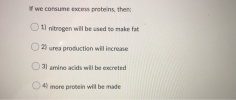 If we consume excess proteins, then: 1) nitrogen will be used to make fat 2) urea production will increase 3) amino acids will be excreted O4) more protein will be made
biochem quest. Each of the following reagents or conditions will denature a protein. For each, describe what the re...
 biochem quest.
Each of the following reagents or conditions will denature a protein. For each, describe what the reagent/condition does to interrupt the native protein structure. (a) temperature (c) detergent (d) extreme pH. Show a melting curve ofa protein - label the Tm and indicate on your graph whether the protein is found in its native structure or in a denatured state. (8 points) (b) high urea
Each of the following reagents or conditions will denature a protein. For each,...
biochem quest.
Each of the following reagents or conditions will denature a protein. For each, describe what the reagent/condition does to interrupt the native protein structure. (a) temperature (c) detergent (d) extreme pH. Show a melting curve ofa protein - label the Tm and indicate on your graph whether the protein is found in its native structure or in a denatured state. (8 points) (b) high urea
Each of the following reagents or conditions will denature a protein. For each,...
What is the mechanism for the first step of Dilantin synthesis (Benzil + Urea in the presence of NaOH)?
What is the mechanism for the first step of Dilantin synthesis (Benzil + Urea in the presence of NaOH)?
D 10. What does it mean for a protein to "denature?" The protein breaks into fatty...
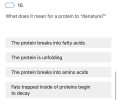 D 10. What does it mean for a protein to "denature?" The protein breaks into fatty acids The protein is unfolding The protein breaks into amino acids Fats trapped inside of proteins begin to decay
How can a highly concentrated salt denature a protein? Due to the increase in the pH....
 How can a highly concentrated salt denature a protein? Due to the increase in the pH. Due to the mechanical forces involved Salts can't never denature a protein Due to the interactions of cations and anions with the salt estion 31 mahelix and beta pleated sheets are examples of which level of protein structure zero order
How do you elute proteins from an affinity column where the protein is bound to a...
 How do you elute proteins from an affinity column where the protein is bound to a ligand which is attached to beads? Add a large amount of the free ligand that specficially binds the protein to compete for binding to the protein. Add SDS to denature the proteins. Add increasing amounts of salt to compete for ionic bonds with the protein. Wash the column with a large amount of buffer so that even the smallest molecules can filter through.
 8) A buffer used to denature proteins incudes the following components: 25 mM Tris-HCI, pH 8.2 . 8 M urea 200 mM glycine · 10 mM β-mercaptoethanol (BME) 250 mM NaCI In the lab you have a 1 M solution of Tris buffer at pH 7.0, a bottle of BME at 14.3 M and solid urea, glycine, and NaCI. How you would prepare this buffer? Provide a step by step description of how to make this buffer with details including...
 in
the plasmid isolation procedure, phenol is the main denaturant that
removes proteins from the lysed cells. how does phenol denature
proteins? why doesn't it denature DNA?
clue in the picture .
08. DNA and phenol are acids. Proteins are folded with many hydrogen and ionic surface bonds that phenol can attack.
in
the plasmid isolation procedure, phenol is the main denaturant that
removes proteins from the lysed cells. how does phenol denature
proteins? why doesn't it denature DNA?
clue in the picture .
08. DNA and phenol are acids. Proteins are folded with many hydrogen and ionic surface bonds that phenol can attack.
 If we consume excess proteins, then: 1) nitrogen will be used to make fat 2) urea production will increase 3) amino acids will be excreted O4) more protein will be made
 biochem quest.
Each of the following reagents or conditions will denature a protein. For each, describe what the reagent/condition does to interrupt the native protein structure. (a) temperature (c) detergent (d) extreme pH. Show a melting curve ofa protein - label the Tm and indicate on your graph whether the protein is found in its native structure or in a denatured state. (8 points) (b) high urea
Each of the following reagents or conditions will denature a protein. For each,...
biochem quest.
Each of the following reagents or conditions will denature a protein. For each, describe what the reagent/condition does to interrupt the native protein structure. (a) temperature (c) detergent (d) extreme pH. Show a melting curve ofa protein - label the Tm and indicate on your graph whether the protein is found in its native structure or in a denatured state. (8 points) (b) high urea
Each of the following reagents or conditions will denature a protein. For each,...
 D 10. What does it mean for a protein to "denature?" The protein breaks into fatty acids The protein is unfolding The protein breaks into amino acids Fats trapped inside of proteins begin to decay
 How can a highly concentrated salt denature a protein? Due to the increase in the pH. Due to the mechanical forces involved Salts can't never denature a protein Due to the interactions of cations and anions with the salt estion 31 mahelix and beta pleated sheets are examples of which level of protein structure zero order
 How do you elute proteins from an affinity column where the protein is bound to a ligand which is attached to beads? Add a large amount of the free ligand that specficially binds the protein to compete for binding to the protein. Add SDS to denature the proteins. Add increasing amounts of salt to compete for ionic bonds with the protein. Wash the column with a large amount of buffer so that even the smallest molecules can filter through.
Most questions answered within 3 hours.
-
Where is the error in this code sequence?
String s1 = "Hello";
String s2 = "ello";...
asked 10 months ago -
Financial data for Joel de Paris, Inc., for last year
follow:
Joel de Paris, Inc.
Balance...
asked 10 months ago -
Consider this reaction:
Al2(SO4)3 (aq)+ BaCl3
(aq) Al2Cl6 (aq)- +
3BaSO4(s) . What is the...
asked 10 months ago -
Suppose that Savneet is considering increasing her
recent random sample from 20 car rentals to 40...
asked 10 months ago -
Trucks arrive at an unloading terminal at an average rate of 120
per hour.
Trucks arrive...
asked 10 months ago -
Why are methanol and ethanol completely soluble in water while
octanol is not very little soluble....
asked 10 months ago -
A facilities manager at a university reads in a research report
that the mean amount of...
asked 10 months ago -
When the CuSO4 is rehydrated by adding water to the anhydrous
compound, is this an endothermic...
asked 10 months ago -
A ray of sunlight is passing from diamond into crown glass; the
angle of incidence is...
asked 10 months ago -
A block of mass 0.249 kg is placed on top of a light, vertical
spring of...
asked 10 months ago -
how do the kidneys compensate in the presences of acidosis
a) trigger hyperventilate
b) reserve acid...
asked 10 months ago -
Question 501 pts
The rental rate of capital to the firm increases. Which of the
following...
asked 10 months ago