
Homework Answers
Add Answer to:
part B: please show every step.
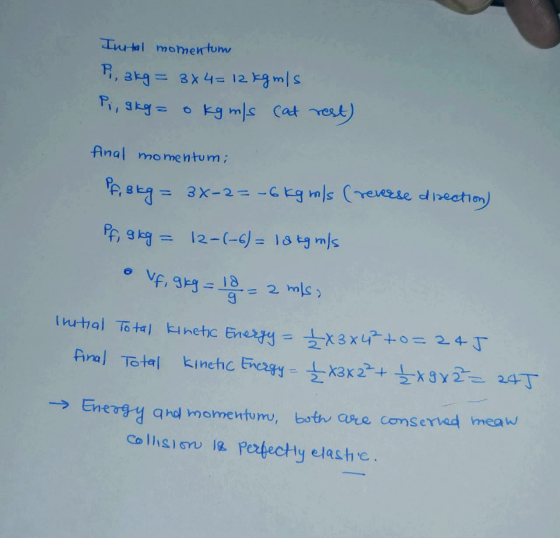
mass one = 3ka is initially travelling w/ a speed...
A hockey puck, mass 0.24 kg, travelling with a speed of +20 m/s. collides with another...
 A hockey puck, mass 0.24 kg, travelling with a speed of +20 m/s. collides with another stationary puck of exactly half the mass, hitting it head-on, but instant superglue makes the pucks stick together. The collision is perfectly inelastic and one dimensional. Ignore any friction with the ice they are travelling on. Calculate the total momentum of the two-puck system both before and after the collision.
(20 pts) On a frictionless, horizontal air table, puck A (with mass 0.15 kg) is moving toward puck B (with mass 0.3 kg), which is initially at rest. After the collision, puck A has a velocity of...
 (20 pts) On a frictionless, horizontal air table, puck A (with mass 0.15 kg) is moving toward puck B (with mass 0.3 kg), which is initially at rest. After the collision, puck A has a velocity of 0.11 m/s to the left, and puck B has a velocity of 0.65 m/s to the right. (a) What was the speed of puck A before the collision? (b) Calculate the change in the total kinetic energy of the system (A and B)...
Sphere A, of mass 0.600 kg, is initially moving to the right at 4.00 m/s. Sphere B, of mass 1.80 kg, is initially to the...
Sphere A, of mass 0.600 kg, is initially moving to the right at 4.00 m/s. Sphere B, of mass 1.80 kg, is initially to the right of sphere A and moving to the right at 2.00 m/s. After the two spheres collide, sphere B is moving at 3.00 m/s in the same direction as before. (a) What is the velocity (magnitude and direction) of sphere A after this collision? (b) Is this collision elastic or inelastic? (c) Sphere B then...
w Lower. Hinge ha 7 Kg mass initially at rest. If ter the collision. What fraction...
 w Lower. Hinge ha 7 Kg mass initially at rest. If ter the collision. What fraction of 3 A 1 Kg mass moving at 5 m/s makes a center line collision with a 7 kg mass the collision is elastic derive the speed of the 1 kg mass after the collision. the total kinetic energy is transferred to the 7 kg mass? Again box answers. N 7 Kg Ik, 5 mis
Initially, mass one (2.80 kg) has a velocity of 5.90 m/s and mass two (2.00 kg)...
 Initially, mass one (2.80 kg) has a velocity of 5.90 m/s and mass two (2.00 kg) is at rest. After they collide, mass one emerges at an angle theta = 31.0 degrees. What is the speed of mass one after the collision if the collision is completely elastic? (Note, there are actually two possible answers two this problem, choose the solution which has m1 going as fast as possible.) What is the angle phi, between mass two's velocity and the...
Billiard ball A of mass mA = 0.130 kg moving with speed vA = 2.95 m/s strikes ball B, initially at rest, of mass mB =...
Billiard ball A of mass mA = 0.130 kg moving with speed vA = 2.95 m/s strikes ball B, initially at rest, of mass mB = 0.150 kg . As a result of the collision, ball A is deflected off at an angle of 29.5 ∘ with a speed vA1 = 2.25 m/s Solve these equations for the speed, vB1, of ball B. Do not assume the collision is elastic. Express your answer numerically with the appropriate units. Solve these equations for the angle, θB, of ball B. Do not assume the collision is elastic. Express your answer numerically...
Elastic collisions: one at rest one moving, two colliding, both initially moving the same direction. Inelastic...
Elastic collisions: one at rest one moving, two colliding, both initially moving the same direction. Inelastic collisions: one at rest one moving, two colliding, both initially moving the same direction. Perfectly elastic collisions: one at rest one moving, two colliding, both initially moving the same direction. Questions1. Was momentum conserved for all types of collisions you examined in this experiment? If not, explain the cause of losing orgaining momentum.2. Was total velocity conserved for all types of collisions you examined...
QUESTION 4 15 points Save A truck of mass 5m traveling with a speed v collides...
 QUESTION 4 15 points Save A truck of mass 5m traveling with a speed v collides with a stationary car of mass m. If the collision is perfectly Inelastic, what is the joint speed of the car and truck immediately after the collision? Or OV 6 OS QUESTION 5 15 points Save An Two objects collide and bounce apart. If the total kinetic energy of the objects is the same before and after the collision, what type of collision is...
6. A 50-kg front seat passenger in a car moving initially with a speed of 25...
 6. A 50-kg front seat passenger in a car moving initially with a speed of 25 m/sisbr rest by an air bag in a time of 0.4 s a) What is the impulse acting on the passenger? b) What is the average force acting on the passenger in this process?? 7. A ball traveling with an initial momentum of 5.0 kg.m/s bounces off a wall and comes back in the opposite direction with a momentum of -4.5 kg.m/s a) What...
(non calculus based physics) Two hockey pucks of equal mass, one blue and one yellow, are...
(non calculus based physics) Two hockey pucks of equal mass, one blue and one yellow, are involved in a perfectly elastic glancing collision. The yellow puck is initially at rest and is struck by the blue puck, which is moving initially to the right at 6.5 m/s. After the collision, the blue puck moves in a direction that makes an angle of 39° with its initial direction, and the velocity of the yellow puck is perpendicular to that of the...
 A hockey puck, mass 0.24 kg, travelling with a speed of +20 m/s. collides with another stationary puck of exactly half the mass, hitting it head-on, but instant superglue makes the pucks stick together. The collision is perfectly inelastic and one dimensional. Ignore any friction with the ice they are travelling on. Calculate the total momentum of the two-puck system both before and after the collision.
 (20 pts) On a frictionless, horizontal air table, puck A (with mass 0.15 kg) is moving toward puck B (with mass 0.3 kg), which is initially at rest. After the collision, puck A has a velocity of 0.11 m/s to the left, and puck B has a velocity of 0.65 m/s to the right. (a) What was the speed of puck A before the collision? (b) Calculate the change in the total kinetic energy of the system (A and B)...
 w Lower. Hinge ha 7 Kg mass initially at rest. If ter the collision. What fraction of 3 A 1 Kg mass moving at 5 m/s makes a center line collision with a 7 kg mass the collision is elastic derive the speed of the 1 kg mass after the collision. the total kinetic energy is transferred to the 7 kg mass? Again box answers. N 7 Kg Ik, 5 mis
 Initially, mass one (2.80 kg) has a velocity of 5.90 m/s and mass two (2.00 kg) is at rest. After they collide, mass one emerges at an angle theta = 31.0 degrees. What is the speed of mass one after the collision if the collision is completely elastic? (Note, there are actually two possible answers two this problem, choose the solution which has m1 going as fast as possible.) What is the angle phi, between mass two's velocity and the...
 QUESTION 4 15 points Save A truck of mass 5m traveling with a speed v collides with a stationary car of mass m. If the collision is perfectly Inelastic, what is the joint speed of the car and truck immediately after the collision? Or OV 6 OS QUESTION 5 15 points Save An Two objects collide and bounce apart. If the total kinetic energy of the objects is the same before and after the collision, what type of collision is...
 6. A 50-kg front seat passenger in a car moving initially with a speed of 25 m/sisbr rest by an air bag in a time of 0.4 s a) What is the impulse acting on the passenger? b) What is the average force acting on the passenger in this process?? 7. A ball traveling with an initial momentum of 5.0 kg.m/s bounces off a wall and comes back in the opposite direction with a momentum of -4.5 kg.m/s a) What...
Most questions answered within 3 hours.
-
Where is the error in this code sequence?
String s1 = "Hello";
String s2 = "ello";...
asked 10 months ago -
Financial data for Joel de Paris, Inc., for last year
follow:
Joel de Paris, Inc.
Balance...
asked 10 months ago -
Consider this reaction:
Al2(SO4)3 (aq)+ BaCl3
(aq) Al2Cl6 (aq)- +
3BaSO4(s) . What is the...
asked 10 months ago -
Suppose that Savneet is considering increasing her
recent random sample from 20 car rentals to 40...
asked 10 months ago -
Trucks arrive at an unloading terminal at an average rate of 120
per hour.
Trucks arrive...
asked 10 months ago -
Why are methanol and ethanol completely soluble in water while
octanol is not very little soluble....
asked 10 months ago -
A facilities manager at a university reads in a research report
that the mean amount of...
asked 10 months ago -
When the CuSO4 is rehydrated by adding water to the anhydrous
compound, is this an endothermic...
asked 10 months ago -
A ray of sunlight is passing from diamond into crown glass; the
angle of incidence is...
asked 10 months ago -
A block of mass 0.249 kg is placed on top of a light, vertical
spring of...
asked 10 months ago -
how do the kidneys compensate in the presences of acidosis
a) trigger hyperventilate
b) reserve acid...
asked 10 months ago -
Question 501 pts
The rental rate of capital to the firm increases. Which of the
following...
asked 10 months ago