Consider the following BNF grammar that we saw in class: EXP ::= EXP + TERM ...
Consider the following BNF grammar that we saw in class:
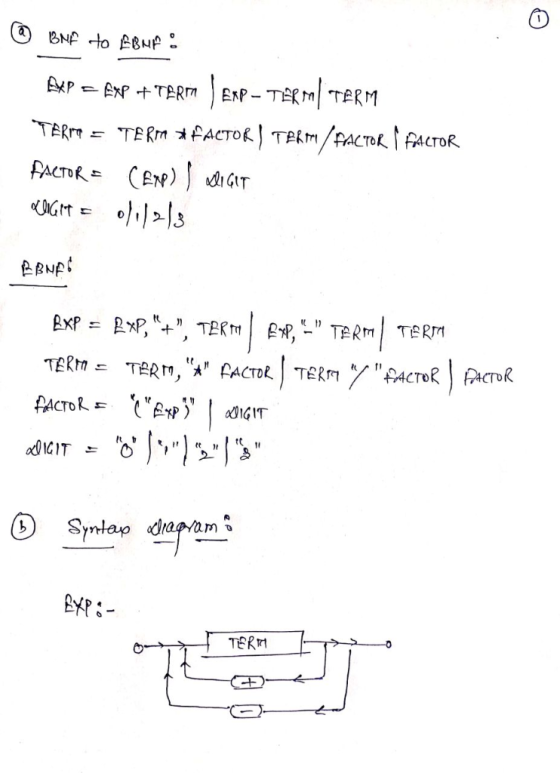
EXP ::= EXP
+ TERM | EXP - TERM | TERM
TERM ::= TERM *
FACTOR | TERM / FACTOR | FACTOR
FACTOR ::= ( EXP ) |
DIGIT
DIGIT ::= 0 | 1 | 2 | 3
(a) Translate into EBNF.
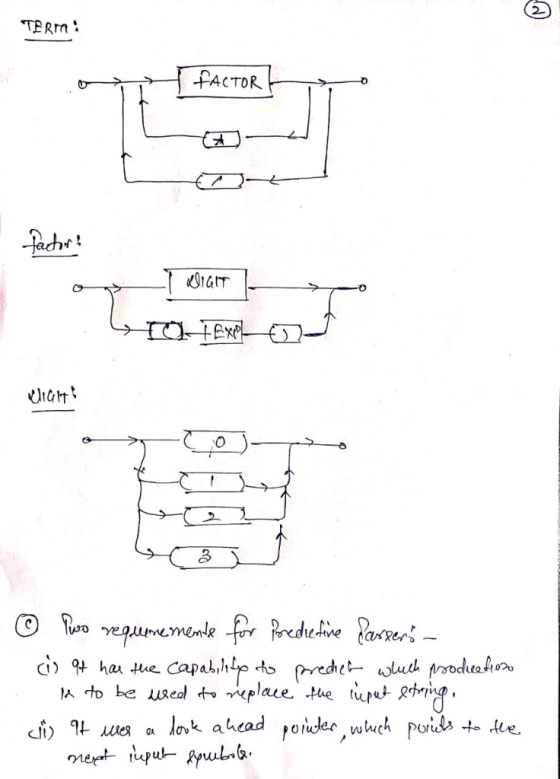
(b) Draw syntax diagrams.
(c) What are the two requirements on a grammar for a
predictive parser to be able to make right choice?
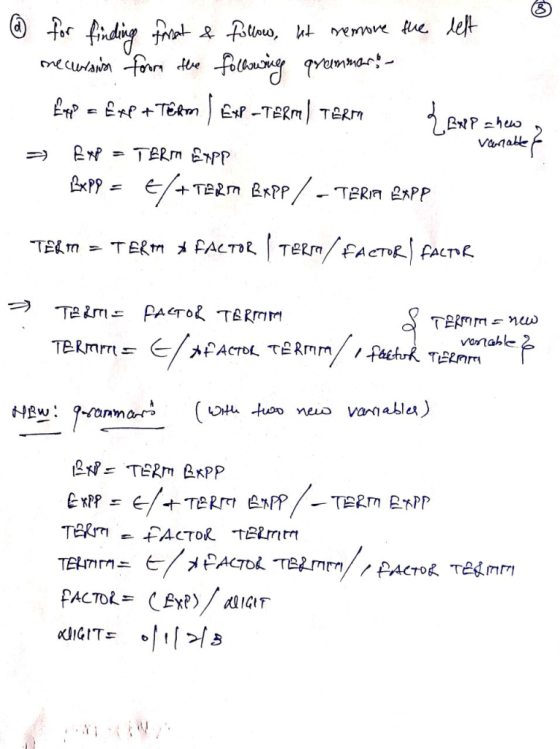
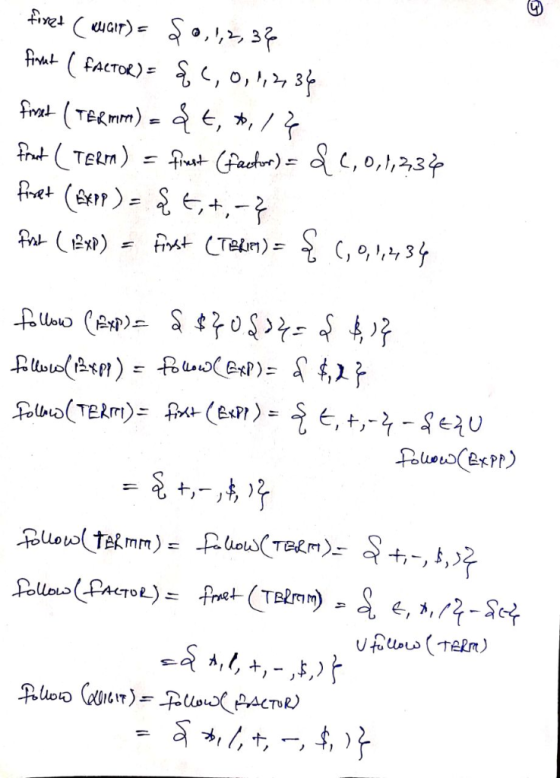
(d) Compute First and Follow sets for each of the
non-terminals
(e) Prove that the grammar satisfy the two
requirements defined in (c).
Homework Answers
Add Answer to:
Consider the following BNF grammar that we saw in class:
EXP ::= EXP
+ TERM ...
please provide good explanation. Consider the following grammar for variable and class declarations in Java: <Decl>...
 please provide good explanation.
Consider the following grammar for variable and class
declarations in Java:
<Decl> -> <VarDecl>
| <ClassDecl>
<VarDecl> -> <Modifiers> <Type> <VarDec> SEM
<ClassDecl> -> <Modifiers> CLASS ID LBRACE <DeclList> RBRACE
<DeclList> -> <Decl>
| <DeclList> <Decl>
<VarDec> -> ID
| ID ASSIGN <Exp>
| <VarDec> COMMA ID
| <VarDec> COMMA ID ASSIGN <Exp>
Indicate any problems in this grammar that prevent it from being
parsed by a recursive-descent parser with one token lookahead. You
can simply...
please provide good explanation.
Consider the following grammar for variable and class
declarations in Java:
<Decl> -> <VarDecl>
| <ClassDecl>
<VarDecl> -> <Modifiers> <Type> <VarDec> SEM
<ClassDecl> -> <Modifiers> CLASS ID LBRACE <DeclList> RBRACE
<DeclList> -> <Decl>
| <DeclList> <Decl>
<VarDec> -> ID
| ID ASSIGN <Exp>
| <VarDec> COMMA ID
| <VarDec> COMMA ID ASSIGN <Exp>
Indicate any problems in this grammar that prevent it from being
parsed by a recursive-descent parser with one token lookahead. You
can simply...
 please provide good explanation.
Consider the following grammar for variable and class
declarations in Java:
<Decl> -> <VarDecl>
| <ClassDecl>
<VarDecl> -> <Modifiers> <Type> <VarDec> SEM
<ClassDecl> -> <Modifiers> CLASS ID LBRACE <DeclList> RBRACE
<DeclList> -> <Decl>
| <DeclList> <Decl>
<VarDec> -> ID
| ID ASSIGN <Exp>
| <VarDec> COMMA ID
| <VarDec> COMMA ID ASSIGN <Exp>
Indicate any problems in this grammar that prevent it from being
parsed by a recursive-descent parser with one token lookahead. You
can simply...
please provide good explanation.
Consider the following grammar for variable and class
declarations in Java:
<Decl> -> <VarDecl>
| <ClassDecl>
<VarDecl> -> <Modifiers> <Type> <VarDec> SEM
<ClassDecl> -> <Modifiers> CLASS ID LBRACE <DeclList> RBRACE
<DeclList> -> <Decl>
| <DeclList> <Decl>
<VarDec> -> ID
| ID ASSIGN <Exp>
| <VarDec> COMMA ID
| <VarDec> COMMA ID ASSIGN <Exp>
Indicate any problems in this grammar that prevent it from being
parsed by a recursive-descent parser with one token lookahead. You
can simply...
Most questions answered within 3 hours.
-
Where is the error in this code sequence?
String s1 = "Hello";
String s2 = "ello";...
asked 10 months ago -
Financial data for Joel de Paris, Inc., for last year
follow:
Joel de Paris, Inc.
Balance...
asked 10 months ago -
Consider this reaction:
Al2(SO4)3 (aq)+ BaCl3
(aq) Al2Cl6 (aq)- +
3BaSO4(s) . What is the...
asked 10 months ago -
Suppose that Savneet is considering increasing her
recent random sample from 20 car rentals to 40...
asked 10 months ago -
Trucks arrive at an unloading terminal at an average rate of 120
per hour.
Trucks arrive...
asked 10 months ago -
Why are methanol and ethanol completely soluble in water while
octanol is not very little soluble....
asked 10 months ago -
A facilities manager at a university reads in a research report
that the mean amount of...
asked 10 months ago -
When the CuSO4 is rehydrated by adding water to the anhydrous
compound, is this an endothermic...
asked 10 months ago -
A ray of sunlight is passing from diamond into crown glass; the
angle of incidence is...
asked 10 months ago -
A block of mass 0.249 kg is placed on top of a light, vertical
spring of...
asked 10 months ago -
how do the kidneys compensate in the presences of acidosis
a) trigger hyperventilate
b) reserve acid...
asked 10 months ago -
Question 501 pts
The rental rate of capital to the firm increases. Which of the
following...
asked 10 months ago