
Homework Answers
2Li3PO4 +3 CuBr2 -------------> Cu3(PO4)2(s) + 6 LiBr(aq)
mass of solid product = 3.70 g
moles of product = 3.70 / 380.58 = 0.0097
according to balanced reaction
1 mole solid product require 2 moles Li3PO4
0.0097 moles solid product require 0.0097 x 2 = 0.0194 moles Li3PO4
moles = Molarity x V in L
0.0194 = 0.172 x V
V = 0.113 L = 113 mL
volume of Li3PO4 require = 113 mL
Add Answer to:
What volume of 0.172M lithium phosphate reacts with 95.4 mL of 0.102 M copper (II) bromide...
Copper (II) phosphate can be prepared by adding sodium phosphate to a solution of copper (II)...
 Copper (II) phosphate can be prepared by adding sodium phosphate to a solution of copper (II) chloride 2Na_3 PO_4(aq) + 3CuCl_2(aq) rightarrow Cu_3(PO_4)_z(s) + 6NaCl_(aq) What volume of 0.175 M Na_3PO_4 solution is necessary to completely react with 95.4 mL of 0.102 M CuCl_2? How many grams of Cu_3(PO_4)_2 will be precipitated using the amounts of reactants described in part (a)? What will the molarity of the NaCl solution be after the reaction describe in part (a) is complete?
aqueous potassium phosphate reacts with aqueous nickel(II) bromide to produce solid nickel(II) phosphate and aqueous potassium bromide
 Write a balanced chemical equation based on the following description: aqueous potassium phosphate reacts with aqueous nickel(II) bromide to produce solid nickel(II) phosphate and aqueous potassium bromide.
b. Sodium phosphate mixed with copper(II) bromide. Molecular equation Complete ionic equation Net ionic equation Spectator...
 b. Sodium phosphate mixed with copper(II) bromide. Molecular equation Complete ionic equation Net ionic equation Spectator ions 6. How many mL of a 0.250 M KCI solution contains 34.5 g KCI? 7. To what volume (in mL) should you dilute 100.0 mL of a 2.50 M CaCl2 solution to obtain a 0.550 M CaCl2 solution?
An aqueous solution of copper(II) bromide is mixed with aqueous sodium phosphate. A precipitate is observed...
An aqueous solution of copper(II) bromide is mixed with aqueous sodium phosphate. A precipitate is observed to form. Write the formula for the solid product. (Use the following format when entering your answer. Ca(BrO3)2 would be entered as Ca(BrO3)2.)
Copper(II) sulfate reacts with sodium phosphate in a precipitation reaction. If 103.77 g of copper(II) sulfate is reacte...
Copper(II) sulfate reacts with sodium phosphate in a precipitation reaction. If 103.77 g of copper(II) sulfate is reacted with 172.33 g of sodium phosphate, what is the theoretical yield of copper(II) phosphate? Report your answer rounded to the hundredths of a gram without units.
10 mL of a 0.30 M sodium phosphate solution reacts with 20 mL of 0.20 M...
10 mL of a 0.30 M sodium phosphate solution reacts with 20 mL of 0.20 M lead(II) nitrate solution What mass of precipitate will form? What is the concentration of nitrate ions left in solution after the reaction is complete? What is the concentration of phosphate ions left in solution after the reaction is complete?
65.0 mL sample of a 0.102 M potassium sulfate solution is mixed with 38.5 mL of...
65.0 mL sample of a 0.102 M potassium sulfate solution is mixed with 38.5 mL of a 0.122 M lead(II) acetate solution and the following precipitation reaction occurs: K2SO4(aq)+Pb(C2H3O2)2(aq)→2KC2H3O2(aq)+PbSO4(s) The solid PbSO4 is collected, dried, and found to have a mass of 0.993 g . a. Define the theoretical yield b. Define the percent yield.
A 55.0 mL sample of a 0.102 M potassium sulfate solution is mixed with 35.0 mL...
A 55.0 mL sample of a 0.102 M potassium sulfate solution is mixed with 35.0 mL of a 0.114 M lead (II) acetate solution. The solid lead (II) sulfate is collected, dried, and found to have a mass of 1.01 g. The Balanced Reaction is: Pb(CH3COO2)(aq) + K2SO4 --> PbSO4(S) + 2K (aq) + 2CH3COO- (aq) b.Write the net ionic reaction. c.Which ions are spectators? d.Determine the limiting reagent. e. Determine the theoretical yield. f.Determine the percent yield. g. Determine...
8. Given that 20 mL of o.200 M potassium bromide reacts with 18 mL of iron...
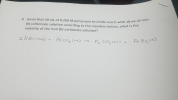 8. Given that 20 mL of o.200 M potassium bromide reacts with 18 mL of iron (Il) carbonate solution according to the equation below, what is t molarity of the iron (II) carbonate solution?
What volume (in mL) of 15.64 %(w/w) Mercury (II) phosphate is required to create a 2000.0...
What volume (in mL) of 15.64 %(w/w) Mercury (II) phosphate is required to create a 2000.0 mL - 0.1163 M solution? Allow the density of the original solution to be 1.380 g/mL.
 Copper (II) phosphate can be prepared by adding sodium phosphate to a solution of copper (II) chloride 2Na_3 PO_4(aq) + 3CuCl_2(aq) rightarrow Cu_3(PO_4)_z(s) + 6NaCl_(aq) What volume of 0.175 M Na_3PO_4 solution is necessary to completely react with 95.4 mL of 0.102 M CuCl_2? How many grams of Cu_3(PO_4)_2 will be precipitated using the amounts of reactants described in part (a)? What will the molarity of the NaCl solution be after the reaction describe in part (a) is complete?
 Write a balanced chemical equation based on the following description: aqueous potassium phosphate reacts with aqueous nickel(II) bromide to produce solid nickel(II) phosphate and aqueous potassium bromide.
 b. Sodium phosphate mixed with copper(II) bromide. Molecular equation Complete ionic equation Net ionic equation Spectator ions 6. How many mL of a 0.250 M KCI solution contains 34.5 g KCI? 7. To what volume (in mL) should you dilute 100.0 mL of a 2.50 M CaCl2 solution to obtain a 0.550 M CaCl2 solution?
 8. Given that 20 mL of o.200 M potassium bromide reacts with 18 mL of iron (Il) carbonate solution according to the equation below, what is t molarity of the iron (II) carbonate solution?
Most questions answered within 3 hours.
-
Where is the error in this code sequence?
String s1 = "Hello";
String s2 = "ello";...
asked 11 months ago -
Financial data for Joel de Paris, Inc., for last year
follow:
Joel de Paris, Inc.
Balance...
asked 11 months ago -
Consider this reaction:
Al2(SO4)3 (aq)+ BaCl3
(aq) Al2Cl6 (aq)- +
3BaSO4(s) . What is the...
asked 11 months ago -
Suppose that Savneet is considering increasing her
recent random sample from 20 car rentals to 40...
asked 11 months ago -
Trucks arrive at an unloading terminal at an average rate of 120
per hour.
Trucks arrive...
asked 11 months ago -
Why are methanol and ethanol completely soluble in water while
octanol is not very little soluble....
asked 11 months ago -
A facilities manager at a university reads in a research report
that the mean amount of...
asked 11 months ago -
When the CuSO4 is rehydrated by adding water to the anhydrous
compound, is this an endothermic...
asked 11 months ago -
A ray of sunlight is passing from diamond into crown glass; the
angle of incidence is...
asked 11 months ago -
A block of mass 0.249 kg is placed on top of a light, vertical
spring of...
asked 11 months ago -
how do the kidneys compensate in the presences of acidosis
a) trigger hyperventilate
b) reserve acid...
asked 11 months ago -
Question 501 pts
The rental rate of capital to the firm increases. Which of the
following...
asked 11 months ago