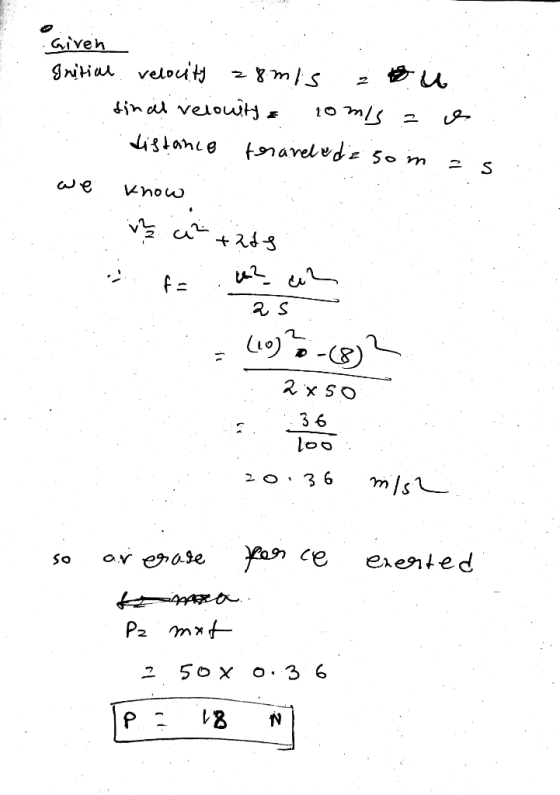
A 50 kg runner changes velocity from 8 m/s to 10 m/s over a 50 meter...
A 50 kg runner changes velocity from 8 m/s to 10 m/s over a 50 meter distance. Calculate the average force the runner exerts on the ground.
Homework Answers
Add Answer to:
A 50 kg runner changes velocity from 8 m/s to 10 m/s over a 50
meter...
Newton’s Second Law: The data below represent the time and displacement of a professional 100-meter runner...
Newton’s Second Law: The data below represent the time and displacement of a professional 100-meter runner from the starting line to the finish line. Calculate velocity & acceleration from change in distance and change in time. Time (s) Distance (m) Change in Displacement (m) Change in Time (s) Velocity (m/s) Change in Velocity (m/s) Acceleration (m/s2) Frame 1 0 0 Frame 2 1 5 Frame 3 2 10 Frame 4 3 20 Frame 5 4 33 Frame 6 5 45...
A 10 kg box on wheels is moving with a velocity of 2.0 m/s. A force...
A 10 kg box on wheels is moving with a velocity of 2.0 m/s. A force is applied to the box over a distance of 1.25m, after which the velocity has been reduced to 0 m/s. Answer the questions below. What was the average force (F1) applied to the box to bring it to a stop?
During a collision with a wall, the velocity of a 0.200-kg ball changes from 20.0 m/s...
 During a collision with a wall, the velocity of a 0.200-kg ball changes from 20.0 m/s toward the wall to 12.0 m/s away from the wall. If the time the ball was in contact with the wall was 60.0 ms, what was the magnitude of the average force applied to the ball?
8) During a collision with a wall,the velocity of a 0.200-kg ball changes from 20.0 m/s...
 8) During a collision with a wall,the velocity of a 0.200-kg ball changes from 20.0 m/s toward the wall to 12.0 m/s away from the wall. If the time the ball was in contact with the wall was 60.0 ms, what was the magnitude of the average force applied to the ball? A) 26.7 N B) 13.3 N C) 107N D) 40.0 N E) 16.7 N 10) A 5.0-m radius playground merry-go-round with a moment of inertia of 2000 kg.m2...
a runner travels 1.5 laps around a circular track in a time of 50 s ....
a runner travels 1.5 laps around a circular track in a time of 50 s . The diameter of the track is 40 m and its circumference is 126 m. Find (a) the average speed of the runner and (b) the magnitude of the runner’s average velocity. Be careful here ; average speed depends on the total distance traveled, whereas average velocity depends on the displacement at the end particular journey
i would appreciate a quick answer 1. The graph shows the velocity of a runner in...
 i would appreciate a quick answer
1. The graph shows the velocity of a runner in a time 16 s. a. Determine the acceleration of the runner from 0-2s 8 12 t (s) b. Calculate the total distance covered by the runner from 0-16 s. c. Calculate the average velocity of the runner during these 16 s.
i would appreciate a quick answer
1. The graph shows the velocity of a runner in a time 16 s. a. Determine the acceleration of the runner from 0-2s 8 12 t (s) b. Calculate the total distance covered by the runner from 0-16 s. c. Calculate the average velocity of the runner during these 16 s.
At the end of a race a runner decelerates from a velocity of 8.70 m/s at...
At the end of a race a runner decelerates from a velocity of 8.70 m/s at a rate of 2.40 m/s2. How far in meters does she travel in the next 4.10 s? (Assume the deceleration of 2.40 m/s2 is constant over the full 4.10 s.) m What is her final velocity in m/s? Evaluate the result. Does it make sense?
7. A 58 kg runner is traveling at a velocity of 5 m/s. What is her...
 7. A 58 kg runner is traveling at a velocity of 5 m/s. What is her momentum (in Ns)?
During a collision with a wall, the velocity of a 0.200-kg ball changes from 20.0 m/s toward the wall to 12.0 m/s away...
During a collision with a wall, the velocity of a 0.200-kg ball changes from 20.0 m/s toward the wall to 12.0 m/s away from the wall. If the time the ball was in contact with the wall was 60.0 ms, what was the magnitude of the average force applied to the ball? Please how do you get 20/32x0.06
The 50-kg crate shown below starts from rest and achieves a velocity of 4 m/s after...
 The 50-kg crate shown below starts from rest and achieves a velocity of 4 m/s after traveling 5m to the right. Determine the magnitude of force Pin Newtons). You may assume the coefficient of kinetic friction between the crate and ground is uk = 0.3 P 30°
 During a collision with a wall, the velocity of a 0.200-kg ball changes from 20.0 m/s toward the wall to 12.0 m/s away from the wall. If the time the ball was in contact with the wall was 60.0 ms, what was the magnitude of the average force applied to the ball?
 8) During a collision with a wall,the velocity of a 0.200-kg ball changes from 20.0 m/s toward the wall to 12.0 m/s away from the wall. If the time the ball was in contact with the wall was 60.0 ms, what was the magnitude of the average force applied to the ball? A) 26.7 N B) 13.3 N C) 107N D) 40.0 N E) 16.7 N 10) A 5.0-m radius playground merry-go-round with a moment of inertia of 2000 kg.m2...
 i would appreciate a quick answer
1. The graph shows the velocity of a runner in a time 16 s. a. Determine the acceleration of the runner from 0-2s 8 12 t (s) b. Calculate the total distance covered by the runner from 0-16 s. c. Calculate the average velocity of the runner during these 16 s.
i would appreciate a quick answer
1. The graph shows the velocity of a runner in a time 16 s. a. Determine the acceleration of the runner from 0-2s 8 12 t (s) b. Calculate the total distance covered by the runner from 0-16 s. c. Calculate the average velocity of the runner during these 16 s.
 7. A 58 kg runner is traveling at a velocity of 5 m/s. What is her momentum (in Ns)?
 The 50-kg crate shown below starts from rest and achieves a velocity of 4 m/s after traveling 5m to the right. Determine the magnitude of force Pin Newtons). You may assume the coefficient of kinetic friction between the crate and ground is uk = 0.3 P 30°
Most questions answered within 3 hours.
-
Where is the error in this code sequence?
String s1 = "Hello";
String s2 = "ello";...
asked 10 months ago -
Financial data for Joel de Paris, Inc., for last year
follow:
Joel de Paris, Inc.
Balance...
asked 10 months ago -
Consider this reaction:
Al2(SO4)3 (aq)+ BaCl3
(aq) Al2Cl6 (aq)- +
3BaSO4(s) . What is the...
asked 10 months ago -
Suppose that Savneet is considering increasing her
recent random sample from 20 car rentals to 40...
asked 10 months ago -
Trucks arrive at an unloading terminal at an average rate of 120
per hour.
Trucks arrive...
asked 10 months ago -
Why are methanol and ethanol completely soluble in water while
octanol is not very little soluble....
asked 10 months ago -
A facilities manager at a university reads in a research report
that the mean amount of...
asked 10 months ago -
When the CuSO4 is rehydrated by adding water to the anhydrous
compound, is this an endothermic...
asked 10 months ago -
A ray of sunlight is passing from diamond into crown glass; the
angle of incidence is...
asked 10 months ago -
A block of mass 0.249 kg is placed on top of a light, vertical
spring of...
asked 10 months ago -
how do the kidneys compensate in the presences of acidosis
a) trigger hyperventilate
b) reserve acid...
asked 10 months ago -
Question 501 pts
The rental rate of capital to the firm increases. Which of the
following...
asked 10 months ago