When performing Electrophilic Aromatic Substitution what do we substitute first the activating or deactivating group?
When performing Electrophilic Aromatic Substitution what do we substitute first the activating or deactivating group?
Homework Answers

Add Answer to:
When performing Electrophilic Aromatic Substitution what do we
substitute first the activating or deactivating group?
6. Napthalene undergoes electrophilic aromatic substitution. Predict its reactivity (activating or deactivating) and predict where it...
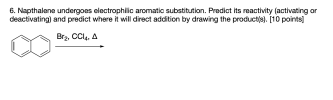 6. Napthalene undergoes electrophilic aromatic substitution. Predict its reactivity (activating or deactivating) and predict where it will direct addition by drawing the product(s). [10 points] Br2, CC14, A
06 Question (1 point) Sort the substituents as activating or deactivating in electrophilic aromatic substitution reactions...
 06 Question (1 point) Sort the substituents as activating or deactivating in electrophilic aromatic substitution reactions 1st attempt d See Periodic Table See Hint Substituents (10 images) (Drag and drop into the appropriate area below Cl SO3H
Choose the incorrect statement for the electrophilic aromatic substitution. a) Bromo group deactivating b) Aniline is...
 Choose the incorrect statement for the electrophilic aromatic substitution. a) Bromo group deactivating b) Aniline is more reactive than benzene b) Nitrobenzene is meta-directing d) Acetophenone is para-directing e) Biphenyl undergoes electrophilic aromatic substitution.
Activating groups "speed up" electrophilic substitution of aromatics and deactivating groups "slow down" electrophilic substitution. 1....
 Activating groups "speed up" electrophilic substitution of
aromatics and deactivating groups "slow down" electrophilic
substitution.
1. Ignoring halogens, what is different between the composition
of the ortho-para directors and the meta directors?
2. What causes the deactivating groups to "slow down" the
substitution? What may be used to speed up these reactions?
3. How does carbocation stabilization affect the orientation of
the products in each orientation?
Activating groups Deactivating groups ortho-, para- directors -hydroxyl (OH) -alkoxy (OR) -amino (NH2, NR)...
Activating groups "speed up" electrophilic substitution of
aromatics and deactivating groups "slow down" electrophilic
substitution.
1. Ignoring halogens, what is different between the composition
of the ortho-para directors and the meta directors?
2. What causes the deactivating groups to "slow down" the
substitution? What may be used to speed up these reactions?
3. How does carbocation stabilization affect the orientation of
the products in each orientation?
Activating groups Deactivating groups ortho-, para- directors -hydroxyl (OH) -alkoxy (OR) -amino (NH2, NR)...
In an electrophilic aromatic substitution reaction, which group is both ortho, para directing and ring ?deactivating...
 In an electrophilic aromatic substitution reaction, which group is both ortho, para directing and ring ?deactivating اختر أحد الخيارات CI- CO2H- NO - O NH2- OH-
In an electrophilic aromatic substitution reaction, which group is both ortho, para directing and ring deactivating?...
 In an electrophilic aromatic substitution reaction, which group is both ortho, para directing and ring deactivating? Select one: -CIN 0 -NH₂ O NO₂ O-CO₂H
In an electrophilic aromatic substitution reaction, which group is both ortho, para directing and ring deactivating?...
 In an electrophilic aromatic substitution reaction, which group is both ortho, para directing and ring deactivating? of Select one: O -NH2 O-SO3H O-1 0 -CN O-OCH3
Activating/Deactivating Substituents Below is a list of different substituents and experimental results from attempted electrophilic aromatic...
 Activating/Deactivating Substituents Below is a list of different substituents and experimental results from attempted electrophilic aromatic substitution. PhNR, PHCN PhCHO PhF PhMe PhoMe PhNH Deactivating Activating PhNO, PhSozH Phl PhH PNHAC POH • Is the aromatic ring an [ electrophile / nucleophile ] in these reactions? Which substituents 'activate the ring (i.e. make it more reactive? 0 Alkyl substituents: Activate OR Deactivate o Halide substituents: Activate OR Deactivate o OH, NH substituents: Activate OR Deactivate o carbonyl groups: Activate OR...
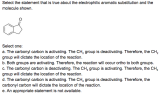
Please answer as soon as possible Select the statement that is true about the electrophilic aromatic...
 Please answer as soon as possible
Select the statement that is true about the electrophilic aromatic substitution and the molecule shown. Select one: a. The carbonyl carbon is activating. The CH, group is deactivating. Therefore, the CH, group will dictate the location of the reaction. b. Both groups are activating. Therefore, the reaction will occur ortho to both groups. c. The carbonyl carbon is deactivating. The CH2 group is activating. Therefore, the CH2 group will dictate the location of the...
Please answer as soon as possible
Select the statement that is true about the electrophilic aromatic substitution and the molecule shown. Select one: a. The carbonyl carbon is activating. The CH, group is deactivating. Therefore, the CH, group will dictate the location of the reaction. b. Both groups are activating. Therefore, the reaction will occur ortho to both groups. c. The carbonyl carbon is deactivating. The CH2 group is activating. Therefore, the CH2 group will dictate the location of the...
Friedel - Craft Acylation Synthesis of 4-Methoxiacetophenone Background Information 1.- What is an electrophilic aromatic substitution?...
 Friedel - Craft Acylation Synthesis of 4-Methoxiacetophenone Background Information 1.- What is an electrophilic aromatic substitution? 2.- Give three examples of activating groups. Explain why they activate the ring for substitution. 3.- Give three examples of deactivating groups. Explain why they deactivate the ring for substitution. 4.- Describe the difference between a Friedel-Craft alkylation and Acylation. Synthesis of 4-Methoxiacetophenone For this Friedel-Craft acylation we will react Anisole with Acetic Anhydride. Write the mechanism and the structure of the final product....
 6. Napthalene undergoes electrophilic aromatic substitution. Predict its reactivity (activating or deactivating) and predict where it will direct addition by drawing the product(s). [10 points] Br2, CC14, A
 06 Question (1 point) Sort the substituents as activating or deactivating in electrophilic aromatic substitution reactions 1st attempt d See Periodic Table See Hint Substituents (10 images) (Drag and drop into the appropriate area below Cl SO3H
 Choose the incorrect statement for the electrophilic aromatic substitution. a) Bromo group deactivating b) Aniline is more reactive than benzene b) Nitrobenzene is meta-directing d) Acetophenone is para-directing e) Biphenyl undergoes electrophilic aromatic substitution.
 Activating groups "speed up" electrophilic substitution of
aromatics and deactivating groups "slow down" electrophilic
substitution.
1. Ignoring halogens, what is different between the composition
of the ortho-para directors and the meta directors?
2. What causes the deactivating groups to "slow down" the
substitution? What may be used to speed up these reactions?
3. How does carbocation stabilization affect the orientation of
the products in each orientation?
Activating groups Deactivating groups ortho-, para- directors -hydroxyl (OH) -alkoxy (OR) -amino (NH2, NR)...
Activating groups "speed up" electrophilic substitution of
aromatics and deactivating groups "slow down" electrophilic
substitution.
1. Ignoring halogens, what is different between the composition
of the ortho-para directors and the meta directors?
2. What causes the deactivating groups to "slow down" the
substitution? What may be used to speed up these reactions?
3. How does carbocation stabilization affect the orientation of
the products in each orientation?
Activating groups Deactivating groups ortho-, para- directors -hydroxyl (OH) -alkoxy (OR) -amino (NH2, NR)...
 In an electrophilic aromatic substitution reaction, which group is both ortho, para directing and ring ?deactivating اختر أحد الخيارات CI- CO2H- NO - O NH2- OH-
 In an electrophilic aromatic substitution reaction, which group is both ortho, para directing and ring deactivating? Select one: -CIN 0 -NH₂ O NO₂ O-CO₂H
 In an electrophilic aromatic substitution reaction, which group is both ortho, para directing and ring deactivating? of Select one: O -NH2 O-SO3H O-1 0 -CN O-OCH3
 Activating/Deactivating Substituents Below is a list of different substituents and experimental results from attempted electrophilic aromatic substitution. PhNR, PHCN PhCHO PhF PhMe PhoMe PhNH Deactivating Activating PhNO, PhSozH Phl PhH PNHAC POH • Is the aromatic ring an [ electrophile / nucleophile ] in these reactions? Which substituents 'activate the ring (i.e. make it more reactive? 0 Alkyl substituents: Activate OR Deactivate o Halide substituents: Activate OR Deactivate o OH, NH substituents: Activate OR Deactivate o carbonyl groups: Activate OR...
 Please answer as soon as possible
Select the statement that is true about the electrophilic aromatic substitution and the molecule shown. Select one: a. The carbonyl carbon is activating. The CH, group is deactivating. Therefore, the CH, group will dictate the location of the reaction. b. Both groups are activating. Therefore, the reaction will occur ortho to both groups. c. The carbonyl carbon is deactivating. The CH2 group is activating. Therefore, the CH2 group will dictate the location of the...
Please answer as soon as possible
Select the statement that is true about the electrophilic aromatic substitution and the molecule shown. Select one: a. The carbonyl carbon is activating. The CH, group is deactivating. Therefore, the CH, group will dictate the location of the reaction. b. Both groups are activating. Therefore, the reaction will occur ortho to both groups. c. The carbonyl carbon is deactivating. The CH2 group is activating. Therefore, the CH2 group will dictate the location of the...
 Friedel - Craft Acylation Synthesis of 4-Methoxiacetophenone Background Information 1.- What is an electrophilic aromatic substitution? 2.- Give three examples of activating groups. Explain why they activate the ring for substitution. 3.- Give three examples of deactivating groups. Explain why they deactivate the ring for substitution. 4.- Describe the difference between a Friedel-Craft alkylation and Acylation. Synthesis of 4-Methoxiacetophenone For this Friedel-Craft acylation we will react Anisole with Acetic Anhydride. Write the mechanism and the structure of the final product....
Most questions answered within 3 hours.
-
Where is the error in this code sequence?
String s1 = "Hello";
String s2 = "ello";...
asked 10 months ago -
Financial data for Joel de Paris, Inc., for last year
follow:
Joel de Paris, Inc.
Balance...
asked 10 months ago -
Consider this reaction:
Al2(SO4)3 (aq)+ BaCl3
(aq) Al2Cl6 (aq)- +
3BaSO4(s) . What is the...
asked 10 months ago -
Suppose that Savneet is considering increasing her
recent random sample from 20 car rentals to 40...
asked 10 months ago -
Trucks arrive at an unloading terminal at an average rate of 120
per hour.
Trucks arrive...
asked 10 months ago -
Why are methanol and ethanol completely soluble in water while
octanol is not very little soluble....
asked 10 months ago -
A facilities manager at a university reads in a research report
that the mean amount of...
asked 10 months ago -
When the CuSO4 is rehydrated by adding water to the anhydrous
compound, is this an endothermic...
asked 10 months ago -
A ray of sunlight is passing from diamond into crown glass; the
angle of incidence is...
asked 10 months ago -
A block of mass 0.249 kg is placed on top of a light, vertical
spring of...
asked 10 months ago -
how do the kidneys compensate in the presences of acidosis
a) trigger hyperventilate
b) reserve acid...
asked 10 months ago -
Question 501 pts
The rental rate of capital to the firm increases. Which of the
following...
asked 10 months ago