
Homework Answers

Add Answer to:
(i) For the 3D unit cube V = (0.1) (0.1) × (0.1), for the Dirichlet problem...
2.) Show that the fundamental theorem of divergences (aka Gauss's theorem, aka Green's theorem), shown below,...
 2.) Show that the fundamental theorem of divergences (aka Gauss's theorem, aka Green's theorem), shown below, holds for the (vector) function v from the previous problem. (Use the cube shown below as the basis for your work; the cube has sides of length 3.) fundamental theorem of divergences (V.v)dr v-da 24 A(v) (ii) 47 (iv) (ii) (vi) 1.) Calculate the divergence of the following (vector) function: v (xy)x +(2yz)y+ (3xz)z (NOTE: x, y, and z are Cartesian unit vectors.) 2.)...
solve problem #1 depending on the given information Consider the following 1D second order elliptic equation with Dirichlet boundary conditions du(x) (c(x)du ) = f(x) (a $15 b), u(a) = ga, u(b) = gb...
 solve problem #1 depending on the given information
Consider the following 1D second order elliptic equation with Dirichlet boundary conditions du(x) (c(x)du ) = f(x) (a $15 b), u(a) = ga, u(b) = gb dr: where u(x) is the unknown function, ga and gb are the Dirichlet boundary values, c(x) is a given coefficient function and f(x) is a given source function. See the theorem 10.1 in the textbook for the existence and uniqueness of the solution. 1.1 Weak Formulation...
solve problem #1 depending on the given information
Consider the following 1D second order elliptic equation with Dirichlet boundary conditions du(x) (c(x)du ) = f(x) (a $15 b), u(a) = ga, u(b) = gb dr: where u(x) is the unknown function, ga and gb are the Dirichlet boundary values, c(x) is a given coefficient function and f(x) is a given source function. See the theorem 10.1 in the textbook for the existence and uniqueness of the solution. 1.1 Weak Formulation...
Problem 6. Let V be a vector space (a) Let (--) : V x V --> R be an inner product. Prove that (-, -) is a bilinear f...
 Problem 6. Let V be a vector space (a) Let (--) : V x V --> R be an inner product. Prove that (-, -) is a bilinear form on V. (b) Let B = (1, ... ,T,) be a basis of V. Prove that there exists a unique inner product on V making Borthonormal. (c) Let (V) be the set of all inner products on V. By part (a), J(V) C B(V). Is J(V) a vector subspace of B(V)?...
Q1: Consider the minimisation of the following function of two variables: f(t, z.) %3D — In(1+ 7) — Т2. Subject to the...
 Q1: Consider the minimisation of the following function of two variables: f(t, z.) %3D — In(1+ 7) — Т2. Subject to the linear constraints: 2я1 + х2 < 3;B х, 22 2 0. (a) Prove that this is a convex minimisation problem (b) Write down the Karush-Kuhn-Tucker conditions for this problem. (c) Find all solutions of the above KKT conditions (d) Are the solutions you found a local or a global minimum (maximum)? Justify your answer.
Q1: Consider the minimisation...
Q1: Consider the minimisation of the following function of two variables: f(t, z.) %3D — In(1+ 7) — Т2. Subject to the linear constraints: 2я1 + х2 < 3;B х, 22 2 0. (a) Prove that this is a convex minimisation problem (b) Write down the Karush-Kuhn-Tucker conditions for this problem. (c) Find all solutions of the above KKT conditions (d) Are the solutions you found a local or a global minimum (maximum)? Justify your answer.
Q1: Consider the minimisation...
Partial Differential Equations 1. (20 points) Consider the problem u" (x)+ u(x) (0.1) f(x) 1 (0.2)...
 Partial Differential Equations
1. (20 points) Consider the problem u" (x)+ u(x) (0.1) f(x) 1 (0.2) u'(0)u(0) (u'(0) + u(l)) with f(x) (10 points) a) Is the solution unique? Justify your answer (10 points) b) Does a solution exist. or is there a condition that f (x) must satisfy for existence? Justify your answer given function a
1. (20 points) Consider the problem u" (x)+ u(x) (0.1) f(x) 1 (0.2) u'(0)u(0) (u'(0) + u(l)) with f(x) (10 points) a) Is...
Partial Differential Equations
1. (20 points) Consider the problem u" (x)+ u(x) (0.1) f(x) 1 (0.2) u'(0)u(0) (u'(0) + u(l)) with f(x) (10 points) a) Is the solution unique? Justify your answer (10 points) b) Does a solution exist. or is there a condition that f (x) must satisfy for existence? Justify your answer given function a
1. (20 points) Consider the problem u" (x)+ u(x) (0.1) f(x) 1 (0.2) u'(0)u(0) (u'(0) + u(l)) with f(x) (10 points) a) Is...
I have a problem with polarities. I can find v', v'', v''' and the current also,...
 I have a problem with polarities. I can find v', v'',
v''' and the current also, but i dont know how to fix the right
sign and i get my final answer wrong when i sum them up. Can you
explain in detail how i determine the signs and polatities?
I have no problem whith the current or voltage division. Only the
signs
. Additional Circuit Analysis Techniques + v 10 v 10 10 1-2 1+3
I have a problem with polarities. I can find v', v'',
v''' and the current also, but i dont know how to fix the right
sign and i get my final answer wrong when i sum them up. Can you
explain in detail how i determine the signs and polatities?
I have no problem whith the current or voltage division. Only the
signs
. Additional Circuit Analysis Techniques + v 10 v 10 10 1-2 1+3
I need some help on this problem. Thank you! 15. Consider the differential equation (*) х%3D Ах + vex where v is an eig...
 I need some help on this problem.
Thank you!
15. Consider the differential equation (*) х%3D Ах + vex where v is an eigenvector of A with eigenvalue X. Suppose moreover, that A has linearly independent eigenvectors v', v2,... , v", with distinct eigenvalues Ар А, гespectively. (a) Show that (*) has no solution /(t) of the form V(t)= ae*. Hint: Write a= а у+.. +a, v. (b) Show that (*) has a solution /(t) of the form n 0)...
I need some help on this problem.
Thank you!
15. Consider the differential equation (*) х%3D Ах + vex where v is an eigenvector of A with eigenvalue X. Suppose moreover, that A has linearly independent eigenvectors v', v2,... , v", with distinct eigenvalues Ар А, гespectively. (a) Show that (*) has no solution /(t) of the form V(t)= ae*. Hint: Write a= а у+.. +a, v. (b) Show that (*) has a solution /(t) of the form n 0)...
So the time domain for this is v(t) = (1-cos(10pi))[u(t) - u(t-0.1)] + 2[u(t-0.1) - u(t-0.15)] + ...
 So the time domain for this is
v(t) = (1-cos(10pi))[u(t) - u(t-0.1)] + 2[u(t-0.1) - u(t-0.15)] +
(-40t+0.2)[u(t-0.15) - u(t-0.25)] + (-2)[u(t-0.25)-u(t-0.3)] +
(2e^(-5(t-0.3)))[u(t-0.3)]
but the equation was reduced before converting into S-domain and
it was reduced to :
v(t) = (-cos(10pi))u(t) + u(t) + cos(10pi)u(t-0.1) + u(t-0.1) -
40(t-0.1))u(t-0.15) + 40(t-0.25)u(t-0.25) + 2u(t-0.3) +
2e^(-5(t-0.3))u(t-0.3)
How do you adjust the time delay? Not sure if I understand how
it was done, if you can show and explain step by...
So the time domain for this is
v(t) = (1-cos(10pi))[u(t) - u(t-0.1)] + 2[u(t-0.1) - u(t-0.15)] +
(-40t+0.2)[u(t-0.15) - u(t-0.25)] + (-2)[u(t-0.25)-u(t-0.3)] +
(2e^(-5(t-0.3)))[u(t-0.3)]
but the equation was reduced before converting into S-domain and
it was reduced to :
v(t) = (-cos(10pi))u(t) + u(t) + cos(10pi)u(t-0.1) + u(t-0.1) -
40(t-0.1))u(t-0.15) + 40(t-0.25)u(t-0.25) + 2u(t-0.3) +
2e^(-5(t-0.3))u(t-0.3)
How do you adjust the time delay? Not sure if I understand how
it was done, if you can show and explain step by...
Linear Algebra. Please explain each step! Thank you. 2 pts) Problem 8: In this Problem you choose either (i) or (ii) to answer: (i)Let V be a finite dimensional vector space with bases B, B', B&#...
 Linear Algebra. Please explain each step! Thank you.
2 pts) Problem 8: In this Problem you choose either (i) or (ii) to answer: (i)Let V be a finite dimensional vector space with bases B, B', B". Prove that (ii) Accept the formula in () without deriving it and instead show that, t the formula in (i) without deriving it and instead show that, B,3'
2 pts) Problem 8: In this Problem you choose either (i) or (ii) to answer: (i)Let...
Linear Algebra. Please explain each step! Thank you.
2 pts) Problem 8: In this Problem you choose either (i) or (ii) to answer: (i)Let V be a finite dimensional vector space with bases B, B', B". Prove that (ii) Accept the formula in () without deriving it and instead show that, t the formula in (i) without deriving it and instead show that, B,3'
2 pts) Problem 8: In this Problem you choose either (i) or (ii) to answer: (i)Let...
Physics of waves Problem 9 Consider a voltage wave of the form V Vocos (w t...
 Physics of waves
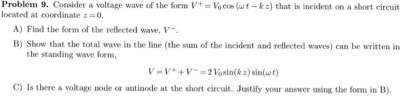
Problem 9 Consider a voltage wave of the form V Vocos (w t -k2) that is incident on a short circuit a located at coordinate 0. A) Find the form of the reflected wave, V B) Show that the total wave in the line (the sum of the incident and reflected waves) can be written in the standing wave form, V V V 2Vo sin (kz) sin (wt) C) Is there a voltage node or antinode at...
Physics of waves
Problem 9 Consider a voltage wave of the form V Vocos (w t -k2) that is incident on a short circuit a located at coordinate 0. A) Find the form of the reflected wave, V B) Show that the total wave in the line (the sum of the incident and reflected waves) can be written in the standing wave form, V V V 2Vo sin (kz) sin (wt) C) Is there a voltage node or antinode at...
 2.) Show that the fundamental theorem of divergences (aka Gauss's theorem, aka Green's theorem), shown below, holds for the (vector) function v from the previous problem. (Use the cube shown below as the basis for your work; the cube has sides of length 3.) fundamental theorem of divergences (V.v)dr v-da 24 A(v) (ii) 47 (iv) (ii) (vi) 1.) Calculate the divergence of the following (vector) function: v (xy)x +(2yz)y+ (3xz)z (NOTE: x, y, and z are Cartesian unit vectors.) 2.)...
 solve problem #1 depending on the given information
Consider the following 1D second order elliptic equation with Dirichlet boundary conditions du(x) (c(x)du ) = f(x) (a $15 b), u(a) = ga, u(b) = gb dr: where u(x) is the unknown function, ga and gb are the Dirichlet boundary values, c(x) is a given coefficient function and f(x) is a given source function. See the theorem 10.1 in the textbook for the existence and uniqueness of the solution. 1.1 Weak Formulation...
solve problem #1 depending on the given information
Consider the following 1D second order elliptic equation with Dirichlet boundary conditions du(x) (c(x)du ) = f(x) (a $15 b), u(a) = ga, u(b) = gb dr: where u(x) is the unknown function, ga and gb are the Dirichlet boundary values, c(x) is a given coefficient function and f(x) is a given source function. See the theorem 10.1 in the textbook for the existence and uniqueness of the solution. 1.1 Weak Formulation...
 Problem 6. Let V be a vector space (a) Let (--) : V x V --> R be an inner product. Prove that (-, -) is a bilinear form on V. (b) Let B = (1, ... ,T,) be a basis of V. Prove that there exists a unique inner product on V making Borthonormal. (c) Let (V) be the set of all inner products on V. By part (a), J(V) C B(V). Is J(V) a vector subspace of B(V)?...
 Q1: Consider the minimisation of the following function of two variables: f(t, z.) %3D — In(1+ 7) — Т2. Subject to the linear constraints: 2я1 + х2 < 3;B х, 22 2 0. (a) Prove that this is a convex minimisation problem (b) Write down the Karush-Kuhn-Tucker conditions for this problem. (c) Find all solutions of the above KKT conditions (d) Are the solutions you found a local or a global minimum (maximum)? Justify your answer.
Q1: Consider the minimisation...
Q1: Consider the minimisation of the following function of two variables: f(t, z.) %3D — In(1+ 7) — Т2. Subject to the linear constraints: 2я1 + х2 < 3;B х, 22 2 0. (a) Prove that this is a convex minimisation problem (b) Write down the Karush-Kuhn-Tucker conditions for this problem. (c) Find all solutions of the above KKT conditions (d) Are the solutions you found a local or a global minimum (maximum)? Justify your answer.
Q1: Consider the minimisation...
 Partial Differential Equations
1. (20 points) Consider the problem u" (x)+ u(x) (0.1) f(x) 1 (0.2) u'(0)u(0) (u'(0) + u(l)) with f(x) (10 points) a) Is the solution unique? Justify your answer (10 points) b) Does a solution exist. or is there a condition that f (x) must satisfy for existence? Justify your answer given function a
1. (20 points) Consider the problem u" (x)+ u(x) (0.1) f(x) 1 (0.2) u'(0)u(0) (u'(0) + u(l)) with f(x) (10 points) a) Is...
Partial Differential Equations
1. (20 points) Consider the problem u" (x)+ u(x) (0.1) f(x) 1 (0.2) u'(0)u(0) (u'(0) + u(l)) with f(x) (10 points) a) Is the solution unique? Justify your answer (10 points) b) Does a solution exist. or is there a condition that f (x) must satisfy for existence? Justify your answer given function a
1. (20 points) Consider the problem u" (x)+ u(x) (0.1) f(x) 1 (0.2) u'(0)u(0) (u'(0) + u(l)) with f(x) (10 points) a) Is...
 I have a problem with polarities. I can find v', v'',
v''' and the current also, but i dont know how to fix the right
sign and i get my final answer wrong when i sum them up. Can you
explain in detail how i determine the signs and polatities?
I have no problem whith the current or voltage division. Only the
signs
. Additional Circuit Analysis Techniques + v 10 v 10 10 1-2 1+3
I have a problem with polarities. I can find v', v'',
v''' and the current also, but i dont know how to fix the right
sign and i get my final answer wrong when i sum them up. Can you
explain in detail how i determine the signs and polatities?
I have no problem whith the current or voltage division. Only the
signs
. Additional Circuit Analysis Techniques + v 10 v 10 10 1-2 1+3
 I need some help on this problem.
Thank you!
15. Consider the differential equation (*) х%3D Ах + vex where v is an eigenvector of A with eigenvalue X. Suppose moreover, that A has linearly independent eigenvectors v', v2,... , v", with distinct eigenvalues Ар А, гespectively. (a) Show that (*) has no solution /(t) of the form V(t)= ae*. Hint: Write a= а у+.. +a, v. (b) Show that (*) has a solution /(t) of the form n 0)...
I need some help on this problem.
Thank you!
15. Consider the differential equation (*) х%3D Ах + vex where v is an eigenvector of A with eigenvalue X. Suppose moreover, that A has linearly independent eigenvectors v', v2,... , v", with distinct eigenvalues Ар А, гespectively. (a) Show that (*) has no solution /(t) of the form V(t)= ae*. Hint: Write a= а у+.. +a, v. (b) Show that (*) has a solution /(t) of the form n 0)...
 So the time domain for this is
v(t) = (1-cos(10pi))[u(t) - u(t-0.1)] + 2[u(t-0.1) - u(t-0.15)] +
(-40t+0.2)[u(t-0.15) - u(t-0.25)] + (-2)[u(t-0.25)-u(t-0.3)] +
(2e^(-5(t-0.3)))[u(t-0.3)]
but the equation was reduced before converting into S-domain and
it was reduced to :
v(t) = (-cos(10pi))u(t) + u(t) + cos(10pi)u(t-0.1) + u(t-0.1) -
40(t-0.1))u(t-0.15) + 40(t-0.25)u(t-0.25) + 2u(t-0.3) +
2e^(-5(t-0.3))u(t-0.3)
How do you adjust the time delay? Not sure if I understand how
it was done, if you can show and explain step by...
So the time domain for this is
v(t) = (1-cos(10pi))[u(t) - u(t-0.1)] + 2[u(t-0.1) - u(t-0.15)] +
(-40t+0.2)[u(t-0.15) - u(t-0.25)] + (-2)[u(t-0.25)-u(t-0.3)] +
(2e^(-5(t-0.3)))[u(t-0.3)]
but the equation was reduced before converting into S-domain and
it was reduced to :
v(t) = (-cos(10pi))u(t) + u(t) + cos(10pi)u(t-0.1) + u(t-0.1) -
40(t-0.1))u(t-0.15) + 40(t-0.25)u(t-0.25) + 2u(t-0.3) +
2e^(-5(t-0.3))u(t-0.3)
How do you adjust the time delay? Not sure if I understand how
it was done, if you can show and explain step by...
 Linear Algebra. Please explain each step! Thank you.
2 pts) Problem 8: In this Problem you choose either (i) or (ii) to answer: (i)Let V be a finite dimensional vector space with bases B, B', B". Prove that (ii) Accept the formula in () without deriving it and instead show that, t the formula in (i) without deriving it and instead show that, B,3'
2 pts) Problem 8: In this Problem you choose either (i) or (ii) to answer: (i)Let...
Linear Algebra. Please explain each step! Thank you.
2 pts) Problem 8: In this Problem you choose either (i) or (ii) to answer: (i)Let V be a finite dimensional vector space with bases B, B', B". Prove that (ii) Accept the formula in () without deriving it and instead show that, t the formula in (i) without deriving it and instead show that, B,3'
2 pts) Problem 8: In this Problem you choose either (i) or (ii) to answer: (i)Let...
 Physics of waves
Problem 9 Consider a voltage wave of the form V Vocos (w t -k2) that is incident on a short circuit a located at coordinate 0. A) Find the form of the reflected wave, V B) Show that the total wave in the line (the sum of the incident and reflected waves) can be written in the standing wave form, V V V 2Vo sin (kz) sin (wt) C) Is there a voltage node or antinode at...
Physics of waves
Problem 9 Consider a voltage wave of the form V Vocos (w t -k2) that is incident on a short circuit a located at coordinate 0. A) Find the form of the reflected wave, V B) Show that the total wave in the line (the sum of the incident and reflected waves) can be written in the standing wave form, V V V 2Vo sin (kz) sin (wt) C) Is there a voltage node or antinode at...
Most questions answered within 3 hours.
-
Where is the error in this code sequence?
String s1 = "Hello";
String s2 = "ello";...
asked 10 months ago -
Financial data for Joel de Paris, Inc., for last year
follow:
Joel de Paris, Inc.
Balance...
asked 10 months ago -
Consider this reaction:
Al2(SO4)3 (aq)+ BaCl3
(aq) Al2Cl6 (aq)- +
3BaSO4(s) . What is the...
asked 10 months ago -
Suppose that Savneet is considering increasing her
recent random sample from 20 car rentals to 40...
asked 10 months ago -
Trucks arrive at an unloading terminal at an average rate of 120
per hour.
Trucks arrive...
asked 10 months ago -
Why are methanol and ethanol completely soluble in water while
octanol is not very little soluble....
asked 10 months ago -
A facilities manager at a university reads in a research report
that the mean amount of...
asked 10 months ago -
When the CuSO4 is rehydrated by adding water to the anhydrous
compound, is this an endothermic...
asked 10 months ago -
A ray of sunlight is passing from diamond into crown glass; the
angle of incidence is...
asked 10 months ago -
A block of mass 0.249 kg is placed on top of a light, vertical
spring of...
asked 10 months ago -
how do the kidneys compensate in the presences of acidosis
a) trigger hyperventilate
b) reserve acid...
asked 10 months ago -
Question 501 pts
The rental rate of capital to the firm increases. Which of the
following...
asked 10 months ago