
Homework Answers

Add Answer to:
17 Use the thermodynamic data in the table below to answer the following questions pertaining to...
1. Estimate the boiling point for water at 1 atm. Please explain your choice of equation. 2. What...
 1. Estimate the boiling point for water at 1 atm. Please explain
your choice of equation.
2. What is the vapor pressure for liquid water at 50oC? Explain
your choice of equation.
In this workshop we will solve a few problems from our old exams. To solve problems in this page please use the thermodynamic data provided in the table. Estimate the boiling point for water at 1 |Name atm. Please explain your choice of equation. H2,g) O2(g) H20(g) H2O(I)...
1. Estimate the boiling point for water at 1 atm. Please explain
your choice of equation.
2. What is the vapor pressure for liquid water at 50oC? Explain
your choice of equation.
In this workshop we will solve a few problems from our old exams. To solve problems in this page please use the thermodynamic data provided in the table. Estimate the boiling point for water at 1 |Name atm. Please explain your choice of equation. H2,g) O2(g) H20(g) H2O(I)...
2. Lastly, use the table of thermodynamic functions to compute the AHo and ASo for the...
 2. Lastly, use the table of thermodynamic functions to compute the AHo and ASo for the reactions in #1. Then using AH° and AS° and your knowledge of the second law, compute which reactions are spontaneous under standard conditions. You must show all your calcualtions. (7pts) Spontaneous ASo ASuniv ΔΗ Reaction 2H2(g) + 02(g) 2H20() CO2(s)-CO2(g) K (aq)+ Cl (aq)- KCI(s) Thermodynamic Properties at 298 K AH AG Substance kJ/mol kJ/mol 3/(mol-K) Ag(s) Ag (aq) AgBr(s) AgCls) Agl(s) Cl:(g) CI(8)...
Use data from the table below to calculate the equilibrium constants at 25∘C for each reaction....
Use data from the table below to calculate the equilibrium constants at 25∘C for each reaction. Standard Thermodynamic Quantities for Selected Substances at 25∘C Substance ΔH∘f(kJ/mol) ΔG∘f(kJ/mol) S∘(J/mol⋅K) H2(g) 0 0 130.7 N2(g) 0 0 191.6 O2(g) 0 0 205.2 NO(g) 91.3 87.6 210.8 NO2(g) 33.2 51.3 240.1 CO(g) -110.5 -137.2 197.7 CO2(g) -393.5 -394.4 213.8 H2S(g) -20.6 -33.4 205.8 S2(g) 128.6 79.7 228.2 1. N2(g)+O2(g)⇌2NO(g)
Thermodynamic Data at 25 C Substance CH4 (B) (kJmol AHof 74.6 -110.5 AGof 50.5 -137.2 S...
 Thermodynamic Data at 25 C Substance CH4 (B) (kJmol AHof 74.6 -110.5 AGof 50.5 -137.2 S (Jmol 'K) 186.3 CO (B Cl2 (g) Cu (s) 197.7 223.1 33.2 42.6 Cuo (s) 157.3 -129.7 202.8 -92.3 -273.3 285.8 241.8 -173.23 -20.6 -95.3 -275.4 -237.1 -228.6 -79.9 33.4 186.9 173.8 70.0 188.8 155.6 205.8 HF H20 (9) HNO3 (1) 91.3 33.2 81.6 45.9 87.6 51.3 103.7 -16.4 191.6 210.8 240.1 220.0 192.8 NO2 (8) NH3 02 205.2 42.6 140.9 AgNO3 (s) 124.4...
Use the data from this table of thermodynamic properties to calculate the values of ASixn for...
 Use the data from this table of thermodynamic properties to calculate the values of ASixn for each reaction at 25 °C. 4NH,(g) + 70,(9) — 4NO2(g) + 6H2O(g) AS:n = J/mol K N,() + 0,(g) 2 NO(g) J/mol K Asian = MISU415) -1065.25 N2(9) N2H4(0) 50.6 N20(9) 81.6 N204(9) 11.1 N205(9) 13.3 NH3(9) -45.9 NH3(aq) -80.29 NH,+(aq) -133.3 NH4CI(S) -314.4 NH4NO3(s) -365.6 (NH2)2CO(s) -333.1 Na(s) Na+(aq) -240.3 Na2CO3(S) -1130.7 NaCl(s) -411.2 NaF(s) -576.6 NaBr(s) -361.1 Nal(s) -287.8 NaNO3(s) -467.9 NaOH(s)...
General Chemistry I! Workshop 8: Gibb's Free Energy Part I. (2 pts) Write down and balance...
 General Chemistry I! Workshop 8: Gibb's Free Energy Part I. (2 pts) Write down and balance chemical equations for (a) the reaction for burning 1 mole of hydrogen gas in oxygen to produce liquid water and (b) the reaction for burning 1 mole of liquid propane (CsHs) in oxygen to produce carbon dioxide gas and liquid water: (a) (b) Now look at the two reactions and discuss with yo group the following questions: (a) Which of these two methods of...
A.) For the decomposition of barium carbonate, consider the following thermodynamic data (Due to variations in thermody...
A.) For the decomposition of barium carbonate, consider the following thermodynamic data (Due to variations in thermodynamic values for different sources, be sure to use the given values in calculating your answer.): ΔH∘rxn 243.5kJ/mol ΔS∘rxn 172.0J/(mol⋅K) Calculate the temperature in kelvins above which this reaction is spontaneous. B.) The thermodynamic values from part A will be useful as you work through part B ΔH∘rxn243.5kJ/mol ΔS∘rxn172.0J/(mol⋅K) Calculate the equilibrium constant for the following reaction at room temperature, 25 ∘C: BaCO3(s)→BaO(s)+CO2(g)
To answer Questions 4.1-4.4, you will need the thermodynamic data pertaining to the hypothetical element "J"...
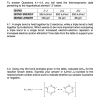 To answer Questions 4.1-4.4, you will need the thermodynamic data pertaining to the hypothetical element "J" below. JEJ BOND BOND ENERGY BOND LENGTH J-J 350 kJ/mol 160 pm J=J 600 kJ/mol 830 kJ/mol 94 pm 68 pm 4.1. A single bond is held together by 2 electrons, while a triple bond is held together by 6 electrons. Which seems to be more important when comparin a triple bond to a single bond: increased electron-electron repulsion or increased electron-proton attraction? Use...
Use data given below to calculate ΔrS∘ΔrS∘ for each of the reactions. Standard Thermodynamic Quantities for...
Use data given below to calculate ΔrS∘ΔrS∘ for each of the reactions. Standard Thermodynamic Quantities for Selected Substances at 25 ∘C∘C Substance ΔrS∘ΔrS∘, JK−1mol−1JK−1mol−1 Cr(s)Cr(s) 23.8 Cr2O3Cr2O3(s)(s) 81.2 CO(g)CO(g) 197.7 CO2(g)CO2(g) 213.8 H2(g)H2(g) 130.7 H2O(g)H2O(g) 188.8 H2O(l)H2O(l) 70.0 HNO3(aq)HNO3(aq) 146.0 N2(g)N2(g) 191.6 N2O4(g)N2O4(g) 304.4 NO(g)NO(g) 210.8 NO2(g)NO2(g) 240.1 O2(g)O2(g) 205.2 SO2(g)SO2(g) 248.2 SO3(g)SO3(g) 256.8 A) 4NO2(g)+2H2O(l)+O2(g)→4HNO3(aq) B) Cr2O3Cr2O3(s)(s) +3CO(g)→2Cr(s)+3CO2(g) C) SO2(g)SO2(g) +12O2(g)→SO3(g) D) N2O4(g)+4H2(g)→N2(g)+4H2O(g)
the second part. Use the data from this table of thermodynamic properties to calculate the values...
 the second part.
Use the data from this table of thermodynamic properties to calculate the values of AS for each of the reactions at 25°C. 2 CO(g) + O2(g) 200,(g) ASE= -173.2 N,(€) +0,(€) -> 2NO(0) ASE
the second part.
Use the data from this table of thermodynamic properties to calculate the values of AS for each of the reactions at 25°C. 2 CO(g) + O2(g) 200,(g) ASE= -173.2 N,(€) +0,(€) -> 2NO(0) ASE
 1. Estimate the boiling point for water at 1 atm. Please explain
your choice of equation.
2. What is the vapor pressure for liquid water at 50oC? Explain
your choice of equation.
In this workshop we will solve a few problems from our old exams. To solve problems in this page please use the thermodynamic data provided in the table. Estimate the boiling point for water at 1 |Name atm. Please explain your choice of equation. H2,g) O2(g) H20(g) H2O(I)...
1. Estimate the boiling point for water at 1 atm. Please explain
your choice of equation.
2. What is the vapor pressure for liquid water at 50oC? Explain
your choice of equation.
In this workshop we will solve a few problems from our old exams. To solve problems in this page please use the thermodynamic data provided in the table. Estimate the boiling point for water at 1 |Name atm. Please explain your choice of equation. H2,g) O2(g) H20(g) H2O(I)...
 2. Lastly, use the table of thermodynamic functions to compute the AHo and ASo for the reactions in #1. Then using AH° and AS° and your knowledge of the second law, compute which reactions are spontaneous under standard conditions. You must show all your calcualtions. (7pts) Spontaneous ASo ASuniv ΔΗ Reaction 2H2(g) + 02(g) 2H20() CO2(s)-CO2(g) K (aq)+ Cl (aq)- KCI(s) Thermodynamic Properties at 298 K AH AG Substance kJ/mol kJ/mol 3/(mol-K) Ag(s) Ag (aq) AgBr(s) AgCls) Agl(s) Cl:(g) CI(8)...
 Thermodynamic Data at 25 C Substance CH4 (B) (kJmol AHof 74.6 -110.5 AGof 50.5 -137.2 S (Jmol 'K) 186.3 CO (B Cl2 (g) Cu (s) 197.7 223.1 33.2 42.6 Cuo (s) 157.3 -129.7 202.8 -92.3 -273.3 285.8 241.8 -173.23 -20.6 -95.3 -275.4 -237.1 -228.6 -79.9 33.4 186.9 173.8 70.0 188.8 155.6 205.8 HF H20 (9) HNO3 (1) 91.3 33.2 81.6 45.9 87.6 51.3 103.7 -16.4 191.6 210.8 240.1 220.0 192.8 NO2 (8) NH3 02 205.2 42.6 140.9 AgNO3 (s) 124.4...
 Use the data from this table of thermodynamic properties to calculate the values of ASixn for each reaction at 25 °C. 4NH,(g) + 70,(9) — 4NO2(g) + 6H2O(g) AS:n = J/mol K N,() + 0,(g) 2 NO(g) J/mol K Asian = MISU415) -1065.25 N2(9) N2H4(0) 50.6 N20(9) 81.6 N204(9) 11.1 N205(9) 13.3 NH3(9) -45.9 NH3(aq) -80.29 NH,+(aq) -133.3 NH4CI(S) -314.4 NH4NO3(s) -365.6 (NH2)2CO(s) -333.1 Na(s) Na+(aq) -240.3 Na2CO3(S) -1130.7 NaCl(s) -411.2 NaF(s) -576.6 NaBr(s) -361.1 Nal(s) -287.8 NaNO3(s) -467.9 NaOH(s)...
 General Chemistry I! Workshop 8: Gibb's Free Energy Part I. (2 pts) Write down and balance chemical equations for (a) the reaction for burning 1 mole of hydrogen gas in oxygen to produce liquid water and (b) the reaction for burning 1 mole of liquid propane (CsHs) in oxygen to produce carbon dioxide gas and liquid water: (a) (b) Now look at the two reactions and discuss with yo group the following questions: (a) Which of these two methods of...
 To answer Questions 4.1-4.4, you will need the thermodynamic data pertaining to the hypothetical element "J" below. JEJ BOND BOND ENERGY BOND LENGTH J-J 350 kJ/mol 160 pm J=J 600 kJ/mol 830 kJ/mol 94 pm 68 pm 4.1. A single bond is held together by 2 electrons, while a triple bond is held together by 6 electrons. Which seems to be more important when comparin a triple bond to a single bond: increased electron-electron repulsion or increased electron-proton attraction? Use...
 the second part.
Use the data from this table of thermodynamic properties to calculate the values of AS for each of the reactions at 25°C. 2 CO(g) + O2(g) 200,(g) ASE= -173.2 N,(€) +0,(€) -> 2NO(0) ASE
the second part.
Use the data from this table of thermodynamic properties to calculate the values of AS for each of the reactions at 25°C. 2 CO(g) + O2(g) 200,(g) ASE= -173.2 N,(€) +0,(€) -> 2NO(0) ASE
Most questions answered within 3 hours.
-
Where is the error in this code sequence?
String s1 = "Hello";
String s2 = "ello";...
asked 10 months ago -
Financial data for Joel de Paris, Inc., for last year
follow:
Joel de Paris, Inc.
Balance...
asked 10 months ago -
Consider this reaction:
Al2(SO4)3 (aq)+ BaCl3
(aq) Al2Cl6 (aq)- +
3BaSO4(s) . What is the...
asked 10 months ago -
Suppose that Savneet is considering increasing her
recent random sample from 20 car rentals to 40...
asked 10 months ago -
Trucks arrive at an unloading terminal at an average rate of 120
per hour.
Trucks arrive...
asked 10 months ago -
Why are methanol and ethanol completely soluble in water while
octanol is not very little soluble....
asked 10 months ago -
A facilities manager at a university reads in a research report
that the mean amount of...
asked 10 months ago -
When the CuSO4 is rehydrated by adding water to the anhydrous
compound, is this an endothermic...
asked 10 months ago -
A ray of sunlight is passing from diamond into crown glass; the
angle of incidence is...
asked 10 months ago -
A block of mass 0.249 kg is placed on top of a light, vertical
spring of...
asked 10 months ago -
how do the kidneys compensate in the presences of acidosis
a) trigger hyperventilate
b) reserve acid...
asked 10 months ago -
Question 501 pts
The rental rate of capital to the firm increases. Which of the
following...
asked 10 months ago