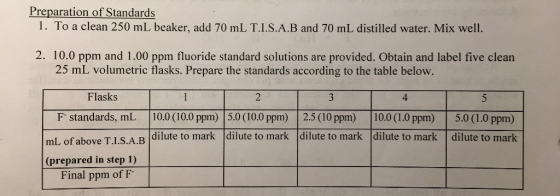
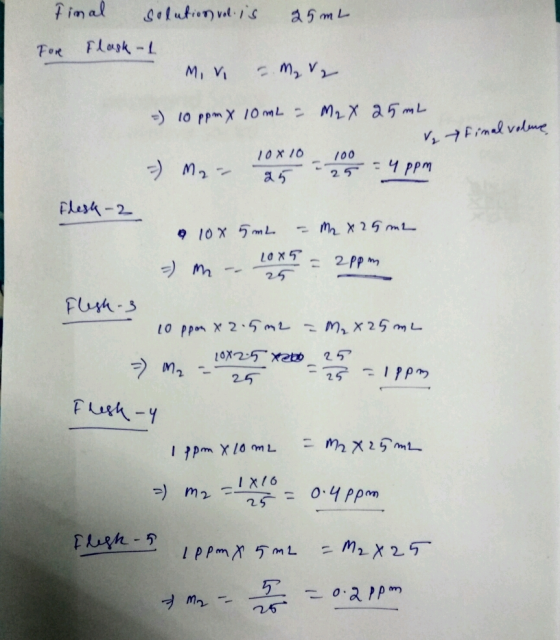
What would be the final ppm of F- in thes five stock solutions, as shown in the last row.
Homework Answers
Add Answer to:
What would be the final ppm of F- in thes five stock solutions,
as shown in...
Calculate the mass of Fe2+ in the tablet by taking the dilutions and volumes of solutions...
 Calculate the mass of Fe2+ in the tablet by taking the
dilutions and volumes of solutions used into account. The
concentration of the unknown is 2.325x10^-5M.
V. PROCEDURE Zou will be working with a partner for this experiment Part A. Initial preparation of the unknown (vitamin tablet) 1. Weigh the vitamin tablet on the Analytical Balance Then grind it to a powder with a mortar and pestle. mL beaker using 25 mL of 6 M HCI. Cover with a wa...
Calculate the mass of Fe2+ in the tablet by taking the
dilutions and volumes of solutions used into account. The
concentration of the unknown is 2.325x10^-5M.
V. PROCEDURE Zou will be working with a partner for this experiment Part A. Initial preparation of the unknown (vitamin tablet) 1. Weigh the vitamin tablet on the Analytical Balance Then grind it to a powder with a mortar and pestle. mL beaker using 25 mL of 6 M HCI. Cover with a wa...
Can you please tell me the grams i need for these 2 solutions? Thank You Weigh...
 Can you please tell me the grams i need for these 2 solutions?
Thank You
Weigh out the necessary mass of KNO3 to make 50 mL of 1.0 M supporting electrolyte solution. Transfer the KNO3 to a 50- mL volumetric flask and dilute to the mark with deionized Analyte motion water. Ensure the solid is dissolved completely before using the solution. Transfer to a small beaker. This is your supporting electrolyte solution. Weigh out the necessary mass of K3Fe(CN)6 to...
Can you please tell me the grams i need for these 2 solutions?
Thank You
Weigh out the necessary mass of KNO3 to make 50 mL of 1.0 M supporting electrolyte solution. Transfer the KNO3 to a 50- mL volumetric flask and dilute to the mark with deionized Analyte motion water. Ensure the solid is dissolved completely before using the solution. Transfer to a small beaker. This is your supporting electrolyte solution. Weigh out the necessary mass of K3Fe(CN)6 to...
How do I calculate the concentrations for my data sheet lab. I have not started my...
 How do I calculate the concentrations for my data sheet lab. I
have not started my lab yet but I just need to see how i would
calculate it with absorbance. Do i just use Beer's law or is there
any other method of solving the concentrations.
7. Weigh 1.45-1.55 g of copper(I) sulfate pentahydrate in a 50 mL beaker. 8. Dissolve the copper(II) sulfate pentahydrate in -15 mL of water 9. Add the aqueous solution of copper(II) to a...
How do I calculate the concentrations for my data sheet lab. I
have not started my lab yet but I just need to see how i would
calculate it with absorbance. Do i just use Beer's law or is there
any other method of solving the concentrations.
7. Weigh 1.45-1.55 g of copper(I) sulfate pentahydrate in a 50 mL beaker. 8. Dissolve the copper(II) sulfate pentahydrate in -15 mL of water 9. Add the aqueous solution of copper(II) to a...
THE DETERMINATION OF IRON BY SPECTROPHOTOMETRY INTRODUCTION In this experiment, the red-orange colored complex formed between...
 THE DETERMINATION OF IRON BY SPECTROPHOTOMETRY INTRODUCTION In this experiment, the red-orange colored complex formed between iron(II) and 1,10- phenanthroline (Eqn.) is used in determination of iron by spectrophotometry. Fe+3PhenH Fe(Phen)2 +3H red-orange (A 512 nm) An excess of reducing reagent, such as hydroxylamine or hydroquinone, is often used to reduce and maintain iron in +2 oxidation state. The complex, once formed, is very stable, and can be stored for a long time. Required Reading: Skoog and West (9E): Chapter...
3. Experimental Procedure, Part A.1. For preparing a set of standard solutions of FeNCS, the equilibrium...
 3. Experimental Procedure, Part A.1. For preparing a set of standard solutions of FeNCS, the equilibrium molar con- centration of FeNCS is assumed to equal the initial molar concentration of the SCN in the reaction mixture. Why is this assumption valid? A. A Set of Standard Solutions to Establish a The set of standard solutions is used to determine the absorbance of known molar con- centrations of FeNCS2. A plot of the data, known as a calibration curve, is used...
Can you answer question 4 & 5? The experiment and porcedure is posted below Question 4...
 Can
you answer question 4 & 5? The experiment and porcedure is
posted below
Question 4 & 5
CHM3120C Analytical Chemistry Lab Lab 7. Spectrophotometric Determination of Iron in Mohr's Salt with o-Phenanthroline Required Reagents and Supplies: 50 mL of 0.0005M -0.0006 M of Mohr's solution (unknown), 10 g of Hydroxylamine hydrochloride (NH2OH, HCI), 500 mL of o-phenanthroline solution (contains 0.5 g of o-phenanthroline monohydrate), 83 g of sodium acetate (NaOAc. 3H20) in 500 mL of water (for 1.2 M...
Can
you answer question 4 & 5? The experiment and porcedure is
posted below
Question 4 & 5
CHM3120C Analytical Chemistry Lab Lab 7. Spectrophotometric Determination of Iron in Mohr's Salt with o-Phenanthroline Required Reagents and Supplies: 50 mL of 0.0005M -0.0006 M of Mohr's solution (unknown), 10 g of Hydroxylamine hydrochloride (NH2OH, HCI), 500 mL of o-phenanthroline solution (contains 0.5 g of o-phenanthroline monohydrate), 83 g of sodium acetate (NaOAc. 3H20) in 500 mL of water (for 1.2 M...
Calculate the concentration of the standard HCl solution you prepared. Determine this concentration for each trial...
 Calculate the concentration of the standard HCl solution you
prepared. Determine this
concentration for each trial and the average and standard
deviation for all three trials.
Part B-Preparation and standardization of an HCl Solution 1. Before you can titrate your saturated Ca(oH)a solutions, you must prepare and standardize a dilute solution of Hcl. With a graduated cylinder measure at least 6 mL of the stock Hcl lution, transfer it to a 125 mL Erlenmeyer, and dilute to approximately 100 mL...
Calculate the concentration of the standard HCl solution you
prepared. Determine this
concentration for each trial and the average and standard
deviation for all three trials.
Part B-Preparation and standardization of an HCl Solution 1. Before you can titrate your saturated Ca(oH)a solutions, you must prepare and standardize a dilute solution of Hcl. With a graduated cylinder measure at least 6 mL of the stock Hcl lution, transfer it to a 125 mL Erlenmeyer, and dilute to approximately 100 mL...
What is the purpose of the acid added in the beginning of the experiment? CHM3120C Analytical...
 What is the purpose of the acid added in the beginning of the
experiment?
CHM3120C Analytical Chemistry Lab Lab 7. Spectrophotometric Determination of Iron in Mole's Salt with e-Phenanthroline Required Reagents and Supplies 50 mL of 0.0005 -0.0006 M of Moher's solution unknown. 10 of Hydroxylamine hydrochloride (NH2OH, HCT, 500 ml of phenantholine solution contains 05 of-phenanthroine monohydrate). 83 g of sodium acetate (NOAC3H20) in 500 ml of water (for 1.2 M of phl 5 buffer som minimum 3 of...
What is the purpose of the acid added in the beginning of the
experiment?
CHM3120C Analytical Chemistry Lab Lab 7. Spectrophotometric Determination of Iron in Mole's Salt with e-Phenanthroline Required Reagents and Supplies 50 mL of 0.0005 -0.0006 M of Moher's solution unknown. 10 of Hydroxylamine hydrochloride (NH2OH, HCT, 500 ml of phenantholine solution contains 05 of-phenanthroine monohydrate). 83 g of sodium acetate (NOAC3H20) in 500 ml of water (for 1.2 M of phl 5 buffer som minimum 3 of...
2. If you prepared a 0.15 M CH.COH - 0.15 M CHCO Na buffer, would you expect the resulting buffer capacity t...
 2. If you prepared a 0.15 M CH.COH - 0.15 M CHCO Na buffer, would you expect the resulting buffer capacity to be higher, lower, or the same as the buffer you prepared in Part II of this lab? Be specific and use your data. c. Measure the pH of the Beaker #2 solution, via a pH meter, and record in data sheet. Part II: Dilute Buffer Solution In this section, the pH of a 0.25 M CH3CO2H - 0.25...
1. In a small beaker mix together 5.0 mL of 0.10 M Co(NO3)2 . 6H2O with...
1. In a small beaker mix together 5.0 mL of 0.10 M Co(NO3)2 . 6H2O with 5.0 mL of concentrated HCl. Be sure to mix thoroughly with your glass stirring rod. This is your equilibrium mixture. 2. Place 1.0 mL of your equilibrium mixture in a small test tube add 1.0 mL of concentrated HCl. Observe any color changes and state in which direction (if any) the equilibrium shifted. Place a new 1.0 mL sample of your equilibrium mixture in...
 Calculate the mass of Fe2+ in the tablet by taking the
dilutions and volumes of solutions used into account. The
concentration of the unknown is 2.325x10^-5M.
V. PROCEDURE Zou will be working with a partner for this experiment Part A. Initial preparation of the unknown (vitamin tablet) 1. Weigh the vitamin tablet on the Analytical Balance Then grind it to a powder with a mortar and pestle. mL beaker using 25 mL of 6 M HCI. Cover with a wa...
Calculate the mass of Fe2+ in the tablet by taking the
dilutions and volumes of solutions used into account. The
concentration of the unknown is 2.325x10^-5M.
V. PROCEDURE Zou will be working with a partner for this experiment Part A. Initial preparation of the unknown (vitamin tablet) 1. Weigh the vitamin tablet on the Analytical Balance Then grind it to a powder with a mortar and pestle. mL beaker using 25 mL of 6 M HCI. Cover with a wa...
 Can you please tell me the grams i need for these 2 solutions?
Thank You
Weigh out the necessary mass of KNO3 to make 50 mL of 1.0 M supporting electrolyte solution. Transfer the KNO3 to a 50- mL volumetric flask and dilute to the mark with deionized Analyte motion water. Ensure the solid is dissolved completely before using the solution. Transfer to a small beaker. This is your supporting electrolyte solution. Weigh out the necessary mass of K3Fe(CN)6 to...
Can you please tell me the grams i need for these 2 solutions?
Thank You
Weigh out the necessary mass of KNO3 to make 50 mL of 1.0 M supporting electrolyte solution. Transfer the KNO3 to a 50- mL volumetric flask and dilute to the mark with deionized Analyte motion water. Ensure the solid is dissolved completely before using the solution. Transfer to a small beaker. This is your supporting electrolyte solution. Weigh out the necessary mass of K3Fe(CN)6 to...
 How do I calculate the concentrations for my data sheet lab. I
have not started my lab yet but I just need to see how i would
calculate it with absorbance. Do i just use Beer's law or is there
any other method of solving the concentrations.
7. Weigh 1.45-1.55 g of copper(I) sulfate pentahydrate in a 50 mL beaker. 8. Dissolve the copper(II) sulfate pentahydrate in -15 mL of water 9. Add the aqueous solution of copper(II) to a...
How do I calculate the concentrations for my data sheet lab. I
have not started my lab yet but I just need to see how i would
calculate it with absorbance. Do i just use Beer's law or is there
any other method of solving the concentrations.
7. Weigh 1.45-1.55 g of copper(I) sulfate pentahydrate in a 50 mL beaker. 8. Dissolve the copper(II) sulfate pentahydrate in -15 mL of water 9. Add the aqueous solution of copper(II) to a...
 THE DETERMINATION OF IRON BY SPECTROPHOTOMETRY INTRODUCTION In this experiment, the red-orange colored complex formed between iron(II) and 1,10- phenanthroline (Eqn.) is used in determination of iron by spectrophotometry. Fe+3PhenH Fe(Phen)2 +3H red-orange (A 512 nm) An excess of reducing reagent, such as hydroxylamine or hydroquinone, is often used to reduce and maintain iron in +2 oxidation state. The complex, once formed, is very stable, and can be stored for a long time. Required Reading: Skoog and West (9E): Chapter...
 3. Experimental Procedure, Part A.1. For preparing a set of standard solutions of FeNCS, the equilibrium molar con- centration of FeNCS is assumed to equal the initial molar concentration of the SCN in the reaction mixture. Why is this assumption valid? A. A Set of Standard Solutions to Establish a The set of standard solutions is used to determine the absorbance of known molar con- centrations of FeNCS2. A plot of the data, known as a calibration curve, is used...
 Can
you answer question 4 & 5? The experiment and porcedure is
posted below
Question 4 & 5
CHM3120C Analytical Chemistry Lab Lab 7. Spectrophotometric Determination of Iron in Mohr's Salt with o-Phenanthroline Required Reagents and Supplies: 50 mL of 0.0005M -0.0006 M of Mohr's solution (unknown), 10 g of Hydroxylamine hydrochloride (NH2OH, HCI), 500 mL of o-phenanthroline solution (contains 0.5 g of o-phenanthroline monohydrate), 83 g of sodium acetate (NaOAc. 3H20) in 500 mL of water (for 1.2 M...
Can
you answer question 4 & 5? The experiment and porcedure is
posted below
Question 4 & 5
CHM3120C Analytical Chemistry Lab Lab 7. Spectrophotometric Determination of Iron in Mohr's Salt with o-Phenanthroline Required Reagents and Supplies: 50 mL of 0.0005M -0.0006 M of Mohr's solution (unknown), 10 g of Hydroxylamine hydrochloride (NH2OH, HCI), 500 mL of o-phenanthroline solution (contains 0.5 g of o-phenanthroline monohydrate), 83 g of sodium acetate (NaOAc. 3H20) in 500 mL of water (for 1.2 M...
 Calculate the concentration of the standard HCl solution you
prepared. Determine this
concentration for each trial and the average and standard
deviation for all three trials.
Part B-Preparation and standardization of an HCl Solution 1. Before you can titrate your saturated Ca(oH)a solutions, you must prepare and standardize a dilute solution of Hcl. With a graduated cylinder measure at least 6 mL of the stock Hcl lution, transfer it to a 125 mL Erlenmeyer, and dilute to approximately 100 mL...
Calculate the concentration of the standard HCl solution you
prepared. Determine this
concentration for each trial and the average and standard
deviation for all three trials.
Part B-Preparation and standardization of an HCl Solution 1. Before you can titrate your saturated Ca(oH)a solutions, you must prepare and standardize a dilute solution of Hcl. With a graduated cylinder measure at least 6 mL of the stock Hcl lution, transfer it to a 125 mL Erlenmeyer, and dilute to approximately 100 mL...
 What is the purpose of the acid added in the beginning of the
experiment?
CHM3120C Analytical Chemistry Lab Lab 7. Spectrophotometric Determination of Iron in Mole's Salt with e-Phenanthroline Required Reagents and Supplies 50 mL of 0.0005 -0.0006 M of Moher's solution unknown. 10 of Hydroxylamine hydrochloride (NH2OH, HCT, 500 ml of phenantholine solution contains 05 of-phenanthroine monohydrate). 83 g of sodium acetate (NOAC3H20) in 500 ml of water (for 1.2 M of phl 5 buffer som minimum 3 of...
What is the purpose of the acid added in the beginning of the
experiment?
CHM3120C Analytical Chemistry Lab Lab 7. Spectrophotometric Determination of Iron in Mole's Salt with e-Phenanthroline Required Reagents and Supplies 50 mL of 0.0005 -0.0006 M of Moher's solution unknown. 10 of Hydroxylamine hydrochloride (NH2OH, HCT, 500 ml of phenantholine solution contains 05 of-phenanthroine monohydrate). 83 g of sodium acetate (NOAC3H20) in 500 ml of water (for 1.2 M of phl 5 buffer som minimum 3 of...
 2. If you prepared a 0.15 M CH.COH - 0.15 M CHCO Na buffer, would you expect the resulting buffer capacity to be higher, lower, or the same as the buffer you prepared in Part II of this lab? Be specific and use your data. c. Measure the pH of the Beaker #2 solution, via a pH meter, and record in data sheet. Part II: Dilute Buffer Solution In this section, the pH of a 0.25 M CH3CO2H - 0.25...
Most questions answered within 3 hours.
-
Where is the error in this code sequence?
String s1 = "Hello";
String s2 = "ello";...
asked 11 months ago -
Financial data for Joel de Paris, Inc., for last year
follow:
Joel de Paris, Inc.
Balance...
asked 11 months ago -
Consider this reaction:
Al2(SO4)3 (aq)+ BaCl3
(aq) Al2Cl6 (aq)- +
3BaSO4(s) . What is the...
asked 11 months ago -
Suppose that Savneet is considering increasing her
recent random sample from 20 car rentals to 40...
asked 11 months ago -
Trucks arrive at an unloading terminal at an average rate of 120
per hour.
Trucks arrive...
asked 11 months ago -
Why are methanol and ethanol completely soluble in water while
octanol is not very little soluble....
asked 11 months ago -
A facilities manager at a university reads in a research report
that the mean amount of...
asked 11 months ago -
When the CuSO4 is rehydrated by adding water to the anhydrous
compound, is this an endothermic...
asked 11 months ago -
A ray of sunlight is passing from diamond into crown glass; the
angle of incidence is...
asked 11 months ago -
A block of mass 0.249 kg is placed on top of a light, vertical
spring of...
asked 11 months ago -
how do the kidneys compensate in the presences of acidosis
a) trigger hyperventilate
b) reserve acid...
asked 11 months ago -
Question 501 pts
The rental rate of capital to the firm increases. Which of the
following...
asked 11 months ago