
Homework Answers
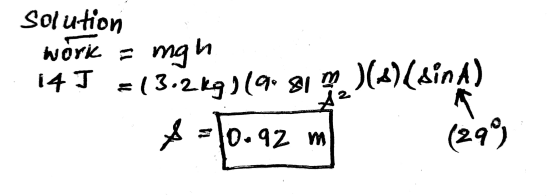
The length s AB of the ramp is 0.92m
Add Answer to:
It requires 14 J of work is needed to push a 3.2-kg object from point A...
An object with a mass, m = 5 kg, is released from rest at the top...
 An object with a mass, m = 5 kg, is released from rest at the top of the ramp. The length of the ramp is 2.3 m. The object slides down the ramp reaching a speed of 2.1 m/s at the bottom. a) If the friction force between the ramp and the object is 3 N, find the angle between the ramp and the horizontal theta (in degrees). b) What speed (in m/s) does the object reach at the bottom...
Do the two questions pls step by step work 33. (II) One 3.2-kg paint bucket is...
 Do the two questions pls step by step work
33. (II) One 3.2-kg paint bucket is hanging by a massless cord from another 3.2-kg paint bucket, also hanging by a mass- less cord, as shown in Fig. 4-37. (a) If the buckets are at rest, what is the tension in each cord? (b) If the two buckets are pulled upward with an acceleration of 1.25 m/s2 by the upper cord, calculate the tension in each cord FIGURE 4-37 Problems 33...
Do the two questions pls step by step work
33. (II) One 3.2-kg paint bucket is hanging by a massless cord from another 3.2-kg paint bucket, also hanging by a mass- less cord, as shown in Fig. 4-37. (a) If the buckets are at rest, what is the tension in each cord? (b) If the two buckets are pulled upward with an acceleration of 1.25 m/s2 by the upper cord, calculate the tension in each cord FIGURE 4-37 Problems 33...
The figure below shows an object with a mass of m = 7.40 kg that starts...
The figure below shows an object with a mass of m = 7.40 kg that starts from rest at point A and slides on a track with negligible friction. Point A is at a height of 5.90 m, point B is at a height of 3.2 m, and point C is at a height of 2.0 m. (a) What is the object's speed at 3.2 m (in m/s)? What is the object's speed at 2.0 m (in m/s)? (b) What...
What is the minimum work needed to push a 1075 kg car 330 m up along...
What is the minimum work needed to push a 1075 kg car 330 m up along a 17.5° incline? (a) Ignore friction. J (b) Assume the effective coefficient of friction retarding the car is 0.20? J
A 3.2 kg plant is hanging 35 cm from the ceiling of a porch from 2...
A 3.2 kg plant is hanging 35 cm from the ceiling of a porch from 2 thin chains whose anchor points on the ceiling are 90 cm apart. The chains are the same length and connect to the plant at the same point. A. What angle(s) do the chains make with the ceiling? B. Draw the free body diagram for the plant. Write out the Newtons’ 2nd law equations for the plant. C. What is the tension in the chains?
A 0.60 kg object travels from point A to point B. If the speed of the...
 A 0.60 kg object travels from point A to point B. If the speed of the object at point A is 5.0 m/s and the kinetic energy at point B is 8.0 J, determine the following. (a) the kinetic energy (in J) of the object at point A J (b) the speed (in m/s) of the object at point B m/s
A bead of mass m = 6.20 kg is released from point A and slides on...
A bead of mass m = 6.20 kg is released from point A and slides on the frictionless track as shown in the figure below. The height of A is ha = 6.30 m. (a) Determine the bead's speed at points B and C. point B m/s point C m/s (b) Determine the net work done by the force of gravity in moving the bead from A to C. J
8.2 A block of mass m = 5.10 kg is released from rest from point and...
 8.2
A block of mass m = 5.10 kg is released from rest from
point and slides on the
frictionless track shown in the figure below. (Let
ha = 7.40 m.)
(a) Determine the block's speed at points and .
vB
= m/s
vC
= m/s
(b) Determine the net work done by the gravitational force on the
block as it moves from point to point
.
J
8.2
A block of mass m = 5.10 kg is released from rest from
point and slides on the
frictionless track shown in the figure below. (Let
ha = 7.40 m.)
(a) Determine the block's speed at points and .
vB
= m/s
vC
= m/s
(b) Determine the net work done by the gravitational force on the
block as it moves from point to point
.
J
A bead of mass m = 7.0 kg is released from point A, where H =...
 A bead of mass m = 7.0 kg is released from point
A, where H = 7.2 m and slides on the frictionless
track shown in Figure P5.30. Determine (a) the bead's speed at
point B. (in m/s) Determine (a) the bead's speed
at point C. (in m/s) Determine the net work done by the force of
gravity in moving the bead from A to C.
(in J)
A bead of mass m = 7.0 kg is released from point
A, where H = 7.2 m and slides on the frictionless
track shown in Figure P5.30. Determine (a) the bead's speed at
point B. (in m/s) Determine (a) the bead's speed
at point C. (in m/s) Determine the net work done by the force of
gravity in moving the bead from A to C.
(in J)
A block of mass m = 6.20 kg is released from rest from point and slides...
 A block of mass m = 6.20 kg is released from rest from point and slides on the frictionless track shown in the figure below. (Assume ha = 6.10 m.) Determine the block's speed at points and point m/s point m/s Determine the net work done by the gravitational force on the block as it moves from point to point J
 An object with a mass, m = 5 kg, is released from rest at the top of the ramp. The length of the ramp is 2.3 m. The object slides down the ramp reaching a speed of 2.1 m/s at the bottom. a) If the friction force between the ramp and the object is 3 N, find the angle between the ramp and the horizontal theta (in degrees). b) What speed (in m/s) does the object reach at the bottom...
 Do the two questions pls step by step work
33. (II) One 3.2-kg paint bucket is hanging by a massless cord from another 3.2-kg paint bucket, also hanging by a mass- less cord, as shown in Fig. 4-37. (a) If the buckets are at rest, what is the tension in each cord? (b) If the two buckets are pulled upward with an acceleration of 1.25 m/s2 by the upper cord, calculate the tension in each cord FIGURE 4-37 Problems 33...
Do the two questions pls step by step work
33. (II) One 3.2-kg paint bucket is hanging by a massless cord from another 3.2-kg paint bucket, also hanging by a mass- less cord, as shown in Fig. 4-37. (a) If the buckets are at rest, what is the tension in each cord? (b) If the two buckets are pulled upward with an acceleration of 1.25 m/s2 by the upper cord, calculate the tension in each cord FIGURE 4-37 Problems 33...
 A 0.60 kg object travels from point A to point B. If the speed of the object at point A is 5.0 m/s and the kinetic energy at point B is 8.0 J, determine the following. (a) the kinetic energy (in J) of the object at point A J (b) the speed (in m/s) of the object at point B m/s
 8.2
A block of mass m = 5.10 kg is released from rest from
point and slides on the
frictionless track shown in the figure below. (Let
ha = 7.40 m.)
(a) Determine the block's speed at points and .
vB
= m/s
vC
= m/s
(b) Determine the net work done by the gravitational force on the
block as it moves from point to point
.
J
8.2
A block of mass m = 5.10 kg is released from rest from
point and slides on the
frictionless track shown in the figure below. (Let
ha = 7.40 m.)
(a) Determine the block's speed at points and .
vB
= m/s
vC
= m/s
(b) Determine the net work done by the gravitational force on the
block as it moves from point to point
.
J
 A bead of mass m = 7.0 kg is released from point
A, where H = 7.2 m and slides on the frictionless
track shown in Figure P5.30. Determine (a) the bead's speed at
point B. (in m/s) Determine (a) the bead's speed
at point C. (in m/s) Determine the net work done by the force of
gravity in moving the bead from A to C.
(in J)
A bead of mass m = 7.0 kg is released from point
A, where H = 7.2 m and slides on the frictionless
track shown in Figure P5.30. Determine (a) the bead's speed at
point B. (in m/s) Determine (a) the bead's speed
at point C. (in m/s) Determine the net work done by the force of
gravity in moving the bead from A to C.
(in J)
 A block of mass m = 6.20 kg is released from rest from point and slides on the frictionless track shown in the figure below. (Assume ha = 6.10 m.) Determine the block's speed at points and point m/s point m/s Determine the net work done by the gravitational force on the block as it moves from point to point J
Most questions answered within 3 hours.
-
Where is the error in this code sequence?
String s1 = "Hello";
String s2 = "ello";...
asked 10 months ago -
Financial data for Joel de Paris, Inc., for last year
follow:
Joel de Paris, Inc.
Balance...
asked 10 months ago -
Consider this reaction:
Al2(SO4)3 (aq)+ BaCl3
(aq) Al2Cl6 (aq)- +
3BaSO4(s) . What is the...
asked 10 months ago -
Suppose that Savneet is considering increasing her
recent random sample from 20 car rentals to 40...
asked 10 months ago -
Trucks arrive at an unloading terminal at an average rate of 120
per hour.
Trucks arrive...
asked 10 months ago -
Why are methanol and ethanol completely soluble in water while
octanol is not very little soluble....
asked 10 months ago -
A facilities manager at a university reads in a research report
that the mean amount of...
asked 10 months ago -
When the CuSO4 is rehydrated by adding water to the anhydrous
compound, is this an endothermic...
asked 10 months ago -
A ray of sunlight is passing from diamond into crown glass; the
angle of incidence is...
asked 10 months ago -
A block of mass 0.249 kg is placed on top of a light, vertical
spring of...
asked 10 months ago -
how do the kidneys compensate in the presences of acidosis
a) trigger hyperventilate
b) reserve acid...
asked 10 months ago -
Question 501 pts
The rental rate of capital to the firm increases. Which of the
following...
asked 10 months ago