
Homework Answers
a.
I/O systems:
In Operating systems management of I/O devices plays very important role and entire all I/O subsystems are devoted and run under its operation.For example we take modern computer and its parts like keyboards, disk drives, display adapters, USB devices, audio I/O, printers, network connections and other -purpose peripherals.
I/O subsystems has two types of trends.
1. For wide range of devices it is easy to add newly developed
devices to an existing systems .
2. For these types the existing standard interfaces ane difficult
and not easy to apply for the development of entirely new types of
devices.
Device frivers are nothig b ut modules and these are plugged in to an Operatinf system to handler .
1.I/O hardware:
I/O devices can be roughly categorized as storage,
communications, user-interface, and other
Devices communicate with the computer via signals sent over wires
or through the air.
Devices connect with the computer via ports, e.g. a serial or
parallel port.
A common set of wires connecting multiple devices is termed a
bus.
We can say that I/O devices are commonly defined as storage, user-interface, communications and other sets.Coming to devices these will communicate with the computer via the signals . These signals will sent over through the air and over some wires.Some devices will connect to the computer via ports.We know that we have a serial port and parallel port. The same set of wires if they connected to multiple devices known as BUS.
Polling
Polling will be very fast and efficient when only both the device and controller are fast and had a efficient and significant data to transfer.However sometimes it become inefficient when the host waits longtime in the loop which is in busy waiting for the device or if the infrequent will happen if the frequent checks will not me made.
Application I/O Interface
while application layers are presented with a common interface for all devices through layering user applications will access to a number of diffrent devices is possible and using through encapsulating all the device specific codes are in to device drivers.
B.
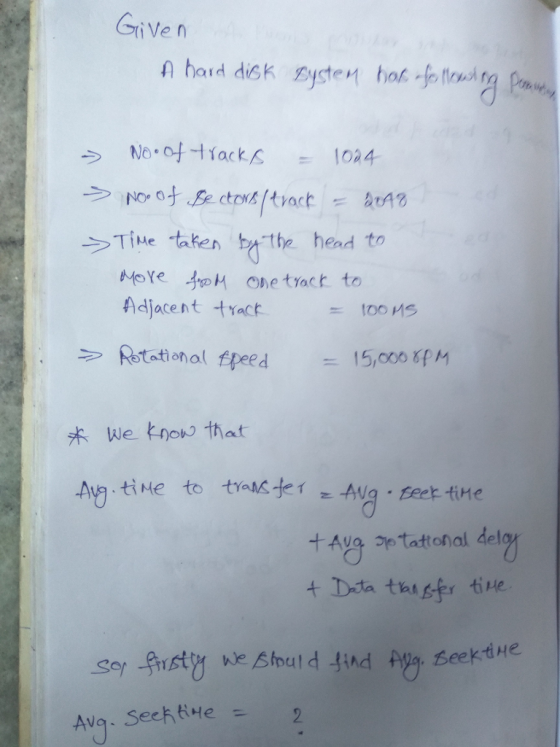
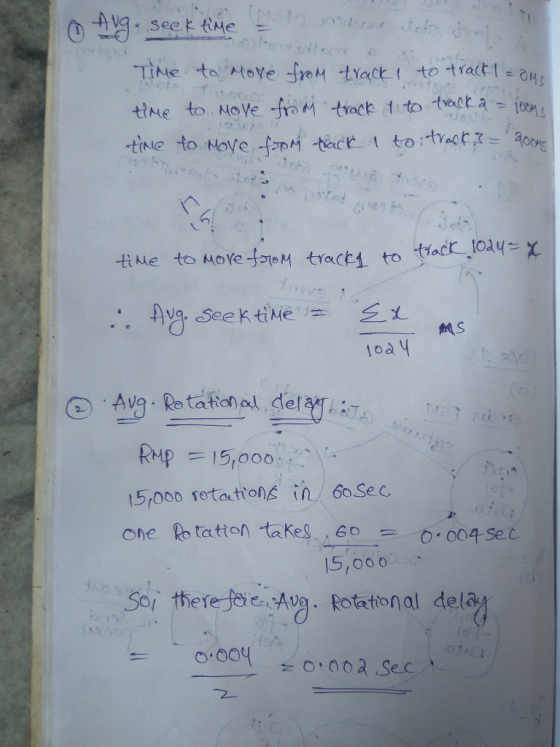
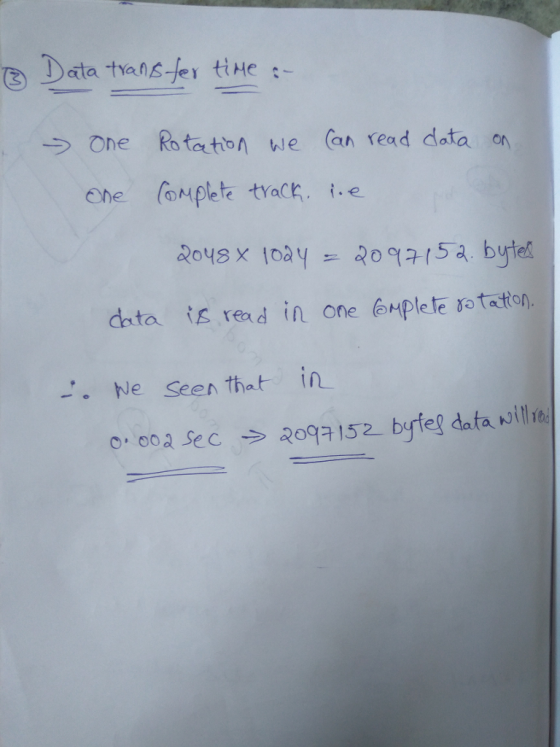
Add Answer to:
(a) Describe the three fundamental ways for performing I/O and compare their advantages and disadvantages. b)...
Consider a single-platter disk with the following parameters: rotation speed: 7200 rpm; number of...
Consider a single-platter disk with the following parameters: rotation speed: 7200 rpm; number of tracks on one side of platter: 30,000; number of sectors per track: 600; seek time: one ms for every hundred tracks traversed. Let the disk receive a request to access a random sector on a random track and assume the disk head starts at track 0. a. What is the average seek time? b. What is the average rotational latency? c. What is the transfer time...
9. a. What are the advantages of using a glass substrate for a magnetic disk? b....
 9. a. What are the advantages of using a glass substrate for a magnetic disk? b. How are data written and read onto/from a magnetic disk? c. What common characteristics are shared by all RAID levels? Describe the seven RAID levels with appropriate illustrations. Explain the term striped data. How is redundancy achieved in a RAID system? d. Consider a 4-drive, 200GB-per-drive RAID array. What is the available data storage capacity for each of the RAID levels 0, 1, 3,...
single-platter disk
Question DetailsConsider a single-platter disk with the following parameters:rotation speed: 7200 rpm; number of tracks on one side ofplatter:30,000; number of sectors per track:600;seek time: one msfor every hundred tracks traversed. Let the disk receive a requestto access a random sector on a random track and assume the diskhead starts at track0.a) What is the average seek time?b) What is the average rotational latency?c) What is the transfer time for a sector?d) What is the total average time to satisfy...
Problem 8, chapter 11-I/O Management And Disk Scheduling, Stalling Operating system
Calculate how much disk space (in sectors, tracks, and surfaces) will be requiredto store 300,000 120-byte logical records if the disk is fixed-sector with 512bytes/sector, with 96 sectors/track, 110 tracks per surface, and 8 usable surfaces.Ignore any file header record(s) and track indexes, and assume that records cannotspan two sectors.---------------------------------------------------------------------------------------------------P4Consider the disk system described in Problem 3, and assume that the disk rotatesat 360 rpm. A processor reads one sector from the disk using interrupt-driven I/O,with one interrupt per byte....
Consider a disk with a sector size of 512 bytes, 2000 tracks per surface, 50 sectors...
Consider a disk with a sector size of 512 bytes, 2000 tracks per surface, 50 sectors per track, five double-sided platters, and average seek time of 10 msec Suppose that a block size of 1024 bytes is chosen. Suppose that a file containing 100,000 records of 100 bytes each is to be stored on such a disk and that no record is allowed to span two blocks 1. Suppose the interleaving factor is 3. What time is required to read...
Question 12 Consider a magnetic disk drive with 10 double sided platters, 512(=2^9) tracks per surface,...
Question 12 Consider a magnetic disk drive with 10 double sided platters, 512(=2^9) tracks per surface, and 1024 (=2^10) sectors per track. Sector size is 2KBytes (=2^10 Bytes ). Assume the average seek time 0.02 ms, the seek time from a track to its adjacent track can be ignored. The drive rotates at 5400 rpm. Successive tracks in a cylinder can be read without head movement. Furthermore, disks can be handled independently, so multiple tracks in a cylinder can be...
Assume a rather old disk drive is configured as follows. The total storage is divided among...
Assume a rather old disk drive is configured as follows. The total storage is divided among 32 surfaces. There are 2048 tracks per sector. There are 512 sectors per track. There are 512 Bytes per sector. The interleaving factor is 4. The disk turns at 7200 rpm. The average startup time for the read/write arm is 15 ms and the average time to move the arm is 0.2 ms per track. Now assume that there is 8 MB file on...
PLEASE SOLVE ONLY 9.13 9.12 IS ONLY GIVEN FOR THE FULL EXPLANATION OF 9.13 9.12 Elementary...
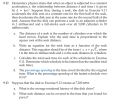 PLEASE SOLVE ONLY 9.13
9.12 IS ONLY GIVEN FOR THE FULL EXPLANATION OF
9.13
9.12 Elementary physics states that when an object is subjected to a constant acceleration a, the relationship between distance d and time t is given by d at2. Suppose that, during a seek, the disk in Exercise 9.11 accelerates the disk arm at a constant rate for the first half of the seek then decelerates the disk arm at the same rate for the second half...
PLEASE SOLVE ONLY 9.13
9.12 IS ONLY GIVEN FOR THE FULL EXPLANATION OF
9.13
9.12 Elementary physics states that when an object is subjected to a constant acceleration a, the relationship between distance d and time t is given by d at2. Suppose that, during a seek, the disk in Exercise 9.11 accelerates the disk arm at a constant rate for the first half of the seek then decelerates the disk arm at the same rate for the second half...
Suppose the daytime processing load consists of 60% CPU activity and 40% disk activity. Your customers are complaining that the system is slow. After doing some research, you have learned that you ca...
Suppose the daytime processing load consists of 60% CPU activity and 40% disk activity. Your customers are complaining that the system is slow. After doing some research, you have learned that you can upgrade your disks for $8,000 to make them 2.5 times as fast as they are currently. You have also learned that you can upgrade your CPU to make it 1.5 times as fast as the current CPU for $5,000. a. Which upgrade option would give a faster...
 9. a. What are the advantages of using a glass substrate for a magnetic disk? b. How are data written and read onto/from a magnetic disk? c. What common characteristics are shared by all RAID levels? Describe the seven RAID levels with appropriate illustrations. Explain the term striped data. How is redundancy achieved in a RAID system? d. Consider a 4-drive, 200GB-per-drive RAID array. What is the available data storage capacity for each of the RAID levels 0, 1, 3,...
 PLEASE SOLVE ONLY 9.13
9.12 IS ONLY GIVEN FOR THE FULL EXPLANATION OF
9.13
9.12 Elementary physics states that when an object is subjected to a constant acceleration a, the relationship between distance d and time t is given by d at2. Suppose that, during a seek, the disk in Exercise 9.11 accelerates the disk arm at a constant rate for the first half of the seek then decelerates the disk arm at the same rate for the second half...
PLEASE SOLVE ONLY 9.13
9.12 IS ONLY GIVEN FOR THE FULL EXPLANATION OF
9.13
9.12 Elementary physics states that when an object is subjected to a constant acceleration a, the relationship between distance d and time t is given by d at2. Suppose that, during a seek, the disk in Exercise 9.11 accelerates the disk arm at a constant rate for the first half of the seek then decelerates the disk arm at the same rate for the second half...
Most questions answered within 3 hours.
-
Where is the error in this code sequence?
String s1 = "Hello";
String s2 = "ello";...
asked 10 months ago -
Financial data for Joel de Paris, Inc., for last year
follow:
Joel de Paris, Inc.
Balance...
asked 10 months ago -
Consider this reaction:
Al2(SO4)3 (aq)+ BaCl3
(aq) Al2Cl6 (aq)- +
3BaSO4(s) . What is the...
asked 10 months ago -
Suppose that Savneet is considering increasing her
recent random sample from 20 car rentals to 40...
asked 10 months ago -
Trucks arrive at an unloading terminal at an average rate of 120
per hour.
Trucks arrive...
asked 10 months ago -
Why are methanol and ethanol completely soluble in water while
octanol is not very little soluble....
asked 10 months ago -
A facilities manager at a university reads in a research report
that the mean amount of...
asked 10 months ago -
When the CuSO4 is rehydrated by adding water to the anhydrous
compound, is this an endothermic...
asked 10 months ago -
A ray of sunlight is passing from diamond into crown glass; the
angle of incidence is...
asked 10 months ago -
A block of mass 0.249 kg is placed on top of a light, vertical
spring of...
asked 10 months ago -
how do the kidneys compensate in the presences of acidosis
a) trigger hyperventilate
b) reserve acid...
asked 10 months ago -
Question 501 pts
The rental rate of capital to the firm increases. Which of the
following...
asked 10 months ago