
Homework Answers
Add Answer to:
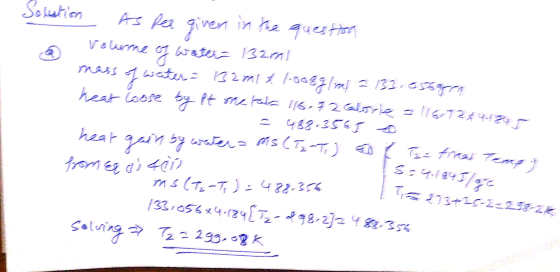
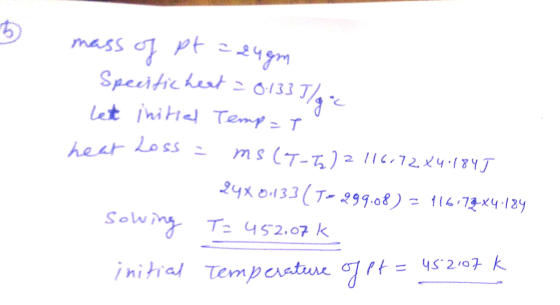
Problem 2 (10 pts) Platinum is a transition metal used by the music industry to press...
URGENT 4 pts Question 6 A 600 g piece of metal was heated to 100 °C...
 URGENT
4 pts Question 6 A 600 g piece of metal was heated to 100 °C and then put it into 100 mL of water initially at 23.7 °C). The metal and water were allowed to come to an equilibrium temperature, determined to be 278°C. Assuming no heat lost to the environment calculate the specific heat of the metal (the specific heat of water is 1.00 cal/g °C). X DE E
URGENT
4 pts Question 6 A 600 g piece of metal was heated to 100 °C and then put it into 100 mL of water initially at 23.7 °C). The metal and water were allowed to come to an equilibrium temperature, determined to be 278°C. Assuming no heat lost to the environment calculate the specific heat of the metal (the specific heat of water is 1.00 cal/g °C). X DE E
2. (15 pts) A 83.5 g sample of a metal alloy is heated to 88.1°C and...
 2. (15 pts) A 83.5 g sample of a metal alloy is heated to 88.1°C and it is then placed in a coffee-cup calorimeter containing 30.0 g water at 15.0°C. The final temperature of the metal + water is 25.3 °C. Calculate the specific heat of metal alloy, in J/(g°C), assuming no heat escapes to the surroundings or is transferred to the calorimeter. The specific heat of water is 4.184 J/(g°C).
Lab 11: Calorimetry: The Determination of the Specific Heat of a Metal directions exactly. How would...
 Lab 11: Calorimetry: The Determination of the Specific Heat of a Metal directions exactly. How would the experiment POST-LABORATORY QUESTIONS 1. In doing this experiment, a student did not follow the directions exactly. How we be affected if the following were done? a. Glass beakers were used to make the calorimeter instead of Styrofoam cups. b. Not all of the water was delivered from the 50 mL volumetric pipet to the calorimeter c. No plot of temperature was carried out....
A metal object with mass of 24.0 g is heated to 97.0 °C and then transferred...
 A metal object with mass of 24.0 g is heated to 97.0 °C and then transferred to an insulated container containing 88.5 g of water at 20.5 °C. The water temperature rises and the temperature of the metal object falls until they both reach the same final temperature of 23.2 °C. What is the specific heat of this metal object? Assume that all the heat lost by the metal object is absorbed by the water. specific heat:
Question 2 1 pts A 312 g sample of a metal is heated to 294.133 °C...
 Question 2 1 pts A 312 g sample of a metal is heated to 294.133 °C and plunged into 200 g of water at a temperature of 31.977 °C. The final temperature of the water is 87.391 °C. Assuming water has a specific heat capacity of 4.184 J/g °C, what is the specific heat capacity of the metal sample, in J/g °C)? Assume no heat loss to the surroundings. Report your response to 3 digits after the decimal.
Question 3 1 pts A 312 g sample of a metal is heated to 257.896 °C...
 Question 3 1 pts A 312 g sample of a metal is heated to 257.896 °C and plunged into 200 g of water at a temperature of 20.43 °C. The final temperature of the water is 79.548 °C. Assuming water has a specific heat capacity of 4.184 J/g °C, what is the specific heat capacity of the metal sample, in J/g °C)? Assume no heat loss to the surroundings. Report your response to 3 digits after the decimal.
A 60.5 g sample of metal at 100°C is placed into a calorimeter containing 123 mL...
A 60.5 g sample of metal at 100°C is placed into a calorimeter containing 123 mL of water at 21.3 °C. After mixing the water/metal mixture reaches a temperature of 25.2 °C. Determine the specific heat of the metal in J/g°C. Assume the calorimeter absorbs a negligible amount of heat. Specific heat of water is 4.184 J/g°C
An irregular lump of an unknown metal has a measured density of 3.84 g/mL. The metal...
An irregular lump of an unknown metal has a measured density of 3.84 g/mL. The metal is heated to a temperature of 161 °C and placed in a graduated cylinder filled with 25.0 mL of water at 25.0 °C. After the system has reached thermal equilibrium, the volume in the cylinder is read at 33.7 mL, and the temperature is recorded as 37.4 °C. What is the specific heat of the unknown metal sample? Assume no heat is lost to...
Question 4 4 pts A piece of metal with a specific heat of 1.29 J/gºC is...
 Question 4 4 pts A piece of metal with a specific heat of 1.29 J/gºC is heated to 126.6°C and then placed in 133.868 g of water which is at a temperature of 10.9 °C. After a minute, the temperature of the water has stopped changing and is now 45.6°C. Assuming that there are no heat losses to the container or surroundings, what is the mass of the piece of metal in grams? Assume that water has a specific heat...
UL. HAL IVCI U IS DIUROFIN S 2. (15 pts) A 83.5 g sample of a metal alloy is heated to 88.1°C and it is then placed...
 UL. HAL IVCI U IS DIUROFIN S 2. (15 pts) A 83.5 g sample of a metal alloy is heated to 88.1°C and it is then placed in a coffee-cup calorimeter containing 30.0 g water at 15.0°C. The final temperature of the metal + water is 25.3 "C. Calculate the specific heat of metal alloy, in J/g °C), assuming no heat escapes to the surroundings or is transferred to the calorimeter. The specific heat of water is 4.184 J/g °C)....
 URGENT
4 pts Question 6 A 600 g piece of metal was heated to 100 °C and then put it into 100 mL of water initially at 23.7 °C). The metal and water were allowed to come to an equilibrium temperature, determined to be 278°C. Assuming no heat lost to the environment calculate the specific heat of the metal (the specific heat of water is 1.00 cal/g °C). X DE E
URGENT
4 pts Question 6 A 600 g piece of metal was heated to 100 °C and then put it into 100 mL of water initially at 23.7 °C). The metal and water were allowed to come to an equilibrium temperature, determined to be 278°C. Assuming no heat lost to the environment calculate the specific heat of the metal (the specific heat of water is 1.00 cal/g °C). X DE E
 2. (15 pts) A 83.5 g sample of a metal alloy is heated to 88.1°C and it is then placed in a coffee-cup calorimeter containing 30.0 g water at 15.0°C. The final temperature of the metal + water is 25.3 °C. Calculate the specific heat of metal alloy, in J/(g°C), assuming no heat escapes to the surroundings or is transferred to the calorimeter. The specific heat of water is 4.184 J/(g°C).
 Lab 11: Calorimetry: The Determination of the Specific Heat of a Metal directions exactly. How would the experiment POST-LABORATORY QUESTIONS 1. In doing this experiment, a student did not follow the directions exactly. How we be affected if the following were done? a. Glass beakers were used to make the calorimeter instead of Styrofoam cups. b. Not all of the water was delivered from the 50 mL volumetric pipet to the calorimeter c. No plot of temperature was carried out....
 A metal object with mass of 24.0 g is heated to 97.0 °C and then transferred to an insulated container containing 88.5 g of water at 20.5 °C. The water temperature rises and the temperature of the metal object falls until they both reach the same final temperature of 23.2 °C. What is the specific heat of this metal object? Assume that all the heat lost by the metal object is absorbed by the water. specific heat:
 Question 2 1 pts A 312 g sample of a metal is heated to 294.133 °C and plunged into 200 g of water at a temperature of 31.977 °C. The final temperature of the water is 87.391 °C. Assuming water has a specific heat capacity of 4.184 J/g °C, what is the specific heat capacity of the metal sample, in J/g °C)? Assume no heat loss to the surroundings. Report your response to 3 digits after the decimal.
 Question 3 1 pts A 312 g sample of a metal is heated to 257.896 °C and plunged into 200 g of water at a temperature of 20.43 °C. The final temperature of the water is 79.548 °C. Assuming water has a specific heat capacity of 4.184 J/g °C, what is the specific heat capacity of the metal sample, in J/g °C)? Assume no heat loss to the surroundings. Report your response to 3 digits after the decimal.
 Question 4 4 pts A piece of metal with a specific heat of 1.29 J/gºC is heated to 126.6°C and then placed in 133.868 g of water which is at a temperature of 10.9 °C. After a minute, the temperature of the water has stopped changing and is now 45.6°C. Assuming that there are no heat losses to the container or surroundings, what is the mass of the piece of metal in grams? Assume that water has a specific heat...
 UL. HAL IVCI U IS DIUROFIN S 2. (15 pts) A 83.5 g sample of a metal alloy is heated to 88.1°C and it is then placed in a coffee-cup calorimeter containing 30.0 g water at 15.0°C. The final temperature of the metal + water is 25.3 "C. Calculate the specific heat of metal alloy, in J/g °C), assuming no heat escapes to the surroundings or is transferred to the calorimeter. The specific heat of water is 4.184 J/g °C)....
Most questions answered within 3 hours.
-
Where is the error in this code sequence?
String s1 = "Hello";
String s2 = "ello";...
asked 10 months ago -
Financial data for Joel de Paris, Inc., for last year
follow:
Joel de Paris, Inc.
Balance...
asked 10 months ago -
Consider this reaction:
Al2(SO4)3 (aq)+ BaCl3
(aq) Al2Cl6 (aq)- +
3BaSO4(s) . What is the...
asked 10 months ago -
Suppose that Savneet is considering increasing her
recent random sample from 20 car rentals to 40...
asked 10 months ago -
Trucks arrive at an unloading terminal at an average rate of 120
per hour.
Trucks arrive...
asked 10 months ago -
Why are methanol and ethanol completely soluble in water while
octanol is not very little soluble....
asked 10 months ago -
A facilities manager at a university reads in a research report
that the mean amount of...
asked 10 months ago -
When the CuSO4 is rehydrated by adding water to the anhydrous
compound, is this an endothermic...
asked 10 months ago -
A ray of sunlight is passing from diamond into crown glass; the
angle of incidence is...
asked 10 months ago -
A block of mass 0.249 kg is placed on top of a light, vertical
spring of...
asked 10 months ago -
how do the kidneys compensate in the presences of acidosis
a) trigger hyperventilate
b) reserve acid...
asked 10 months ago -
Question 501 pts
The rental rate of capital to the firm increases. Which of the
following...
asked 10 months ago