
Homework Answers
Add Answer to:
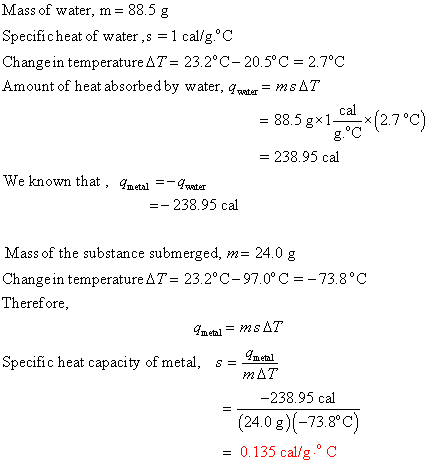
A metal object with mass of 24.0 g is heated to 97.0 °C and then transferred...
A metal object with mass of 20.8 g is heated to 97.0 °C and then transferred to an insulated container containing 8...
 A metal object with mass of 20.8 g is heated to 97.0 °C and then transferred to an insulated container containing 86.6 g of water at 20.5 °C. The water temperature rises and the temperature of the metal object falls until they both reach the same final temperature of 23.2 °C. What is the specific heat of this metal object? Assume that all the heat lost by the metal object is absorbed by the water. specific heat: cal
A metal object with mass of 20.9 g is heated to 97.0 "Cand then transferred to...
 A metal object with mass of 20.9 g is heated to 97.0 "Cand then transferred to an insulated container containing 85.1 g of water at 20.5 °C. The water temperature rises and the temperature of the metal object falls until they both reach the same temperature of 23.5 °C. What is the specific heat of this metal object? Assume that all the heat lost by the metal object is absorbed by the water specific heat: I o e
< Question 2 of 20 > A metal object with mass of 22.9 g is heated...
 < Question 2 of 20 > A metal object with mass of 22.9 g is heated to 97.0 °C and then transferred to an insulated container containing 97.2 g of water at 20.5 °C. The water temperature rises and the temperature of the metal object falls until they both reach the same final temperature of 23.5 °C. What is the specific heat of this metal object? Assume that all the heat lost by the metal object is absorbed by the...
Specific Heat Capacity A 21.5-g sample of an unknown metal is heated to 94.0°C and is...
 Specific Heat Capacity A 21.5-g sample of an unknown metal is heated to 94.0°C and is placed in a insulated container containing 128 g of water at a temperature of 21.4°C. After the metal cools, the final temperature of the metal and water is 25.0°C. Calculate the specific heat capacity of the metal, assuming that no heat escapes to the surroundings. Heat loss=Heat gained. Specific Heat Capacity of water is 4.18 J/g/K in this temperature range. Submit Answer Incompatible units....
In an experiment, 26.0 g of metal was heated to 98.0°C and then quickly transferred to...
In an experiment, 26.0 g of metal was heated to 98.0°C and then quickly transferred to 150.0 g of water in a calorimeter. The initial temperature of the water was 26.0°C, and the final temperature after the addition of the metal was 32.5°C. Assume the calorimeter behaves ideally and does not absorb or release heat. What is the value of the specific heat capacity (in J/g•°C) of the metal?
A metal sample weighing 24.000 g is heated to 100.0 degrees celsius and then transferred into a calorimeter containing 3...
A metal sample weighing 24.000 g is heated to 100.0 degrees celsius and then transferred into a calorimeter containing 30.0 mL of water at a temperature of 22.8 degrees celsius. If the specific heat of the metal is 0.105 J/g*C, what is the final temperature of the metal sample plus water?
A 24.5-g sample of an unknown metal is heated to 91.5°C and is placed in a...
A 24.5-g sample of an unknown metal is heated to 91.5°C and is placed in a perfectly insulated container along with 186.g of water at an initial temperature of 21.15°C. After a short time the temperature of both the metal and water become equal at 23.70°C. The specific Heat Capacity of water is 4.18 J/g/K in this temperature range. What is the specific heat capacity of the metal?
100 g of unknown material is heated to 80 oC, and then dropped into 50 g...
100 g of unknown material is heated to 80 oC, and then dropped into 50 g of water at 20 oC in an insulated container. The water temperature rises within a few seconds to 38 oC. What is the final temperature of the metal? Find the specific heat of the metal. Please show work
Determine the specific heat of a metal. a) A 1.500g of metal was heated to 90.00°C...
Determine the specific heat of a metal. a) A 1.500g of metal was heated to 90.00°C and transferred to a Calorimeter (qcal = 20.5 J) containing 40.00mL of water at 25.00°C, it registered an equilibrium temperature of 32.50°C.
Following the procedure in lab, a student heated their 36.353 g metal sample to 100.0°C ....
 Following the procedure in lab, a student heated their 36.353 g metal sample to 100.0°C . The metal was added to a coffee cup calorimeter containing 20.079 g of water at 21.9 *C . The final temperature of the water was 36 "С . Assuming no heat was absorbed by the calorimeter, calculate the specific heat of the metal. Report your answer in units of
 A metal object with mass of 20.8 g is heated to 97.0 °C and then transferred to an insulated container containing 86.6 g of water at 20.5 °C. The water temperature rises and the temperature of the metal object falls until they both reach the same final temperature of 23.2 °C. What is the specific heat of this metal object? Assume that all the heat lost by the metal object is absorbed by the water. specific heat: cal
 A metal object with mass of 20.9 g is heated to 97.0 "Cand then transferred to an insulated container containing 85.1 g of water at 20.5 °C. The water temperature rises and the temperature of the metal object falls until they both reach the same temperature of 23.5 °C. What is the specific heat of this metal object? Assume that all the heat lost by the metal object is absorbed by the water specific heat: I o e
 < Question 2 of 20 > A metal object with mass of 22.9 g is heated to 97.0 °C and then transferred to an insulated container containing 97.2 g of water at 20.5 °C. The water temperature rises and the temperature of the metal object falls until they both reach the same final temperature of 23.5 °C. What is the specific heat of this metal object? Assume that all the heat lost by the metal object is absorbed by the...
 Specific Heat Capacity A 21.5-g sample of an unknown metal is heated to 94.0°C and is placed in a insulated container containing 128 g of water at a temperature of 21.4°C. After the metal cools, the final temperature of the metal and water is 25.0°C. Calculate the specific heat capacity of the metal, assuming that no heat escapes to the surroundings. Heat loss=Heat gained. Specific Heat Capacity of water is 4.18 J/g/K in this temperature range. Submit Answer Incompatible units....
 Following the procedure in lab, a student heated their 36.353 g metal sample to 100.0°C . The metal was added to a coffee cup calorimeter containing 20.079 g of water at 21.9 *C . The final temperature of the water was 36 "С . Assuming no heat was absorbed by the calorimeter, calculate the specific heat of the metal. Report your answer in units of
Most questions answered within 3 hours.
-
Where is the error in this code sequence?
String s1 = "Hello";
String s2 = "ello";...
asked 11 months ago -
Financial data for Joel de Paris, Inc., for last year
follow:
Joel de Paris, Inc.
Balance...
asked 11 months ago -
Consider this reaction:
Al2(SO4)3 (aq)+ BaCl3
(aq) Al2Cl6 (aq)- +
3BaSO4(s) . What is the...
asked 11 months ago -
Suppose that Savneet is considering increasing her
recent random sample from 20 car rentals to 40...
asked 11 months ago -
Trucks arrive at an unloading terminal at an average rate of 120
per hour.
Trucks arrive...
asked 11 months ago -
Why are methanol and ethanol completely soluble in water while
octanol is not very little soluble....
asked 11 months ago -
A facilities manager at a university reads in a research report
that the mean amount of...
asked 11 months ago -
When the CuSO4 is rehydrated by adding water to the anhydrous
compound, is this an endothermic...
asked 11 months ago -
A ray of sunlight is passing from diamond into crown glass; the
angle of incidence is...
asked 11 months ago -
A block of mass 0.249 kg is placed on top of a light, vertical
spring of...
asked 11 months ago -
how do the kidneys compensate in the presences of acidosis
a) trigger hyperventilate
b) reserve acid...
asked 11 months ago -
Question 501 pts
The rental rate of capital to the firm increases. Which of the
following...
asked 11 months ago