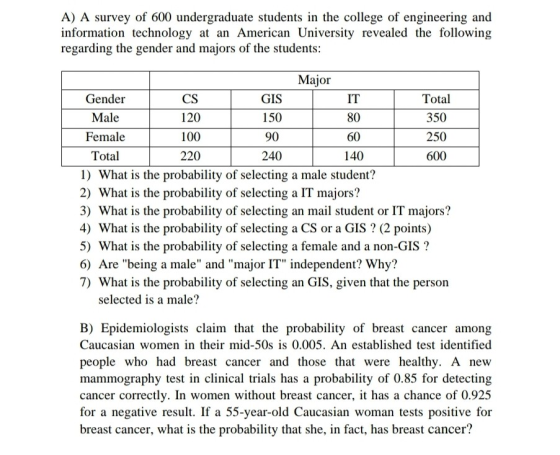
B) Epidemiologists claim that the probability of
breast cancer among
Caucasian women in their mid-50s is 0.005. An established test
identified
people who had breast cancer and those that were healthy. A
new
mammography test in clinical trials has a probability of 0.85 for
detecting
cancer correctly. In women without breast cancer, it has a chance
of 0.925
for a negative result. If a 55-year-old Caucasian woman tests
positive for
breast cancer, what is the probability that she, in fact, has
breast cancer?
Homework Answers
(A)
(1)
P(Male) = 350/600= 0.5833
(2)
P(IT) = 140/600 = 0.2333
(3)
P(Male OR IT) = P(Male) +P(IT) - P(Male AND IT)
= 350/600 + 140/600 - 80/600
= 410/600
= 0.6833
(4)
P(CS OR GIS)= P(CS) + P(GIS)
= 220/600 + 240/600
= 460/600
= 0.7667
(5)
P(Female OR Non-GIS) = P(Female) + P(Non-GIS)- P(Female AND Non-GIS)
= 250/600 + 360/600 - 160/600
= 450/600
= 0.75
(6)
P(Male) = 350/600 = 0.5833
P(IT) = 140/600 = 0.2333
P(Male) X P(IT) = 0.5833 X 0.2333 = 0.1361
P(Male AND IT) = 80/600 = 0.1333
Since P(Male) X P(IT) = 0.1361  P(Male AND IT) = 0.1333, the events "being a male" and "major IT"
are not independent.
P(Male AND IT) = 0.1333, the events "being a male" and "major IT"
are not independent.
(7)
P(GIS/ Male) = P(GIS AND Male)/ P(Male)
= 150/350
= 0.4286
(B)
From the given data, the following Table is calculated:
| Has breast cancer | Does not have breast cancer | Total | |
| Test positive | 0.005 X 0.85 = 0.00425 | 0.074625 | 0.078875 |
| Test negative | 0.00075 | 0.995 X 0.925 = 0.920375 | 0.921125 |
| Total | 0.005 | 0.995 | 1.00 |
P(Has breast cancer/ Test positive) = P(Has breast cancer AND Test positive) /P(Test positive)
=0.00425/ 0.078875
= 0.0539
So,
Answer is:
0.0539
Add Answer to:
B) Epidemiologists claim that the probability of
breast cancer among
Caucasian women in their mid-50s is...
Breast cancer is the most common non-skin malignancy among women in the United States, and it...
Breast cancer is the most common non-skin malignancy among women in the United States, and it is the second leading cause of death from cancer among women (lung cancer ranks Örst). A mammogram is a diagnostic procedure designed to quickly detect breast cancer. Such a test can exhibit two kinds of errors: One error is known as a false positive: The test incorrectly indicates cancer in a healthy woman. The other error (which is more serious error in this situation)...
About 20 women in 80,000 have breast cancer. Suppose the mammogram detecting breast cancer when a...
About 20 women in 80,000 have breast cancer. Suppose the mammogram detecting breast cancer when a woman has breast cancer is 0.90 and the mammogram detecting breast cancer on a woman who does not have breast cancer is 0.01. If a woman has breast cancer, what is the probability that the mammogram will not detect breast cancer? If the mammogram shows breast cancer, what is the probability that she truly has breast cancer? If the mammogram shows a woman has...
Approximately 3% of women aged 40-50 have breast cancer. A woman with breast cancer has a...
Approximately 3% of women aged 40-50 have breast cancer. A woman with breast cancer has a 90% chance of positive test from a mammogram, while a woman without breast cancer has a 2% chance of a positice result. What is the probability that a woman has breast cancer given that she just had a positive test?
The incidence of breast cancer varies depending on a woman's age. The National Cancer Institute gives...
 The incidence of breast cancer varies depending on a woman's age. The National Cancer Institute gives the following probabilities for a randomly chosen woman in her 40s who takes a mammography to screen for breast cancer 0.8 Positive 0.2 Negative Postive 0.9 Negative Cancer 0.0149 0.9851 No cancer A true positive happens when someone getting a mammography has cancer and recelves a positive test result. What percent of women in their 40s taking a screening mammography receive a true positive?...
Of all 40-year-old women, 8% have breast cancer. If a woman has breast cancer, a mammogram...
Of all 40-year-old women, 8% have breast cancer. If a woman has breast cancer, a mammogram with give a positive indication for cancer 80% of the time. If a woman does not have breast cancer, a mammogram will give a positive indication for cancer 2% of the time. If a 40-year-old woman’s mammogram gives a positive indication for a cancer, what is the probability that she has cancer?
Breast cancer occurs most frequently among older women. Of all age groups, women in their 60s...
Breast cancer occurs most frequently among older women. Of all age groups, women in their 60s have the highest rate of breast cancer. It is estimated that 3.7% of women in their 60s get breast cancer. Mammograms are X-ray images of the breast used to detect breast cancer. A mammogram can typically identify correctly 84.9% of cancer cases (sensitivity = 84.9%) and 95.13% of cases without cancer (specificity = 95%). (This is exactly like problem #11) First write down the...
4. Breast cancer occurs most frequently among older women, Of all age groups, women in their...
 4. Breast cancer occurs most frequently among older women, Of all age groups, women in their 60s have the highest rate of breast cancer. It is estimated that 3.7% of women in their 60s get breast cancer. Mammograms are X-ray images of the breast used to detect breast cancer. A mammogram can typically identify correctly 84.9% of cancer cases (sensitivity 84.9%) and 95.13% of cases without cancer (specificity = 95%). (This is exactly like problem #11) First write down the...
In a certain population of women 4 percent have had breast cancer (BC), 20 percent are...
In a certain population of women 4 percent have had breast cancer (BC), 20 percent are smokers (S), and 3 percent are smokers and have had breast cancer (BC ∩S). A woman is selected at random from the population. What is the probability: P(BC ∪S)? [i.e. the probability that she has had breast cancer or smokes or both?
 The incidence of breast cancer varies depending on a woman's age. The National Cancer Institute gives the following probabilities for a randomly chosen woman in her 40s who takes a mammography to screen for breast cancer 0.8 Positive 0.2 Negative Postive 0.9 Negative Cancer 0.0149 0.9851 No cancer A true positive happens when someone getting a mammography has cancer and recelves a positive test result. What percent of women in their 40s taking a screening mammography receive a true positive?...
 4. Breast cancer occurs most frequently among older women, Of all age groups, women in their 60s have the highest rate of breast cancer. It is estimated that 3.7% of women in their 60s get breast cancer. Mammograms are X-ray images of the breast used to detect breast cancer. A mammogram can typically identify correctly 84.9% of cancer cases (sensitivity 84.9%) and 95.13% of cases without cancer (specificity = 95%). (This is exactly like problem #11) First write down the...
Most questions answered within 3 hours.
-
Where is the error in this code sequence?
String s1 = "Hello";
String s2 = "ello";...
asked 10 months ago -
Financial data for Joel de Paris, Inc., for last year
follow:
Joel de Paris, Inc.
Balance...
asked 10 months ago -
Consider this reaction:
Al2(SO4)3 (aq)+ BaCl3
(aq) Al2Cl6 (aq)- +
3BaSO4(s) . What is the...
asked 10 months ago -
Suppose that Savneet is considering increasing her
recent random sample from 20 car rentals to 40...
asked 10 months ago -
Trucks arrive at an unloading terminal at an average rate of 120
per hour.
Trucks arrive...
asked 10 months ago -
Why are methanol and ethanol completely soluble in water while
octanol is not very little soluble....
asked 10 months ago -
A facilities manager at a university reads in a research report
that the mean amount of...
asked 10 months ago -
When the CuSO4 is rehydrated by adding water to the anhydrous
compound, is this an endothermic...
asked 10 months ago -
A ray of sunlight is passing from diamond into crown glass; the
angle of incidence is...
asked 10 months ago -
A block of mass 0.249 kg is placed on top of a light, vertical
spring of...
asked 10 months ago -
how do the kidneys compensate in the presences of acidosis
a) trigger hyperventilate
b) reserve acid...
asked 10 months ago -
Question 501 pts
The rental rate of capital to the firm increases. Which of the
following...
asked 10 months ago