
Homework Answers


Add Answer to:
Q2.3. (15%) Consider sending a file of F bytes over a path of Q links. Each...
03) Consider sending a file size of O bits over a path of 2 links. Suppose...
 03) Consider sending a file size of O bits over a path of 2 links. Suppose the first link can transmit at R1 bit/sec (bps) and the second link can transmit R2 bits/sec (bps) (R1+ R2), both links have a propagation delay of tp, network lightly loaded (no queuing delays), and each link's maximum frame size, S bits, is same (S < O and number of segments is integer and headers are negligible.). (a) How long does it take to...
Consider sending a large file of F bits from Host A to Host B. There are...
Consider sending a large file of F bits from Host A to Host B. There are m links (and m-1 switches) between A and B, and the links are uncongested (that is, no queueing delays). Host A segments the file into segments of S bits each and adds H bits of header to each segment, forming packets of L = H + S bits. Each link has a transmission rate of R bps. Find the value of S that minimizes...
Suppose that x bits of user data are to be transmitted over a k-hop path in...
Suppose that x bits of user data are to be transmitted over a k-hop path in a packet- switched network as a series of packets, each containing p data bits and h header bits, with x > p + h. The bit rate of the lines is b bps and the propagation delay is negligible. What value of p minimizes the total delay?
Consider sending a large file of Z bits from Host A to Host B. There are four links (and three sw...
 Consider sending a large file of Z bits from Host A to Host B. There are four links (and three switches) between A and B, and the links are uncongested (that is, no queuing delays). Host A segments the file segments of S bits each and adds 60 bits of header to each segment, forming packets of L 60S bits. Each link has a transmitting rte of R bps. Propagation delay is ρ microseconds kilometer. Consider the following distances: A...
2. (10 pts.) Consider sending a large file of F bits from Host A to Host...
 2. (10 pts.) Consider sending a large file of F bits from Host A to Host B. There are six links (and five switches) between A and B, and the links are not congested (that is, no queueing delays). Host A segments the file into segments of S bits each and adds 30 bits of header to each segment, forming packets of L 30+S bits. Each link has a transmission rate of R bps. Find the value of S that...
3. Suppose there is exactly one packet switch (or router) between a sending host and a...
3. Suppose there is exactly one packet switch (or router) between a sending host and a receiving host. The transmission rates between the sending host and the switch and between the switch and the receiving host are R1 = 1Mbps and R2 = 2Mbps, respectively. Assuming that the switch uses store-and-forward packet switching, what is the total end-to-end delay to send a packet of length 18000bits? Assume that the propagation speed is 2 * 108 meters/sec, the distance between source...
QUESTION 1 "A single router is transmitting packets, each of length L bits, over a single...
QUESTION 1 "A single router is transmitting packets, each of length L bits, over a single link with transmission rate R Mbps to another router at the other end of the link. Suppose that the packet length is L= 12000 bits, and that the link transmission rate along the link to router on the right is R = 1000 Mbps. What is the maximum number of packets per second that can be transmitted by the link (use a whole number)?"...
Consider sending a large file of Z bits from Host A to Host B. There are...
Consider sending a large file of Z bits from Host A to Host B. There are four links (and three switches) between A and B, and the links are uncogested (that is, no queuing delays). Host A segments the file segments of S bits each and adds 60 bits header to each segment, forming packets of L = 60 + s bits. Each link has a transmitting rate of R bps. Propagation delay is p microseconds/kilometer. Consider the following distances:...
Circuit Switching Consider the transfer of a file in a circuit switched network. The file is...
 Circuit Switching
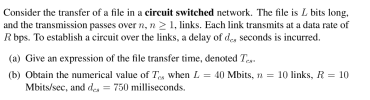
Consider the transfer of a file in a circuit switched network. The file is L bits long, and the transmission passes over n, n 2 1, links. Each link transmits at a data rate of R bps. To establish a circuit over the links, a delay of des seconds is incurred. (a) Give an expression of the file transfer time, denoted Tcs (b) Obtain the numerical value of Tos when L-40 Mbits, n-10 links, R CS. 10 Mbits/sec,...
Circuit Switching
Consider the transfer of a file in a circuit switched network. The file is L bits long, and the transmission passes over n, n 2 1, links. Each link transmits at a data rate of R bps. To establish a circuit over the links, a delay of des seconds is incurred. (a) Give an expression of the file transfer time, denoted Tcs (b) Obtain the numerical value of Tos when L-40 Mbits, n-10 links, R CS. 10 Mbits/sec,...
What happens to the time when the message is segmented? Network delay and throughput 4. [20...
 What
happens to the time when the message is segmented?
Network delay and throughput 4. [20 pts.] In a packet-switched network, the source host segments a long message into smaller packets and sends the packets into the network. The receiver then reassembles the packets back into the original message. The figure below illustrates the end-to-end transport of a message: (a) without message segmentation, and (b) with message segmentation. Assume the following: message size is M 8 × 106 bits, transmission...
What
happens to the time when the message is segmented?
Network delay and throughput 4. [20 pts.] In a packet-switched network, the source host segments a long message into smaller packets and sends the packets into the network. The receiver then reassembles the packets back into the original message. The figure below illustrates the end-to-end transport of a message: (a) without message segmentation, and (b) with message segmentation. Assume the following: message size is M 8 × 106 bits, transmission...
 03) Consider sending a file size of O bits over a path of 2 links. Suppose the first link can transmit at R1 bit/sec (bps) and the second link can transmit R2 bits/sec (bps) (R1+ R2), both links have a propagation delay of tp, network lightly loaded (no queuing delays), and each link's maximum frame size, S bits, is same (S < O and number of segments is integer and headers are negligible.). (a) How long does it take to...
 Consider sending a large file of Z bits from Host A to Host B. There are four links (and three switches) between A and B, and the links are uncongested (that is, no queuing delays). Host A segments the file segments of S bits each and adds 60 bits of header to each segment, forming packets of L 60S bits. Each link has a transmitting rte of R bps. Propagation delay is ρ microseconds kilometer. Consider the following distances: A...
 2. (10 pts.) Consider sending a large file of F bits from Host A to Host B. There are six links (and five switches) between A and B, and the links are not congested (that is, no queueing delays). Host A segments the file into segments of S bits each and adds 30 bits of header to each segment, forming packets of L 30+S bits. Each link has a transmission rate of R bps. Find the value of S that...
 Circuit Switching
Consider the transfer of a file in a circuit switched network. The file is L bits long, and the transmission passes over n, n 2 1, links. Each link transmits at a data rate of R bps. To establish a circuit over the links, a delay of des seconds is incurred. (a) Give an expression of the file transfer time, denoted Tcs (b) Obtain the numerical value of Tos when L-40 Mbits, n-10 links, R CS. 10 Mbits/sec,...
Circuit Switching
Consider the transfer of a file in a circuit switched network. The file is L bits long, and the transmission passes over n, n 2 1, links. Each link transmits at a data rate of R bps. To establish a circuit over the links, a delay of des seconds is incurred. (a) Give an expression of the file transfer time, denoted Tcs (b) Obtain the numerical value of Tos when L-40 Mbits, n-10 links, R CS. 10 Mbits/sec,...
 What
happens to the time when the message is segmented?
Network delay and throughput 4. [20 pts.] In a packet-switched network, the source host segments a long message into smaller packets and sends the packets into the network. The receiver then reassembles the packets back into the original message. The figure below illustrates the end-to-end transport of a message: (a) without message segmentation, and (b) with message segmentation. Assume the following: message size is M 8 × 106 bits, transmission...
What
happens to the time when the message is segmented?
Network delay and throughput 4. [20 pts.] In a packet-switched network, the source host segments a long message into smaller packets and sends the packets into the network. The receiver then reassembles the packets back into the original message. The figure below illustrates the end-to-end transport of a message: (a) without message segmentation, and (b) with message segmentation. Assume the following: message size is M 8 × 106 bits, transmission...
Most questions answered within 3 hours.
-
Where is the error in this code sequence?
String s1 = "Hello";
String s2 = "ello";...
asked 11 months ago -
Financial data for Joel de Paris, Inc., for last year
follow:
Joel de Paris, Inc.
Balance...
asked 11 months ago -
Consider this reaction:
Al2(SO4)3 (aq)+ BaCl3
(aq) Al2Cl6 (aq)- +
3BaSO4(s) . What is the...
asked 11 months ago -
Suppose that Savneet is considering increasing her
recent random sample from 20 car rentals to 40...
asked 11 months ago -
Trucks arrive at an unloading terminal at an average rate of 120
per hour.
Trucks arrive...
asked 11 months ago -
Why are methanol and ethanol completely soluble in water while
octanol is not very little soluble....
asked 11 months ago -
A facilities manager at a university reads in a research report
that the mean amount of...
asked 11 months ago -
When the CuSO4 is rehydrated by adding water to the anhydrous
compound, is this an endothermic...
asked 11 months ago -
A ray of sunlight is passing from diamond into crown glass; the
angle of incidence is...
asked 11 months ago -
A block of mass 0.249 kg is placed on top of a light, vertical
spring of...
asked 11 months ago -
how do the kidneys compensate in the presences of acidosis
a) trigger hyperventilate
b) reserve acid...
asked 11 months ago -
Question 501 pts
The rental rate of capital to the firm increases. Which of the
following...
asked 11 months ago