
Homework Answers
a. Demand for a certain good in US is QU(p)=100-p
When p=0,QU=100 and when QU=0,p=100
Thus, plotting price on vertical axis and quantity on horizontal axis, the demand curve for US has a vertical intercept of 100 and a horizontal intercept of 100 as shown below in the diagram.
Now, demand for a certain good in Japan is QJ(p)=150-2p
When p=0,QJ=150 and when QJ=0,p=75
Thus, plotting price on vertical axis and quantity on horizontal axis, the demand curve for japan has a vertical intercept of 75 and a horizontal intercept of 150 as shown below in the diagram.
b. Now, the aggregate demand curve is given by QA(p) = QU(p) + QJ(p)
or, QA = 100-p+150-2p
or, QA = 250-3p
For the aggregate demand curve, when p=0,QA=250 and when QA=0,p=83.33. Thus, the vertical and horizontal intercepts of the aggregate demand curve are 83.33 and 250 respectively. We have shown the aggregate demand curve on the same diagram below.
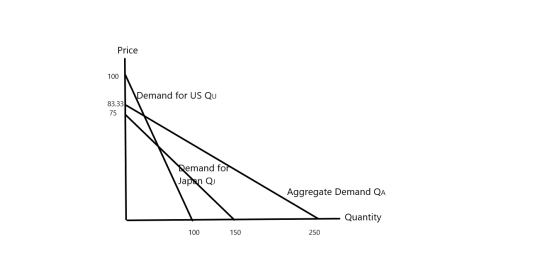
c. In the above diagram, we can find three price ranges, i.e, p=75, p=83.33 and p=100.
d. Inverse demand curve is given by p(QA) = 250/3 - QA/3.
Add Answer to:
4. (Aggregating Demand Curves and finding Inverse Demand) The demand function for a certain good is:...
For each of the following demand curves: i) Find the price-elasticity of demand in terms of...
For each of the following demand curves: i) Find the price-elasticity of demand in terms of P. ii) Determine the range of P values for which the demand curve is perfectly elastic, elastic, unitary elastic, inelastic and perfectly inelastic (your answer will look like, the demand is inelastic for 0 < P < 10, unitary elastic at P = 10, etc). iii) Calculate the price-elasticity of demand at P = 3 and give an interpretation in words of what that...
For each of the following demand curves: i) Find the price-elasticity of demand in terms of...
For each of the following demand curves: i) Find the price-elasticity of demand in terms of P. ii) Determine the range of P values for which the demand curve is perfectly elastic, elastic, unitary elastic, inelastic and perfectly inelastic (your answer will look like, the demand is inelastic for 0 < P < 10, unitary elastic at P = 10, etc). iii) Calculate the price-elasticity of demand at P = 3 and give an interpretation in words of what that...
3. For each of the following demand curves i) Find the price-elasticity of demand in terms...
 3. For each of the following demand curves i) Find the price-elasticity of demand in terms of P ii) Determine the range of P values for which the de- mand curve is perfectly elastic, elastic, unitary elas tic, inelastic and perfectly inelastic (your answer will look like, the demand is inelastic for 0< P < 10, unitary elastic at P 10, etc) iii) Calculate the price-elasticity of demand at P-3 and give an interpretation in words of what that means...
3. For each of the following demand curves i) Find the price-elasticity of demand in terms...
 3. For each of the following demand curves i) Find the price-elasticity of demand in terms of P ii) Determine the range of P values for which the de- mand curve is perfectly elastic, elastic, unitary elas tic, inelastic and perfectly inelastic (your answer will look like, the demand is inelastic for 0< P < 10, unitary elastic at P 10, etc) iii) Calculate the price-elasticity of demand at P-3 and give an interpretation in words of what that means...
I need help understanding how to graph the inverse functions. I have you all th steps but it's pa...
 I need help understanding how to graph the inverse functions. I
have you all th steps but it's part C i dont get. I dont know how
to translate the informstion into the graph so cpuld you please
shoe me step by step.
3. (25 points) The market demand function for corn is Q'(P) 5-2P and the market supply function for corn is Q(P)5P 6, where both quantities are measured in billions of bushels per year (a) (5 points) Calculate...
I need help understanding how to graph the inverse functions. I
have you all th steps but it's part C i dont get. I dont know how
to translate the informstion into the graph so cpuld you please
shoe me step by step.
3. (25 points) The market demand function for corn is Q'(P) 5-2P and the market supply function for corn is Q(P)5P 6, where both quantities are measured in billions of bushels per year (a) (5 points) Calculate...
1. There are two potential consumers for a public good. Consumer 1 has inverse demand P...
1. There are two potential consumers for a public good. Consumer 1 has inverse demand P 1 = 30 − Q, Consumer 2 has inverse demand P 2 = 60 − 3 Q, where Q is the level of provision of the public good. The marginal cost of providing the public good is 30. What is the optimal level of provision of the public good? 30 0 25 15 2. Production of widgets creates pollution: a negative externality. The marginal...
[Cournot competition with N firms] There are three identical firms in the industry. The inverse demand...
 [Cournot competition with N firms] There are three identical firms in the industry. The inverse demand function is p(Q-1-Q, where Q = q1 +92+93 denotes aggregate output. To facilitate your calculations, assume that the marginal cost for all firms is zero, c 0· 2. (a) Find the best response function for each firm. Interpret b) Compute the Cournot equilibrium. (c) Assume that two of the three firms merge (transforming the industry into a duopoly). Show that the profit of the...
1. Given the demand function Q = 500 - 3P - 2P, +0.01Y where and P...
 1. Given the demand function Q = 500 - 3P - 2P, +0.01Y where and P denote quantity and price of the good, Y is income, and price of an alternative good. is the a) If P=20, PA = 30, and Y= 5000, find (i) the price elasticity of demand (ii) the cross-price elasticity of demand (iii) the income elasticity of demand b) If income rises by 5%, calculate the corresponding percentage change in demand, Is the good inferior or...
2*. Consider a market with two firms where the inverse demand function is given by p...
2*. Consider a market with two firms where the inverse demand function is given by p = 28 - 2q and where q = q1 + q2. Each firm has the total cost function c(qi) = 4qi, where i = {1,2}. a) Compare price level, quantities and profits in this market calculating the Cournot equilibrium and the Stackelberg equilibrium. Draw a graph with best response functions and illustrate the Cournot and Stackelberg solutions in that graph. b) Compare your solutions...
2*. Consider a market with two firms where the inverse demand function is given by p...
2*. Consider a market with two firms where the inverse demand function is given by p = 28 - 2q and where q = q1 + q2. Each firm has the total cost function c(qi) = 4qi, where i = {1,2}. a) Compare price level, quantities and profits in this market calculating the Cournot equilibrium and the Stackelberg equilibrium. Draw a graph with best response functions and illustrate the Cournot and Stackelberg solutions in that graph. b) Compare your solutions...
 3. For each of the following demand curves i) Find the price-elasticity of demand in terms of P ii) Determine the range of P values for which the de- mand curve is perfectly elastic, elastic, unitary elas tic, inelastic and perfectly inelastic (your answer will look like, the demand is inelastic for 0< P < 10, unitary elastic at P 10, etc) iii) Calculate the price-elasticity of demand at P-3 and give an interpretation in words of what that means...
 3. For each of the following demand curves i) Find the price-elasticity of demand in terms of P ii) Determine the range of P values for which the de- mand curve is perfectly elastic, elastic, unitary elas tic, inelastic and perfectly inelastic (your answer will look like, the demand is inelastic for 0< P < 10, unitary elastic at P 10, etc) iii) Calculate the price-elasticity of demand at P-3 and give an interpretation in words of what that means...
 I need help understanding how to graph the inverse functions. I
have you all th steps but it's part C i dont get. I dont know how
to translate the informstion into the graph so cpuld you please
shoe me step by step.
3. (25 points) The market demand function for corn is Q'(P) 5-2P and the market supply function for corn is Q(P)5P 6, where both quantities are measured in billions of bushels per year (a) (5 points) Calculate...
I need help understanding how to graph the inverse functions. I
have you all th steps but it's part C i dont get. I dont know how
to translate the informstion into the graph so cpuld you please
shoe me step by step.
3. (25 points) The market demand function for corn is Q'(P) 5-2P and the market supply function for corn is Q(P)5P 6, where both quantities are measured in billions of bushels per year (a) (5 points) Calculate...
 [Cournot competition with N firms] There are three identical firms in the industry. The inverse demand function is p(Q-1-Q, where Q = q1 +92+93 denotes aggregate output. To facilitate your calculations, assume that the marginal cost for all firms is zero, c 0· 2. (a) Find the best response function for each firm. Interpret b) Compute the Cournot equilibrium. (c) Assume that two of the three firms merge (transforming the industry into a duopoly). Show that the profit of the...
 1. Given the demand function Q = 500 - 3P - 2P, +0.01Y where and P denote quantity and price of the good, Y is income, and price of an alternative good. is the a) If P=20, PA = 30, and Y= 5000, find (i) the price elasticity of demand (ii) the cross-price elasticity of demand (iii) the income elasticity of demand b) If income rises by 5%, calculate the corresponding percentage change in demand, Is the good inferior or...
Most questions answered within 3 hours.
-
Where is the error in this code sequence?
String s1 = "Hello";
String s2 = "ello";...
asked 10 months ago -
Financial data for Joel de Paris, Inc., for last year
follow:
Joel de Paris, Inc.
Balance...
asked 10 months ago -
Consider this reaction:
Al2(SO4)3 (aq)+ BaCl3
(aq) Al2Cl6 (aq)- +
3BaSO4(s) . What is the...
asked 10 months ago -
Suppose that Savneet is considering increasing her
recent random sample from 20 car rentals to 40...
asked 10 months ago -
Trucks arrive at an unloading terminal at an average rate of 120
per hour.
Trucks arrive...
asked 10 months ago -
Why are methanol and ethanol completely soluble in water while
octanol is not very little soluble....
asked 10 months ago -
A facilities manager at a university reads in a research report
that the mean amount of...
asked 10 months ago -
When the CuSO4 is rehydrated by adding water to the anhydrous
compound, is this an endothermic...
asked 10 months ago -
A ray of sunlight is passing from diamond into crown glass; the
angle of incidence is...
asked 10 months ago -
A block of mass 0.249 kg is placed on top of a light, vertical
spring of...
asked 10 months ago -
how do the kidneys compensate in the presences of acidosis
a) trigger hyperventilate
b) reserve acid...
asked 10 months ago -
Question 501 pts
The rental rate of capital to the firm increases. Which of the
following...
asked 10 months ago