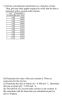
 Shown below is a concentration
vs. time plot for the reaction 2A ⇌ B. What is the value for the
equilibrium constant for this reaction?
Shown below is a concentration
vs. time plot for the reaction 2A ⇌ B. What is the value for the
equilibrium constant for this reaction?
Homework Answers
For any reaction at equilibrium:
aA ⇌bB
KC = [A]a / [B]b.
![from the given graph: at Egm. [A] = 0.02 moll, [B] = 0.05 mol/L 0.05 1) 125 morte 2 [B] [A]² (0.02)](http://img.homeworklib.com/questions/dd9ee360-a154-11eb-9435-9bbb58c9f280.png?x-oss-process=image/resize,w_560)
Add Answer to:
Shown below is a concentration
vs. time plot for the reaction 2A ⇌ B. What is...
(a) (3 pts.) Shown below is plot of concentration as a function of time for the...
 (a) (3 pts.) Shown below is plot of concentration as a function of time for the reaction A = B. What is the value of the equilibrium constant (Kc) for this reaction? 0.100 0.080 0.060 B 0.040 Concentration (M) A 0.020 0.000 0.00 1.00 2.00 3.00 4.00 5.00 Time (min) (b) (4 pts.) The following pictures represent the equilibrium state for four different reactions of the type A, + X 2 2 AX (X=B, C, D, E) A atoms are...
For the reaction 2A → 2B a plot of 1/[A] vs time is linear with a...
For the reaction 2A → 2B a plot of 1/[A] vs time is linear with a slope of 0.0782 M-1s-1. This reaction is initiated with [A]0=0.573 M and [B] = 0.000 M. What is the concentration of B after 75.1 seconds?
Shown below is a concentration vs. time plot for the reaction A leftrightarrow 2B. For this...
 Shown below is a concentration vs. time plot for the reaction A leftrightarrow 2B. For this reaction the value of the equilibrium constant is K_c < 1. K_c = 0. K_c = 1. K_c > 1.
please help with parts a-c (a) (3 pts) Shown below is plot of concentration as a...
 please help with parts a-c
(a) (3 pts) Shown below is plot of concentration as a function of time for the reaction A B. What is the value of the equilibrium constant (K) for this reaction? 190 30.000 0.040 A Concentration (M) 0020 6000 1.00 3.00 0.00 (b) (4 pts.) The following pictures represent the equilibrium state for four different reactions of the type A, + x = 2 Ax (X-B, C, D, E) 2x A atoms are unshaded. X...
please help with parts a-c
(a) (3 pts) Shown below is plot of concentration as a function of time for the reaction A B. What is the value of the equilibrium constant (K) for this reaction? 190 30.000 0.040 A Concentration (M) 0020 6000 1.00 3.00 0.00 (b) (4 pts.) The following pictures represent the equilibrium state for four different reactions of the type A, + x = 2 Ax (X-B, C, D, E) 2x A atoms are unshaded. X...
Plot the concentrations listed below as a function of time. Then, plot any other graphs required...
Plot the concentrations listed below as a function of time. Then, plot any other graphs required to verify that the data is consistent with a second-order reaction. time Concentration (in minutes) (in moles / liter) 0.00 1.0000 1.00 0.8696 2.00 0.7692 3.00 0.6896 4.00 0.6250 5.00 0.5714 6.00 0.5263 7.00 0.4878 8.00 0.4545 9.00 0.4255 10.00 0.4000 (b) Determine the value of the rate constant k. Write an expression for the rate law. (c) Determine the time at which [A]...
2. Plot the concentrations listed below as a function of time. Then, plot any other graphs...
 2. Plot the concentrations listed below as a function of time. Then, plot any other graphs required to verify that the data is consistent with a second-order reaction. time Concentration (in minutes)(in moles/liter) 0.00 1.0000 1.00 0.8696 2.00 0.7692 3.00 0.6896 4.00 0.6250 5.00 0.5714 6.00 0.5263 7.00 0.4878 8.00 0.4545 9.00 0.4255 10.00 0.40001 (b) Determine the value of the rate constant k. Write an expression for the rate law. (c) Determine the time at which [A] =0.500 mol/L....
Suppose a solution of Co(NO3)2 has an extinction coefficient of 5.1 L/mol-cm at 505nm. On the graph provided, plot a gr...
Suppose a solution of Co(NO3)2 has an extinction coefficient of 5.1 L/mol-cm at 505nm. On the graph provided, plot a graph of A versus C (mol/L) for solutions of 0.020, 0.040, 0.060, 0.080, and 0.100 M Co(NO3)2 in a 1.00 cm cell. On the same graph, plot the percent transmittance, %T, of each solution versus concentration.
1. (a) Plot the concentrations listed below as a function of time. Then, plot any other...
 1. (a) Plot the concentrations listed below as a function of time. Then, plot any other graphs required to verify that the data is consistent with a first-order reaction. time concentration (in minutes) (in moles / liter) 0.00 1.0000 1.00 0.8607 2.00 0.7408 3.00 0.6376 4.00 0.5488 5.00 0.4724 6.00 0.4066 7.00 0.3499 8.00 0.3012 9.00 0.2592 10.00 0.2331 (b) Determine the value of the rate constant k. Write an expression for the rate law. (c) Determine the time at...
(a) Plot the concentrations listed below as a function of time. Then, plot any other graphs...
(a) Plot the concentrations listed below as a function of time. Then, plot any other graphs required to verify that the data is consistent with a first-order reaction. time concentration (in minutes) (in moles / liter) 0.00 1.0000 1.00 0.8607 2.00 0.7408 3.00 0.6376 4.00 0.5488 5.00 0.4724 6.00 0.4066 7.00 0.3499 8.00 0.3012 9.00 0.2592 10.00 0.2331 (b) Determine the value of the rate constant k. Write an expression for the rate law. (c) Determine the time at which...
The plot below shows the velocity vs. time for an object moving along the x axis....
 The plot below shows the velocity vs. time for an object moving
along the x axis. The object is initially at position x = 0 at time
t = 0. Assume two significant figures for your graph
values.
a. Find an equation for the velocity v(t)
2. The plot below shows the velocity vs. time for an object moving along the x axis. The object is initially at position x = 0 at time t = 0, Assume two significant...
The plot below shows the velocity vs. time for an object moving
along the x axis. The object is initially at position x = 0 at time
t = 0. Assume two significant figures for your graph
values.
a. Find an equation for the velocity v(t)
2. The plot below shows the velocity vs. time for an object moving along the x axis. The object is initially at position x = 0 at time t = 0, Assume two significant...
 (a) (3 pts.) Shown below is plot of concentration as a function of time for the reaction A = B. What is the value of the equilibrium constant (Kc) for this reaction? 0.100 0.080 0.060 B 0.040 Concentration (M) A 0.020 0.000 0.00 1.00 2.00 3.00 4.00 5.00 Time (min) (b) (4 pts.) The following pictures represent the equilibrium state for four different reactions of the type A, + X 2 2 AX (X=B, C, D, E) A atoms are...
 Shown below is a concentration vs. time plot for the reaction A leftrightarrow 2B. For this reaction the value of the equilibrium constant is K_c < 1. K_c = 0. K_c = 1. K_c > 1.
 please help with parts a-c
(a) (3 pts) Shown below is plot of concentration as a function of time for the reaction A B. What is the value of the equilibrium constant (K) for this reaction? 190 30.000 0.040 A Concentration (M) 0020 6000 1.00 3.00 0.00 (b) (4 pts.) The following pictures represent the equilibrium state for four different reactions of the type A, + x = 2 Ax (X-B, C, D, E) 2x A atoms are unshaded. X...
please help with parts a-c
(a) (3 pts) Shown below is plot of concentration as a function of time for the reaction A B. What is the value of the equilibrium constant (K) for this reaction? 190 30.000 0.040 A Concentration (M) 0020 6000 1.00 3.00 0.00 (b) (4 pts.) The following pictures represent the equilibrium state for four different reactions of the type A, + x = 2 Ax (X-B, C, D, E) 2x A atoms are unshaded. X...
 2. Plot the concentrations listed below as a function of time. Then, plot any other graphs required to verify that the data is consistent with a second-order reaction. time Concentration (in minutes)(in moles/liter) 0.00 1.0000 1.00 0.8696 2.00 0.7692 3.00 0.6896 4.00 0.6250 5.00 0.5714 6.00 0.5263 7.00 0.4878 8.00 0.4545 9.00 0.4255 10.00 0.40001 (b) Determine the value of the rate constant k. Write an expression for the rate law. (c) Determine the time at which [A] =0.500 mol/L....
 1. (a) Plot the concentrations listed below as a function of time. Then, plot any other graphs required to verify that the data is consistent with a first-order reaction. time concentration (in minutes) (in moles / liter) 0.00 1.0000 1.00 0.8607 2.00 0.7408 3.00 0.6376 4.00 0.5488 5.00 0.4724 6.00 0.4066 7.00 0.3499 8.00 0.3012 9.00 0.2592 10.00 0.2331 (b) Determine the value of the rate constant k. Write an expression for the rate law. (c) Determine the time at...
 The plot below shows the velocity vs. time for an object moving
along the x axis. The object is initially at position x = 0 at time
t = 0. Assume two significant figures for your graph
values.
a. Find an equation for the velocity v(t)
2. The plot below shows the velocity vs. time for an object moving along the x axis. The object is initially at position x = 0 at time t = 0, Assume two significant...
The plot below shows the velocity vs. time for an object moving
along the x axis. The object is initially at position x = 0 at time
t = 0. Assume two significant figures for your graph
values.
a. Find an equation for the velocity v(t)
2. The plot below shows the velocity vs. time for an object moving along the x axis. The object is initially at position x = 0 at time t = 0, Assume two significant...
Most questions answered within 3 hours.
-
Where is the error in this code sequence?
String s1 = "Hello";
String s2 = "ello";...
asked 1 year ago -
Financial data for Joel de Paris, Inc., for last year
follow:
Joel de Paris, Inc.
Balance...
asked 1 year ago -
Consider this reaction:
Al2(SO4)3 (aq)+ BaCl3
(aq) Al2Cl6 (aq)- +
3BaSO4(s) . What is the...
asked 1 year ago -
Suppose that Savneet is considering increasing her
recent random sample from 20 car rentals to 40...
asked 1 year ago -
Trucks arrive at an unloading terminal at an average rate of 120
per hour.
Trucks arrive...
asked 1 year ago -
Why are methanol and ethanol completely soluble in water while
octanol is not very little soluble....
asked 1 year ago -
A facilities manager at a university reads in a research report
that the mean amount of...
asked 1 year ago -
When the CuSO4 is rehydrated by adding water to the anhydrous
compound, is this an endothermic...
asked 1 year ago -
A ray of sunlight is passing from diamond into crown glass; the
angle of incidence is...
asked 1 year ago -
A block of mass 0.249 kg is placed on top of a light, vertical
spring of...
asked 1 year ago -
how do the kidneys compensate in the presences of acidosis
a) trigger hyperventilate
b) reserve acid...
asked 1 year ago -
Question 501 pts
The rental rate of capital to the firm increases. Which of the
following...
asked 1 year ago