![A function is continuous on the closed, bounded interval [-2, 1] , and differentiable on the open interval (-2,1)Given that f](http://img.homeworklib.com/questions/23b1ded0-a18e-11eb-b528-d1dfbe4e6382.png?x-oss-process=image/resize,w_560)
Homework Answers

Add Answer to:
A function is continuous on the closed, bounded interval [-2, 1] , and differentiable on the...
(a) Suppose f is continuously differentiable on the closed and bounded interval I = [0, 1]....
 (a) Suppose f is continuously differentiable on the closed and bounded interval I = [0, 1]. Show that f is uniformly continuous on I. (b) Suppose g is continuously differentiable on the open interval J = (0,1). Give and example of such a function which is NOT uniformly continuous on J, and prove your answer.
2. Let I be an interval and let f be a function which is differentiable on...
 2. Let I be an interval and let f be a function which is differentiable on I. Prove that if f' is bounded on I then f is uniformly continuous on I. 3. Give an example to show that the converse of the result in the previous question is false, i.e., give an example of a function which is differentiable and uniformly continuous on an interval but whose derivative is not bounded. (Proofs for your assertions are necessary, unless they...
4. The function f is continuous on the closed interval (-2, 1). Some values of f...
 4. The function f is continuous on the closed interval (-2, 1). Some values of f are shown in the table below. --2 f(x) -3 -1 0 1 7 k3 The equation f(x) = 3 must have at least two solutions in the interval [-1,1) if k = a. 1 b. C. 2 CONN NICO d. 5. If k(r) is a continuous function over the interval (-2, 4) such that k(-2) = 3 and k(4) = 1, then k(2) 0...
2. Let f: R R be a continuous function. Suppose that f is differentiable on R\{0} and that there exists an L e R such that lim,of,(z) = L. Prove that f is differentiable at 1-0 with f,(0) = L. (Hint:...
 2. Let f: R R be a continuous function. Suppose that f is differentiable on R\{0} and that there exists an L e R such that lim,of,(z) = L. Prove that f is differentiable at 1-0 with f,(0) = L. (Hint: Use the definition of derivative and then use mean value theorem)
2. Let f: R R be a continuous function. Suppose that f is differentiable on R\{0} and that there exists an L e R such that lim,of,(z) =...
2. Let f: R R be a continuous function. Suppose that f is differentiable on R\{0} and that there exists an L e R such that lim,of,(z) = L. Prove that f is differentiable at 1-0 with f,(0) = L. (Hint: Use the definition of derivative and then use mean value theorem)
2. Let f: R R be a continuous function. Suppose that f is differentiable on R\{0} and that there exists an L e R such that lim,of,(z) =...
Let f be the function given by f () = on the closed interval [-7,7]. Of...
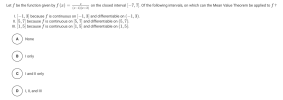 Let f be the function given by f () = on the closed interval [-7,7]. Of the following intervals, on which can the Mean Value Theorem be applied to f? 11-1, 3 because f is continuous on (-1,3] and differentiable on (-1,3). II. [5, 7 because f is continuous on 5,7] and differentiable on (5,7). III. (1,5) because f is continuous on (1,5) and differentiable on (1,5). None © anal only
Graph of A continuous function fis defined on the closed interval - 4sxs6. The graph of...
 Graph of A continuous function fis defined on the closed interval - 4sxs6. The graph of consists of a line segment and a curve that is tangent to the x-axis at x-3, as shown in the figure above. On th interval Dexc6, the function fis twice differentiable, with f(x)>0. Is there a value of a -4sach, for which the Mean Value Theorem applied to the interval (a 6), guarantees a value ca cx6, at which f'(c) = ? Justify your...
Let f be defined on an open interval I containing a point a (1) Prove that if f is differentiable on I and f"(a) exists, then lim h-+0 (a 2 h2 (2) Prove that if f is continuous at a and there...
 Let f be defined on an open interval I containing a point a (1) Prove that if f is differentiable on I and f"(a) exists, then lim h-+0 (a 2 h2 (2) Prove that if f is continuous at a and there exist constants α and β such that the limit L := lim h2 exists, then f(a)-α and f'(a)-β. Does f"(a) exist and equal to 2L?
Let f be defined on an open interval I containing a point a...
Let f be defined on an open interval I containing a point a (1) Prove that if f is differentiable on I and f"(a) exists, then lim h-+0 (a 2 h2 (2) Prove that if f is continuous at a and there exist constants α and β such that the limit L := lim h2 exists, then f(a)-α and f'(a)-β. Does f"(a) exist and equal to 2L?
Let f be defined on an open interval I containing a point a...
3. (12) If the function below is continuous and differentiable everywhere within the interval [-3, 3),...
 3. (12) If the function below is continuous and differentiable everywhere within the interval [-3, 3), sketch the graph which satisfies the following conditions: f(-3) = 0, f(-2) = 3, f(-1) = 2, f(1) = -1, f(3) = -2 f'(-2)=0 f'(x) >0 on (-3,-2), f'(x) <0 on (-2, 3) f"(x) > 0 on (-1, 1), f '(x) <0 on (-3,-1) U(1, 3)
3. (12) If the function below is continuous and differentiable everywhere within the interval (-3, 3),...
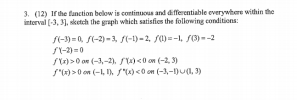 3. (12) If the function below is continuous and differentiable everywhere within the interval (-3, 3), sketch the graph which satisfies the following conditions: f(-3) = 0, f(-2) = 3, f(-1) = 2, f(1) = -1, S (3) = -2 f'(-2) = 0 f'(x) > 0 on (-3,-2), f '(x) <0 on (-2, 3) f"(x) > 0 on (-1, 1), f '(x) <0 on (-3,-1) (1, 3)
7.7.4 The hypotheses of Theorem 7.24 require that f be differentiable on all of the interval I. Y...
 7.7.4 The hypotheses of Theorem 7.24 require that f be differentiable on all of the interval I. You might think that a positive derivative at a single point also implies that the function is increasing, at least in a neighborhood of that point. This is not true. Consider the function /(z) _{0,/2 + ra sin.ri. if 0 (e) Prove that if a function F is differentiable on a neighborhood of ro with F(ro)0 and F is continuous at zo, then...
 (a) Suppose f is continuously differentiable on the closed and bounded interval I = [0, 1]. Show that f is uniformly continuous on I. (b) Suppose g is continuously differentiable on the open interval J = (0,1). Give and example of such a function which is NOT uniformly continuous on J, and prove your answer.
 2. Let I be an interval and let f be a function which is differentiable on I. Prove that if f' is bounded on I then f is uniformly continuous on I. 3. Give an example to show that the converse of the result in the previous question is false, i.e., give an example of a function which is differentiable and uniformly continuous on an interval but whose derivative is not bounded. (Proofs for your assertions are necessary, unless they...
 4. The function f is continuous on the closed interval (-2, 1). Some values of f are shown in the table below. --2 f(x) -3 -1 0 1 7 k3 The equation f(x) = 3 must have at least two solutions in the interval [-1,1) if k = a. 1 b. C. 2 CONN NICO d. 5. If k(r) is a continuous function over the interval (-2, 4) such that k(-2) = 3 and k(4) = 1, then k(2) 0...
 2. Let f: R R be a continuous function. Suppose that f is differentiable on R\{0} and that there exists an L e R such that lim,of,(z) = L. Prove that f is differentiable at 1-0 with f,(0) = L. (Hint: Use the definition of derivative and then use mean value theorem)
2. Let f: R R be a continuous function. Suppose that f is differentiable on R\{0} and that there exists an L e R such that lim,of,(z) =...
2. Let f: R R be a continuous function. Suppose that f is differentiable on R\{0} and that there exists an L e R such that lim,of,(z) = L. Prove that f is differentiable at 1-0 with f,(0) = L. (Hint: Use the definition of derivative and then use mean value theorem)
2. Let f: R R be a continuous function. Suppose that f is differentiable on R\{0} and that there exists an L e R such that lim,of,(z) =...
 Let f be the function given by f () = on the closed interval [-7,7]. Of the following intervals, on which can the Mean Value Theorem be applied to f? 11-1, 3 because f is continuous on (-1,3] and differentiable on (-1,3). II. [5, 7 because f is continuous on 5,7] and differentiable on (5,7). III. (1,5) because f is continuous on (1,5) and differentiable on (1,5). None © anal only
 Graph of A continuous function fis defined on the closed interval - 4sxs6. The graph of consists of a line segment and a curve that is tangent to the x-axis at x-3, as shown in the figure above. On th interval Dexc6, the function fis twice differentiable, with f(x)>0. Is there a value of a -4sach, for which the Mean Value Theorem applied to the interval (a 6), guarantees a value ca cx6, at which f'(c) = ? Justify your...
 Let f be defined on an open interval I containing a point a (1) Prove that if f is differentiable on I and f"(a) exists, then lim h-+0 (a 2 h2 (2) Prove that if f is continuous at a and there exist constants α and β such that the limit L := lim h2 exists, then f(a)-α and f'(a)-β. Does f"(a) exist and equal to 2L?
Let f be defined on an open interval I containing a point a...
Let f be defined on an open interval I containing a point a (1) Prove that if f is differentiable on I and f"(a) exists, then lim h-+0 (a 2 h2 (2) Prove that if f is continuous at a and there exist constants α and β such that the limit L := lim h2 exists, then f(a)-α and f'(a)-β. Does f"(a) exist and equal to 2L?
Let f be defined on an open interval I containing a point a...
 3. (12) If the function below is continuous and differentiable everywhere within the interval [-3, 3), sketch the graph which satisfies the following conditions: f(-3) = 0, f(-2) = 3, f(-1) = 2, f(1) = -1, f(3) = -2 f'(-2)=0 f'(x) >0 on (-3,-2), f'(x) <0 on (-2, 3) f"(x) > 0 on (-1, 1), f '(x) <0 on (-3,-1) U(1, 3)
 3. (12) If the function below is continuous and differentiable everywhere within the interval (-3, 3), sketch the graph which satisfies the following conditions: f(-3) = 0, f(-2) = 3, f(-1) = 2, f(1) = -1, S (3) = -2 f'(-2) = 0 f'(x) > 0 on (-3,-2), f '(x) <0 on (-2, 3) f"(x) > 0 on (-1, 1), f '(x) <0 on (-3,-1) (1, 3)
 7.7.4 The hypotheses of Theorem 7.24 require that f be differentiable on all of the interval I. You might think that a positive derivative at a single point also implies that the function is increasing, at least in a neighborhood of that point. This is not true. Consider the function /(z) _{0,/2 + ra sin.ri. if 0 (e) Prove that if a function F is differentiable on a neighborhood of ro with F(ro)0 and F is continuous at zo, then...
Most questions answered within 3 hours.
-
Where is the error in this code sequence?
String s1 = "Hello";
String s2 = "ello";...
asked 11 months ago -
Financial data for Joel de Paris, Inc., for last year
follow:
Joel de Paris, Inc.
Balance...
asked 11 months ago -
Consider this reaction:
Al2(SO4)3 (aq)+ BaCl3
(aq) Al2Cl6 (aq)- +
3BaSO4(s) . What is the...
asked 11 months ago -
Suppose that Savneet is considering increasing her
recent random sample from 20 car rentals to 40...
asked 11 months ago -
Trucks arrive at an unloading terminal at an average rate of 120
per hour.
Trucks arrive...
asked 11 months ago -
Why are methanol and ethanol completely soluble in water while
octanol is not very little soluble....
asked 11 months ago -
A facilities manager at a university reads in a research report
that the mean amount of...
asked 11 months ago -
When the CuSO4 is rehydrated by adding water to the anhydrous
compound, is this an endothermic...
asked 11 months ago -
A ray of sunlight is passing from diamond into crown glass; the
angle of incidence is...
asked 11 months ago -
A block of mass 0.249 kg is placed on top of a light, vertical
spring of...
asked 11 months ago -
how do the kidneys compensate in the presences of acidosis
a) trigger hyperventilate
b) reserve acid...
asked 11 months ago -
Question 501 pts
The rental rate of capital to the firm increases. Which of the
following...
asked 11 months ago