**Please answer everything and don't write in cursive, high rating will be given out**
Homework Answers
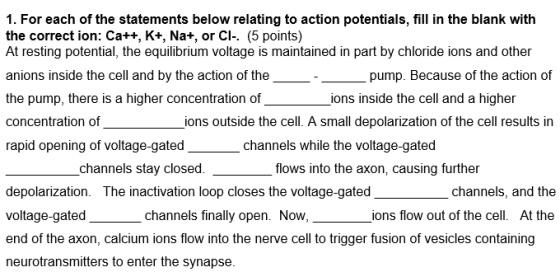
At resting potential , the equilibrium voltage is maintained in part by chloride ions and other anions inside the cell and by the action of the Na+ - K+ pump. Because of the action of the pump, there is a higher concentration of K+ ions inside the cell and a higher concentration of Na+ ions outside the cell. A small depolarization of the cell results in rapid opening of voltage-gated Na+ channels while the voltage -gated K+ channels stay closed. Na+ flows into the axon, causing further depolarization. The inactivation loop closes the voltage-gated Na+ channels and the voltage gated K+ channels finally open. Now Na+ ions flow out of the cell. At the end of axon, calcium ions flow into the nerve cell to trigger fusion of vesicles containing neurotransmitters to enter synapse.
The above process discusses the resting membrane potential and the propagation of action potential.
Add Answer to:
**Please answer everything and don't write in cursive,
high rating will be given out**
1. For...
KEY TERMS March the numbered form with the definition that is it be definition the responding...
 KEY TERMS March the numbered form with the definition that is it be definition the responding sumber in front of the appropriate 40. excitatory postsynaptic potential 21. resting potential 22 on leakage channels 23. equilibrium potential -24 graded potential 25. gated ion channels 26. depolarization 27. hyperpolarization Sensory neurons 2. central nervous system 3. motor neurons 4. intercurons 5. peripheral nervous system 6. somatic motor neurons *7. autonomic motor neurons 8. sympathetic 9. parasympathetic 10. cell body all dendrites 12....
Put these steps in neuromuscular junction synaptic transmission and excitation-contraction coupling in chronological order. A. Ryanodine...
Put these steps in neuromuscular junction synaptic transmission and excitation-contraction coupling in chronological order. A. Ryanodine receptors open B. Voltage-gated Na+ channels open in the muscle cell membrane near the neuromuscular junction C. Tropomyosin rotates into the groove of the thin filament (out of the way of the myosin binding site) D. Depolarization of motoneuron axon terminal E. Ca2+ dissociates from troponin F. [Ca2+] rises in the muscle cell cytoplasm G. An EPSP occurs in the muscle cell H. Myosin...
Question 4 2 pts During and action potential, sodium (Na+) rushes into the cell causing of...
 Question 4 2 pts During and action potential, sodium (Na+) rushes into the cell causing of the cell. Then sodium channels close and potassium (K+) rushes out of the cell, causing of the cell. However, the potassium overshoots and causes Question 5 2 pts During the refractory period, the pumps Na+ ions out of the cell and K+ions into the cell, re-establishing the resting membrane potential and concentration gradient. Serotonin Acetylcholine Glutamate Endorphins Barbiturates GABA Dopamine Cocaine Sodium Potassium Calcium...
Neurons are electrically excitable cells in the nervous system that function to process and transmit information...
 Neurons are electrically excitable cells in the nervous system that function to process and transmit information from one part the body to another, through specialized connections called synapses. The signaling process is partly electrical and partly chemical. In vertebrate animals, neurons are the core components of the brain, spinal cord and peripheral nerves. Neurons carry messages in the form of electrical signals called nerve impulses or action potentials. An action potential occurs when the resting membrane potential at a specific...
Section 1 Answer the multiple-choice questions 1-46 on the scantron. 1. Rapid impulse conduction from "node" to "node" (node of Ranvier) is called: A) spatial propagation. B) salt...
 Section 1 Answer the multiple-choice questions 1-46 on the scantron. 1. Rapid impulse conduction from "node" to "node" (node of Ranvier) is called: A) spatial propagation. B) saltatory propagation. C) divergent propagation. D) synaptic transmission. E) continuous propagation. 2. Nerve cells control skeletal muscles by using A) the cranial nerves only B) plasma cells C) the spinal nerves only D) electrical impulses E) none of the above 3. The term "voltage regulated" channels means that the membrane ion channels open...
could you please explain how you did each one 5. Draw a graph showing what would...
 could you please explain how you did each one
5. Draw a graph showing what would happen to resting membrane potential over time, if the sodium/potassium pump were not functioning. How would this affect a neuron's ability to produce action potentials? What does this imply about the quantity of ions that normally cross the membrane during the course of an action potential? (Group D). Topic 2: Action potential conduction and synaptic transmission 6. How would you alter sodium and/or potassium...
could you please explain how you did each one
5. Draw a graph showing what would happen to resting membrane potential over time, if the sodium/potassium pump were not functioning. How would this affect a neuron's ability to produce action potentials? What does this imply about the quantity of ions that normally cross the membrane during the course of an action potential? (Group D). Topic 2: Action potential conduction and synaptic transmission 6. How would you alter sodium and/or potassium...
please write thorough answers thanks PART 1 Answer ONLY ONE of the following TWO questions of...
 please write thorough answers thanks
PART 1 Answer ONLY ONE of the following TWO questions of Part 1 ie a) OR b) a) A typical, healthy nerve cell in the body has intracellular and extracellular Na, K and Cl' concentrations as shown below. Na concentration: Extracellular: = 150 mm K concentration: Extracellular: = 4 mm Ci concentration: Extracellular: = 100 mm Temperature = 37°C (303.3K) R (the Universal Gas constant) = 8.315 VCmol'k F (Faraday's constant) = 96,485 Cmol Intracellular:...
please write thorough answers thanks
PART 1 Answer ONLY ONE of the following TWO questions of Part 1 ie a) OR b) a) A typical, healthy nerve cell in the body has intracellular and extracellular Na, K and Cl' concentrations as shown below. Na concentration: Extracellular: = 150 mm K concentration: Extracellular: = 4 mm Ci concentration: Extracellular: = 100 mm Temperature = 37°C (303.3K) R (the Universal Gas constant) = 8.315 VCmol'k F (Faraday's constant) = 96,485 Cmol Intracellular:...
Lo 10: Electrochemical Gradient The difference in voltage across the membrane is called the __________________________________. The...
Lo 10: Electrochemical Gradient The difference in voltage across the membrane is called the __________________________________. The inside of a normal cell is ___________________ (+/-); while the outside is ___________(+/-). The resting membrane potential of a neuron is ___________mV. Diagram the relative ratios of Ca++, Na+ and K+ in a cell under resting conditions. Draw an arrow for each of the molecules indicating which direction would be passive transport (into or out of the cell). For each of the following sentences, fill in...
Efer Figure2 to answer questions 18-21: 8. produce the myelin sheaths of neurons in the central F...
 efer Figure2 to answer questions 18-21: 8. produce the myelin sheaths of neurons in the central Figure 2 nervous system. 19 form the Blood Brain Barrier 20._ are responsible for neurotransmitter release. 21 have ligand gated ion channels that are activated by neurotransmitters 22. Functionally, which cellular location is the neuron's "decision- making site" as to whether or not an action potential will be initiated? A axonal membrane B. axon hillock C. dendritic membrane D. presynaptic membrane 23. Calcium and...
41. Phospholipids are amphipathic molecules a. True 42. Which of the following structure's protect a plant...
 41. Phospholipids are amphipathic molecules a. True 42. Which of the following structure's protect a plant cell from bursting due to the uptake of excess water? b. False a. Mitochondria b. Plasma membrane c. Chloroplast 43. The opening of d. Cell wall channels is controlled by the binding of a substance to the channel. a. Mechanically-gated c. Voltage-gated b. Ligand-gated d. DNA 44. The concentration of Ca' is in the cell, but outside of the cell. c. Higher .... Lower...
 KEY TERMS March the numbered form with the definition that is it be definition the responding sumber in front of the appropriate 40. excitatory postsynaptic potential 21. resting potential 22 on leakage channels 23. equilibrium potential -24 graded potential 25. gated ion channels 26. depolarization 27. hyperpolarization Sensory neurons 2. central nervous system 3. motor neurons 4. intercurons 5. peripheral nervous system 6. somatic motor neurons *7. autonomic motor neurons 8. sympathetic 9. parasympathetic 10. cell body all dendrites 12....
 Question 4 2 pts During and action potential, sodium (Na+) rushes into the cell causing of the cell. Then sodium channels close and potassium (K+) rushes out of the cell, causing of the cell. However, the potassium overshoots and causes Question 5 2 pts During the refractory period, the pumps Na+ ions out of the cell and K+ions into the cell, re-establishing the resting membrane potential and concentration gradient. Serotonin Acetylcholine Glutamate Endorphins Barbiturates GABA Dopamine Cocaine Sodium Potassium Calcium...
 Neurons are electrically excitable cells in the nervous system that function to process and transmit information from one part the body to another, through specialized connections called synapses. The signaling process is partly electrical and partly chemical. In vertebrate animals, neurons are the core components of the brain, spinal cord and peripheral nerves. Neurons carry messages in the form of electrical signals called nerve impulses or action potentials. An action potential occurs when the resting membrane potential at a specific...
 Section 1 Answer the multiple-choice questions 1-46 on the scantron. 1. Rapid impulse conduction from "node" to "node" (node of Ranvier) is called: A) spatial propagation. B) saltatory propagation. C) divergent propagation. D) synaptic transmission. E) continuous propagation. 2. Nerve cells control skeletal muscles by using A) the cranial nerves only B) plasma cells C) the spinal nerves only D) electrical impulses E) none of the above 3. The term "voltage regulated" channels means that the membrane ion channels open...
 could you please explain how you did each one
5. Draw a graph showing what would happen to resting membrane potential over time, if the sodium/potassium pump were not functioning. How would this affect a neuron's ability to produce action potentials? What does this imply about the quantity of ions that normally cross the membrane during the course of an action potential? (Group D). Topic 2: Action potential conduction and synaptic transmission 6. How would you alter sodium and/or potassium...
could you please explain how you did each one
5. Draw a graph showing what would happen to resting membrane potential over time, if the sodium/potassium pump were not functioning. How would this affect a neuron's ability to produce action potentials? What does this imply about the quantity of ions that normally cross the membrane during the course of an action potential? (Group D). Topic 2: Action potential conduction and synaptic transmission 6. How would you alter sodium and/or potassium...
 please write thorough answers thanks
PART 1 Answer ONLY ONE of the following TWO questions of Part 1 ie a) OR b) a) A typical, healthy nerve cell in the body has intracellular and extracellular Na, K and Cl' concentrations as shown below. Na concentration: Extracellular: = 150 mm K concentration: Extracellular: = 4 mm Ci concentration: Extracellular: = 100 mm Temperature = 37°C (303.3K) R (the Universal Gas constant) = 8.315 VCmol'k F (Faraday's constant) = 96,485 Cmol Intracellular:...
please write thorough answers thanks
PART 1 Answer ONLY ONE of the following TWO questions of Part 1 ie a) OR b) a) A typical, healthy nerve cell in the body has intracellular and extracellular Na, K and Cl' concentrations as shown below. Na concentration: Extracellular: = 150 mm K concentration: Extracellular: = 4 mm Ci concentration: Extracellular: = 100 mm Temperature = 37°C (303.3K) R (the Universal Gas constant) = 8.315 VCmol'k F (Faraday's constant) = 96,485 Cmol Intracellular:...
 efer Figure2 to answer questions 18-21: 8. produce the myelin sheaths of neurons in the central Figure 2 nervous system. 19 form the Blood Brain Barrier 20._ are responsible for neurotransmitter release. 21 have ligand gated ion channels that are activated by neurotransmitters 22. Functionally, which cellular location is the neuron's "decision- making site" as to whether or not an action potential will be initiated? A axonal membrane B. axon hillock C. dendritic membrane D. presynaptic membrane 23. Calcium and...
 41. Phospholipids are amphipathic molecules a. True 42. Which of the following structure's protect a plant cell from bursting due to the uptake of excess water? b. False a. Mitochondria b. Plasma membrane c. Chloroplast 43. The opening of d. Cell wall channels is controlled by the binding of a substance to the channel. a. Mechanically-gated c. Voltage-gated b. Ligand-gated d. DNA 44. The concentration of Ca' is in the cell, but outside of the cell. c. Higher .... Lower...
Most questions answered within 3 hours.
-
Where is the error in this code sequence?
String s1 = "Hello";
String s2 = "ello";...
asked 11 months ago -
Financial data for Joel de Paris, Inc., for last year
follow:
Joel de Paris, Inc.
Balance...
asked 11 months ago -
Consider this reaction:
Al2(SO4)3 (aq)+ BaCl3
(aq) Al2Cl6 (aq)- +
3BaSO4(s) . What is the...
asked 11 months ago -
Suppose that Savneet is considering increasing her
recent random sample from 20 car rentals to 40...
asked 11 months ago -
Trucks arrive at an unloading terminal at an average rate of 120
per hour.
Trucks arrive...
asked 11 months ago -
Why are methanol and ethanol completely soluble in water while
octanol is not very little soluble....
asked 11 months ago -
A facilities manager at a university reads in a research report
that the mean amount of...
asked 11 months ago -
When the CuSO4 is rehydrated by adding water to the anhydrous
compound, is this an endothermic...
asked 11 months ago -
A ray of sunlight is passing from diamond into crown glass; the
angle of incidence is...
asked 11 months ago -
A block of mass 0.249 kg is placed on top of a light, vertical
spring of...
asked 11 months ago -
how do the kidneys compensate in the presences of acidosis
a) trigger hyperventilate
b) reserve acid...
asked 11 months ago -
Question 501 pts
The rental rate of capital to the firm increases. Which of the
following...
asked 11 months ago