
Homework Answers
![BARAT ☺ SSB upper side Band SW = zasmets + www.mas) st=[xit.net) mu note] mat → Hilbert Transform signal nu - Hilbert Transfo](http://img.homeworklib.com/questions/9c5c9d70-a38c-11eb-9c1e-35de1154fd92.png?x-oss-process=image/resize,w_560)
Add Answer to:
4.(30p) A message signal is consisting of voice signal and information code as shown in the...
4.(30p) A message signal is consisting of voice signal and information code as shown in the...
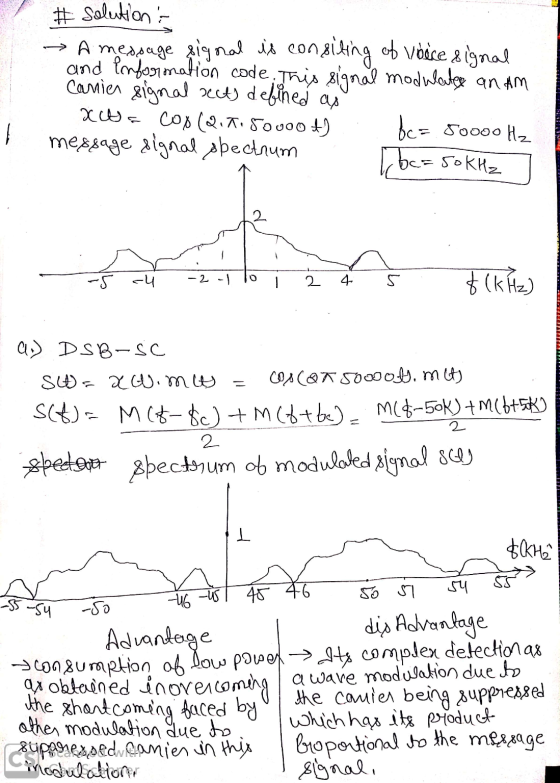
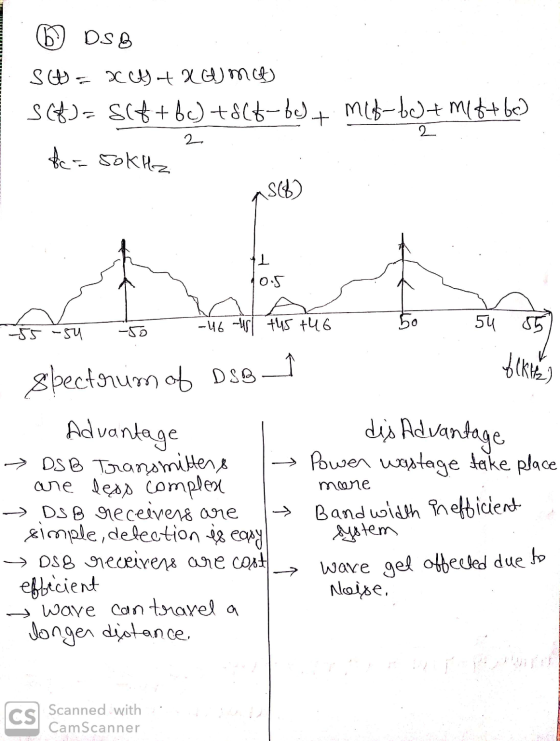
 4.(30p) A message signal is consisting of voice signal and information code as shown in the figure. This signal modulates an AM carrier signal x(t) defined as x(t) = cos(2 *T*50000*t) Find and sketch the spectrum of the modulated signal for each AM modulation type below. Explain the advantages and disadvantages of each modulation type. a) DSB-SC b) DSB c) SSB Upper Side Band AM(A) 2 a 1 2 -5 -4 -21 4 5 f (kHz)
The message signal m(t) = 2 cos 400t + 3 sin(800t + 22) modulates the carrier...
 The message signal m(t) = 2 cos 400t + 3 sin(800t + 22) modulates the carrier signal e(t) A cos(700π) using DSB-SC (dual side band, suppressed carrier) modulations Find the time domain and frequency domain representation of the modulated signal and plot the spectrum (Fourier transform) of the modulated signal. What is power content of the modulated signal?
below is used to modulate a carrier to generate the AM signal yt) (Am()) cos(1000t) The periodic signal m() shown a) The power efficiency of the system is measured to be 1 () The type of AM modula...
 below is used to modulate a carrier to generate the AM signal yt) (Am()) cos(1000t) The periodic signal m() shown a) The power efficiency of the system is measured to be 1 () The type of AM modulation, i.e. SSB, DSBSC, (i) The constant A. (ili) The modulation index 1/13. Determine DSB with carrier enit -3 b) An angle modulated signal is given by d(t-2 cos (2n1061+ sin 2 1000). Find i) The carrier frequency. ii) The baseband signal bandwidth....
Problem 5 (bonus): Explain how vestigial side band (VSB) modulated signal can be generated. Show in...
 Problem 5 (bonus): Explain how vestigial side band (VSB) modulated signal can be generated. Show in table the advantages and disadvantages of the VSB modulation in comparison with the other modulation formats such as the full AM, the DSB-SC nd the SSB modulations.
When the message signal m (t) =cos (2π fmt) and the carrier signal is c(t)=cos (2π fct) , fm<&...
 When the message signal m (t) =cos (2π fmt) and the
carrier signal is c(t)=cos (2π fct) ,
fm<< fc,
The modulated DSB-SC signal
SDSB-SC=m(t)cos(2πfct) is generated, and only
the upper sideband
To generate and transmit the SSB signal. As shown in the figure
below, the receiver is a local oscillator
cosine signal to the received signal and passes it through a
low-pass filter. Answer the following questions.
(a) Draw the waveform of DSB-SC modulated signal
SDSB-SC(t)
(b)Find the result...
When the message signal m (t) =cos (2π fmt) and the
carrier signal is c(t)=cos (2π fct) ,
fm<< fc,
The modulated DSB-SC signal
SDSB-SC=m(t)cos(2πfct) is generated, and only
the upper sideband
To generate and transmit the SSB signal. As shown in the figure
below, the receiver is a local oscillator
cosine signal to the received signal and passes it through a
low-pass filter. Answer the following questions.
(a) Draw the waveform of DSB-SC modulated signal
SDSB-SC(t)
(b)Find the result...
A message signal m(t)=2 cos (10πt) + 3 sin(20πt) is used DSB-SC system to modulate by...
A message signal m(t)=2 cos (10πt) + 3 sin(20πt) is used DSB-SC system to modulate by carrier c(t)= 20 cos (200πt). Find: 1) Modulated signal s(t) , s(f). 2) Sketch modulated signal s(t). 3) Find bandwidth of modulated signal. 4) Find power of modulated and carrier. 5) Sketch upper side band and LSB?
3(a) A complex signal given by the expression cos (9t x 103t) Vm(t) %3D 0.5cos(Зл х 103t) + сos(8т х 103t) + is used to...
 3(a) A complex signal given by the expression cos (9t x 103t) Vm(t) %3D 0.5cos(Зл х 103t) + сos(8т х 103t) + is used to amplitude modulate a carrier signal, Vc(t) = 3cos(2n shown in Figure 3(a) 105t) as X Vm(t) 0.5cos(3t x 103t) cos(8T x 103t) AM Modulator AM Signal cos(9t x 10t) Vc(t) 3cos(2n x 105t) Figure 3(a) The AM signal in Question 3(a) is developed across 2.2 kn load resistance The modulated carrier in Question 3(a) is...
()=< a) Consider the case where a modulating tone v, a cos(2ft) is used in a...
 ()=< a) Consider the case where a modulating tone v, a cos(2ft) is used in a Double Side Band m Amplitude Modulation (DSC-AM) scheme whose varying with time carrier amplitude is [K+a cos(2ft Provide the equation of the modulated carrier signal v (t and then derive from that an expression that shows the spectral components of v (t). Furthermore provide the phasor representation of DSB-AM. Now consider the case of Double Side Band Suppressed carrier AM and provide both the...
Problem No. 1: Let us consider that a baseband message signal m(t)=4cos(2000xt) has to be transmitted...
 Problem No. 1: Let us consider that a baseband message signal m(t)=4cos(2000xt) has to be transmitted from a location 'A' to its destination 'B' using a carrier signal given by c(t)=2cos(10000#t). The signal s() m(t)c(i) is the modulated signal which will be transmitted. Consider that the signal is transmitted through a noiseless channel and received at the receiver at location 'B' as the signal s(t). Based on this information, perform the following tasks. 1. Find, sketch and label the spectrum...
In a DSB-SC amplitude modulation system, the message signal is m(t)=e^(-3t)*u(t-2) and the carrier signal is...
In a DSB-SC amplitude modulation system, the message signal is m(t)=e^(-3t)*u(t-2) and the carrier signal is ???( 2000??). Find the Fourier transform of the modulated signal.
 4.(30p) A message signal is consisting of voice signal and information code as shown in the figure. This signal modulates an AM carrier signal x(t) defined as x(t) = cos(2 *T*50000*t) Find and sketch the spectrum of the modulated signal for each AM modulation type below. Explain the advantages and disadvantages of each modulation type. a) DSB-SC b) DSB c) SSB Upper Side Band AM(A) 2 a 1 2 -5 -4 -21 4 5 f (kHz)
 The message signal m(t) = 2 cos 400t + 3 sin(800t + 22) modulates the carrier signal e(t) A cos(700π) using DSB-SC (dual side band, suppressed carrier) modulations Find the time domain and frequency domain representation of the modulated signal and plot the spectrum (Fourier transform) of the modulated signal. What is power content of the modulated signal?
 below is used to modulate a carrier to generate the AM signal yt) (Am()) cos(1000t) The periodic signal m() shown a) The power efficiency of the system is measured to be 1 () The type of AM modulation, i.e. SSB, DSBSC, (i) The constant A. (ili) The modulation index 1/13. Determine DSB with carrier enit -3 b) An angle modulated signal is given by d(t-2 cos (2n1061+ sin 2 1000). Find i) The carrier frequency. ii) The baseband signal bandwidth....
 Problem 5 (bonus): Explain how vestigial side band (VSB) modulated signal can be generated. Show in table the advantages and disadvantages of the VSB modulation in comparison with the other modulation formats such as the full AM, the DSB-SC nd the SSB modulations.
 When the message signal m (t) =cos (2π fmt) and the
carrier signal is c(t)=cos (2π fct) ,
fm<< fc,
The modulated DSB-SC signal
SDSB-SC=m(t)cos(2πfct) is generated, and only
the upper sideband
To generate and transmit the SSB signal. As shown in the figure
below, the receiver is a local oscillator
cosine signal to the received signal and passes it through a
low-pass filter. Answer the following questions.
(a) Draw the waveform of DSB-SC modulated signal
SDSB-SC(t)
(b)Find the result...
When the message signal m (t) =cos (2π fmt) and the
carrier signal is c(t)=cos (2π fct) ,
fm<< fc,
The modulated DSB-SC signal
SDSB-SC=m(t)cos(2πfct) is generated, and only
the upper sideband
To generate and transmit the SSB signal. As shown in the figure
below, the receiver is a local oscillator
cosine signal to the received signal and passes it through a
low-pass filter. Answer the following questions.
(a) Draw the waveform of DSB-SC modulated signal
SDSB-SC(t)
(b)Find the result...
 3(a) A complex signal given by the expression cos (9t x 103t) Vm(t) %3D 0.5cos(Зл х 103t) + сos(8т х 103t) + is used to amplitude modulate a carrier signal, Vc(t) = 3cos(2n shown in Figure 3(a) 105t) as X Vm(t) 0.5cos(3t x 103t) cos(8T x 103t) AM Modulator AM Signal cos(9t x 10t) Vc(t) 3cos(2n x 105t) Figure 3(a) The AM signal in Question 3(a) is developed across 2.2 kn load resistance The modulated carrier in Question 3(a) is...
 ()=< a) Consider the case where a modulating tone v, a cos(2ft) is used in a Double Side Band m Amplitude Modulation (DSC-AM) scheme whose varying with time carrier amplitude is [K+a cos(2ft Provide the equation of the modulated carrier signal v (t and then derive from that an expression that shows the spectral components of v (t). Furthermore provide the phasor representation of DSB-AM. Now consider the case of Double Side Band Suppressed carrier AM and provide both the...
 Problem No. 1: Let us consider that a baseband message signal m(t)=4cos(2000xt) has to be transmitted from a location 'A' to its destination 'B' using a carrier signal given by c(t)=2cos(10000#t). The signal s() m(t)c(i) is the modulated signal which will be transmitted. Consider that the signal is transmitted through a noiseless channel and received at the receiver at location 'B' as the signal s(t). Based on this information, perform the following tasks. 1. Find, sketch and label the spectrum...
Most questions answered within 3 hours.
-
Where is the error in this code sequence?
String s1 = "Hello";
String s2 = "ello";...
asked 11 months ago -
Financial data for Joel de Paris, Inc., for last year
follow:
Joel de Paris, Inc.
Balance...
asked 11 months ago -
Consider this reaction:
Al2(SO4)3 (aq)+ BaCl3
(aq) Al2Cl6 (aq)- +
3BaSO4(s) . What is the...
asked 11 months ago -
Suppose that Savneet is considering increasing her
recent random sample from 20 car rentals to 40...
asked 11 months ago -
Trucks arrive at an unloading terminal at an average rate of 120
per hour.
Trucks arrive...
asked 11 months ago -
Why are methanol and ethanol completely soluble in water while
octanol is not very little soluble....
asked 11 months ago -
A facilities manager at a university reads in a research report
that the mean amount of...
asked 11 months ago -
When the CuSO4 is rehydrated by adding water to the anhydrous
compound, is this an endothermic...
asked 11 months ago -
A ray of sunlight is passing from diamond into crown glass; the
angle of incidence is...
asked 11 months ago -
A block of mass 0.249 kg is placed on top of a light, vertical
spring of...
asked 11 months ago -
how do the kidneys compensate in the presences of acidosis
a) trigger hyperventilate
b) reserve acid...
asked 11 months ago -
Question 501 pts
The rental rate of capital to the firm increases. Which of the
following...
asked 11 months ago