
Homework Answers
![[sn Bru] = 0.492M, come nsnibru = 10.492x40) = 19.68 mmol In Bry (99) + 2NC2S (ez initial 19.68 5.4102 (mmol) (Na2S] = 0.1271](http://img.homeworklib.com/questions/b62a1ec0-a39a-11eb-a1e6-8399cf8db811.png?x-oss-process=image/resize,w_560)
Add Answer to:
Tin(IV) sulfide, Sns,, a yellow pigment, can be produced using the following reaction. SnBr.(aq) + 2...
Heted 15 out of 20 Suppose a student als 42.3 mL of a 0.412 M solution...
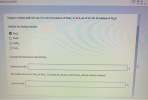 Heted 15 out of 20 Suppose a student als 42.3 mL of a 0.412 M solution of SnBr, to 41.3 mL of a 0.121 M solution of Na,s. Identify the limiting reactant. Na,s NaBr SnBr, Sns, Calculate the theoretical yield of Sus, theoretical yield: The student recovers 0.243 g of Sns, Calculate the percent yield of Sns, that the student obtained. percent yield:
5. A student performs the following reaction using the procedure outlined in Part A of this...
 5. A student performs the following reaction using the procedure outlined in Part A of this experiment. Ba(NO3)2 (aq) + K2SO4 (aq) - BaSO4(s) + 2 KNO3(aq) The student adds 55.0 mL of 0.050 M K SO. solution to 50.0 ml of 0.050 M Ba(NO3)2 solution. The precipitate of Baso. is collected by gravity filtration and dried to a constant mass. The BaSO.is determined to have a mass of 0.49 g. (See section 3.9 in the textbook for a review...
A precipitation reaction occurs when 749 mL of 0.846 M Pb(NO3)2 reacts with 375 mL of...
 A precipitation reaction occurs when 749 mL of 0.846 M Pb(NO3)2 reacts with 375 mL of 0.810 M KI, as shown by the following equation. Pb(NO3)2(aq) + 2 Kl(aq) – PbL,(s) + 2 KNO, (aq) Identify the limiting reactant. O Pb(NO3)2 ОРЫ, OKI O KNO, Calculate the theoretical yield of Pol, from the reaction. mass of Pble: Calculate the percent yield of Pbl, if 50.6 g of Pol, are formed experimentally. percent yield of Pbl Suppose 57.2 mL of a...
Lead ions can be precipitated from solution with KCl according to the following reaction: Pb2+(aq)+2KCl(aq) →PbCl2(s)+2K+(aq)...
 Lead ions can be precipitated from solution with KCl according to the following reaction: Pb2+(aq)+2KCl(aq) →PbCl2(s)+2K+(aq) When 28.5 g KCl is added to a solution containing 25.5 g Pb2+, a PbCl2 precipitate forms. The precipitate is filtered and dried and found to have a mass of 29.3 g. Determine the limiting reactant. Determine the theoretical yield of PbCl2. Determine the percent yield for the reaction.
Chlorine gas can be prepared in the laboratory by the reaction of hydrochloric acid with manganese(IV) oxide. 4 HCI(aq) + MnO2(s) MnClj(aq) + 2H20) +C2(g) A sample of 38.7 g MnO2 is added to a soluti...
 Chlorine gas can be prepared in the laboratory by the reaction of hydrochloric acid with manganese(IV) oxide. 4 HCI(aq) + MnO2(s) MnClj(aq) + 2H20) +C2(g) A sample of 38.7 g MnO2 is added to a solution containing 41.3 g HC. What is the limiting reactant? O HCI O Mno, What is the theoretical yield of Cl2? theoretical yield: g Cl If the yield of the reaction is 78.9%, what is the actual yield of chlorine? actual yield: gC2
Chlorine gas...
Chlorine gas can be prepared in the laboratory by the reaction of hydrochloric acid with manganese(IV) oxide. 4 HCI(aq) + MnO2(s) MnClj(aq) + 2H20) +C2(g) A sample of 38.7 g MnO2 is added to a solution containing 41.3 g HC. What is the limiting reactant? O HCI O Mno, What is the theoretical yield of Cl2? theoretical yield: g Cl If the yield of the reaction is 78.9%, what is the actual yield of chlorine? actual yield: gC2
Chlorine gas...
Chlorine gas can be prepared in the laboratory by the reaction of hydrochloric acid with manganese(IV) oxide. 4HCl(aq)+M...
Chlorine gas can be prepared in the laboratory by the reaction of hydrochloric acid with manganese(IV) oxide. 4HCl(aq)+MnO2(s)⟶MnCl2(aq)+2H2O(l)+Cl2(g) A sample of 37.9 g MnO2 is added to a solution containing 42.3 g HCl. What is the limiting reactant? MnO2 OR HCl What is the theoretical yield of Cl2? If the yield of the reaction is 79.1%, what is the actual yield of chlorine?
Consider the following reaction. MgCl2(aq)+2NaOH(aq)⟶Mg(OH)2(s)+2NaCl(aq) A 166.0 mL solution of 0.381 M MgCl2 reacts with a...
Consider the following reaction. MgCl2(aq)+2NaOH(aq)⟶Mg(OH)2(s)+2NaCl(aq) A 166.0 mL solution of 0.381 M MgCl2 reacts with a 47.33 mL solution of 0.568 M NaOH to produce Mg(OH)2 and NaCl. Identify the limiting reactant. NaOH Mg(OH)2 MgCl2 NaCl Caclulate the mass of Mg(OH)2 that can be produced. The actual mass of Mg(OH)2 isolated was 0.559 g. Calculate the percent yield of Mg(OH)2.
Chlorine gas can be prepared in the laboratory by the reaction of hydrochloric acid with manganese(IV)...
 Chlorine gas can be prepared in the laboratory by the reaction of hydrochloric acid with manganese(IV) oxide. 4 HCl(aq) + MnO,(s) —MnCl(aq) + 2 H2O(l) + Cl2(g) A sample of 42.1 g Mno, is added to a solution containing 42.1 g HCI. What is the limiting reactant? MnO2 OHCI What is the theoretical yield of CI,? theoretical yield: CI, If the yield of the reaction is 77.5%, what is the actual yield of chlorine? actual yield: g CI Dimethyl oxalate,...
The following chemical reaction takes place in aqueous solution: Fe2(SO4), (aq)+6 KOH(aq) — 2 Fe(OH)3(s)+3 K,...
 The following chemical reaction takes place in aqueous solution: Fe2(SO4), (aq)+6 KOH(aq) — 2 Fe(OH)3(s)+3 K, SO4(aq) Write the net ionic equation for this reaction. 0- Identifying the limiting reactant in a drawing of a mixture The drawing below shows a mixture of molecules: key carbon hydrogen nitrogen sulfur 000000 oxygen chlorine Suppose the following chemical reaction can take place in this mixture: CH,(9)+4S(s) → CS (9)+2 H, S(9) of which reactant are there the most initial moles? Enter its...
Two chemicals, A and B, react according to the following equation: A(aq) + 2 B(aq) ⟶...
Two chemicals, A and B, react according to the following equation: A(aq) + 2 B(aq) ⟶ AB2(aq) Suppose that the reaction between 40.0 mL of 0.0135 M A(aq) and 50.0 mL of 0.0215 M B(aq) resulted in 0.000376 moles of AB2. Calculate the moles of A and B initially present before the reaction. mol A mol B Answer the following questions assuming the reaction went to completion. a. Given the amounts of reactants that were mixed, determine which should be...
 Heted 15 out of 20 Suppose a student als 42.3 mL of a 0.412 M solution of SnBr, to 41.3 mL of a 0.121 M solution of Na,s. Identify the limiting reactant. Na,s NaBr SnBr, Sns, Calculate the theoretical yield of Sus, theoretical yield: The student recovers 0.243 g of Sns, Calculate the percent yield of Sns, that the student obtained. percent yield:
 5. A student performs the following reaction using the procedure outlined in Part A of this experiment. Ba(NO3)2 (aq) + K2SO4 (aq) - BaSO4(s) + 2 KNO3(aq) The student adds 55.0 mL of 0.050 M K SO. solution to 50.0 ml of 0.050 M Ba(NO3)2 solution. The precipitate of Baso. is collected by gravity filtration and dried to a constant mass. The BaSO.is determined to have a mass of 0.49 g. (See section 3.9 in the textbook for a review...
 A precipitation reaction occurs when 749 mL of 0.846 M Pb(NO3)2 reacts with 375 mL of 0.810 M KI, as shown by the following equation. Pb(NO3)2(aq) + 2 Kl(aq) – PbL,(s) + 2 KNO, (aq) Identify the limiting reactant. O Pb(NO3)2 ОРЫ, OKI O KNO, Calculate the theoretical yield of Pol, from the reaction. mass of Pble: Calculate the percent yield of Pbl, if 50.6 g of Pol, are formed experimentally. percent yield of Pbl Suppose 57.2 mL of a...
 Lead ions can be precipitated from solution with KCl according to the following reaction: Pb2+(aq)+2KCl(aq) →PbCl2(s)+2K+(aq) When 28.5 g KCl is added to a solution containing 25.5 g Pb2+, a PbCl2 precipitate forms. The precipitate is filtered and dried and found to have a mass of 29.3 g. Determine the limiting reactant. Determine the theoretical yield of PbCl2. Determine the percent yield for the reaction.
 Chlorine gas can be prepared in the laboratory by the reaction of hydrochloric acid with manganese(IV) oxide. 4 HCI(aq) + MnO2(s) MnClj(aq) + 2H20) +C2(g) A sample of 38.7 g MnO2 is added to a solution containing 41.3 g HC. What is the limiting reactant? O HCI O Mno, What is the theoretical yield of Cl2? theoretical yield: g Cl If the yield of the reaction is 78.9%, what is the actual yield of chlorine? actual yield: gC2
Chlorine gas...
Chlorine gas can be prepared in the laboratory by the reaction of hydrochloric acid with manganese(IV) oxide. 4 HCI(aq) + MnO2(s) MnClj(aq) + 2H20) +C2(g) A sample of 38.7 g MnO2 is added to a solution containing 41.3 g HC. What is the limiting reactant? O HCI O Mno, What is the theoretical yield of Cl2? theoretical yield: g Cl If the yield of the reaction is 78.9%, what is the actual yield of chlorine? actual yield: gC2
Chlorine gas...
 Chlorine gas can be prepared in the laboratory by the reaction of hydrochloric acid with manganese(IV) oxide. 4 HCl(aq) + MnO,(s) —MnCl(aq) + 2 H2O(l) + Cl2(g) A sample of 42.1 g Mno, is added to a solution containing 42.1 g HCI. What is the limiting reactant? MnO2 OHCI What is the theoretical yield of CI,? theoretical yield: CI, If the yield of the reaction is 77.5%, what is the actual yield of chlorine? actual yield: g CI Dimethyl oxalate,...
 The following chemical reaction takes place in aqueous solution: Fe2(SO4), (aq)+6 KOH(aq) — 2 Fe(OH)3(s)+3 K, SO4(aq) Write the net ionic equation for this reaction. 0- Identifying the limiting reactant in a drawing of a mixture The drawing below shows a mixture of molecules: key carbon hydrogen nitrogen sulfur 000000 oxygen chlorine Suppose the following chemical reaction can take place in this mixture: CH,(9)+4S(s) → CS (9)+2 H, S(9) of which reactant are there the most initial moles? Enter its...
Most questions answered within 3 hours.
-
Where is the error in this code sequence?
String s1 = "Hello";
String s2 = "ello";...
asked 10 months ago -
Financial data for Joel de Paris, Inc., for last year
follow:
Joel de Paris, Inc.
Balance...
asked 10 months ago -
Consider this reaction:
Al2(SO4)3 (aq)+ BaCl3
(aq) Al2Cl6 (aq)- +
3BaSO4(s) . What is the...
asked 10 months ago -
Suppose that Savneet is considering increasing her
recent random sample from 20 car rentals to 40...
asked 10 months ago -
Trucks arrive at an unloading terminal at an average rate of 120
per hour.
Trucks arrive...
asked 10 months ago -
Why are methanol and ethanol completely soluble in water while
octanol is not very little soluble....
asked 10 months ago -
A facilities manager at a university reads in a research report
that the mean amount of...
asked 10 months ago -
When the CuSO4 is rehydrated by adding water to the anhydrous
compound, is this an endothermic...
asked 10 months ago -
A ray of sunlight is passing from diamond into crown glass; the
angle of incidence is...
asked 10 months ago -
A block of mass 0.249 kg is placed on top of a light, vertical
spring of...
asked 10 months ago -
how do the kidneys compensate in the presences of acidosis
a) trigger hyperventilate
b) reserve acid...
asked 10 months ago -
Question 501 pts
The rental rate of capital to the firm increases. Which of the
following...
asked 10 months ago