Two chemicals, A and B, react according to the following equation: A(aq) + 2 B(aq) ⟶...
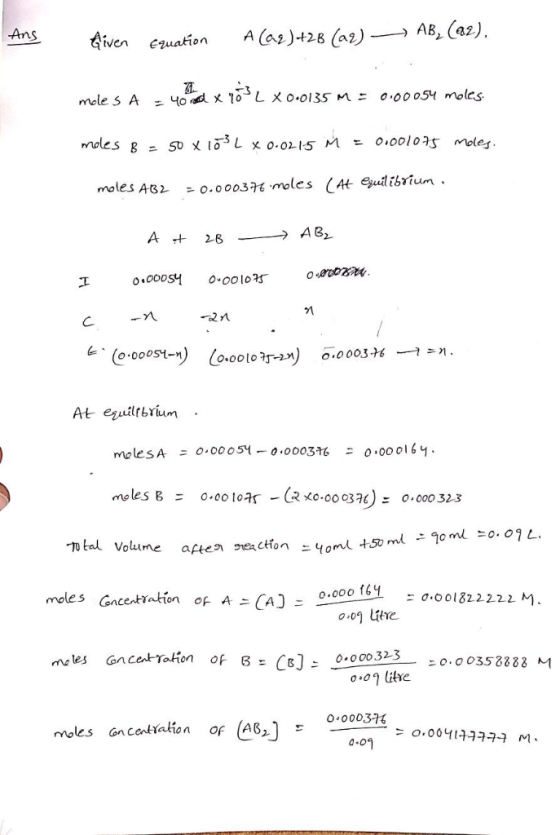
Two chemicals, A and B, react according to the following equation: A(aq) + 2 B(aq) ⟶ AB2(aq) Suppose that the reaction between 40.0 mL of 0.0135 M A(aq) and 50.0 mL of 0.0215 M B(aq) resulted in 0.000376 moles of AB2. Calculate the moles of A and B initially present before the reaction. mol A mol B Answer the following questions assuming the reaction went to completion. a. Given the amounts of reactants that were mixed, determine which should be the limiting reactant? A is the limiting reactantB is the limiting reactant b. Theoreticially, how many moles of AB2 would have been produced? mol c. What is the actual percent yield? Hint: % Answer the following questions assuming the reaction reached equilibrium. Using the moles of reactant initially present and the moles of product that actually formed, Hint: a. How many moles of A and B are left unreacted? mol A mol B b. Calculate Keq for the reaction. To do this, three molar concentrations will need to be calculated. First, divide each number of moles (A remaining, B remaining, AB2 formed) by the total volume of 0.0900 L using the equation below. Then, find Keq. Hint: m o l a r i t y = m o l e s l i t r e m o l a r i t y = m o l e s l i t r e Keq = When more of the reactant-in-excess was added to the reaction mixture, it was found that significant additional product was formed, Based upon this observation, did the reaction go to completion or reach equilibrium? completion equilibrium
Homework Answers
 I HOPE THIS HELPS IF YOU FIND
ANY PROBLEM.PLEASE COMMENT ON BELOW. DON'T FORGET TO GIVE A THUMBS
UP IF YOU LIKED IT.
I HOPE THIS HELPS IF YOU FIND
ANY PROBLEM.PLEASE COMMENT ON BELOW. DON'T FORGET TO GIVE A THUMBS
UP IF YOU LIKED IT.
Add Answer to:
Two chemicals, A and B, react according to the following
equation: A(aq) + 2 B(aq) ⟶...
Question 18 2 pts Consider the following hypothetical reaction: A (aq) B (aq) At the beginning...
 Question 18 2 pts Consider the following hypothetical reaction: A (aq) B (aq) At the beginning of the reaction, 0.850 mol of A are added to the reaction flask containing 1.0 L of solution. The reaction is then monitored and the following data is collected: Time (minutes) 0 10 20 Moles of A 0.850 mol 0.550 mol 0.420 Calculate the average rate of disappearance of A between t = 0 minutes and t = 20 minutes. 0.0215 mol/min -0.0215 mol/min...
In the following chemical reaction, 2 mol of A will react with 1 mol of B...
In the following chemical reaction, 2 mol of A will react with 1 mol of B to produce 1 mol of A2B without anything left over: 2A+B→A2B But what if you're given 2.8 mol of A and 3.2 mol of B? The amount of product formed is limited by the reactant that runs out first, called the limiting reactant. To identify the limiting reactant, calculate the amount of product formed from each amount of reactant separately: 2.8 mol A×1 mol...
11. Use the equation below to calculate the following. a. Balance the reaction. K2CO3 (aq) +...
 11. Use the equation below to calculate the following. a. Balance the reaction. K2CO3 (aq) + _HCH3O2 (aq) → KCH:O2 (aq) + H20 (1) +_ CO2 (g) b. Moles of H2O that can be obtained from 25.0 mL of 0.150 M HC2H302 c. Volume of 0.210 MK2CO3 needed to produce 17.5 mol KC,H,O, d. Volume of 1.25 M HC,H,O2 needed to react with 75.2 mL 0.750 M K.CO; e. Liters of CO2 gas at 25°C and 0.750 atm, produced by...
2003B #2 2. Answer the following questions that relate to chemical reactions. (a) Iron(III) oxide can...
 2003B #2 2. Answer the following questions that relate to chemical reactions. (a) Iron(III) oxide can be reduced with carbon monoxide according to the following equation. Fe,0,(s) + 3 CO(g) → 2 Fe(s) + 3 COLC) A 162 L sample of CO(g) at 1.50 atm and 200.°C is combined with 15.39 g of Fe,o (8). (1) How many moles of COG) are available for the reaction? (1) What is the limiting reactant for the reaction? Justify your answer with calculations....
Aluminum hydroxide reacts with sulfuric acid as follows: 2Al(OH)3(s)+3H2SO4(aq)→Al2(SO4)3(aq)+6H2O(l) a. Which reagent i...
Aluminum hydroxide reacts with sulfuric acid as follows: 2Al(OH)3(s)+3H2SO4(aq)→Al2(SO4)3(aq)+6H2O(l) a. Which reagent is the limiting reactant when 0.450 mol Al(OH)3 and 0.450 mol H2SO4 are allowed to react? b. How many moles of Al2(SO4)3 can form under these conditions? c. How many moles of the excess reactant remain after the completion of the reaction?
IEM122_02 Consider the equilibrium A(aq) + B(aq) = C(aq), K = 17.06. A reaction is started...
 IEM122_02 Consider the equilibrium A(aq) + B(aq) = C(aq), K = 17.06. A reaction is started with C being the only chemical present and [C, = 0.3825. Compute the B concentration in equilibrium. At 590 °C, the K, for the reaction Caco (s) =Ca0(s) + co (9) expressed in atm is 2.559. A111 gram sample of Caco, is put into a 10.0-L container and heated to 590 °C. Compute the moles co, present in equilibrium. [Hint: R = 0.082057 atm...
Question 2: (1 point) Suppose that A and B react to form C according to the...
Question 2: (1 point) Suppose that A and B react to form C according to the equation below. A + 2 B ⇌ C What are the equilibrium concentrations of A, B and C if 2.4 mol A and 2.4 mol B are added to a 1.0 L flask? Assume that the equilibrium constant for this reaction is Kc = 7.9x10¹³. Hint: The equilibrium constant for this reaction is quite large. Therefore, the reaction goes almost 100% to completion. Equilibrium...
1. Two chemicals A and B react to form another chemical C. The rate at which...
 1. Two chemicals A and B react to form another chemical C. The rate at which is formed varies as the product of the instantaneous amounts of A and B present. For each gram of B the reaction requires 2g of A to produce C. 10g of A and 20g of B are present initially; there is no C present initially, and 6g of Care formed in 20 min. (a) Show that æ(t), the amount (g) of C present at...
In a chemical reaction, the reactant that limits the amount of product that can be formed...
 In a chemical reaction, the reactant that limits the amount of product that can be formed is called the limiting reactant (or limiting reagent). The reaction will stop when all of the limiting reactant is consumed. In the sandwich example, bread was our limiting reactant. The reactant or reactants in a chemical reaction that remain when a reaction stops when the limiting reactant is completely consumed are called the excess reactant(s). The excess reactant(s) remain because there is nothing with...
Question 2: (1 point) Suppose that A and B react to form C according to the...
Question 2: (1 point) Suppose that A and B react to form C according to the equation below. A + 2 B ⇌ C What are the equilibrium concentrations of A, B and C if 2.4 mol A and 2.4 mol B are added to a 1.0 L flask? Assume that the equilibrium constant for this reaction is Kc = 8.5x10¹³. Hint: The equilibrium constant for this reaction is quite large. Therefore, the reaction goes almost 100% to completion. Enter...
 Question 18 2 pts Consider the following hypothetical reaction: A (aq) B (aq) At the beginning of the reaction, 0.850 mol of A are added to the reaction flask containing 1.0 L of solution. The reaction is then monitored and the following data is collected: Time (minutes) 0 10 20 Moles of A 0.850 mol 0.550 mol 0.420 Calculate the average rate of disappearance of A between t = 0 minutes and t = 20 minutes. 0.0215 mol/min -0.0215 mol/min...
 11. Use the equation below to calculate the following. a. Balance the reaction. K2CO3 (aq) + _HCH3O2 (aq) → KCH:O2 (aq) + H20 (1) +_ CO2 (g) b. Moles of H2O that can be obtained from 25.0 mL of 0.150 M HC2H302 c. Volume of 0.210 MK2CO3 needed to produce 17.5 mol KC,H,O, d. Volume of 1.25 M HC,H,O2 needed to react with 75.2 mL 0.750 M K.CO; e. Liters of CO2 gas at 25°C and 0.750 atm, produced by...
 2003B #2 2. Answer the following questions that relate to chemical reactions. (a) Iron(III) oxide can be reduced with carbon monoxide according to the following equation. Fe,0,(s) + 3 CO(g) → 2 Fe(s) + 3 COLC) A 162 L sample of CO(g) at 1.50 atm and 200.°C is combined with 15.39 g of Fe,o (8). (1) How many moles of COG) are available for the reaction? (1) What is the limiting reactant for the reaction? Justify your answer with calculations....
 IEM122_02 Consider the equilibrium A(aq) + B(aq) = C(aq), K = 17.06. A reaction is started with C being the only chemical present and [C, = 0.3825. Compute the B concentration in equilibrium. At 590 °C, the K, for the reaction Caco (s) =Ca0(s) + co (9) expressed in atm is 2.559. A111 gram sample of Caco, is put into a 10.0-L container and heated to 590 °C. Compute the moles co, present in equilibrium. [Hint: R = 0.082057 atm...
 1. Two chemicals A and B react to form another chemical C. The rate at which is formed varies as the product of the instantaneous amounts of A and B present. For each gram of B the reaction requires 2g of A to produce C. 10g of A and 20g of B are present initially; there is no C present initially, and 6g of Care formed in 20 min. (a) Show that æ(t), the amount (g) of C present at...
 In a chemical reaction, the reactant that limits the amount of product that can be formed is called the limiting reactant (or limiting reagent). The reaction will stop when all of the limiting reactant is consumed. In the sandwich example, bread was our limiting reactant. The reactant or reactants in a chemical reaction that remain when a reaction stops when the limiting reactant is completely consumed are called the excess reactant(s). The excess reactant(s) remain because there is nothing with...
Most questions answered within 3 hours.
-
Where is the error in this code sequence?
String s1 = "Hello";
String s2 = "ello";...
asked 10 months ago -
Financial data for Joel de Paris, Inc., for last year
follow:
Joel de Paris, Inc.
Balance...
asked 10 months ago -
Consider this reaction:
Al2(SO4)3 (aq)+ BaCl3
(aq) Al2Cl6 (aq)- +
3BaSO4(s) . What is the...
asked 10 months ago -
Suppose that Savneet is considering increasing her
recent random sample from 20 car rentals to 40...
asked 10 months ago -
Trucks arrive at an unloading terminal at an average rate of 120
per hour.
Trucks arrive...
asked 10 months ago -
Why are methanol and ethanol completely soluble in water while
octanol is not very little soluble....
asked 10 months ago -
A facilities manager at a university reads in a research report
that the mean amount of...
asked 10 months ago -
When the CuSO4 is rehydrated by adding water to the anhydrous
compound, is this an endothermic...
asked 10 months ago -
A ray of sunlight is passing from diamond into crown glass; the
angle of incidence is...
asked 10 months ago -
A block of mass 0.249 kg is placed on top of a light, vertical
spring of...
asked 10 months ago -
how do the kidneys compensate in the presences of acidosis
a) trigger hyperventilate
b) reserve acid...
asked 10 months ago -
Question 501 pts
The rental rate of capital to the firm increases. Which of the
following...
asked 10 months ago