
Homework Answers
Add Answer to:
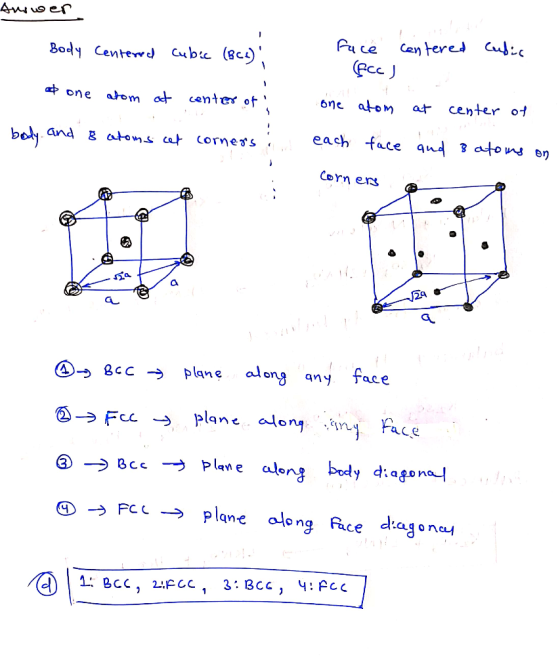
26. Which one of the following crystallographic planes represents FCC and BCC planes respectively? av2 (4...
1. State the difference between I and polycrystalline materials. Deformability of BCC and FCC met...
 1. State the difference between I and polycrystalline materials. Deformability of BCC and FCC metals. Strength and UTS of metals. 2. Determine the slip systems in BCC and FCC materials. Show the calculations that support your determinations. 3. Find the indices that represent the planes in the following cubic unit cell and show the X-Ray diffract-ability of the these planes in FCC and BCC structures: 4. A tensile specimen with a 12 mm initial diameter and 50 mm gauge length...
1.1 A/an ____________ unit cell has Edge length = A) Simple Cubic B) BCC C) FCC...
 1.1
A/an ____________ unit cell has Edge length =
A) Simple Cubic
B) BCC
C) FCC
1.2
Which method provides the average distances between planes of
atoms in a solid?
A) stoichiometric analysis
B) differential scanning calorimetry
C) X-ray diffraction
D) high pressure liquid chromatography
E) mass spectrometry
1.3
There are ______ atoms contained within a FCC unit cell.
A) 2
B) 1
C) 4
D) 3
1.4
Polyvinyl chloride is an example of which type of polymer?
A) polyester...
1.1
A/an ____________ unit cell has Edge length =
A) Simple Cubic
B) BCC
C) FCC
1.2
Which method provides the average distances between planes of
atoms in a solid?
A) stoichiometric analysis
B) differential scanning calorimetry
C) X-ray diffraction
D) high pressure liquid chromatography
E) mass spectrometry
1.3
There are ______ atoms contained within a FCC unit cell.
A) 2
B) 1
C) 4
D) 3
1.4
Polyvinyl chloride is an example of which type of polymer?
A) polyester...
(a) Differentiate between Face- Centered Cubic (FCC) and Body-Centered Cubic (BCC) crystal structures. Why FCC metals...
 (a) Differentiate between Face- Centered Cubic (FCC) and Body-Centered Cubic (BCC) crystal structures. Why FCC metals are more ductile than BCC metals? 5 marks) (ii) show the relationship between the unit cell edge length, a, and the atomic radius, R, for a BCC crystal. Iron has a BCC crystal structure, an atomic radius of 0.124 nm, and atomic weight of 55.85 g/mol. Calculate its theoretical density Given: Avogardo's Number is 6.02 x 10⁵ atoms/mol (5 marks) Figure 1 Determine the...
mot MSE 260 Materials Science and Engineering - Homework 4 1. (3.70) The metal niobium (Nb)...
 mot MSE 260 Materials Science and Engineering - Homework 4 1. (3.70) The metal niobium (Nb) has a BCC crystal structure. If the angle of diffraction for the (211) set of planes occurs at 75.99° (first-order reflection) when monochromatic X-radiation having a wavelength of 0.1659 nm is used, compute the following: (a) the interplanar spacing for this set of planes and (b) the atomic radius for the Nb atom. 2. (3.71) For which set of crystallographic planes will a first-order...
Calculate (a) LD for FCC Al and (b) for BCC Cr Problem 4 on Linear density...
 Calculate (a) LD for FCC Al
and (b) for BCC Cr
Problem 4 on Linear density of atoms (LD) LD along a certain direction vector of a crystal is defined as LDZ= number of atoms centered along the x direction vector length of the x direction vector For example, along 100 direction of a cubic crystal Linear density is defined as LD 100 = 1 number of atoms centered on [100] direction vector length of [100] direction vector Similarly LD...
Calculate (a) LD for FCC Al
and (b) for BCC Cr
Problem 4 on Linear density of atoms (LD) LD along a certain direction vector of a crystal is defined as LDZ= number of atoms centered along the x direction vector length of the x direction vector For example, along 100 direction of a cubic crystal Linear density is defined as LD 100 = 1 number of atoms centered on [100] direction vector length of [100] direction vector Similarly LD...
1.1 Which of the following is NOT a combination of slip planes and slip directions of...
 1.1 Which of the following is NOT a combination of slip planes and slip directions of FCC? (A) (111) [10i] (8) (111) (T10] 1.2 Which of the following best explains why FCC metals (Cu, Al, Ni, Ag, Au) are of higher ductility than HCP metals (Mg, Ti, Zn)? (A) Because FCC metals have more free electrons to move around and facilitate dislocation motion; (B) Because FCC metals have more number of slip systems (i.e. slip planes and slip directions) (C)...
4.) Given that the ionic radii of cesium and bromine are 0.165 and 0.196 nm respectively,...
 4.) Given that the ionic radii of cesium and bromine are 0.165 and 0.196 nm respectively, and their atomic weights are 132.91 g/mol and 79.90 g/mol, respectively, a.) find the theoretical lattice parameter for CsBr b.) describe a Schottky defect in this structure, c.) find the ionic packing factor. Although this is not a bcc structure, your result is similar to that found for the atomic packing factor for a bce structure. Why is this So? d.) describe Schottky defects...
Planes The following set of three linear algebraic equations (3) – (5) represents three planes in...
Planes The following set of three linear algebraic equations (3) – (5) represents three planes in an X-Y-Z coordinate system. Visualize the three planes in MATLAB. Find the intersection of the three planes by manual Gauss elimination and indicate the solution with the three planes. Find the intersection programmatically using Ax = b to validate your answer. I need help plotting the planes nothing seems to work when i do this A=[1 1 1; 2 3 1; 3 2 1...
--Given Values-- Atomic Radius (nm) = 0.116 FCC Metal = Gold BCC Metal: = Sodium Temperature...
--Given Values-- Atomic Radius (nm) = 0.116 FCC Metal = Gold BCC Metal: = Sodium Temperature ( C ) = 1017 Metal A = Tin Equilibrium Number of Vacancies (m-3) = 6.02E+23 Temperature for Metal A = 369 Metal B = Gallium 1) If the atomic radius of a metal is the value shown above and it has the face-centered cubic crystal structure, calculate the volume of its unit cell in nm3? Write your answers in Engineering Notation. ...
1. Which of the following systems (i.e., pair of metals) would you expect to exhibit completed...
 1. Which of the following systems (i.e., pair of metals) would you expect to exhibit completed solubility? Explain your answers. Use following elemental data. Metal Electronegativity Valence Atomic Radius (nm) 0.125 0.132 Crystal Structure BCC BCC +5 (+3) +2 HCP 0.159 HCP FCC HCP FCC FCC 0.144 FCC
 1. State the difference between I and polycrystalline materials. Deformability of BCC and FCC metals. Strength and UTS of metals. 2. Determine the slip systems in BCC and FCC materials. Show the calculations that support your determinations. 3. Find the indices that represent the planes in the following cubic unit cell and show the X-Ray diffract-ability of the these planes in FCC and BCC structures: 4. A tensile specimen with a 12 mm initial diameter and 50 mm gauge length...
 1.1
A/an ____________ unit cell has Edge length =
A) Simple Cubic
B) BCC
C) FCC
1.2
Which method provides the average distances between planes of
atoms in a solid?
A) stoichiometric analysis
B) differential scanning calorimetry
C) X-ray diffraction
D) high pressure liquid chromatography
E) mass spectrometry
1.3
There are ______ atoms contained within a FCC unit cell.
A) 2
B) 1
C) 4
D) 3
1.4
Polyvinyl chloride is an example of which type of polymer?
A) polyester...
1.1
A/an ____________ unit cell has Edge length =
A) Simple Cubic
B) BCC
C) FCC
1.2
Which method provides the average distances between planes of
atoms in a solid?
A) stoichiometric analysis
B) differential scanning calorimetry
C) X-ray diffraction
D) high pressure liquid chromatography
E) mass spectrometry
1.3
There are ______ atoms contained within a FCC unit cell.
A) 2
B) 1
C) 4
D) 3
1.4
Polyvinyl chloride is an example of which type of polymer?
A) polyester...
 (a) Differentiate between Face- Centered Cubic (FCC) and Body-Centered Cubic (BCC) crystal structures. Why FCC metals are more ductile than BCC metals? 5 marks) (ii) show the relationship between the unit cell edge length, a, and the atomic radius, R, for a BCC crystal. Iron has a BCC crystal structure, an atomic radius of 0.124 nm, and atomic weight of 55.85 g/mol. Calculate its theoretical density Given: Avogardo's Number is 6.02 x 10⁵ atoms/mol (5 marks) Figure 1 Determine the...
 mot MSE 260 Materials Science and Engineering - Homework 4 1. (3.70) The metal niobium (Nb) has a BCC crystal structure. If the angle of diffraction for the (211) set of planes occurs at 75.99° (first-order reflection) when monochromatic X-radiation having a wavelength of 0.1659 nm is used, compute the following: (a) the interplanar spacing for this set of planes and (b) the atomic radius for the Nb atom. 2. (3.71) For which set of crystallographic planes will a first-order...
 Calculate (a) LD for FCC Al
and (b) for BCC Cr
Problem 4 on Linear density of atoms (LD) LD along a certain direction vector of a crystal is defined as LDZ= number of atoms centered along the x direction vector length of the x direction vector For example, along 100 direction of a cubic crystal Linear density is defined as LD 100 = 1 number of atoms centered on [100] direction vector length of [100] direction vector Similarly LD...
Calculate (a) LD for FCC Al
and (b) for BCC Cr
Problem 4 on Linear density of atoms (LD) LD along a certain direction vector of a crystal is defined as LDZ= number of atoms centered along the x direction vector length of the x direction vector For example, along 100 direction of a cubic crystal Linear density is defined as LD 100 = 1 number of atoms centered on [100] direction vector length of [100] direction vector Similarly LD...
 1.1 Which of the following is NOT a combination of slip planes and slip directions of FCC? (A) (111) [10i] (8) (111) (T10] 1.2 Which of the following best explains why FCC metals (Cu, Al, Ni, Ag, Au) are of higher ductility than HCP metals (Mg, Ti, Zn)? (A) Because FCC metals have more free electrons to move around and facilitate dislocation motion; (B) Because FCC metals have more number of slip systems (i.e. slip planes and slip directions) (C)...
 4.) Given that the ionic radii of cesium and bromine are 0.165 and 0.196 nm respectively, and their atomic weights are 132.91 g/mol and 79.90 g/mol, respectively, a.) find the theoretical lattice parameter for CsBr b.) describe a Schottky defect in this structure, c.) find the ionic packing factor. Although this is not a bcc structure, your result is similar to that found for the atomic packing factor for a bce structure. Why is this So? d.) describe Schottky defects...
 1. Which of the following systems (i.e., pair of metals) would you expect to exhibit completed solubility? Explain your answers. Use following elemental data. Metal Electronegativity Valence Atomic Radius (nm) 0.125 0.132 Crystal Structure BCC BCC +5 (+3) +2 HCP 0.159 HCP FCC HCP FCC FCC 0.144 FCC
Most questions answered within 3 hours.
-
Where is the error in this code sequence?
String s1 = "Hello";
String s2 = "ello";...
asked 11 months ago -
Financial data for Joel de Paris, Inc., for last year
follow:
Joel de Paris, Inc.
Balance...
asked 11 months ago -
Consider this reaction:
Al2(SO4)3 (aq)+ BaCl3
(aq) Al2Cl6 (aq)- +
3BaSO4(s) . What is the...
asked 11 months ago -
Suppose that Savneet is considering increasing her
recent random sample from 20 car rentals to 40...
asked 11 months ago -
Trucks arrive at an unloading terminal at an average rate of 120
per hour.
Trucks arrive...
asked 11 months ago -
Why are methanol and ethanol completely soluble in water while
octanol is not very little soluble....
asked 11 months ago -
A facilities manager at a university reads in a research report
that the mean amount of...
asked 11 months ago -
When the CuSO4 is rehydrated by adding water to the anhydrous
compound, is this an endothermic...
asked 11 months ago -
A ray of sunlight is passing from diamond into crown glass; the
angle of incidence is...
asked 11 months ago -
A block of mass 0.249 kg is placed on top of a light, vertical
spring of...
asked 11 months ago -
how do the kidneys compensate in the presences of acidosis
a) trigger hyperventilate
b) reserve acid...
asked 11 months ago -
Question 501 pts
The rental rate of capital to the firm increases. Which of the
following...
asked 11 months ago