Planes The following set of three linear algebraic equations (3) – (5) represents three planes in...
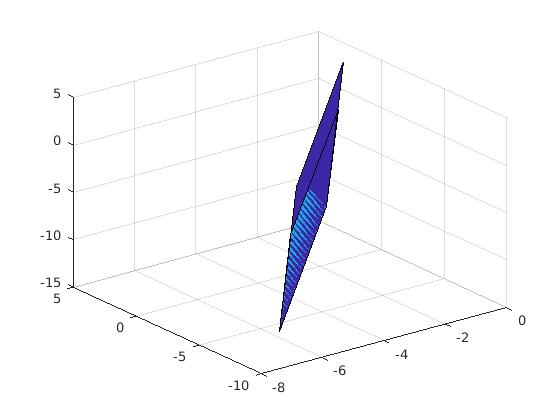
Planes The following set of three linear algebraic equations (3) – (5) represents three planes in an X-Y-Z coordinate system. Visualize the three planes in MATLAB. Find the intersection of the three planes by manual Gauss elimination and indicate the solution with the three planes. Find the intersection programmatically using Ax = b to validate your answer.
I need help plotting the planes nothing seems to work when i do this
A=[1 1 1; 2 3 1; 3 2 1 ];
% b=[2;1;3];
% n=A\b;
%
% m = linspace(-2,0,2);
% z = linspace(-2,0,2);
% y1 = n+m+z-2;
% y2 = 2*n+3*m-1;
% y3 = 3*n+2*m+z-3;
% figure
% fsurf(y1,m,z)
Homework Answers
Please find the required MATLAB script as the following. You need to use meshgrid.
%=============================================
A=[1 1 1; 2 3 1; 3 2 1 ];
b=[2;1;3];
n=A\b;
m = linspace(-2,0,2);
z = linspace(-2,0,2);
[N,M,Z] = meshgrid(n,m,z) ;
y1 = n+m+z-2;
y2 = 2*n+3*m-1;
y3 = 3*n+2*m+z-3;
figure
surf(y1,y2,y3)
%=============================================
output:
Add Answer to:
Planes The following set of three linear algebraic equations (3)
– (5) represents three planes in...
1) Consider the system of linear algebraic equations Ax = B where | 1 1/2 1/31...
 1) Consider the system of linear algebraic equations Ax = B where | 1 1/2 1/31 1/2 1/3 1/4 11/3 1/4 1/5 a) Find x, A" and det(A) using Gauss-Jordan elimination without pivoting. b) Using the result of part (a), find the condition number of A based on the Euclidean (Frobenius) norm. How many digits of precision do you suspect are lost in the solution x due to ill-conditioning?
Tutorial 4. Linear systems of algebraic equations 2 October, 4-5 pm in FN2 (Q1) Consider this linear system of equation...
 Tutorial 4. Linear systems of algebraic equations 2 October, 4-5 pm in FN2 (Q1) Consider this linear system of equations a. 1 p -2 0 0 0 1 0 q 0 4 2r -2 0 -1 0 4s Order the four equations such that the system of equations can be solved efficiently by Gauss elimination b. Solve the system by Gauss elimination (Q2) -1] 6 Given the linear system of equations A5 with [A| solve for i 10 and by...
Experiment 3 Design with Decoders and Multiplexers 1. Function Set Assignment Function set number...
 Logic design
Experiment 3 Design with Decoders and Multiplexers 1. Function Set Assignment Function set number F(wxya)-E m(e, 5,6,9, 13,15)+d,z,s,lo) Fs(wx.ya)Cy +u'+2)(x +y 2 2. Design Procedures Fxw.xya)-Em, 5,10,12,13,14, 1s (Show the implementation of F, and F by a 74155 IC and some external gates. Draw a circuit diagram.) 155 15o C Y3 b12 Y2 YO Y2 13 Y1 YO Draw the sub-function K-maps for F3 with w, x, z as expansion variables. Based on the sub-function K-maps, the data...
Logic design
Experiment 3 Design with Decoders and Multiplexers 1. Function Set Assignment Function set number F(wxya)-E m(e, 5,6,9, 13,15)+d,z,s,lo) Fs(wx.ya)Cy +u'+2)(x +y 2 2. Design Procedures Fxw.xya)-Em, 5,10,12,13,14, 1s (Show the implementation of F, and F by a 74155 IC and some external gates. Draw a circuit diagram.) 155 15o C Y3 b12 Y2 YO Y2 13 Y1 YO Draw the sub-function K-maps for F3 with w, x, z as expansion variables. Based on the sub-function K-maps, the data...
Please solve with detailed expplanation and graphs. Thank you! 8. Set up the following integrals in...
 Please solve with detailed expplanation and graphs.
Thank you!
8. Set up the following integrals in whatever coordinate system is most appropriate; use symmetry to simplify the integral if possible. You do not need to evaluate the integrals. ry+xz+yz) dV, where A is the region bounded by + y2 = 16 and the planes 2 = 0 and 2 = 4-y. -2 +32°) dV, where B is the region bounded by y = 4 - x, and the planes y...
Please solve with detailed expplanation and graphs.
Thank you!
8. Set up the following integrals in whatever coordinate system is most appropriate; use symmetry to simplify the integral if possible. You do not need to evaluate the integrals. ry+xz+yz) dV, where A is the region bounded by + y2 = 16 and the planes 2 = 0 and 2 = 4-y. -2 +32°) dV, where B is the region bounded by y = 4 - x, and the planes y...
3. Consider the following system of linear equations: 2.0 + 2y + 2kz = 2 kx...
 3. Consider the following system of linear equations: 2.0 + 2y + 2kz = 2 kx + ky+z=1 2x + 3y + 72 = 4 (i) Turn the system into row echelon form. (ii) Determine which values of k give (i) a unique solution (ii) infinitely many solutions and (iii) no solutions. Show your working. 4. Solve the following system of linear equations using Gauss-Jordan elimination: x1 + x2 - 2.13 + 24 +3.25 = 1 2.x1 - x2 +...
1. Consider the following system of linear equations: (8 marks) x+y = 3 7 7 2...
 1. Consider the following system of linear equations: (8 marks) x+y = 3 7 7 2 -x+z=2 y-w=1 W = 4 z + w = 4 1) Use Gauss-Jordan elimination to put the augmented matrix corresponding to this system into reduced row echelon form. Clearly show all the elementary row operations applied. (3 marks) 12 nn
All I need help with on this question is the MIRR for all three projects. I...
 All I need help with on this question is the MIRR for all three
projects. I have tried both excel and handwriting and can't seem to
get it right, so this is my last attempt. Thank you!
Since the picture seems hard to see: The values for Project M
are 400,000 years 1-5, N is 600,000 years 1-5, and O is 900,000
(Y1), 700,000 (Y2), 500,000 (Y3), 300,000 (Y4), and 100,000 (Y5).
The discount rate for M is 8%, N...
All I need help with on this question is the MIRR for all three
projects. I have tried both excel and handwriting and can't seem to
get it right, so this is my last attempt. Thank you!
Since the picture seems hard to see: The values for Project M
are 400,000 years 1-5, N is 600,000 years 1-5, and O is 900,000
(Y1), 700,000 (Y2), 500,000 (Y3), 300,000 (Y4), and 100,000 (Y5).
The discount rate for M is 8%, N...
N MATLAB: This is an easy problem to demonstrate how polyfit and polyval work! The values...
N MATLAB: This is an easy problem to demonstrate how polyfit and polyval work! The values in y are basically a sine function on x. You can validate by checking in MATLAB >> x = 0:9 x = 0 1 2 3 4 5 6 7 8 9 >> y = sin(x) y = 0 0.8415 0.9093 0.1411 -0.7568 -0.9589 -0.2794 0.6570 0.9894 0.4121 Now, let us try to see what happens if we use polyfit on the values of...
Please Answer the Following Questions (SHOW ALL WORK) 1. 2. 3. 4. Write an iterated integral...
 Please Answer the Following Questions (SHOW ALL WORK)
1.
2.
3.
4.
Write an iterated integral for SSSo flexy.z)dV where D is a sphere of radius 3 centered at (0,0,0). Use the order dx dz dy. Choose the correct answer below. 3 3 3 OA. S S f(x,y,z) dx dz dy -3 -3 -3 3 OB. S 19-x2 19-32-22 s f(x,y,z) dy dz dx 19-x2 - 19-2-22 s -3 3 3 3 oc. S S [ f(x,y,z) dy dz dx...
Please Answer the Following Questions (SHOW ALL WORK)
1.
2.
3.
4.
Write an iterated integral for SSSo flexy.z)dV where D is a sphere of radius 3 centered at (0,0,0). Use the order dx dz dy. Choose the correct answer below. 3 3 3 OA. S S f(x,y,z) dx dz dy -3 -3 -3 3 OB. S 19-x2 19-32-22 s f(x,y,z) dy dz dx 19-x2 - 19-2-22 s -3 3 3 3 oc. S S [ f(x,y,z) dy dz dx...
using matlab thank you 3 MARKS QUESTION 3 Background The van der Pol equation is a 2nd-order ODE that describes self-sustaining oscillations in which energy is withdrawn from large oscillations and fe...
 using matlab thank you
3 MARKS QUESTION 3 Background The van der Pol equation is a 2nd-order ODE that describes self-sustaining oscillations in which energy is withdrawn from large oscillations and fed into the small oscillations. This equation typically models electronic circuits containing vacuum tubes. The van der Pol equation is: dt2 dt where y represents the position coordinate, t is time, and u is a damping coefficient The 2nd-order ODE can be solved as a set of 1st-order ODEs,...
using matlab thank you
3 MARKS QUESTION 3 Background The van der Pol equation is a 2nd-order ODE that describes self-sustaining oscillations in which energy is withdrawn from large oscillations and fed into the small oscillations. This equation typically models electronic circuits containing vacuum tubes. The van der Pol equation is: dt2 dt where y represents the position coordinate, t is time, and u is a damping coefficient The 2nd-order ODE can be solved as a set of 1st-order ODEs,...
 1) Consider the system of linear algebraic equations Ax = B where | 1 1/2 1/31 1/2 1/3 1/4 11/3 1/4 1/5 a) Find x, A" and det(A) using Gauss-Jordan elimination without pivoting. b) Using the result of part (a), find the condition number of A based on the Euclidean (Frobenius) norm. How many digits of precision do you suspect are lost in the solution x due to ill-conditioning?
 Tutorial 4. Linear systems of algebraic equations 2 October, 4-5 pm in FN2 (Q1) Consider this linear system of equations a. 1 p -2 0 0 0 1 0 q 0 4 2r -2 0 -1 0 4s Order the four equations such that the system of equations can be solved efficiently by Gauss elimination b. Solve the system by Gauss elimination (Q2) -1] 6 Given the linear system of equations A5 with [A| solve for i 10 and by...
 Logic design
Experiment 3 Design with Decoders and Multiplexers 1. Function Set Assignment Function set number F(wxya)-E m(e, 5,6,9, 13,15)+d,z,s,lo) Fs(wx.ya)Cy +u'+2)(x +y 2 2. Design Procedures Fxw.xya)-Em, 5,10,12,13,14, 1s (Show the implementation of F, and F by a 74155 IC and some external gates. Draw a circuit diagram.) 155 15o C Y3 b12 Y2 YO Y2 13 Y1 YO Draw the sub-function K-maps for F3 with w, x, z as expansion variables. Based on the sub-function K-maps, the data...
Logic design
Experiment 3 Design with Decoders and Multiplexers 1. Function Set Assignment Function set number F(wxya)-E m(e, 5,6,9, 13,15)+d,z,s,lo) Fs(wx.ya)Cy +u'+2)(x +y 2 2. Design Procedures Fxw.xya)-Em, 5,10,12,13,14, 1s (Show the implementation of F, and F by a 74155 IC and some external gates. Draw a circuit diagram.) 155 15o C Y3 b12 Y2 YO Y2 13 Y1 YO Draw the sub-function K-maps for F3 with w, x, z as expansion variables. Based on the sub-function K-maps, the data...
 Please solve with detailed expplanation and graphs.
Thank you!
8. Set up the following integrals in whatever coordinate system is most appropriate; use symmetry to simplify the integral if possible. You do not need to evaluate the integrals. ry+xz+yz) dV, where A is the region bounded by + y2 = 16 and the planes 2 = 0 and 2 = 4-y. -2 +32°) dV, where B is the region bounded by y = 4 - x, and the planes y...
Please solve with detailed expplanation and graphs.
Thank you!
8. Set up the following integrals in whatever coordinate system is most appropriate; use symmetry to simplify the integral if possible. You do not need to evaluate the integrals. ry+xz+yz) dV, where A is the region bounded by + y2 = 16 and the planes 2 = 0 and 2 = 4-y. -2 +32°) dV, where B is the region bounded by y = 4 - x, and the planes y...
 3. Consider the following system of linear equations: 2.0 + 2y + 2kz = 2 kx + ky+z=1 2x + 3y + 72 = 4 (i) Turn the system into row echelon form. (ii) Determine which values of k give (i) a unique solution (ii) infinitely many solutions and (iii) no solutions. Show your working. 4. Solve the following system of linear equations using Gauss-Jordan elimination: x1 + x2 - 2.13 + 24 +3.25 = 1 2.x1 - x2 +...
 1. Consider the following system of linear equations: (8 marks) x+y = 3 7 7 2 -x+z=2 y-w=1 W = 4 z + w = 4 1) Use Gauss-Jordan elimination to put the augmented matrix corresponding to this system into reduced row echelon form. Clearly show all the elementary row operations applied. (3 marks) 12 nn
 All I need help with on this question is the MIRR for all three
projects. I have tried both excel and handwriting and can't seem to
get it right, so this is my last attempt. Thank you!
Since the picture seems hard to see: The values for Project M
are 400,000 years 1-5, N is 600,000 years 1-5, and O is 900,000
(Y1), 700,000 (Y2), 500,000 (Y3), 300,000 (Y4), and 100,000 (Y5).
The discount rate for M is 8%, N...
All I need help with on this question is the MIRR for all three
projects. I have tried both excel and handwriting and can't seem to
get it right, so this is my last attempt. Thank you!
Since the picture seems hard to see: The values for Project M
are 400,000 years 1-5, N is 600,000 years 1-5, and O is 900,000
(Y1), 700,000 (Y2), 500,000 (Y3), 300,000 (Y4), and 100,000 (Y5).
The discount rate for M is 8%, N...
 Please Answer the Following Questions (SHOW ALL WORK)
1.
2.
3.
4.
Write an iterated integral for SSSo flexy.z)dV where D is a sphere of radius 3 centered at (0,0,0). Use the order dx dz dy. Choose the correct answer below. 3 3 3 OA. S S f(x,y,z) dx dz dy -3 -3 -3 3 OB. S 19-x2 19-32-22 s f(x,y,z) dy dz dx 19-x2 - 19-2-22 s -3 3 3 3 oc. S S [ f(x,y,z) dy dz dx...
Please Answer the Following Questions (SHOW ALL WORK)
1.
2.
3.
4.
Write an iterated integral for SSSo flexy.z)dV where D is a sphere of radius 3 centered at (0,0,0). Use the order dx dz dy. Choose the correct answer below. 3 3 3 OA. S S f(x,y,z) dx dz dy -3 -3 -3 3 OB. S 19-x2 19-32-22 s f(x,y,z) dy dz dx 19-x2 - 19-2-22 s -3 3 3 3 oc. S S [ f(x,y,z) dy dz dx...
 using matlab thank you
3 MARKS QUESTION 3 Background The van der Pol equation is a 2nd-order ODE that describes self-sustaining oscillations in which energy is withdrawn from large oscillations and fed into the small oscillations. This equation typically models electronic circuits containing vacuum tubes. The van der Pol equation is: dt2 dt where y represents the position coordinate, t is time, and u is a damping coefficient The 2nd-order ODE can be solved as a set of 1st-order ODEs,...
using matlab thank you
3 MARKS QUESTION 3 Background The van der Pol equation is a 2nd-order ODE that describes self-sustaining oscillations in which energy is withdrawn from large oscillations and fed into the small oscillations. This equation typically models electronic circuits containing vacuum tubes. The van der Pol equation is: dt2 dt where y represents the position coordinate, t is time, and u is a damping coefficient The 2nd-order ODE can be solved as a set of 1st-order ODEs,...
Most questions answered within 3 hours.
-
Where is the error in this code sequence?
String s1 = "Hello";
String s2 = "ello";...
asked 10 months ago -
Financial data for Joel de Paris, Inc., for last year
follow:
Joel de Paris, Inc.
Balance...
asked 10 months ago -
Consider this reaction:
Al2(SO4)3 (aq)+ BaCl3
(aq) Al2Cl6 (aq)- +
3BaSO4(s) . What is the...
asked 10 months ago -
Suppose that Savneet is considering increasing her
recent random sample from 20 car rentals to 40...
asked 10 months ago -
Trucks arrive at an unloading terminal at an average rate of 120
per hour.
Trucks arrive...
asked 10 months ago -
Why are methanol and ethanol completely soluble in water while
octanol is not very little soluble....
asked 10 months ago -
A facilities manager at a university reads in a research report
that the mean amount of...
asked 10 months ago -
When the CuSO4 is rehydrated by adding water to the anhydrous
compound, is this an endothermic...
asked 10 months ago -
A ray of sunlight is passing from diamond into crown glass; the
angle of incidence is...
asked 10 months ago -
A block of mass 0.249 kg is placed on top of a light, vertical
spring of...
asked 10 months ago -
how do the kidneys compensate in the presences of acidosis
a) trigger hyperventilate
b) reserve acid...
asked 10 months ago -
Question 501 pts
The rental rate of capital to the firm increases. Which of the
following...
asked 10 months ago