
Homework Answers
Add Answer to:
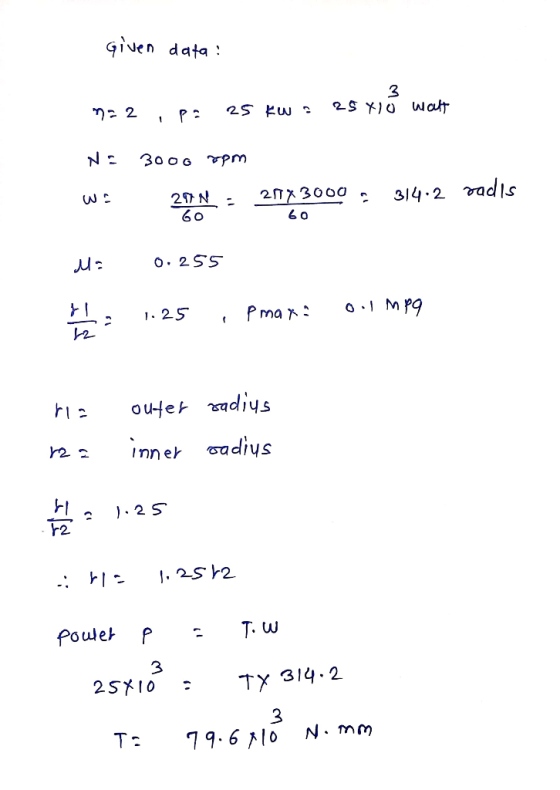
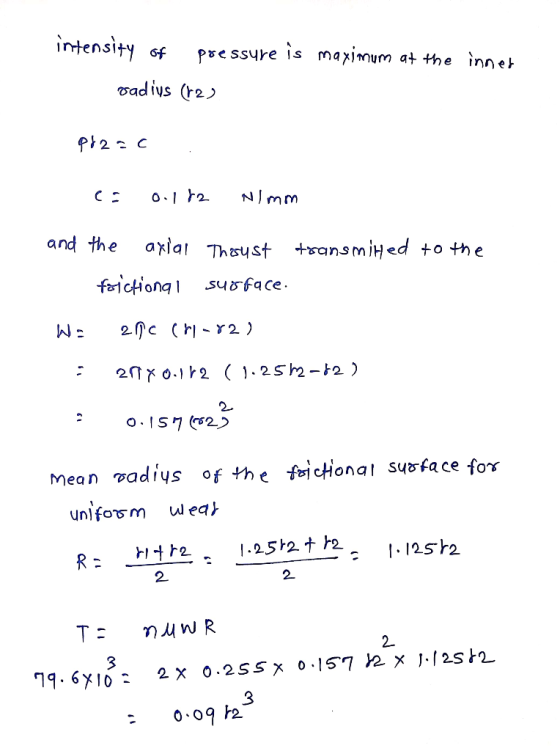
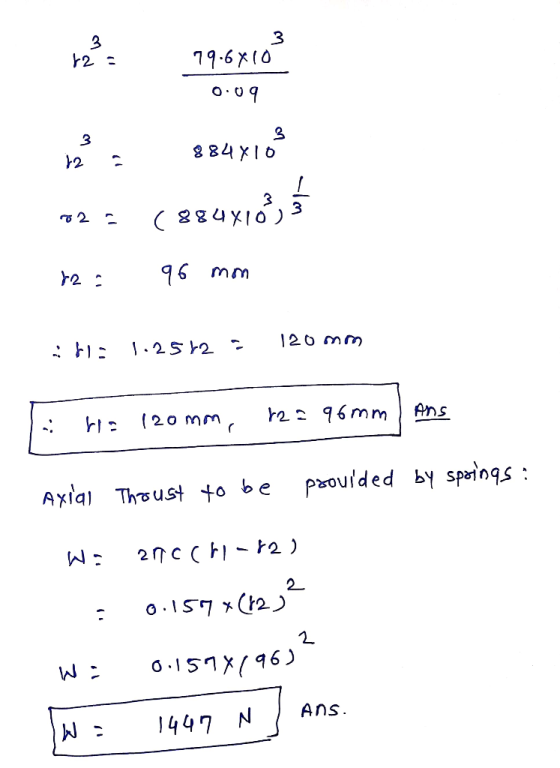
3. A single plate clutch, effective on both sides, is required to transmit 25 kW at...
A cone clutch is to be designed to transmit 7.5 kW at 900 r.p.m. The cone...
 A cone clutch is to be designed to transmit 7.5 kW at 900 r.p.m. The cone has a face angle of 12°. The width of the face is half of the mean radius and the normal pressure between the contact faces is not to exceed 0.09 N/mm². Assuming uniform wear and the coefficient of friction between the contact faces as 0.2, find the main dimensions of the clutch and the axial force required to engage the clutch.
1. A multiple friction clutch is required to transmit 89.52 kW at 3000 rpm. The plates...
 1. A multiple friction clutch is required to transmit 89.52 kW at 3000 rpm. The plates are alternatively of steel and phosphor bronze and they run in oil. The coefficient of friction is 0.08. The internal radius of the friction surface is 0.8 times the radius of the external surface. The axial pressure is limited to 20 x 104 N/m2. If the maximum diameter of the frictional surface is not to exceed 250 mm, determine the number of plates required.
A friction clutch is used to rotate a machine from a shaft rotating at a uniform...
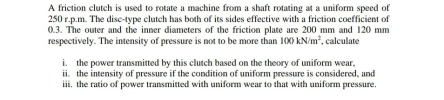 A friction clutch is used to rotate a machine from a shaft rotating at a uniform speed of 250 r.p.m. The disc-type clutch has both of its sides effective with a friction coefficient of 0.3. The outer and the inner diameters of the friction plate are 200 mm and 120 mm respectively. The intensity of pressure is not to be more than 100 kN/m², calculate i. the power transmitted by this clutch based on the theory of uniform wear, ii....
Question 5 A multi-disc friction clutch has to be desıgned to transmıt 75 kW from a motor running at 1440rev/mın The di...
 Question 5 A multi-disc friction clutch has to be desıgned to transmıt 75 kW from a motor running at 1440rev/mın The discs are to have an outer diameter of 200 mm and an ınsıde diameter of 150 mm Assume condıtion of uniform wear and that the maximum design pressure is lmited to 150 kPa Assume μ-0 25 (12) 5 1 Determine the necessary end thrust and the necessary number of plates After this clutch (from 5 1) in manufactured it...
A single disk clutch with both sides effective is used to run a machine through a...
A single disk clutch with both sides effective is used to run a machine through a shaft rotating at uniform speeds of 240rpm. Assume © 0.25. di=120mm. Do=240mm. Maximum intensity of pressure 120KPA. MOI= 7 kg-m2. Determine 1. time required to attain the full speed by machine and 2. energy lost in slipping of the clutch
Question 4 [25 marks] An electric motor drives a coaxial rotor through a single-plate clutch which...
 Question 4 [25 marks] An electric motor drives a coaxial rotor through a single-plate clutch which has two pairs of driving surfaces each 300 mm external and 175 mm internal diameter. The variation of normal pressure with radius is given by a + b/r Pa and the maximum pressure is 150 kPa. The spring force on the system is 500 N. The mass of the motor armature and shaft is 750 kg and its radius of gyration is 240 mm;...
 A cone clutch is to be designed to transmit 7.5 kW at 900 r.p.m. The cone has a face angle of 12°. The width of the face is half of the mean radius and the normal pressure between the contact faces is not to exceed 0.09 N/mm². Assuming uniform wear and the coefficient of friction between the contact faces as 0.2, find the main dimensions of the clutch and the axial force required to engage the clutch.
 1. A multiple friction clutch is required to transmit 89.52 kW at 3000 rpm. The plates are alternatively of steel and phosphor bronze and they run in oil. The coefficient of friction is 0.08. The internal radius of the friction surface is 0.8 times the radius of the external surface. The axial pressure is limited to 20 x 104 N/m2. If the maximum diameter of the frictional surface is not to exceed 250 mm, determine the number of plates required.
 A friction clutch is used to rotate a machine from a shaft rotating at a uniform speed of 250 r.p.m. The disc-type clutch has both of its sides effective with a friction coefficient of 0.3. The outer and the inner diameters of the friction plate are 200 mm and 120 mm respectively. The intensity of pressure is not to be more than 100 kN/m², calculate i. the power transmitted by this clutch based on the theory of uniform wear, ii....
 Question 5 A multi-disc friction clutch has to be desıgned to transmıt 75 kW from a motor running at 1440rev/mın The discs are to have an outer diameter of 200 mm and an ınsıde diameter of 150 mm Assume condıtion of uniform wear and that the maximum design pressure is lmited to 150 kPa Assume μ-0 25 (12) 5 1 Determine the necessary end thrust and the necessary number of plates After this clutch (from 5 1) in manufactured it...
 Question 4 [25 marks] An electric motor drives a coaxial rotor through a single-plate clutch which has two pairs of driving surfaces each 300 mm external and 175 mm internal diameter. The variation of normal pressure with radius is given by a + b/r Pa and the maximum pressure is 150 kPa. The spring force on the system is 500 N. The mass of the motor armature and shaft is 750 kg and its radius of gyration is 240 mm;...
Most questions answered within 3 hours.
-
Where is the error in this code sequence?
String s1 = "Hello";
String s2 = "ello";...
asked 10 months ago -
Financial data for Joel de Paris, Inc., for last year
follow:
Joel de Paris, Inc.
Balance...
asked 10 months ago -
Consider this reaction:
Al2(SO4)3 (aq)+ BaCl3
(aq) Al2Cl6 (aq)- +
3BaSO4(s) . What is the...
asked 10 months ago -
Suppose that Savneet is considering increasing her
recent random sample from 20 car rentals to 40...
asked 10 months ago -
Trucks arrive at an unloading terminal at an average rate of 120
per hour.
Trucks arrive...
asked 10 months ago -
Why are methanol and ethanol completely soluble in water while
octanol is not very little soluble....
asked 10 months ago -
A facilities manager at a university reads in a research report
that the mean amount of...
asked 10 months ago -
When the CuSO4 is rehydrated by adding water to the anhydrous
compound, is this an endothermic...
asked 10 months ago -
A ray of sunlight is passing from diamond into crown glass; the
angle of incidence is...
asked 10 months ago -
A block of mass 0.249 kg is placed on top of a light, vertical
spring of...
asked 10 months ago -
how do the kidneys compensate in the presences of acidosis
a) trigger hyperventilate
b) reserve acid...
asked 10 months ago -
Question 501 pts
The rental rate of capital to the firm increases. Which of the
following...
asked 10 months ago