
Homework Answers

Add Answer to:
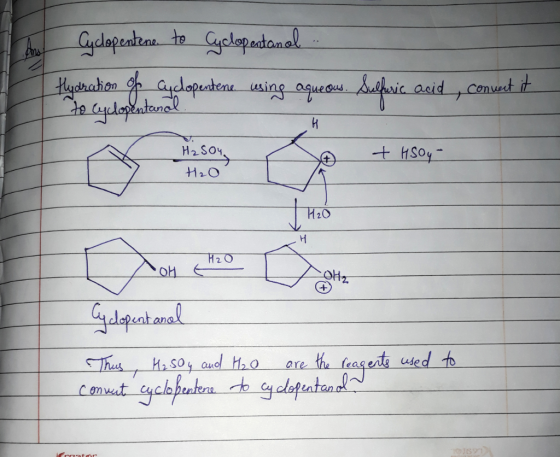
Question 10.20 From the drop-down lists below select the reagent(s) you could use to convert cyclopentene...
References From the lists of available reagents select the one(s) you would use to in a...
 References From the lists of available reagents select the one(s) you would use to in a preparation of acetophenone (phenyl methyl katone) from methylberate (In no case are more than three steps necessary.) . SOCH Reagents Available a CH,COCI, AICI d. CH CHO g. Mg b. (CH3)2Culi e. Ho(OA), H,Othen NaBH, h. NaOH, H, C. CH, MgBr, then H30* . KMnO, H2O 1. Dess-Martin periodinane List reagents by letter in the order that they are used; example: la Reagents used:...
From the table of available reagents, select the one(s) you would use to convert toluene (shown...
 From the table of available reagents, select the one(s) you would use to convert toluene (shown above) to each of the following products: (Use the minimum number of steps; in no ease arc more than six steps necessary. List reagents by letter in the order that they are used (example: fa). If an acid workup is required, for example after a Grignard reaction, it must be specified.)
Draw the structure(s) of the major organic product(s) obtained after workup of the following reaction. NaOH...
 Draw the structure(s) of the major organic product(s) obtained after workup of the following reaction. NaOH O-S CH3 excess NH2 workup . You do not have to consider stereochemistry. If no reaction occurs, draw the organic starting material. Draw structure(s) of product(s) after workup to neutralize acid. Include counter-ions, e.g., Nat, I, in your submission, but draw them in their own separate sketcher. Draw one structure per sketcher. Add additional sketchers using the drop-down menu in the bottom right corner....
[References] From the table of available reagents select the one(s) you would use to convert cyclohexanone...
 [References] From the table of available reagents select the one(s) you would use to convert cyclohexanone to the following compound: CH2CH2CO2H Use the minimum number of steps: from one to five are required. List reagents by letter in the order that they are used; example: fa. Reagents Available a. BH3, THF; followed by H2O2, OH g. Nat -CH(CO2C2H5) (from CH2(CO2C2H5)2 + Nat -OC2H5) b. Br2, CH3CO2H h. PBr3 c. HCN, KCN i. PhCH Br d. H307, heat j. Ph3P+- CH2...
Select the reagents you would use to synthesize the compound below from benzene. (More than one...
 Select the reagents you would use to synthesize the compound
below from benzene.
(More than one step is required. If no third step is needed,
choose (none).)
Reagents Available f. KMnO4, H20 g. H2, Pd/C h. SO3, H2SO4 i. NaOH, H2O a. Br2, FeBr3 b. Cl2, FeCl 0 d. CH3CI, AICl3 Br e. CH3COCI, AICl3 N-bromosuccinimide (NBS) ball & stick labels Step 1: Step 2 Step 3
Select the reagents you would use to synthesize the compound
below from benzene.
(More than one step is required. If no third step is needed,
choose (none).)
Reagents Available f. KMnO4, H20 g. H2, Pd/C h. SO3, H2SO4 i. NaOH, H2O a. Br2, FeBr3 b. Cl2, FeCl 0 d. CH3CI, AICl3 Br e. CH3COCI, AICl3 N-bromosuccinimide (NBS) ball & stick labels Step 1: Step 2 Step 3
Help please From the table of available reagents below, select the one(s) you would use to...
 Help please
From the table of available reagents below, select the one(s) you would use to accomplish the following conversions. Use the minimum number of steps. List the reagents in order used. No more than 4 steps are necessary. 1-hexyne to 2-methoxyhexane _____ cis-1-methoxy-4-methylcyclohexane to trans-1-bromo-4-methylcyclohexane _____Reagents available a. BH_3, THF: then H_2O_2, ^-OH b. Br_2 c. Hg(OCOCF_3)_2, CH_3CH_2OH: then NaBH_4 d. Hg(OCOCF_3)_2, CH_3OH: then NaBH_4 e. HI, H_2O f: H_2, Lindlar catalyst g. NaH h. ^-OH, H_2O i. ^-OCH_3,...
Help please
From the table of available reagents below, select the one(s) you would use to accomplish the following conversions. Use the minimum number of steps. List the reagents in order used. No more than 4 steps are necessary. 1-hexyne to 2-methoxyhexane _____ cis-1-methoxy-4-methylcyclohexane to trans-1-bromo-4-methylcyclohexane _____Reagents available a. BH_3, THF: then H_2O_2, ^-OH b. Br_2 c. Hg(OCOCF_3)_2, CH_3CH_2OH: then NaBH_4 d. Hg(OCOCF_3)_2, CH_3OH: then NaBH_4 e. HI, H_2O f: H_2, Lindlar catalyst g. NaH h. ^-OH, H_2O i. ^-OCH_3,...
Use seratch paper if necessary, and copy your completed calculations to this sheet Shown below are...
 Use seratch paper if necessary, and copy your completed calculations to this sheet Shown below are the 4 reactions involved in the Cu cycle listed in random order CuPO )HC1 ag)--CuCl (ag)+HPO, (aq) CuCl (ag)+Mg )-MgCl (ag)+Cu (G Cu )+4HNO, (ag)-CuNO) (ag)+2NO2 ()+2HO D CuNO (ag)+NaPO. (ag)- Cu(PO.)2 (s) +NaNO, (ag) The first reaction in the cycle is initiated by adding 6 M nitric acid to elemental copper 1. Calculate the volume of 6 MHNO3 needed to react with 0.636...
Grignard reagent THE GRIGNARD REAGENT-PREPARATION AND REACTION In this experiment, you will prepa...
 i need help with the postlab questions please
Grignard reagent THE GRIGNARD REAGENT-PREPARATION AND REACTION In this experiment, you will prepare a Grignard reagent, phenyl magnesium bromide, from bromobenzene and magnesium metal. The Grignard reagent will then react with methyl benzoate to form triphenylmethanol. Introduction Grignard reagents, such as organomagnesium halides, were discovered in 1910 by French chemist Victor Grignard. The Grignard reaction is one of the most general methods for carbon- carbon bond formation in all of organic chemistry....
i need help with the postlab questions please
Grignard reagent THE GRIGNARD REAGENT-PREPARATION AND REACTION In this experiment, you will prepare a Grignard reagent, phenyl magnesium bromide, from bromobenzene and magnesium metal. The Grignard reagent will then react with methyl benzoate to form triphenylmethanol. Introduction Grignard reagents, such as organomagnesium halides, were discovered in 1910 by French chemist Victor Grignard. The Grignard reaction is one of the most general methods for carbon- carbon bond formation in all of organic chemistry....
Fatty Acid Metabolism. The reactions of the fatty acid spiral are shown below. Use the description...
 Fatty Acid Metabolism. The reactions of the fatty acid spiral are shown below. Use the description on the left side of the page to classify the reactions and fill in the boxes on the right side of the page Activation Step. The activation of the fatty acid begins by the addition of CoA which will carry the fatty acid from the cytosol into the mitochondria. The product, which is a fatty acid with a CoA attached, is known as a...
2-methylocta-4,6-dien-1-amine Assignment 1: Draw your molecule from IUPAC name
 2-methylocta-4,6-dien-1-amineAssignment 1: Draw your molecule from IUPAC
name Using the given IUPAC name, draw your molecule Complete the cover page (p.1) of your portfolio with the
following:o Structural formula of the moleculeo IUPAC name Use a thin, clear binder or report cover to protect the
portfolio Submit the following in the binder:o Cover page as described above (page 1)Assignment 2: Formula, Molar Mass and Functional
Groups On a page titled Expanded Structural Formula draw the expanded
structure of themolecule.o Show...
2-methylocta-4,6-dien-1-amineAssignment 1: Draw your molecule from IUPAC
name Using the given IUPAC name, draw your molecule Complete the cover page (p.1) of your portfolio with the
following:o Structural formula of the moleculeo IUPAC name Use a thin, clear binder or report cover to protect the
portfolio Submit the following in the binder:o Cover page as described above (page 1)Assignment 2: Formula, Molar Mass and Functional
Groups On a page titled Expanded Structural Formula draw the expanded
structure of themolecule.o Show...
 References From the lists of available reagents select the one(s) you would use to in a preparation of acetophenone (phenyl methyl katone) from methylberate (In no case are more than three steps necessary.) . SOCH Reagents Available a CH,COCI, AICI d. CH CHO g. Mg b. (CH3)2Culi e. Ho(OA), H,Othen NaBH, h. NaOH, H, C. CH, MgBr, then H30* . KMnO, H2O 1. Dess-Martin periodinane List reagents by letter in the order that they are used; example: la Reagents used:...
 From the table of available reagents, select the one(s) you would use to convert toluene (shown above) to each of the following products: (Use the minimum number of steps; in no ease arc more than six steps necessary. List reagents by letter in the order that they are used (example: fa). If an acid workup is required, for example after a Grignard reaction, it must be specified.)
 Draw the structure(s) of the major organic product(s) obtained after workup of the following reaction. NaOH O-S CH3 excess NH2 workup . You do not have to consider stereochemistry. If no reaction occurs, draw the organic starting material. Draw structure(s) of product(s) after workup to neutralize acid. Include counter-ions, e.g., Nat, I, in your submission, but draw them in their own separate sketcher. Draw one structure per sketcher. Add additional sketchers using the drop-down menu in the bottom right corner....
 [References] From the table of available reagents select the one(s) you would use to convert cyclohexanone to the following compound: CH2CH2CO2H Use the minimum number of steps: from one to five are required. List reagents by letter in the order that they are used; example: fa. Reagents Available a. BH3, THF; followed by H2O2, OH g. Nat -CH(CO2C2H5) (from CH2(CO2C2H5)2 + Nat -OC2H5) b. Br2, CH3CO2H h. PBr3 c. HCN, KCN i. PhCH Br d. H307, heat j. Ph3P+- CH2...
 Select the reagents you would use to synthesize the compound
below from benzene.
(More than one step is required. If no third step is needed,
choose (none).)
Reagents Available f. KMnO4, H20 g. H2, Pd/C h. SO3, H2SO4 i. NaOH, H2O a. Br2, FeBr3 b. Cl2, FeCl 0 d. CH3CI, AICl3 Br e. CH3COCI, AICl3 N-bromosuccinimide (NBS) ball & stick labels Step 1: Step 2 Step 3
Select the reagents you would use to synthesize the compound
below from benzene.
(More than one step is required. If no third step is needed,
choose (none).)
Reagents Available f. KMnO4, H20 g. H2, Pd/C h. SO3, H2SO4 i. NaOH, H2O a. Br2, FeBr3 b. Cl2, FeCl 0 d. CH3CI, AICl3 Br e. CH3COCI, AICl3 N-bromosuccinimide (NBS) ball & stick labels Step 1: Step 2 Step 3
 Help please
From the table of available reagents below, select the one(s) you would use to accomplish the following conversions. Use the minimum number of steps. List the reagents in order used. No more than 4 steps are necessary. 1-hexyne to 2-methoxyhexane _____ cis-1-methoxy-4-methylcyclohexane to trans-1-bromo-4-methylcyclohexane _____Reagents available a. BH_3, THF: then H_2O_2, ^-OH b. Br_2 c. Hg(OCOCF_3)_2, CH_3CH_2OH: then NaBH_4 d. Hg(OCOCF_3)_2, CH_3OH: then NaBH_4 e. HI, H_2O f: H_2, Lindlar catalyst g. NaH h. ^-OH, H_2O i. ^-OCH_3,...
Help please
From the table of available reagents below, select the one(s) you would use to accomplish the following conversions. Use the minimum number of steps. List the reagents in order used. No more than 4 steps are necessary. 1-hexyne to 2-methoxyhexane _____ cis-1-methoxy-4-methylcyclohexane to trans-1-bromo-4-methylcyclohexane _____Reagents available a. BH_3, THF: then H_2O_2, ^-OH b. Br_2 c. Hg(OCOCF_3)_2, CH_3CH_2OH: then NaBH_4 d. Hg(OCOCF_3)_2, CH_3OH: then NaBH_4 e. HI, H_2O f: H_2, Lindlar catalyst g. NaH h. ^-OH, H_2O i. ^-OCH_3,...
 Use seratch paper if necessary, and copy your completed calculations to this sheet Shown below are the 4 reactions involved in the Cu cycle listed in random order CuPO )HC1 ag)--CuCl (ag)+HPO, (aq) CuCl (ag)+Mg )-MgCl (ag)+Cu (G Cu )+4HNO, (ag)-CuNO) (ag)+2NO2 ()+2HO D CuNO (ag)+NaPO. (ag)- Cu(PO.)2 (s) +NaNO, (ag) The first reaction in the cycle is initiated by adding 6 M nitric acid to elemental copper 1. Calculate the volume of 6 MHNO3 needed to react with 0.636...
 i need help with the postlab questions please
Grignard reagent THE GRIGNARD REAGENT-PREPARATION AND REACTION In this experiment, you will prepare a Grignard reagent, phenyl magnesium bromide, from bromobenzene and magnesium metal. The Grignard reagent will then react with methyl benzoate to form triphenylmethanol. Introduction Grignard reagents, such as organomagnesium halides, were discovered in 1910 by French chemist Victor Grignard. The Grignard reaction is one of the most general methods for carbon- carbon bond formation in all of organic chemistry....
i need help with the postlab questions please
Grignard reagent THE GRIGNARD REAGENT-PREPARATION AND REACTION In this experiment, you will prepare a Grignard reagent, phenyl magnesium bromide, from bromobenzene and magnesium metal. The Grignard reagent will then react with methyl benzoate to form triphenylmethanol. Introduction Grignard reagents, such as organomagnesium halides, were discovered in 1910 by French chemist Victor Grignard. The Grignard reaction is one of the most general methods for carbon- carbon bond formation in all of organic chemistry....
 Fatty Acid Metabolism. The reactions of the fatty acid spiral are shown below. Use the description on the left side of the page to classify the reactions and fill in the boxes on the right side of the page Activation Step. The activation of the fatty acid begins by the addition of CoA which will carry the fatty acid from the cytosol into the mitochondria. The product, which is a fatty acid with a CoA attached, is known as a...
 2-methylocta-4,6-dien-1-amineAssignment 1: Draw your molecule from IUPAC
name Using the given IUPAC name, draw your molecule Complete the cover page (p.1) of your portfolio with the
following:o Structural formula of the moleculeo IUPAC name Use a thin, clear binder or report cover to protect the
portfolio Submit the following in the binder:o Cover page as described above (page 1)Assignment 2: Formula, Molar Mass and Functional
Groups On a page titled Expanded Structural Formula draw the expanded
structure of themolecule.o Show...
2-methylocta-4,6-dien-1-amineAssignment 1: Draw your molecule from IUPAC
name Using the given IUPAC name, draw your molecule Complete the cover page (p.1) of your portfolio with the
following:o Structural formula of the moleculeo IUPAC name Use a thin, clear binder or report cover to protect the
portfolio Submit the following in the binder:o Cover page as described above (page 1)Assignment 2: Formula, Molar Mass and Functional
Groups On a page titled Expanded Structural Formula draw the expanded
structure of themolecule.o Show...
Most questions answered within 3 hours.
-
Where is the error in this code sequence?
String s1 = "Hello";
String s2 = "ello";...
asked 10 months ago -
Financial data for Joel de Paris, Inc., for last year
follow:
Joel de Paris, Inc.
Balance...
asked 10 months ago -
Consider this reaction:
Al2(SO4)3 (aq)+ BaCl3
(aq) Al2Cl6 (aq)- +
3BaSO4(s) . What is the...
asked 10 months ago -
Suppose that Savneet is considering increasing her
recent random sample from 20 car rentals to 40...
asked 10 months ago -
Trucks arrive at an unloading terminal at an average rate of 120
per hour.
Trucks arrive...
asked 10 months ago -
Why are methanol and ethanol completely soluble in water while
octanol is not very little soluble....
asked 10 months ago -
A facilities manager at a university reads in a research report
that the mean amount of...
asked 10 months ago -
When the CuSO4 is rehydrated by adding water to the anhydrous
compound, is this an endothermic...
asked 10 months ago -
A ray of sunlight is passing from diamond into crown glass; the
angle of incidence is...
asked 10 months ago -
A block of mass 0.249 kg is placed on top of a light, vertical
spring of...
asked 10 months ago -
how do the kidneys compensate in the presences of acidosis
a) trigger hyperventilate
b) reserve acid...
asked 10 months ago -
Question 501 pts
The rental rate of capital to the firm increases. Which of the
following...
asked 10 months ago