
Homework Answers
Add Answer to:
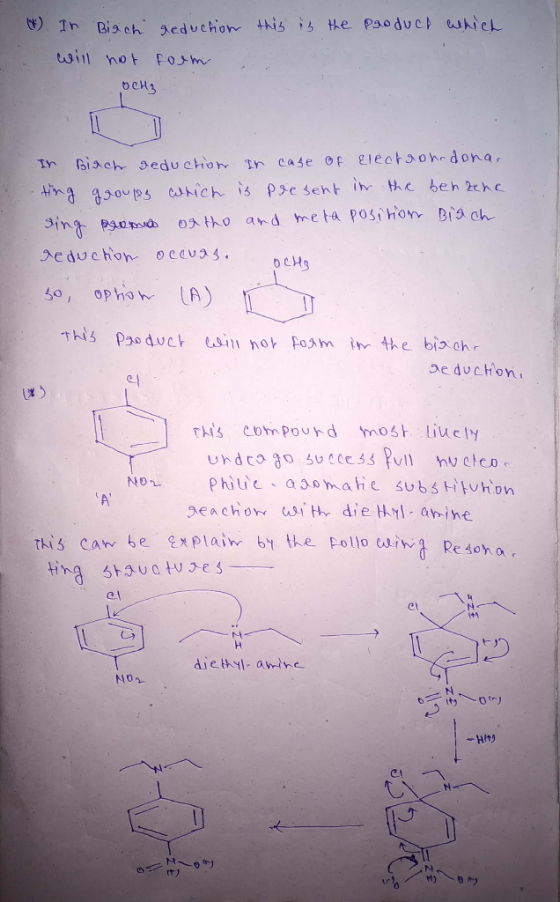
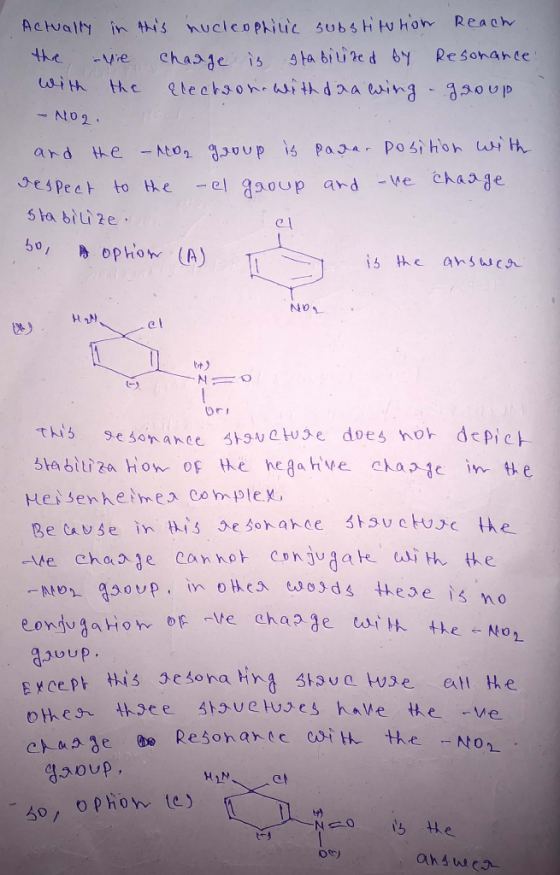
to form Which of the following possible Birch reduction products would not be expected CH3 CH3...
Activating groups "speed up" electrophilic substitution of aromatics and deactivating groups "slow down" electrophilic substitution. 1....
 Activating groups "speed up" electrophilic substitution of
aromatics and deactivating groups "slow down" electrophilic
substitution.
1. Ignoring halogens, what is different between the composition
of the ortho-para directors and the meta directors?
2. What causes the deactivating groups to "slow down" the
substitution? What may be used to speed up these reactions?
3. How does carbocation stabilization affect the orientation of
the products in each orientation?
Activating groups Deactivating groups ortho-, para- directors -hydroxyl (OH) -alkoxy (OR) -amino (NH2, NR)...
Activating groups "speed up" electrophilic substitution of
aromatics and deactivating groups "slow down" electrophilic
substitution.
1. Ignoring halogens, what is different between the composition
of the ortho-para directors and the meta directors?
2. What causes the deactivating groups to "slow down" the
substitution? What may be used to speed up these reactions?
3. How does carbocation stabilization affect the orientation of
the products in each orientation?
Activating groups Deactivating groups ortho-, para- directors -hydroxyl (OH) -alkoxy (OR) -amino (NH2, NR)...
MULTIPLE ANSWER CHOICES ARE POSSIBLE (more than one correct) Question 7 Which of the following statements...
 MULTIPLE ANSWER CHOICES ARE POSSIBLE (more than one correct)
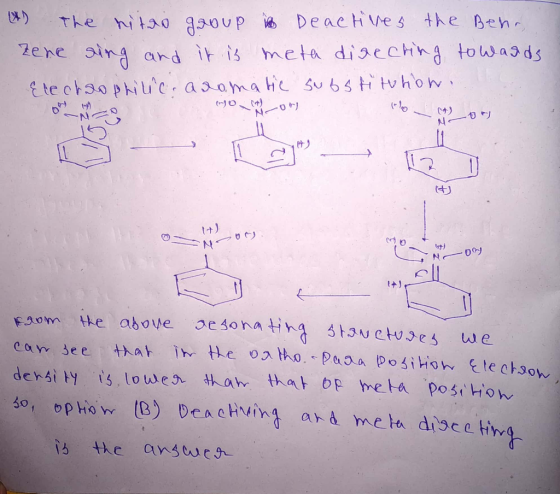
Question 7 Which of the following statements are true about the deactivating nitroso substituent in electrophilic aromatic substitution reactions? NFO The nitroso group is predicted to be an ortho/para-directing group. Resonance withdrawing effects can explain why the nitroso group is deactivating. The nitroso group is predicted to be an meta-directing group. Inductive withdrawing effects can explain why the nitroso group is deactivating.
MULTIPLE ANSWER CHOICES ARE POSSIBLE (more than one correct)
Question 7 Which of the following statements are true about the deactivating nitroso substituent in electrophilic aromatic substitution reactions? NFO The nitroso group is predicted to be an ortho/para-directing group. Resonance withdrawing effects can explain why the nitroso group is deactivating. The nitroso group is predicted to be an meta-directing group. Inductive withdrawing effects can explain why the nitroso group is deactivating.
1) Which of the following is an intermediate in the bromination of toluene? p) Ha BrH...
 1) Which of the following is an intermediate in the bromination of toluene? p) Ha BrH 2 2) Under what reaction conditions would the electrophilic chlorination of aromatic compounds usually occur? A) Cl2, AlCl3 B) C12, CCl4 C) Cl2, H20 D) NaCl, H20 E) NaCI, CH3OH 3) 3) Which of the following is the strongest activating group in electrophilic aromatic substitution reactions? A) -CO2CH3 B)-NO2 C) -OCH3 D) -CH2CH3 E) -N(CH3)2 4) _ 4) In electrophilic aromatic substitution reactions the...
Label the following as activating (A) or deactivating (D), and then also as ortho/para directors (OP)...
 Label the following as activating (A) or deactivating (D), and then also as ortho/para directors (OP) or meta directors (M). Write the answer below each group. N "Here with other ty A/D? = = = = OP/M? = f) Using resonance structures, explain why a nitro group is "meta-directing" (i.e. does the nitro group actually affect the meta positions?) g) As mentioned in class, the halogens are a bit anomalous as substituents on the aromatic ring: they are deactivating groups,...
6. (9 pts) In regards to an electrophilic aromatic substitution reaction, define the 3 compounds shown...
 6. (9 pts) In regards to an electrophilic aromatic substitution reaction, define the 3 compounds shown below as either: a) Activating, ortho, para director b) Deactivating, ortho para director, c) Activating, meta director, d) Deactivating, meta director. CH -ОН -N-CH3 CH3 7. Answer a-c for compounds A-F below dos a. (5 pts) Which compound(s) have an aromatic carbocation intermediate if it underwent an Snl or E1 reaction? b. (5 pts) Which compound(s) would have an anti-aromatic carbocation intermediate if it...
(V) 10pts. When aniline (C6H3-NH2) reacts with bromonium ion (NO2. the nitro group can become bonded...
 (V) 10pts. When aniline (C6H3-NH2) reacts with bromonium ion (NO2. the nitro group can become bonded to a carbon at one of the three possible positions: ortho, meta, and para to the -NH2 group in the benzene ring. Consider meta and ortho attack and draw RESONANCE STRUCTURES for the carbocations that result when NO2 undergoes electrophilic aromatic substitution to aniline. Then, on the basis of these resonance structures, explain whether the --NH2, group.is meta director, or ortho/para director. Show which...
There are 3 pictures, 18 exercises in total. Topics are Benzenes and their reactions No -I...
 There are 3 pictures, 18 exercises in total. Topics are Benzenes
and their reactions
No -I ab 0 CH3 Br nooit 1. Aromatic molecules contain Tt electrons. a. 4n b. 4n+2 c. An odd number d. 4n+1 c. Zero Condition needed for benzene halogenation to occur a. NaC1, 1120 b. C12, H20 c. C12, AICI3 d. NaCl, CH3OH e. C12, CC14 3. In an electrophilic aromatic substitution, the hydroxyl group orients ortho-para because a, removes electronic density from the benzene...
There are 3 pictures, 18 exercises in total. Topics are Benzenes
and their reactions
No -I ab 0 CH3 Br nooit 1. Aromatic molecules contain Tt electrons. a. 4n b. 4n+2 c. An odd number d. 4n+1 c. Zero Condition needed for benzene halogenation to occur a. NaC1, 1120 b. C12, H20 c. C12, AICI3 d. NaCl, CH3OH e. C12, CC14 3. In an electrophilic aromatic substitution, the hydroxyl group orients ortho-para because a, removes electronic density from the benzene...
Which of the following sets of substituents are all ortho/para directing in electrophilic aromatic substitution reactions?...
 Which of the following sets of substituents are all ortho/para directing in electrophilic aromatic substitution reactions? O CN, NO2, COCH3 O CI, OH, CH3 OBr, OH, COCH3 OCI, CH3. CN
10. (12 points) Cua CHaCHa Les eb Predict whether the following substituents on the benzene ring...
 10. (12 points) Cua CHaCHa Les eb Predict whether the following substituents on the benzene ring are likely to be ortho/para directing or meta directing and whether they are likely to be ring activating or ring deactivating ..n(CH3)2 CEN ОСН з -NO C-OCH 11. (6 points) Starting with benzene as the only aromatic starting material, devise a
Which of the following statements are true about the deactivating nitroso substituent in electrophilic aroman -N=0...
 Which of the following statements are true about the deactivating nitroso substituent in electrophilic aroman -N=0 The nitroso group is predicted to be an ortho/para-directing group. Resonance withdrawing effects can explain why the nitroso group is deactivating. The nitroso group is predicted to be an meta-directing group. Inductive withdrawing effects can explain why the nitroso group is deactivating.
 Activating groups "speed up" electrophilic substitution of
aromatics and deactivating groups "slow down" electrophilic
substitution.
1. Ignoring halogens, what is different between the composition
of the ortho-para directors and the meta directors?
2. What causes the deactivating groups to "slow down" the
substitution? What may be used to speed up these reactions?
3. How does carbocation stabilization affect the orientation of
the products in each orientation?
Activating groups Deactivating groups ortho-, para- directors -hydroxyl (OH) -alkoxy (OR) -amino (NH2, NR)...
Activating groups "speed up" electrophilic substitution of
aromatics and deactivating groups "slow down" electrophilic
substitution.
1. Ignoring halogens, what is different between the composition
of the ortho-para directors and the meta directors?
2. What causes the deactivating groups to "slow down" the
substitution? What may be used to speed up these reactions?
3. How does carbocation stabilization affect the orientation of
the products in each orientation?
Activating groups Deactivating groups ortho-, para- directors -hydroxyl (OH) -alkoxy (OR) -amino (NH2, NR)...
 MULTIPLE ANSWER CHOICES ARE POSSIBLE (more than one correct)
Question 7 Which of the following statements are true about the deactivating nitroso substituent in electrophilic aromatic substitution reactions? NFO The nitroso group is predicted to be an ortho/para-directing group. Resonance withdrawing effects can explain why the nitroso group is deactivating. The nitroso group is predicted to be an meta-directing group. Inductive withdrawing effects can explain why the nitroso group is deactivating.
MULTIPLE ANSWER CHOICES ARE POSSIBLE (more than one correct)
Question 7 Which of the following statements are true about the deactivating nitroso substituent in electrophilic aromatic substitution reactions? NFO The nitroso group is predicted to be an ortho/para-directing group. Resonance withdrawing effects can explain why the nitroso group is deactivating. The nitroso group is predicted to be an meta-directing group. Inductive withdrawing effects can explain why the nitroso group is deactivating.
 1) Which of the following is an intermediate in the bromination of toluene? p) Ha BrH 2 2) Under what reaction conditions would the electrophilic chlorination of aromatic compounds usually occur? A) Cl2, AlCl3 B) C12, CCl4 C) Cl2, H20 D) NaCl, H20 E) NaCI, CH3OH 3) 3) Which of the following is the strongest activating group in electrophilic aromatic substitution reactions? A) -CO2CH3 B)-NO2 C) -OCH3 D) -CH2CH3 E) -N(CH3)2 4) _ 4) In electrophilic aromatic substitution reactions the...
 Label the following as activating (A) or deactivating (D), and then also as ortho/para directors (OP) or meta directors (M). Write the answer below each group. N "Here with other ty A/D? = = = = OP/M? = f) Using resonance structures, explain why a nitro group is "meta-directing" (i.e. does the nitro group actually affect the meta positions?) g) As mentioned in class, the halogens are a bit anomalous as substituents on the aromatic ring: they are deactivating groups,...
 6. (9 pts) In regards to an electrophilic aromatic substitution reaction, define the 3 compounds shown below as either: a) Activating, ortho, para director b) Deactivating, ortho para director, c) Activating, meta director, d) Deactivating, meta director. CH -ОН -N-CH3 CH3 7. Answer a-c for compounds A-F below dos a. (5 pts) Which compound(s) have an aromatic carbocation intermediate if it underwent an Snl or E1 reaction? b. (5 pts) Which compound(s) would have an anti-aromatic carbocation intermediate if it...
 (V) 10pts. When aniline (C6H3-NH2) reacts with bromonium ion (NO2. the nitro group can become bonded to a carbon at one of the three possible positions: ortho, meta, and para to the -NH2 group in the benzene ring. Consider meta and ortho attack and draw RESONANCE STRUCTURES for the carbocations that result when NO2 undergoes electrophilic aromatic substitution to aniline. Then, on the basis of these resonance structures, explain whether the --NH2, group.is meta director, or ortho/para director. Show which...
 There are 3 pictures, 18 exercises in total. Topics are Benzenes
and their reactions
No -I ab 0 CH3 Br nooit 1. Aromatic molecules contain Tt electrons. a. 4n b. 4n+2 c. An odd number d. 4n+1 c. Zero Condition needed for benzene halogenation to occur a. NaC1, 1120 b. C12, H20 c. C12, AICI3 d. NaCl, CH3OH e. C12, CC14 3. In an electrophilic aromatic substitution, the hydroxyl group orients ortho-para because a, removes electronic density from the benzene...
There are 3 pictures, 18 exercises in total. Topics are Benzenes
and their reactions
No -I ab 0 CH3 Br nooit 1. Aromatic molecules contain Tt electrons. a. 4n b. 4n+2 c. An odd number d. 4n+1 c. Zero Condition needed for benzene halogenation to occur a. NaC1, 1120 b. C12, H20 c. C12, AICI3 d. NaCl, CH3OH e. C12, CC14 3. In an electrophilic aromatic substitution, the hydroxyl group orients ortho-para because a, removes electronic density from the benzene...
 Which of the following sets of substituents are all ortho/para directing in electrophilic aromatic substitution reactions? O CN, NO2, COCH3 O CI, OH, CH3 OBr, OH, COCH3 OCI, CH3. CN
 10. (12 points) Cua CHaCHa Les eb Predict whether the following substituents on the benzene ring are likely to be ortho/para directing or meta directing and whether they are likely to be ring activating or ring deactivating ..n(CH3)2 CEN ОСН з -NO C-OCH 11. (6 points) Starting with benzene as the only aromatic starting material, devise a
 Which of the following statements are true about the deactivating nitroso substituent in electrophilic aroman -N=0 The nitroso group is predicted to be an ortho/para-directing group. Resonance withdrawing effects can explain why the nitroso group is deactivating. The nitroso group is predicted to be an meta-directing group. Inductive withdrawing effects can explain why the nitroso group is deactivating.
Most questions answered within 3 hours.
-
Where is the error in this code sequence?
String s1 = "Hello";
String s2 = "ello";...
asked 11 months ago -
Financial data for Joel de Paris, Inc., for last year
follow:
Joel de Paris, Inc.
Balance...
asked 11 months ago -
Consider this reaction:
Al2(SO4)3 (aq)+ BaCl3
(aq) Al2Cl6 (aq)- +
3BaSO4(s) . What is the...
asked 11 months ago -
Suppose that Savneet is considering increasing her
recent random sample from 20 car rentals to 40...
asked 11 months ago -
Trucks arrive at an unloading terminal at an average rate of 120
per hour.
Trucks arrive...
asked 11 months ago -
Why are methanol and ethanol completely soluble in water while
octanol is not very little soluble....
asked 11 months ago -
A facilities manager at a university reads in a research report
that the mean amount of...
asked 11 months ago -
When the CuSO4 is rehydrated by adding water to the anhydrous
compound, is this an endothermic...
asked 11 months ago -
A ray of sunlight is passing from diamond into crown glass; the
angle of incidence is...
asked 11 months ago -
A block of mass 0.249 kg is placed on top of a light, vertical
spring of...
asked 11 months ago -
how do the kidneys compensate in the presences of acidosis
a) trigger hyperventilate
b) reserve acid...
asked 11 months ago -
Question 501 pts
The rental rate of capital to the firm increases. Which of the
following...
asked 11 months ago