
Homework Answers
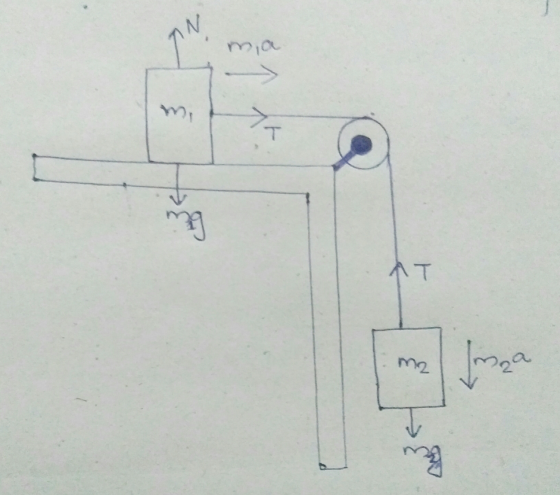
Acceleration of the system, a = F/(m1+m2)
Here, F = m2g
Therefore, a = m2g/(m1+m2)
Tension in the cable, T = m1a
= m1m2g/(m1+m2)
Add Answer to:
w ma A block of mass my=1.7 kg is resting on a frictionless metal table. The...
A metal block with a mass of 2.1 kg is resting on a table. The coefficient...
A metal block with a mass of 2.1 kg is resting on a table. The coefficient of kinetic friction between the block and the table is 0.39. A horizontal force of 21 N is applied to the block. Find the velocity of the block after 2.0 s. Draw a free body diagram and show all steps in the calculation.
1.A block of mass m = 5.00 kg is pulled along a horizontal frictionless floor by...
1.A block of mass m = 5.00 kg is pulled along a horizontal frictionless floor by a cord that exerts a force of magnitude F = 12.0 N at an angle θ = 25o . (a) Draw the free body diagram of the block. (b) Find the normal force. 2.Two crates are at rest on frictionless horizontal surface. Both crates are connected by a light rope. A woman wearing golf shoes (so she can get traction on the ice) pulls...
F 100 N 15kg 4. A block of mass m, 8.0 kg slides on a frictionless...
 F 100 N 15kg 4. A block of mass m, 8.0 kg slides on a frictionless tabletop. It is connected to a string that passes over a pulley and suspends a mass m2 -12 kg. The system is released from rest. a) Draw a free-body diagram for each mass b) Write Newton's Second Law for each mass. c) Find tension and the acceleration of the masses?
A block of mass m2 = 38 kg on a horizontal surface is connected to a...
 A block of mass m2 = 38 kg on a horizontal surface is connected to a mass m2 = 20.1 kg that hangs vertically as shown in the figure below. The two blocks are connected by a string of negligible mass passing over a frictionless pulley. The coefficient of kinetic friction between m, and the horizontal surface is 0.24. m (a) What is the magnitude of the acceleration (in m/s2) of the hanging mass? 3.39 Did you draw a free-body...
Problem 2: (6 pts) ) Two masses are connected by a string as shown in the figure below. Mass mB = 2.00 kg moves up while mA 12.0 kg moves down a frictionless inclined. The pulley is frictionless...
 Problem 2: (6 pts) ) Two masses are connected by a string as shown in the figure below. Mass mB = 2.00 kg moves up while mA 12.0 kg moves down a frictionless inclined. The pulley is frictionless and has a mass M-2.00 kg, and a radius R-0.200 m (1= ½ MR) (a) Draw the free body diagram for the masses and pulley separately. (b) Use Newton's Second Law of Motion to find the resulting acceleration (2pts) (2pts) (2pts) of...
Consider the system shown below. Block A (mass 8 kg) is connected to block B (mass...
Consider the system shown below. Block A (mass 8 kg) is connected to block B (mass 2 kg) by a horizontal string that passes over a massless, frictionless pulley. a. Draw and label all forces acting on blocks A and B. b. Draw a free–body diagram for each block c. Determine the acceleration of the system d. Determine the tension on the string.
Consider the system shown below. Block A (mass 8 kg) is connected to block B (mass 2 kg) by a horizontal string that pas...
 Consider the system shown below. Block A (mass 8 kg) is
connected to block B (mass 2 kg) by a horizontal string that passes
over a massless, frictionless pulley.
a. Draw and label all forces acting on blocks A and B.
b. Draw a free–body diagram for each block
c. Determine the acceleration of the system
d. Determine the tension on the string
.
A
A
Consider the system shown below. Block A (mass 8 kg) is
connected to block B (mass 2 kg) by a horizontal string that passes
over a massless, frictionless pulley.
a. Draw and label all forces acting on blocks A and B.
b. Draw a free–body diagram for each block
c. Determine the acceleration of the system
d. Determine the tension on the string
.
A
A
2. (2 points) A 7.00-kg aluminum block and a 12.00-kg copper block are connected by a...
 2. (2 points) A 7.00-kg aluminum block and a 12.00-kg copper block are connected by a light string over a frictionless pulley. The two blocks are allowed to move on a inclined steel block surface (of angle 0 = 37.0° ) as shown in Figure 2. Making use of Table 4.2, a. Choose your coordinate system for aluminum block and copper block. b. Draw free body diagram for both blocks (mi and m2). c. List all forces applied. d. List...
The system shown in the figure below consists of a mass M = 3.3-kg block resting...
The system shown in the figure below consists of a mass M = 3.3-kg block resting on a frictionless horizontal ledge. This block is attached to a string that passes over a pulley, and the other end of the string is attached to a hanging m = 1.7-kg block. The pulley is a uniform disk of radius 8.0 cm and mass 0.60 kg. (a) What is the acceleration of each block? acceleration of M = 3.3 kg _____ m/s2 acceleration...
F 7. Block A has a mass of ma and block B has a mass of...
 F 7. Block A has a mass of ma and block B has a mass of mp. The coefficient of friction (kinetic) between all surfaces in this system is taken to be ľk. Find the magnitude of the force + necessary to drag block B to the left “at constant speed” if blocks A and B are connected by a light, fle cord passing around a fixed, frictionless pulley.
 F 100 N 15kg 4. A block of mass m, 8.0 kg slides on a frictionless tabletop. It is connected to a string that passes over a pulley and suspends a mass m2 -12 kg. The system is released from rest. a) Draw a free-body diagram for each mass b) Write Newton's Second Law for each mass. c) Find tension and the acceleration of the masses?
 A block of mass m2 = 38 kg on a horizontal surface is connected to a mass m2 = 20.1 kg that hangs vertically as shown in the figure below. The two blocks are connected by a string of negligible mass passing over a frictionless pulley. The coefficient of kinetic friction between m, and the horizontal surface is 0.24. m (a) What is the magnitude of the acceleration (in m/s2) of the hanging mass? 3.39 Did you draw a free-body...
 Problem 2: (6 pts) ) Two masses are connected by a string as shown in the figure below. Mass mB = 2.00 kg moves up while mA 12.0 kg moves down a frictionless inclined. The pulley is frictionless and has a mass M-2.00 kg, and a radius R-0.200 m (1= ½ MR) (a) Draw the free body diagram for the masses and pulley separately. (b) Use Newton's Second Law of Motion to find the resulting acceleration (2pts) (2pts) (2pts) of...
 Consider the system shown below. Block A (mass 8 kg) is
connected to block B (mass 2 kg) by a horizontal string that passes
over a massless, frictionless pulley.
a. Draw and label all forces acting on blocks A and B.
b. Draw a free–body diagram for each block
c. Determine the acceleration of the system
d. Determine the tension on the string
.
A
A
Consider the system shown below. Block A (mass 8 kg) is
connected to block B (mass 2 kg) by a horizontal string that passes
over a massless, frictionless pulley.
a. Draw and label all forces acting on blocks A and B.
b. Draw a free–body diagram for each block
c. Determine the acceleration of the system
d. Determine the tension on the string
.
A
A
 2. (2 points) A 7.00-kg aluminum block and a 12.00-kg copper block are connected by a light string over a frictionless pulley. The two blocks are allowed to move on a inclined steel block surface (of angle 0 = 37.0° ) as shown in Figure 2. Making use of Table 4.2, a. Choose your coordinate system for aluminum block and copper block. b. Draw free body diagram for both blocks (mi and m2). c. List all forces applied. d. List...
 F 7. Block A has a mass of ma and block B has a mass of mp. The coefficient of friction (kinetic) between all surfaces in this system is taken to be ľk. Find the magnitude of the force + necessary to drag block B to the left “at constant speed” if blocks A and B are connected by a light, fle cord passing around a fixed, frictionless pulley.
Most questions answered within 3 hours.
-
Where is the error in this code sequence?
String s1 = "Hello";
String s2 = "ello";...
asked 11 months ago -
Financial data for Joel de Paris, Inc., for last year
follow:
Joel de Paris, Inc.
Balance...
asked 11 months ago -
Consider this reaction:
Al2(SO4)3 (aq)+ BaCl3
(aq) Al2Cl6 (aq)- +
3BaSO4(s) . What is the...
asked 11 months ago -
Suppose that Savneet is considering increasing her
recent random sample from 20 car rentals to 40...
asked 11 months ago -
Trucks arrive at an unloading terminal at an average rate of 120
per hour.
Trucks arrive...
asked 11 months ago -
Why are methanol and ethanol completely soluble in water while
octanol is not very little soluble....
asked 11 months ago -
A facilities manager at a university reads in a research report
that the mean amount of...
asked 11 months ago -
When the CuSO4 is rehydrated by adding water to the anhydrous
compound, is this an endothermic...
asked 11 months ago -
A ray of sunlight is passing from diamond into crown glass; the
angle of incidence is...
asked 11 months ago -
A block of mass 0.249 kg is placed on top of a light, vertical
spring of...
asked 11 months ago -
how do the kidneys compensate in the presences of acidosis
a) trigger hyperventilate
b) reserve acid...
asked 11 months ago -
Question 501 pts
The rental rate of capital to the firm increases. Which of the
following...
asked 11 months ago