
Homework Answers
Add Answer to:
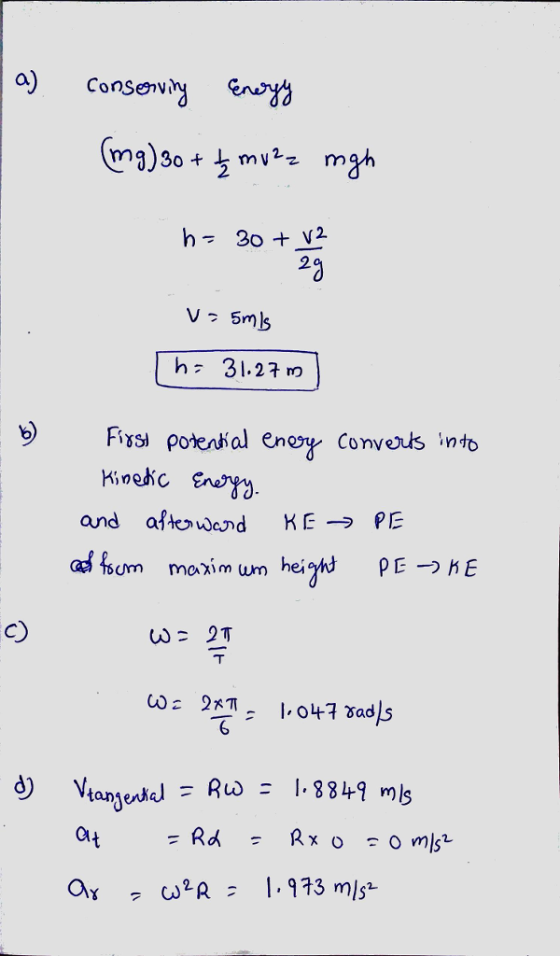
a) A man jumps off the roof of an office building onto a trampoline 30 m...
A man jumps horizontally from the third floor of a burning building to a rescue trampoline...
A man jumps horizontally from the third floor of a burning building to a rescue trampoline below. His initial speed is 3.00 m/s. If the third floor window is 11.9 m above the trampoline, how much time (in seconds) will elapse between when he jumps and when he lands on the trampoline?
2. Answer a - e along with reasoning and show directions where ever it's required. a....
 2. Answer a - e along with reasoning and show directions where ever it's required. a. A ladybug sits at the outer edge of a merry-go-round, and a gentleman bug sits halfway between her and the axis of rotation. The merry-go-round makes a complete revolution once each second. The gentleman bug's angular speed is a. half the ladybug's. b. the same as the ladybug's. c. twice the ladybug's. d. impossible to determine b. A cockroach sits at the outer edge...
A man jumps horizontally from the third floor of a burning building to a rescue trampoline...
A man jumps horizontally from the third floor of a burning building to a rescue trampoline below. His initial speed is 3.00 m/s. If the third floor window is 11.9 m above the trampoline, where should the firefighters place the trampoline? That is, how far from the base of the building (in m) should the center of the trampoline be? Neglect air resistance.
A 75 kg man running at 2.5 m/s jumps off a roof that is 3 m...
A 75 kg man running at 2.5 m/s jumps off a roof that is 3 m high. As he hits the ground, he tucks into a ball and rolls without slipping to break his fall. Modeling the man as a solid sphere of a radius 0.75 m, assuming no rotational motion before he hits the ground, and ignoring any effects of him tucking into a ball, what is his center of mass velocity on the ground?
A person is riding exactly 1.4 m from the axis of rotation of a merry-go-round. The...
A person is riding exactly 1.4 m from the axis of rotation of a merry-go-round. The merry-go-round’s angular speed is 0.34 rad/s and its angular acceleration has a magnitude of 0.18 rad/s^2. Find the tangential and radial components of the person’s linear acceleration. Find the person’s linear speed and the magnitude of the person’s linear acceleration.
A merry-go-round starts from rest and accelerates uniformly over 19.5 s to a final angular velocity of 6.75 rev/min. (a)...
A merry-go-round starts from rest and accelerates uniformly over 19.5 s to a final angular velocity of 6.75 rev/min. (a) Find the maximum linear speed of a person sitting on the merry-go-round 6.50 m from the center. (b) Find the person's maximum radial acceleration. (c) Find the angular acceleration of the merry-go-round. (d) Find the person's tangential acceleration.
A rotating merry-go-round makes one complete revolution in 4.8 s . Assume the wheel is moving...
A rotating merry-go-round makes one complete revolution in 4.8 s . Assume the wheel is moving with a constant angular velocity. What is the linear speed of a child seated 1.3 m from the center? What is her acceleration (give components)? Enter the radial and tangential components of the acceleration using two significant figures separated by a comma.
9. A child of mas 40kg runs at a speed of 5 m/s and jumps onto...
 9. A child of mas 40kg runs at a speed of 5 m/s and jumps onto a disc shaped merry go round of mass 100 kg and radius 5m. The child lands on the outer edge of the disc when the disc is stationary.. What is the angular speed of the merry go round with the child on it? Was energy lost? If so, how much energy was lost in the process? loo kg 5 he
A 25-kg child running at 1.6 m/s jumps onto the outer edge of a merry-go-round of...
A 25-kg child running at 1.6 m/s jumps onto the outer edge of a merry-go-round of 200-kg mass and 1.8 m radius. If the merry-go-round starts from rest, what is the final angular velocity in rad/s of the child and merry-go-round? Use conservation of angular momentum and treat the merry-go-round as a solid disk.
A 40.0-kg child running at 3.00 m/s suddenly jumps onto a stationary playground merry-go-round at a...
A 40.0-kg child running at 3.00 m/s suddenly jumps onto a stationary playground merry-go-round at a distance 1.50 m from the axis of rotation of the merry-go-round. The child is traveling tangential to the edge of the merry-go-round just before jumping on. The moment of inertia about its axis of rotation is 600 kg ? m2 and very little friction at its rotation axis. What is the angular speed of the merry-go-round just after the child has jumped onto it?...
 2. Answer a - e along with reasoning and show directions where ever it's required. a. A ladybug sits at the outer edge of a merry-go-round, and a gentleman bug sits halfway between her and the axis of rotation. The merry-go-round makes a complete revolution once each second. The gentleman bug's angular speed is a. half the ladybug's. b. the same as the ladybug's. c. twice the ladybug's. d. impossible to determine b. A cockroach sits at the outer edge...
 9. A child of mas 40kg runs at a speed of 5 m/s and jumps onto a disc shaped merry go round of mass 100 kg and radius 5m. The child lands on the outer edge of the disc when the disc is stationary.. What is the angular speed of the merry go round with the child on it? Was energy lost? If so, how much energy was lost in the process? loo kg 5 he
Most questions answered within 3 hours.
-
Where is the error in this code sequence?
String s1 = "Hello";
String s2 = "ello";...
asked 11 months ago -
Financial data for Joel de Paris, Inc., for last year
follow:
Joel de Paris, Inc.
Balance...
asked 11 months ago -
Consider this reaction:
Al2(SO4)3 (aq)+ BaCl3
(aq) Al2Cl6 (aq)- +
3BaSO4(s) . What is the...
asked 11 months ago -
Suppose that Savneet is considering increasing her
recent random sample from 20 car rentals to 40...
asked 11 months ago -
Trucks arrive at an unloading terminal at an average rate of 120
per hour.
Trucks arrive...
asked 11 months ago -
Why are methanol and ethanol completely soluble in water while
octanol is not very little soluble....
asked 11 months ago -
A facilities manager at a university reads in a research report
that the mean amount of...
asked 11 months ago -
When the CuSO4 is rehydrated by adding water to the anhydrous
compound, is this an endothermic...
asked 11 months ago -
A ray of sunlight is passing from diamond into crown glass; the
angle of incidence is...
asked 11 months ago -
A block of mass 0.249 kg is placed on top of a light, vertical
spring of...
asked 11 months ago -
how do the kidneys compensate in the presences of acidosis
a) trigger hyperventilate
b) reserve acid...
asked 11 months ago -
Question 501 pts
The rental rate of capital to the firm increases. Which of the
following...
asked 11 months ago