Market Equilibrium
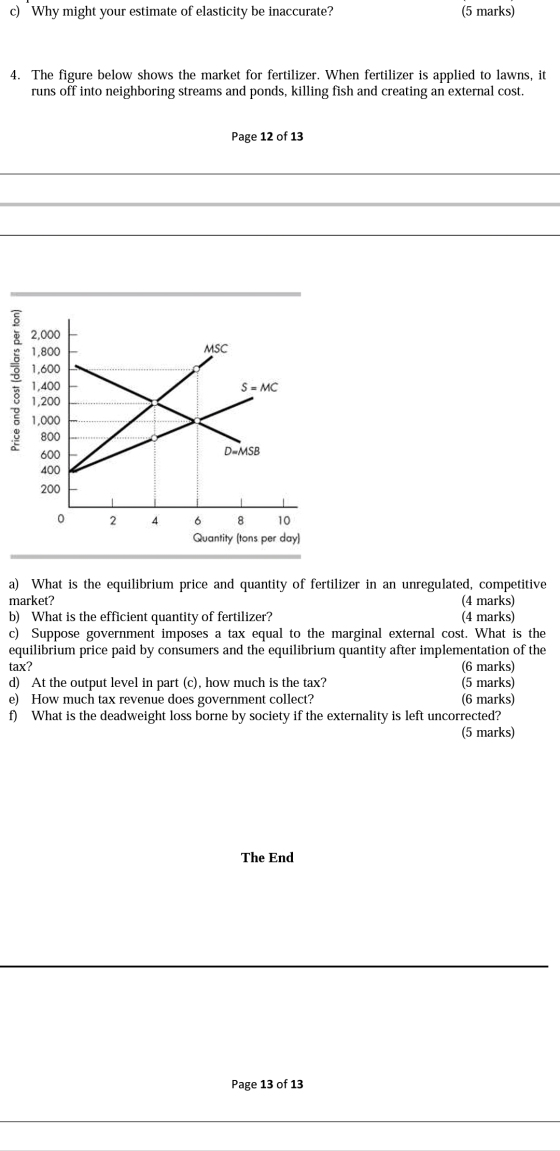
The figure below shows the market for fertilizer. When fertilizer is applied to lawns, it runs off into neighboring streams and ponds, killing fish and creating an external cost.
a) What is the equilibrium price and quantity of fertilizer in an unregulated, competitive market?
b) What is the efficient quantity of fertilizer?
c) Suppose government imposes a tax equal to the marginal external cost. What is the equilibrium price paid by consumers and the equilibrium quantity after implementation of the tax ?
d) At the output level in part (c), how much is the tax?
e) How much tax revenue does government collect?
f) What is the deadweight loss borne by society if the externality is left uncorrected?
Homework Answers
a) equilibrium price=1000 and quantity =6 ie where MC and MB intersects
b) efficient quantity of fertiliser is where MSC =MB so efficient quantity=4tons per day
b) equilibrium price after tax is 1200 and quantity =4
d) tax=1200-800=400
e) tax revenue=tax*quantity=4*400=1600
f) DWL=area of triangle=1/2*(400)*(6-4)=400
PROBLEM #6 The equilibrium price of cars in Boston in an unregulated automobile market is $25,000...
 PROBLEM #6 The equilibrium price of cars in Boston in an unregulated automobile market is $25,000 per car, and the equilibrium quantity is 20,000 cars per year. Assume that the elasticities of supply and demand are equal. a) Using our supply-and-demand framework, graph the market in its initial equilibrium. Graphpaper is readily available at http://www.printfreegraphpaper.com/. b) The government imposes a $6,000 tax on suppliers. Draw the post-tax supply curve, and calculate how much of the tax is borne by producers...
The market for vodka is described as the following: Supply: P = 5 + QS 10...
The market for vodka is described as the following: Supply: P = 5 + QS 10 Demand: P = 20− QD 5 However, drinking vodka causes $3 worth of harm per bottle to the rest of society, through health care costs, reduced productivity, and drunken mistakes. (a) Sketch a graph of this market. Calculate the private equilibrium price, quantity, producer surplus, consumer surplus, total external costs, and total surplus. (Be careful about fractions.) Label the area of deadweight loss on...
2)Consider the following supply and demand schedule for steel.. Pa 100-4Qd a. Calculate the market equilibrium...
 2)Consider the following supply and demand schedule for steel.. Pa 100-4Qd a. Calculate the market equilibrium price and quantity for steel. (4pts)- Answer: 100-4Q-9+3Q Q-13 Quantity-13. P-48 Pricw b. Pollution from steel production is estimated to create an external cost of $14 per ton. Show the demand and supply schedule graphically and identify the external cost curve, market equilibrium, deadweight loss, and social optimum quantity. (4pts)- c. Assume there is no intervention in this market. Calculate consumer surplus and producer...
1) Suppose supply is given by:10+2Q, and demand is given by: P-120-3Qs A) Find equilibrium price...
 1) Suppose supply is given by:10+2Q, and demand is given by: P-120-3Qs A) Find equilibrium price and quantity B) What are the demand and supply elasticities at equilibrium? C) Neaxt, suppose the government imposes an excise tax of $10 per unit. What is the price that consumers pay, the price that selers receive after paying the tax, and the tax revenue? D) Show the portion of the tax that is borne by consumers and what portion is borne by producers...
Tax Problem: Suppose the demand curve for a good is given by Q D = 10...
 Tax Problem:
Suppose the demand curve for a good is given by Q D = 10 - 2P and
the supply curve is given by
Q S = -2 + P.
a) (4 points) Find the equilibrium price and quantity in the
absence of any government intervention.
b) (6 points) Now suppose the government imposes a tax of t = 3.
Find the new equilibrium price at
which the good is sold in the market and the quantity of the...
Tax Problem:
Suppose the demand curve for a good is given by Q D = 10 - 2P and
the supply curve is given by
Q S = -2 + P.
a) (4 points) Find the equilibrium price and quantity in the
absence of any government intervention.
b) (6 points) Now suppose the government imposes a tax of t = 3.
Find the new equilibrium price at
which the good is sold in the market and the quantity of the...
3. (20%) Consider the market was unregulated, with an equilibrium price of $200, and a quantity of 20,000 The suppl...
 3. (20%) Consider the market was unregulated, with an equilibrium price of $200, and a quantity of 20,000 The supply curve is perfectly inelastic, while the demand curve is perfectly elastic. (a) What burden of taxation falls on producers (this is an amount from $0 to $16)?3 (b) What is the Deadweight Loss from the tax? a tax on producers of $16 per unit. Before the tax's imposition,
3. (20%) Consider the market was unregulated, with an equilibrium price of...
3. (20%) Consider the market was unregulated, with an equilibrium price of $200, and a quantity of 20,000 The supply curve is perfectly inelastic, while the demand curve is perfectly elastic. (a) What burden of taxation falls on producers (this is an amount from $0 to $16)?3 (b) What is the Deadweight Loss from the tax? a tax on producers of $16 per unit. Before the tax's imposition,
3. (20%) Consider the market was unregulated, with an equilibrium price of...
5. TAXES/SUBSIDIES, AND OTHER GOVERNMENT REGULATIONS 1. Consider the demand and supply for bubbly water in...
 5. TAXES/SUBSIDIES, AND OTHER GOVERNMENT REGULATIONS 1. Consider the demand and supply for bubbly water in a market represented by the following equations: QD = 15 - 10P QS = 40P - 50 where Q is millions of bottles per year and P measures dollars per bottle. The equilibrium price of bubbly water is $1.30 per bottle and 2 million bottles are sold each year. (a) Calculate the price elasticity of demand and the price elasticity of supply at the...
Assume that the market for a good is in equilibrium at a price of $20 and a quantity of 100 units. After the government imposes a $5 per-unit excise tax on the good, the price that buyers pay for the good increases by $3. Which of the following are possib
Assume that the market for a good is in equilibrium at a price of $20 and a quantity of 100 units. After the government imposes a $5 per-unit excise tax on the good, the price that buyers pay for the good increases by $3. Which of the following are possible values for the government tax revenue and deadweight loss in the market
The accompnying graph depicts the market for socks. Adjust the graph to demonstrate what happens if...
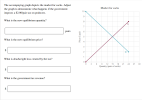 The accompnying graph depicts the market for socks. Adjust the graph to demonstrate what happens if the government imposes a $2.00/pair tax on poducers Market for socks 10 What is the new equilibrium quantity? pairs What is the new equilibrium price? What is deadweight loss created by the tax? 0 36 92 5 18 21 24 27 30 Quantity (pairs of socks) What is the government tax revenue?
Suppose the equilibrium price of potatoes is $5 per pound, but the government imposes a price...
Suppose the equilibrium price of potatoes is $5 per pound, but the government imposes a price ceiling of $2 per pound, creating a deadweight loss. True or False: If the government imposes a sales tax of $1 per pound of potatoes (while continuing to maintain the price ceiling), then the deadweight loss will get even larger.
 PROBLEM #6 The equilibrium price of cars in Boston in an unregulated automobile market is $25,000 per car, and the equilibrium quantity is 20,000 cars per year. Assume that the elasticities of supply and demand are equal. a) Using our supply-and-demand framework, graph the market in its initial equilibrium. Graphpaper is readily available at http://www.printfreegraphpaper.com/. b) The government imposes a $6,000 tax on suppliers. Draw the post-tax supply curve, and calculate how much of the tax is borne by producers...
 2)Consider the following supply and demand schedule for steel.. Pa 100-4Qd a. Calculate the market equilibrium price and quantity for steel. (4pts)- Answer: 100-4Q-9+3Q Q-13 Quantity-13. P-48 Pricw b. Pollution from steel production is estimated to create an external cost of $14 per ton. Show the demand and supply schedule graphically and identify the external cost curve, market equilibrium, deadweight loss, and social optimum quantity. (4pts)- c. Assume there is no intervention in this market. Calculate consumer surplus and producer...
 1) Suppose supply is given by:10+2Q, and demand is given by: P-120-3Qs A) Find equilibrium price and quantity B) What are the demand and supply elasticities at equilibrium? C) Neaxt, suppose the government imposes an excise tax of $10 per unit. What is the price that consumers pay, the price that selers receive after paying the tax, and the tax revenue? D) Show the portion of the tax that is borne by consumers and what portion is borne by producers...
 Tax Problem:
Suppose the demand curve for a good is given by Q D = 10 - 2P and
the supply curve is given by
Q S = -2 + P.
a) (4 points) Find the equilibrium price and quantity in the
absence of any government intervention.
b) (6 points) Now suppose the government imposes a tax of t = 3.
Find the new equilibrium price at
which the good is sold in the market and the quantity of the...
Tax Problem:
Suppose the demand curve for a good is given by Q D = 10 - 2P and
the supply curve is given by
Q S = -2 + P.
a) (4 points) Find the equilibrium price and quantity in the
absence of any government intervention.
b) (6 points) Now suppose the government imposes a tax of t = 3.
Find the new equilibrium price at
which the good is sold in the market and the quantity of the...
 3. (20%) Consider the market was unregulated, with an equilibrium price of $200, and a quantity of 20,000 The supply curve is perfectly inelastic, while the demand curve is perfectly elastic. (a) What burden of taxation falls on producers (this is an amount from $0 to $16)?3 (b) What is the Deadweight Loss from the tax? a tax on producers of $16 per unit. Before the tax's imposition,
3. (20%) Consider the market was unregulated, with an equilibrium price of...
3. (20%) Consider the market was unregulated, with an equilibrium price of $200, and a quantity of 20,000 The supply curve is perfectly inelastic, while the demand curve is perfectly elastic. (a) What burden of taxation falls on producers (this is an amount from $0 to $16)?3 (b) What is the Deadweight Loss from the tax? a tax on producers of $16 per unit. Before the tax's imposition,
3. (20%) Consider the market was unregulated, with an equilibrium price of...
 5. TAXES/SUBSIDIES, AND OTHER GOVERNMENT REGULATIONS 1. Consider the demand and supply for bubbly water in a market represented by the following equations: QD = 15 - 10P QS = 40P - 50 where Q is millions of bottles per year and P measures dollars per bottle. The equilibrium price of bubbly water is $1.30 per bottle and 2 million bottles are sold each year. (a) Calculate the price elasticity of demand and the price elasticity of supply at the...
 The accompnying graph depicts the market for socks. Adjust the graph to demonstrate what happens if the government imposes a $2.00/pair tax on poducers Market for socks 10 What is the new equilibrium quantity? pairs What is the new equilibrium price? What is deadweight loss created by the tax? 0 36 92 5 18 21 24 27 30 Quantity (pairs of socks) What is the government tax revenue?
Most questions answered within 3 hours.
-
Where is the error in this code sequence?
String s1 = "Hello";
String s2 = "ello";...
asked 11 months ago -
Financial data for Joel de Paris, Inc., for last year
follow:
Joel de Paris, Inc.
Balance...
asked 11 months ago -
Consider this reaction:
Al2(SO4)3 (aq)+ BaCl3
(aq) Al2Cl6 (aq)- +
3BaSO4(s) . What is the...
asked 11 months ago -
Suppose that Savneet is considering increasing her
recent random sample from 20 car rentals to 40...
asked 11 months ago -
Trucks arrive at an unloading terminal at an average rate of 120
per hour.
Trucks arrive...
asked 11 months ago -
Why are methanol and ethanol completely soluble in water while
octanol is not very little soluble....
asked 11 months ago -
A facilities manager at a university reads in a research report
that the mean amount of...
asked 11 months ago -
When the CuSO4 is rehydrated by adding water to the anhydrous
compound, is this an endothermic...
asked 11 months ago -
A ray of sunlight is passing from diamond into crown glass; the
angle of incidence is...
asked 11 months ago -
A block of mass 0.249 kg is placed on top of a light, vertical
spring of...
asked 11 months ago -
how do the kidneys compensate in the presences of acidosis
a) trigger hyperventilate
b) reserve acid...
asked 11 months ago -
Question 501 pts
The rental rate of capital to the firm increases. Which of the
following...
asked 11 months ago