
Homework Answers
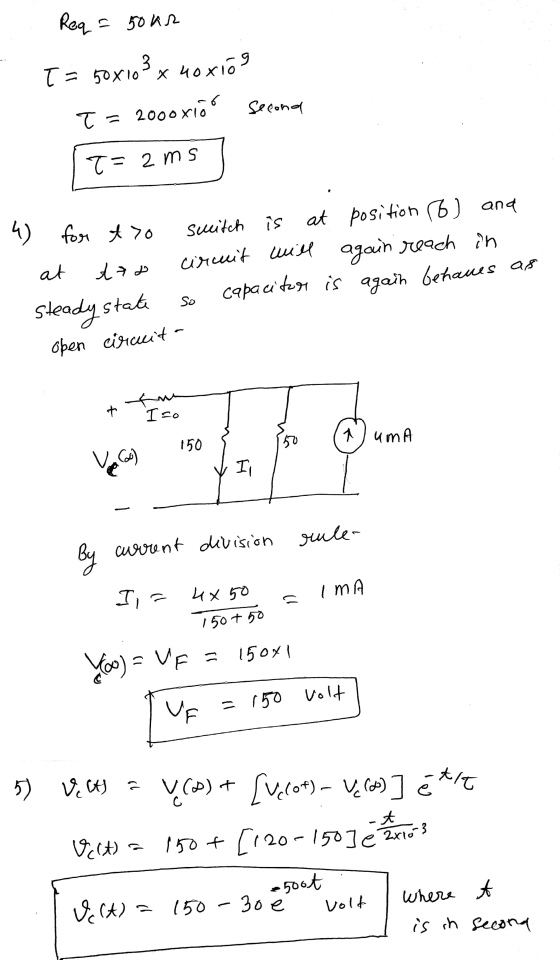
![Answer 1 so circuit at aruit is behaues as t=0 steady state open circut capacitor in lour ce] + . y Cory a 120v I VCO) = 120V](http://img.homeworklib.com/questions/9b34e5a0-a5eb-11eb-990a-7fd4fd9d309b.png?x-oss-process=image/resize,w_560)
Add Answer to:
QUESTION 1 The switch in the circuit seen in Figure has been in a position @...
2. The switch in the circuit shown in Figure 1 has been in position 'a' for...
 2. The switch in the circuit shown in Figure 1 has been in position 'a' for a long time. At t=0, the switch moves instantaneously to position b. a) Find the numerical expression for io(t) when t > 0. b) Find the numerical expression for volt) fort > 0 1 = 0 b! 51 602 45 A 2150 vo 20 10 mH 240 V 1
4. The switch in the circuit in the figure below has been in position 'a' for...
 4. The switch in the circuit in the figure below has been in position 'a' for a long time. At t = 0, the switch moves instantaneously to position b. For t> 0*, find a) vo(t) b) io(t). 5k12 b 10 k 12 11 = 0 + 10 kn} 1,040nF 40 kN 75 V 100 V
Problem #1 The switch in the circuit shown has been in position “a” for a long...
 Problem #1 The switch in the circuit shown has been in position “a” for a long time. Att= 0, the switch moves instantaneously to position “b”. Construct an s-domain equivalent circuit for t>0. Find V. (s). Find v. (t). b 2k12 b) t=0 15 ma 15 mA o 2 ke 3 2 kn> 0.8 1.25 uF Vo
Problem 7.31 The switch in the circuit seen in the figure has been in position x...
 Problem 7.31 The switch in the circuit seen in the figure has been in position x for a long time. Att 0, the switch moves instantaneously to position y. (Figure 1) Part A Find ? so that the time constant for t > 0 is 40 ms a-Value Units Submit Request Answer Figure 1 of 1 Part B For the found ?, find t Express your answer in terms of t, where t is in seconds 20 k2 Ds 5...
USE differential Approach in your analysis The switch in the circuit has been in position 1...
 USE differential Approach in your analysis The switch in the circuit has been in position 1 for a long time. At t = 0 it moves instantaneously to position 2. (Figure 1) 10 12 50 VO 331 31.5 HŽ 402 How many milliseconds after the switch operates does v, equal 160 V ?
The switch in the circuit shown in Fig. Shown has been in position a for a...
 The switch in the circuit shown in Fig. Shown has been in position a for a long time. At t-o the switch is moved to position b. a) What is the initial value of vc? b) What is the final value of vc? c) What is the time constant of the circuit when the switch is in position a? d) What is the expression for vc(t) when t > 0? 80 V 315 kn 100 V 2F What is the...
2 First-Order RC Circuit: Natural Response The switch in the circuit in Figure 2 has been...
 2 First-Order RC Circuit: Natural Response The switch in the circuit in Figure 2 has been in position for a long time. At t = 0, the switch moves to position (the switch opens) and stays there. Assuming that V. > O for the constant voltage source, (a) find vc(0-), vc(0+), ic(0-), and ic(0+); (b) find vc(t) when t 20 (if you want, you can write vo(t) by circuit inspection; you don't need to show the differential equation); and (c)...
For the circuit in figure below, the switch has been in position a for a long...
 For the circuit in figure below, the switch has been in position a for a long time. At t=0, it moves to position b. Calculate v(t) for all t>0. 20 kg 20 kg 120 Vo bo 20 V 5 F Zan 50 V For v(t) given in the form: v(t) = A+Be-t/c v for t>o Enter numerical values (with a negative sign if needed) for the constants A, B and C below: A = B = C =
Problem 3: The switch in the following circuit has been in position a for a long...
 Problem 3: The switch in the following circuit has been in position a for a long time. At t = 0 the switch moves instantaneously to position b. Find the voltage vo(t) for t 2 0. t =0 10ih 6 ΚΩ а 50 V4 k vo3 51.2 mH 8 μF 150 Q 60 0
Part A The action of the two switches in the circuit seen in the figure is...
 Part A The action of the two switches in the circuit seen in the figure is as follows. For t<0, switch 1 is in position a and switch 2 is open. This state has existed for a long time. At t 0, switch 1 moves instantaneously from position a to position b, while switch 2 remains open. Ten milliseconds after switch 1 operates, switch 2 closes, remains closed for 10 ms and then opens. (Figure 1) Find vo(t) 44 ms...
 2. The switch in the circuit shown in Figure 1 has been in position 'a' for a long time. At t=0, the switch moves instantaneously to position b. a) Find the numerical expression for io(t) when t > 0. b) Find the numerical expression for volt) fort > 0 1 = 0 b! 51 602 45 A 2150 vo 20 10 mH 240 V 1
 4. The switch in the circuit in the figure below has been in position 'a' for a long time. At t = 0, the switch moves instantaneously to position b. For t> 0*, find a) vo(t) b) io(t). 5k12 b 10 k 12 11 = 0 + 10 kn} 1,040nF 40 kN 75 V 100 V
 Problem #1 The switch in the circuit shown has been in position “a” for a long time. Att= 0, the switch moves instantaneously to position “b”. Construct an s-domain equivalent circuit for t>0. Find V. (s). Find v. (t). b 2k12 b) t=0 15 ma 15 mA o 2 ke 3 2 kn> 0.8 1.25 uF Vo
 Problem 7.31 The switch in the circuit seen in the figure has been in position x for a long time. Att 0, the switch moves instantaneously to position y. (Figure 1) Part A Find ? so that the time constant for t > 0 is 40 ms a-Value Units Submit Request Answer Figure 1 of 1 Part B For the found ?, find t Express your answer in terms of t, where t is in seconds 20 k2 Ds 5...
 USE differential Approach in your analysis The switch in the circuit has been in position 1 for a long time. At t = 0 it moves instantaneously to position 2. (Figure 1) 10 12 50 VO 331 31.5 HŽ 402 How many milliseconds after the switch operates does v, equal 160 V ?
 The switch in the circuit shown in Fig. Shown has been in position a for a long time. At t-o the switch is moved to position b. a) What is the initial value of vc? b) What is the final value of vc? c) What is the time constant of the circuit when the switch is in position a? d) What is the expression for vc(t) when t > 0? 80 V 315 kn 100 V 2F What is the...
 2 First-Order RC Circuit: Natural Response The switch in the circuit in Figure 2 has been in position for a long time. At t = 0, the switch moves to position (the switch opens) and stays there. Assuming that V. > O for the constant voltage source, (a) find vc(0-), vc(0+), ic(0-), and ic(0+); (b) find vc(t) when t 20 (if you want, you can write vo(t) by circuit inspection; you don't need to show the differential equation); and (c)...
 For the circuit in figure below, the switch has been in position a for a long time. At t=0, it moves to position b. Calculate v(t) for all t>0. 20 kg 20 kg 120 Vo bo 20 V 5 F Zan 50 V For v(t) given in the form: v(t) = A+Be-t/c v for t>o Enter numerical values (with a negative sign if needed) for the constants A, B and C below: A = B = C =
 Problem 3: The switch in the following circuit has been in position a for a long time. At t = 0 the switch moves instantaneously to position b. Find the voltage vo(t) for t 2 0. t =0 10ih 6 ΚΩ а 50 V4 k vo3 51.2 mH 8 μF 150 Q 60 0
 Part A The action of the two switches in the circuit seen in the figure is as follows. For t<0, switch 1 is in position a and switch 2 is open. This state has existed for a long time. At t 0, switch 1 moves instantaneously from position a to position b, while switch 2 remains open. Ten milliseconds after switch 1 operates, switch 2 closes, remains closed for 10 ms and then opens. (Figure 1) Find vo(t) 44 ms...
Most questions answered within 3 hours.
-
Where is the error in this code sequence?
String s1 = "Hello";
String s2 = "ello";...
asked 10 months ago -
Financial data for Joel de Paris, Inc., for last year
follow:
Joel de Paris, Inc.
Balance...
asked 10 months ago -
Consider this reaction:
Al2(SO4)3 (aq)+ BaCl3
(aq) Al2Cl6 (aq)- +
3BaSO4(s) . What is the...
asked 10 months ago -
Suppose that Savneet is considering increasing her
recent random sample from 20 car rentals to 40...
asked 10 months ago -
Trucks arrive at an unloading terminal at an average rate of 120
per hour.
Trucks arrive...
asked 10 months ago -
Why are methanol and ethanol completely soluble in water while
octanol is not very little soluble....
asked 10 months ago -
A facilities manager at a university reads in a research report
that the mean amount of...
asked 10 months ago -
When the CuSO4 is rehydrated by adding water to the anhydrous
compound, is this an endothermic...
asked 10 months ago -
A ray of sunlight is passing from diamond into crown glass; the
angle of incidence is...
asked 10 months ago -
A block of mass 0.249 kg is placed on top of a light, vertical
spring of...
asked 10 months ago -
how do the kidneys compensate in the presences of acidosis
a) trigger hyperventilate
b) reserve acid...
asked 10 months ago -
Question 501 pts
The rental rate of capital to the firm increases. Which of the
following...
asked 10 months ago