
Homework Answers
PFK-1 is one of the regulatory enzymes of the glycolysis. It is a flux controlling enzyme. It catalyzes the following reaction.
Fructose-6-phosphate + ATP -------> Fructose-1, 6-bisphosphate + ADP
A. Option A is correct
As the concentration of the fructose-6-phosphate increased, the
reaction rate is increased. So, It is a substrate for the
reaction.
B. Option C is correct
Fructose-2, 6-bisphosphate is an allosteric activator of PFK-1.
C. Options A and B are correct
ATP is substrate as well as an allosteric inhibitor of PFK-I
D. Option C is correct
Fructose-2, 6-bisphosphate is an allosteric activator of PFK-1.
Add Answer to:
Les one phonphate A) (3 pts) What is the role of fructose 6-phosphate in the PFK...
please answer all questions. thank you A) List, in order, the three enzymes that catalyze the...
 please answer all questions. thank you
A) List, in order, the three enzymes that catalyze the highly regulated steps in glycolysis. (Don't just enter 1, 2, 3 for reaction numbers - give the reaction number based on the 10 steps of glycolysis.) Reaction # Enzyme Reaction # Enzyme Reaction # Enzyme B) For each of these reactions, name ONE allosteric regulator of the enzyme and whether that regulator inhibits or activates the enzyme. Reaction # allosteric regulator allosteric regulator Inhibitor...
please answer all questions. thank you
A) List, in order, the three enzymes that catalyze the highly regulated steps in glycolysis. (Don't just enter 1, 2, 3 for reaction numbers - give the reaction number based on the 10 steps of glycolysis.) Reaction # Enzyme Reaction # Enzyme Reaction # Enzyme B) For each of these reactions, name ONE allosteric regulator of the enzyme and whether that regulator inhibits or activates the enzyme. Reaction # allosteric regulator allosteric regulator Inhibitor...
29. The activity of the enzyme phosphofructokinase is a) stimulated by low energy charge b) inhibited...
 29. The activity of the enzyme phosphofructokinase is a) stimulated by low energy charge b) inhibited by fructose 2,6-bisphosphate c stimulated by fructose 1.6-bisphosphate d) all of the above 30. NADH is produced at a) aldolase catalyzed reaction b) Glyceraldehyde-3-phosphate dehydrogenase catalyzed reaction c) pyruvate kinase catalyzed reaction d) hexokinase catalyzed reaction 31. The transfer of 3-phosphoglycerate to 2-phosphoglycerate is catalyzed by which enzyme? a) PGM b)PK c)G2PDH d)TPI e)PFK 32. The enzyme aldolase catalyzes which reaction in Glycolysis? a)...
3. It is uncommon for one molecule to act as both an activator and inhibitor in...
 3. It is uncommon for one molecule to act as both an activator and inhibitor in metabolism. Which of the following molecules both activates glycolysis and inhibits gluconeogenesis? A. NAD B. Fructose 1,6-bisphosphate C. Pyruvate D. Fructose 2,6-bisphosphate E. Glucose 6-phosphate 4. Regulation of phosphorylase is by phosphorylation. However, this covalent modification increases or decreases activity without completely inhibiting it. The velocity plot is sigmoidal. What statement can be made about this enzyme? A. It likely follows a Michaelis-Menten kinetic....
In anaerobic metabolism, what is the fate of pyruvate produced by glycolysis a. 2 b. 4...
In anaerobic metabolism, what is the fate of pyruvate produced by glycolysis a. 2 b. 4 c. 6 d. 8 e. none of the above Fructose 1,6-bisphosphate is: a. stimulated by fructose-2,6-bisphosphate b. stimulated by citrate c. stimulated by AMP d. not subject to allosteric control e. none of the above
0.01 M A PFK-1 wity 2 mM ATT 02 M AMT -2 MATT 0 1.0 20...
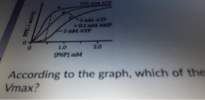 0.01 M A PFK-1 wity 2 mM ATT 02 M AMT -2 MATT 0 1.0 20 (RSP) MM According to the graph, which of the Vmax? According to the graph, which of the following best explains why curve C reaches AMP has a weak affinity for the regulatory site so ATP does not interfere with the reaction. ATP has a better affinity for the catalytic domain than the regulatory domain, thus binds in active site when concentrations of ATP are...
Can any one do 2 and 3 Pyruvate kinase is one of the irreversible steps of...
 Can any one do 2 and 3
Pyruvate kinase is one of the irreversible steps of glycolysis. The human genome has four genes that encode different pyruvate kinases, including a muscle specific form and a liver specific form. The liver specific form differs from the muscle specific form since it has additional regulation through phosphorylation by protein kinase A and allosteric regulation by the amino acid alanine. A V. vs. [S] plot of liver pyruvate kinase is shown below. hi...
Can any one do 2 and 3
Pyruvate kinase is one of the irreversible steps of glycolysis. The human genome has four genes that encode different pyruvate kinases, including a muscle specific form and a liver specific form. The liver specific form differs from the muscle specific form since it has additional regulation through phosphorylation by protein kinase A and allosteric regulation by the amino acid alanine. A V. vs. [S] plot of liver pyruvate kinase is shown below. hi...
1 Consider this graph that we talked discussed in class on how an enzymes affects the...
 1 Consider this graph that we talked discussed in class on how an enzymes affects the rate of product formation. Catalyzed Uncatalyzed reaction Substrate concentration Now consider you have discovered an allosteric inhibitor of the enzyme. You do this experiment again, adding enough allosteric inhibitor to block 50% of the enzyme activity present in the reaction. a. Thinking in terms of the models shown in class, what does it actually mean in molecular terms when "50% of the enzymatic activity"...
4. The X-fold increase in [AMP] (resulting from a 10% decrease in [ATP]) can be shown...
 4. The X-fold increase in [AMP] (resulting from a 10% decrease in [ATP]) can be shown to be responsible for about a 9 told increase in flux through glycolysis by its action on phosphofructokinase alone. But a 9-fold increase is still not an -fold increase, so there must be something more to the story. That "something more" includes substrate cycling (see Figure 15-25 in your text). The reaction catalyzed by fructose-1,6-bisphosphatase (FBPase) acts as the reverse direction reaction for the...
D Question 9 0.59 pts 2 mM ATP 5 3- C21 nM AMPK-AMP Kinase Which of the following best explains what is happening in this graph? e There is a negative correlation between substrate concentration and...
 D Question 9 0.59 pts 2 mM ATP 5 3- C21 nM AMPK-AMP Kinase Which of the following best explains what is happening in this graph? e There is a negative correlation between substrate concentration and AMPK activity. ATP acts as an allosteric activator when concentration of substrate is at least 10 nM. AMPK is not active without the presence of the substrate at 10 nM or greater concentration.
D Question 9 0.59 pts 2 mM ATP 5 3- C21...
D Question 9 0.59 pts 2 mM ATP 5 3- C21 nM AMPK-AMP Kinase Which of the following best explains what is happening in this graph? e There is a negative correlation between substrate concentration and AMPK activity. ATP acts as an allosteric activator when concentration of substrate is at least 10 nM. AMPK is not active without the presence of the substrate at 10 nM or greater concentration.
D Question 9 0.59 pts 2 mM ATP 5 3- C21...
the following questions Fructose-1.6- Fructose-6 ADP phosphate phosphate ATP ADP diphosphate Glucose-6 F ATP Glucose-→ Glucose-p)→...
 the following questions Fructose-1.6- Fructose-6 ADP phosphate phosphate ATP ADP diphosphate Glucose-6 F ATP Glucose-→ Glucose-p)→ Fructose-P P-Fructose-(P FIGURE 5.7 glyceraldyde 3-phosphate P) ADP H-C-OH H20-P 1,3 diphospho- glycerate CH20-P 3 phospho glycerate phosphoenol pyruvate 15) Which step in Figure 5.7 shows a split of one molecule into two smaller molecules? 15) 4) 2 B) 4 )6 Dy H E) 5 16) Which step in Figure 5.7 shows a reaction involving a dehydrogenase? D) 8 A) 2 C) 6 E)5...
 please answer all questions. thank you
A) List, in order, the three enzymes that catalyze the highly regulated steps in glycolysis. (Don't just enter 1, 2, 3 for reaction numbers - give the reaction number based on the 10 steps of glycolysis.) Reaction # Enzyme Reaction # Enzyme Reaction # Enzyme B) For each of these reactions, name ONE allosteric regulator of the enzyme and whether that regulator inhibits or activates the enzyme. Reaction # allosteric regulator allosteric regulator Inhibitor...
please answer all questions. thank you
A) List, in order, the three enzymes that catalyze the highly regulated steps in glycolysis. (Don't just enter 1, 2, 3 for reaction numbers - give the reaction number based on the 10 steps of glycolysis.) Reaction # Enzyme Reaction # Enzyme Reaction # Enzyme B) For each of these reactions, name ONE allosteric regulator of the enzyme and whether that regulator inhibits or activates the enzyme. Reaction # allosteric regulator allosteric regulator Inhibitor...
 29. The activity of the enzyme phosphofructokinase is a) stimulated by low energy charge b) inhibited by fructose 2,6-bisphosphate c stimulated by fructose 1.6-bisphosphate d) all of the above 30. NADH is produced at a) aldolase catalyzed reaction b) Glyceraldehyde-3-phosphate dehydrogenase catalyzed reaction c) pyruvate kinase catalyzed reaction d) hexokinase catalyzed reaction 31. The transfer of 3-phosphoglycerate to 2-phosphoglycerate is catalyzed by which enzyme? a) PGM b)PK c)G2PDH d)TPI e)PFK 32. The enzyme aldolase catalyzes which reaction in Glycolysis? a)...
 3. It is uncommon for one molecule to act as both an activator and inhibitor in metabolism. Which of the following molecules both activates glycolysis and inhibits gluconeogenesis? A. NAD B. Fructose 1,6-bisphosphate C. Pyruvate D. Fructose 2,6-bisphosphate E. Glucose 6-phosphate 4. Regulation of phosphorylase is by phosphorylation. However, this covalent modification increases or decreases activity without completely inhibiting it. The velocity plot is sigmoidal. What statement can be made about this enzyme? A. It likely follows a Michaelis-Menten kinetic....
 0.01 M A PFK-1 wity 2 mM ATT 02 M AMT -2 MATT 0 1.0 20 (RSP) MM According to the graph, which of the Vmax? According to the graph, which of the following best explains why curve C reaches AMP has a weak affinity for the regulatory site so ATP does not interfere with the reaction. ATP has a better affinity for the catalytic domain than the regulatory domain, thus binds in active site when concentrations of ATP are...
 Can any one do 2 and 3
Pyruvate kinase is one of the irreversible steps of glycolysis. The human genome has four genes that encode different pyruvate kinases, including a muscle specific form and a liver specific form. The liver specific form differs from the muscle specific form since it has additional regulation through phosphorylation by protein kinase A and allosteric regulation by the amino acid alanine. A V. vs. [S] plot of liver pyruvate kinase is shown below. hi...
Can any one do 2 and 3
Pyruvate kinase is one of the irreversible steps of glycolysis. The human genome has four genes that encode different pyruvate kinases, including a muscle specific form and a liver specific form. The liver specific form differs from the muscle specific form since it has additional regulation through phosphorylation by protein kinase A and allosteric regulation by the amino acid alanine. A V. vs. [S] plot of liver pyruvate kinase is shown below. hi...
 1 Consider this graph that we talked discussed in class on how an enzymes affects the rate of product formation. Catalyzed Uncatalyzed reaction Substrate concentration Now consider you have discovered an allosteric inhibitor of the enzyme. You do this experiment again, adding enough allosteric inhibitor to block 50% of the enzyme activity present in the reaction. a. Thinking in terms of the models shown in class, what does it actually mean in molecular terms when "50% of the enzymatic activity"...
 4. The X-fold increase in [AMP] (resulting from a 10% decrease in [ATP]) can be shown to be responsible for about a 9 told increase in flux through glycolysis by its action on phosphofructokinase alone. But a 9-fold increase is still not an -fold increase, so there must be something more to the story. That "something more" includes substrate cycling (see Figure 15-25 in your text). The reaction catalyzed by fructose-1,6-bisphosphatase (FBPase) acts as the reverse direction reaction for the...
 D Question 9 0.59 pts 2 mM ATP 5 3- C21 nM AMPK-AMP Kinase Which of the following best explains what is happening in this graph? e There is a negative correlation between substrate concentration and AMPK activity. ATP acts as an allosteric activator when concentration of substrate is at least 10 nM. AMPK is not active without the presence of the substrate at 10 nM or greater concentration.
D Question 9 0.59 pts 2 mM ATP 5 3- C21...
D Question 9 0.59 pts 2 mM ATP 5 3- C21 nM AMPK-AMP Kinase Which of the following best explains what is happening in this graph? e There is a negative correlation between substrate concentration and AMPK activity. ATP acts as an allosteric activator when concentration of substrate is at least 10 nM. AMPK is not active without the presence of the substrate at 10 nM or greater concentration.
D Question 9 0.59 pts 2 mM ATP 5 3- C21...
 the following questions Fructose-1.6- Fructose-6 ADP phosphate phosphate ATP ADP diphosphate Glucose-6 F ATP Glucose-→ Glucose-p)→ Fructose-P P-Fructose-(P FIGURE 5.7 glyceraldyde 3-phosphate P) ADP H-C-OH H20-P 1,3 diphospho- glycerate CH20-P 3 phospho glycerate phosphoenol pyruvate 15) Which step in Figure 5.7 shows a split of one molecule into two smaller molecules? 15) 4) 2 B) 4 )6 Dy H E) 5 16) Which step in Figure 5.7 shows a reaction involving a dehydrogenase? D) 8 A) 2 C) 6 E)5...
Most questions answered within 3 hours.
-
Where is the error in this code sequence?
String s1 = "Hello";
String s2 = "ello";...
asked 11 months ago -
Financial data for Joel de Paris, Inc., for last year
follow:
Joel de Paris, Inc.
Balance...
asked 11 months ago -
Consider this reaction:
Al2(SO4)3 (aq)+ BaCl3
(aq) Al2Cl6 (aq)- +
3BaSO4(s) . What is the...
asked 11 months ago -
Suppose that Savneet is considering increasing her
recent random sample from 20 car rentals to 40...
asked 11 months ago -
Trucks arrive at an unloading terminal at an average rate of 120
per hour.
Trucks arrive...
asked 11 months ago -
Why are methanol and ethanol completely soluble in water while
octanol is not very little soluble....
asked 11 months ago -
A facilities manager at a university reads in a research report
that the mean amount of...
asked 11 months ago -
When the CuSO4 is rehydrated by adding water to the anhydrous
compound, is this an endothermic...
asked 11 months ago -
A ray of sunlight is passing from diamond into crown glass; the
angle of incidence is...
asked 11 months ago -
A block of mass 0.249 kg is placed on top of a light, vertical
spring of...
asked 11 months ago -
how do the kidneys compensate in the presences of acidosis
a) trigger hyperventilate
b) reserve acid...
asked 11 months ago -
Question 501 pts
The rental rate of capital to the firm increases. Which of the
following...
asked 11 months ago