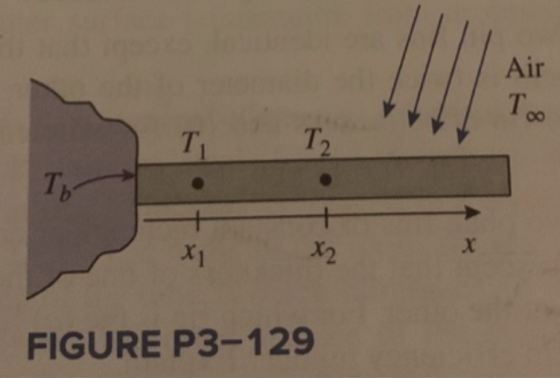
Consider a very long, slender rod. One end of the rod is attached to a base surface maintained at Tb
Consider a very long, slender rod. One end of the rod is attached to a base surface maintained at Tb, while the surface of the rod is exposed to an air temperature of 400°C. Thermocouples imbedded in the rod at locations 25 and 120 mm from the base surface register temperatures of 325°C and 375°C, respectively. (a) Calculate the rod base temperature (°C). (b) Determine the rod length (mm) for the case where the ratio of the heat transfer from a finite length fin to the heat transfer from a very long fin under the same conditions is 99 percent.
Homework Answers


Add Answer to:
Consider a very long, slender rod. One end of the rod is attached to a base surface maintained at Tb
A very long rod 5mm in diameter has one end maintained at 100℃
A very long rod 5mm in diameter has one end maintained at 100℃. The Surface of the rod is exposed to ambient air at 25℃, with a convective heat transfer coefficient of 100 W/m2K. If the rod is constructed from pure copper, what is the heat loss from the rod?
Consider two long, slender rods of the same diameter but different materials. One end of each...
 Consider two long, slender rods of the same diameter but different materials. One end of each rod is attached to a base surface maintained at 100°C, while the surfaces of the rods are exposed to ambient air at 20°C. By traversing the length of each rod with a thermocouple, it was observed that the temperatures of the rods were equal at the positions XA = 0.15 m and XB = 0.25 m, where x is measured from the base surface....
QUESTION 3 Consider a very long rectangular fin attached to a flat surface such that the...
 QUESTION 3 Consider a very long rectangular fin attached to a flat surface such that the temperature at the end of the finis essentially that of the surrounding air, le 10°C its width is 10 cm; thickness is 2 mm: thermal conductivity is 150 Wim K and base temperature is 100'C. The heat transfer coefficient is 20 W/ m K Estimate (a) the fin temperature at a distance of 5.0 cm from the base in c to the nearest degree...
1) An aluminum fin is attached to a warm surface at a steady temperature Tb. The...
 1) An aluminum fin is attached to a warm surface at a steady temperature Tb. The fin is 8mm in diameter and 130mm in length, and is exposed to air at a constant temperature Tamb with a convection coefficient of 15 Determine the percent error in the rate of heat transfer when the infinitely long fin assumption is used instead of the adiabatic fin tip assumption. (20 points)
Consider a very long aluminum fin (k = 237W/m-K) fin
Consider a very long aluminum fin (k = 237W/m-K) fin, with the temperature at the end of the fin essentially that of the surrounding air. This fin has a diameter of lcm, and is attached to a surface at 80°C. The surface is exposed to ambient air at 22°C with a heat transfer coefficient of 15W/m2-K. Estimate: a) The fin temperature at a distance of 5cm from the base; b) The rate of heat loss from the entire fin; c) The effectiveness of...
4. A silicon chip is attached with a copper pin fin in order to enhance the...
 4. A silicon chip is attached with a copper pin fin in order to enhance the heat transfer. The square shape silicon chip has a width of W=10 mm on each side. The length and diameter of the copper pin are L=20 mm and D=4 mm, respectively. During the operation, the surface of the chip, as well as the base of the pin, are maintained at the temperature of To=375 K. The thermal conductivity of the copper pin fin is...
4. A silicon chip is attached with a copper pin fin in order to enhance the...
 4. A silicon chip is attached with a copper pin fin in order to enhance the heat transfer. The square shape silicon chip has a width of W=10 mm on each side. The length and diameter of the copper pin are L=20 mm and D=4 mm, respectively. During the operation, the surface of the chip, as well as the base of the pin, are maintained at the temperature of To=375 K. The thermal conductivity of the copper pin fin is...
4. A silicon chip is attached with a copper pin fin in order to enhance the...
 4. A silicon chip is attached with a copper pin fin in order to enhance the heat transfer. The square shape silicon chip has a width of W=10 mm on each side. The length and diameter of the copper pin are L=20 mm and D=4 mm, respectively. During the operation, the surface of the chip, as well as the base of the pin, are maintained at the temperature of To=375 K. The thermal conductivity of the copper pin fin is...
A brass rod (k = 133 W/m-K) with a diameter of 5 mm and a length...
A brass rod (k = 133 W/m-K) with a diameter of 5 mm and a length of 100 mm is used to enhance heat transfer from a surface which is maintained at 200 C. The cylindrical surface of the rod is exposed to a convection environment with h = 30 W/m2-K and an ambient temperature of 20 C. a) Calculate the heat convected away from the rod. b) Calculate the temperature 50 mm from the wall. c) Plot the temperature...
A long slender solid cylindrical rod made of copper is 2 cm in diameter. It is...
A long slender solid cylindrical rod made of copper is 2 cm in diameter. It is taken out of a liquid nitrogen bath at 77 K and exposed to a stream of warm air at a temperature of 50 C. Neglect internal temperature gradients find the time taken by the rod to heat up to a temperature of 10 C if the surface heat transfer coefficient is 20 W/m^2K. For copper, take k=330 W/mK and ?=95*10^-6 m^2/s.
 Consider two long, slender rods of the same diameter but different materials. One end of each rod is attached to a base surface maintained at 100°C, while the surfaces of the rods are exposed to ambient air at 20°C. By traversing the length of each rod with a thermocouple, it was observed that the temperatures of the rods were equal at the positions XA = 0.15 m and XB = 0.25 m, where x is measured from the base surface....
 QUESTION 3 Consider a very long rectangular fin attached to a flat surface such that the temperature at the end of the finis essentially that of the surrounding air, le 10°C its width is 10 cm; thickness is 2 mm: thermal conductivity is 150 Wim K and base temperature is 100'C. The heat transfer coefficient is 20 W/ m K Estimate (a) the fin temperature at a distance of 5.0 cm from the base in c to the nearest degree...
 1) An aluminum fin is attached to a warm surface at a steady temperature Tb. The fin is 8mm in diameter and 130mm in length, and is exposed to air at a constant temperature Tamb with a convection coefficient of 15 Determine the percent error in the rate of heat transfer when the infinitely long fin assumption is used instead of the adiabatic fin tip assumption. (20 points)
 4. A silicon chip is attached with a copper pin fin in order to enhance the heat transfer. The square shape silicon chip has a width of W=10 mm on each side. The length and diameter of the copper pin are L=20 mm and D=4 mm, respectively. During the operation, the surface of the chip, as well as the base of the pin, are maintained at the temperature of To=375 K. The thermal conductivity of the copper pin fin is...
 4. A silicon chip is attached with a copper pin fin in order to enhance the heat transfer. The square shape silicon chip has a width of W=10 mm on each side. The length and diameter of the copper pin are L=20 mm and D=4 mm, respectively. During the operation, the surface of the chip, as well as the base of the pin, are maintained at the temperature of To=375 K. The thermal conductivity of the copper pin fin is...
 4. A silicon chip is attached with a copper pin fin in order to enhance the heat transfer. The square shape silicon chip has a width of W=10 mm on each side. The length and diameter of the copper pin are L=20 mm and D=4 mm, respectively. During the operation, the surface of the chip, as well as the base of the pin, are maintained at the temperature of To=375 K. The thermal conductivity of the copper pin fin is...
Most questions answered within 3 hours.
-
Where is the error in this code sequence?
String s1 = "Hello";
String s2 = "ello";...
asked 11 months ago -
Financial data for Joel de Paris, Inc., for last year
follow:
Joel de Paris, Inc.
Balance...
asked 11 months ago -
Consider this reaction:
Al2(SO4)3 (aq)+ BaCl3
(aq) Al2Cl6 (aq)- +
3BaSO4(s) . What is the...
asked 11 months ago -
Suppose that Savneet is considering increasing her
recent random sample from 20 car rentals to 40...
asked 11 months ago -
Trucks arrive at an unloading terminal at an average rate of 120
per hour.
Trucks arrive...
asked 11 months ago -
Why are methanol and ethanol completely soluble in water while
octanol is not very little soluble....
asked 11 months ago -
A facilities manager at a university reads in a research report
that the mean amount of...
asked 11 months ago -
When the CuSO4 is rehydrated by adding water to the anhydrous
compound, is this an endothermic...
asked 11 months ago -
A ray of sunlight is passing from diamond into crown glass; the
angle of incidence is...
asked 11 months ago -
A block of mass 0.249 kg is placed on top of a light, vertical
spring of...
asked 11 months ago -
how do the kidneys compensate in the presences of acidosis
a) trigger hyperventilate
b) reserve acid...
asked 11 months ago -
Question 501 pts
The rental rate of capital to the firm increases. Which of the
following...
asked 11 months ago