
Homework Answers
Add Answer to:
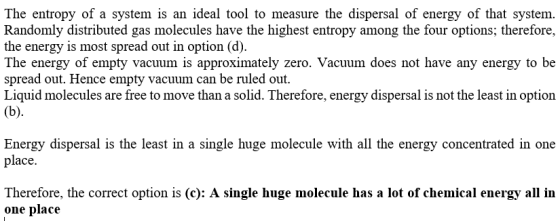
In which situation is the energy of the system LEAST spread out? an empty vacuum A...
Which of the following statements is false? a Energy will disperse unless it is hindered from...
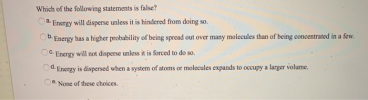 Which of the following statements is false? a Energy will disperse unless it is hindered from doing so. b. Energy has a higher probability of being spread out over many molecules than of being concentrated in a few. C. Energy will not disperse unless it is forced to do so. d. Energy is dispersed when a system of atoms or molecules expands to occupy a larger volume. None of these choices.
Which of the following are true about radiation of heat? Mark all that apply. The rate...
 Which of the following are true about radiation of heat? Mark all that apply. The rate of energy transfer is proportional to the surface area of the object Radiation occurs when mass at one temperature transfers to a different location Radiation can transfer heat through empty space (vacuum) Radiation is a result of the collisions between molecules in two different objects at two different temperatures Which of the following characteristics describe good thermal conductors? Mark all that apply. High thermal...
Learning Goal Internal Energy of an ideal gas The internal energy of a system is the...
 Learning Goal Internal Energy of an ideal gas The internal energy of a system is the energy stored in the system. In an ideal gas, the internal energy includes the kinetic energies (translational and rotational) of all the molecules, and other energies due to the interactions among the molecules. The internal energy is proportional to the Absolute Temperature T and the number of moles n (or the number of molecules N). n monatomic ideal gases, the interactions among the molecules...
For the statements below, circle the all correct answer(s). Each statement has at least one, and...
For the statements below, circle the all correct answer(s). Each statement has at least one, and may have more than one , correct answer. (assume all thermodynamic quantities refer to the system, except where indicated) e. which of the following statements is TRUE concerning single-component phase equilibria? 1 at the critical point, the densities of vapor and liquid are equal 2. the triple point on a P-T phase diagram becomes a triple line on a P-V phase diagram 3. the...
1. Consider a dilute solution of molecules at fixed temperature T. These molecules have access to...
 1. Consider a dilute solution of molecules at fixed temperature T. These molecules have access to a surface that has a total of B binding sites where molecules can bind. To count states in this system, we will divide space into small cells that each can hold a single molecule. There are a total of B cells that have a binding site, and a total of M cells that do not have binding sites. The overall number of cells is...
Problem 4: Read Appendix 2 below (Sec. 1.4.1 of Kasap) and then solve. A metallic back...
 Problem 4: Read Appendix 2 below (Sec. 1.4.1 of Kasap) and then solve. A metallic back contact is applied to the CdTe solar cell of Problem 1 using a set up similar to that described in Figure 1.74 (b) on the next page. To form the metallic back contact, two evaporation sources are used, Cu and Au. An initial 3 nm layer of Cu is deposited first and then 30 nm of Au is deposited. After these depositions, the sample...
Question 2 Which of the following best describes how both symport and antiport transporters move two...
Question 2 Which of the following best describes how both symport and antiport transporters move two different types of molecules? They move two molecule types down both of their electrochemical gradients. They move two molecule types up both of their electrochemical gradients. They move one molecule type up and one down their electrochemical gradients. They move two molecule types into the cytosol. They move two molecule types out of the cell. They use ATP to power active transport. Question 3...
Electron transport chains (ETCs), large proteins through which electrons move, play important roles in two of...
Electron transport chains (ETCs), large proteins through which electrons move, play important roles in two of nature's fundamental processes: (1) the conversion of electromagnetic energy from the Sun into the energy in the chemical bonds in glucose molecules and (2) the conversion of the energy in these glucose molecules into useful forms for metabolic processes, such as muscle contraction, building proteins, and respiration. Respiratory ETCs are located in the inner membranes of mitochondria, the power plants of eukaryotic cells. ETCs...
Which of these is wrong? It says I've gotten all but one right. Word bank listed...
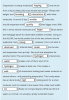 Which of these is wrong? It says I've gotten all but one right.
Word bank listed below.
Evaporation is simply molecules leaping nto the air from a liquid. Molecules must achieve two things-- lifting their weight, and breaking a interactions with other molecules. In terms of size smaller molecules should evaporate more quickly than bigger ones. With this in mind, ethanol molecules are larger than waters (see webpage above for observable oddities of water). Going on that ALONE, we would...
Which of these is wrong? It says I've gotten all but one right.
Word bank listed below.
Evaporation is simply molecules leaping nto the air from a liquid. Molecules must achieve two things-- lifting their weight, and breaking a interactions with other molecules. In terms of size smaller molecules should evaporate more quickly than bigger ones. With this in mind, ethanol molecules are larger than waters (see webpage above for observable oddities of water). Going on that ALONE, we would...
1- Which battery system is based on half reactions involving zinc metal and manganese dioxide? Select...
1- Which battery system is based on half reactions involving zinc metal and manganese dioxide? Select one: a. None of these b. dry-cell batteries c. lead-acid storage batteries d. alkaline batteries e. fuel cells 2- According to the collision theory of chemical reactions: Select one: a. low energy collisions result in many successful reactions as there is sufficient time for the reactants to form products. b. low energy collisions do not occur in the gas phase. c. high energy collisions...
 Which of the following statements is false? a Energy will disperse unless it is hindered from doing so. b. Energy has a higher probability of being spread out over many molecules than of being concentrated in a few. C. Energy will not disperse unless it is forced to do so. d. Energy is dispersed when a system of atoms or molecules expands to occupy a larger volume. None of these choices.
 Which of the following are true about radiation of heat? Mark all that apply. The rate of energy transfer is proportional to the surface area of the object Radiation occurs when mass at one temperature transfers to a different location Radiation can transfer heat through empty space (vacuum) Radiation is a result of the collisions between molecules in two different objects at two different temperatures Which of the following characteristics describe good thermal conductors? Mark all that apply. High thermal...
 Learning Goal Internal Energy of an ideal gas The internal energy of a system is the energy stored in the system. In an ideal gas, the internal energy includes the kinetic energies (translational and rotational) of all the molecules, and other energies due to the interactions among the molecules. The internal energy is proportional to the Absolute Temperature T and the number of moles n (or the number of molecules N). n monatomic ideal gases, the interactions among the molecules...
 1. Consider a dilute solution of molecules at fixed temperature T. These molecules have access to a surface that has a total of B binding sites where molecules can bind. To count states in this system, we will divide space into small cells that each can hold a single molecule. There are a total of B cells that have a binding site, and a total of M cells that do not have binding sites. The overall number of cells is...
 Problem 4: Read Appendix 2 below (Sec. 1.4.1 of Kasap) and then solve. A metallic back contact is applied to the CdTe solar cell of Problem 1 using a set up similar to that described in Figure 1.74 (b) on the next page. To form the metallic back contact, two evaporation sources are used, Cu and Au. An initial 3 nm layer of Cu is deposited first and then 30 nm of Au is deposited. After these depositions, the sample...
 Which of these is wrong? It says I've gotten all but one right.
Word bank listed below.
Evaporation is simply molecules leaping nto the air from a liquid. Molecules must achieve two things-- lifting their weight, and breaking a interactions with other molecules. In terms of size smaller molecules should evaporate more quickly than bigger ones. With this in mind, ethanol molecules are larger than waters (see webpage above for observable oddities of water). Going on that ALONE, we would...
Which of these is wrong? It says I've gotten all but one right.
Word bank listed below.
Evaporation is simply molecules leaping nto the air from a liquid. Molecules must achieve two things-- lifting their weight, and breaking a interactions with other molecules. In terms of size smaller molecules should evaporate more quickly than bigger ones. With this in mind, ethanol molecules are larger than waters (see webpage above for observable oddities of water). Going on that ALONE, we would...
Most questions answered within 3 hours.
-
Where is the error in this code sequence?
String s1 = "Hello";
String s2 = "ello";...
asked 11 months ago -
Financial data for Joel de Paris, Inc., for last year
follow:
Joel de Paris, Inc.
Balance...
asked 11 months ago -
Consider this reaction:
Al2(SO4)3 (aq)+ BaCl3
(aq) Al2Cl6 (aq)- +
3BaSO4(s) . What is the...
asked 11 months ago -
Suppose that Savneet is considering increasing her
recent random sample from 20 car rentals to 40...
asked 11 months ago -
Trucks arrive at an unloading terminal at an average rate of 120
per hour.
Trucks arrive...
asked 11 months ago -
Why are methanol and ethanol completely soluble in water while
octanol is not very little soluble....
asked 11 months ago -
A facilities manager at a university reads in a research report
that the mean amount of...
asked 11 months ago -
When the CuSO4 is rehydrated by adding water to the anhydrous
compound, is this an endothermic...
asked 11 months ago -
A ray of sunlight is passing from diamond into crown glass; the
angle of incidence is...
asked 11 months ago -
A block of mass 0.249 kg is placed on top of a light, vertical
spring of...
asked 11 months ago -
how do the kidneys compensate in the presences of acidosis
a) trigger hyperventilate
b) reserve acid...
asked 11 months ago -
Question 501 pts
The rental rate of capital to the firm increases. Which of the
following...
asked 11 months ago