

Homework Answers
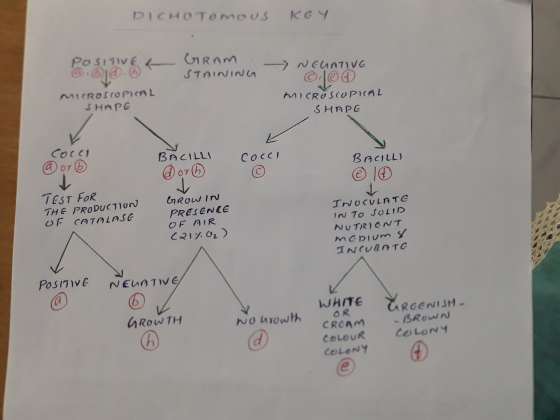
From the above information, let us categorize the given 8 microbes as a,b,c,d,e,f,g and h, respectively.
a -Streptococcus aureus
b -Streptococcus pyrogens
c -Mycoplasma pneumoniae
d -Clostridiumbotulinm
e -Escherichia coli
f -Pseudomonas aeruginosa
g -Campylobacter fetus
h -Listeria monocytogens
Note:After microscopical experiments if it is Gram negative comma shaped bacteria ,we can directly confirm it is g, i.e Campylobacter fetus
Add Answer to:
Table of diagnostic tests and bacterial characteristics "+" means positive for that test or characteristic "-"...
make a dichotmois identifcation key for eight gram positive bacteria TENT DE Insert Table Chart Text...
 make a dichotmois identifcation key for eight gram positive
bacteria
TENT DE Insert Table Chart Text Shape Media Comment Collab Dichotomous Identification Key for eight Gram positive Bacteria Staphylococcus aureus, Staphylococcus Sanghyticus Streptococcus n ige, Streptococcus Orale Streptococcus R . Bacillus , Bacillus shows, Enterococcus Day 1 test: Inoculate Unknown on TSA blood Chocolate Agar/CNA blood Gram stain colonies Day 2: Gram + coccus (SaS o S r . Soral S Gram + bacillus B. Alpha hemolysis Beta hemolysis Gamma...
make a dichotmois identifcation key for eight gram positive
bacteria
TENT DE Insert Table Chart Text Shape Media Comment Collab Dichotomous Identification Key for eight Gram positive Bacteria Staphylococcus aureus, Staphylococcus Sanghyticus Streptococcus n ige, Streptococcus Orale Streptococcus R . Bacillus , Bacillus shows, Enterococcus Day 1 test: Inoculate Unknown on TSA blood Chocolate Agar/CNA blood Gram stain colonies Day 2: Gram + coccus (SaS o S r . Soral S Gram + bacillus B. Alpha hemolysis Beta hemolysis Gamma...
The chart below describes the biochemical reactions of six different Gram-positive bacteria for the indicated tests....
 The chart below describes the biochemical reactions of six
different Gram-positive bacteria for the indicated tests. Following
the example your instructor presented at the beginning of the lab
period, construct a dichotomous key to identify the six bacteria
listed below. IMPORTANT: do not start your key with the same test
your instructor used to start the example in class. Draw your chart
by hand on the next page titled “Dichotomous Key.” Your key should
include all the tests needed to...
The chart below describes the biochemical reactions of six
different Gram-positive bacteria for the indicated tests. Following
the example your instructor presented at the beginning of the lab
period, construct a dichotomous key to identify the six bacteria
listed below. IMPORTANT: do not start your key with the same test
your instructor used to start the example in class. Draw your chart
by hand on the next page titled “Dichotomous Key.” Your key should
include all the tests needed to...
BACTERIAL DISEASES If your disease was caused by a bacterium, answer the questions on this page....
 BACTERIAL DISEASES
If your disease was caused by a bacterium, answer the questions
on this page. If not, skip to another page.
Your Name _________________________________ Genus and species of
bacterium ____________________________________
Case Study # ____________
Approximately when was the causative agent for this disease
first identified? By whom?
Is this bacterium a ______Gram + bacillus ______ Acid-Fast
[check one]
______ Gram + coccus ______ Spirillum
______Gram – bacillus ______ Spirochete
_____ Gram – coccus ______ Vibrio
Does this bacterium have...
BACTERIAL DISEASES
If your disease was caused by a bacterium, answer the questions
on this page. If not, skip to another page.
Your Name _________________________________ Genus and species of
bacterium ____________________________________
Case Study # ____________
Approximately when was the causative agent for this disease
first identified? By whom?
Is this bacterium a ______Gram + bacillus ______ Acid-Fast
[check one]
______ Gram + coccus ______ Spirillum
______Gram – bacillus ______ Spirochete
_____ Gram – coccus ______ Vibrio
Does this bacterium have...
Laboratory & Exercises 1. You will not be physically performing these activities. However, you will be...
 Laboratory & Exercises 1. You will not be physically performing these activities. However, you will be responsible for knowing how to perform and interpret them. View the following video clips: • SE Broth & Bile Esculin • CAMP Test 2. Review how to interpret the following tests by completing the chart: Positive Result Negative Result Gram Stain for cocci and bacilli purple Schaeffer-Fulton Stain for Endospores Negative Stain for Capsules Catalase (Reagent: Hydrogen peroxide) Coagulase (Reagent: Rabbit Plasma) Oxidase (Reagent:...
BACTERIAL DISEASES If your disease was caused by a bacterium, answer the questions on this page. ...
 BACTERIAL DISEASES
If your disease was caused by a bacterium, answer the questions
on this page. If not, skip to another page.
Your Name _________________________________ Genus and species of
bacterium ____________________________________
Case Study # ____________
Approximately when was the causative agent for this disease
first identified? By whom?
Is this bacterium a ______Gram + bacillus ______ Acid-Fast
[check one]
______ Gram + coccus ______ Spirillum
______Gram – bacillus ______ Spirochete
_____ Gram – coccus ______ Vibrio
Does this bacterium have...
BACTERIAL DISEASES
If your disease was caused by a bacterium, answer the questions
on this page. If not, skip to another page.
Your Name _________________________________ Genus and species of
bacterium ____________________________________
Case Study # ____________
Approximately when was the causative agent for this disease
first identified? By whom?
Is this bacterium a ______Gram + bacillus ______ Acid-Fast
[check one]
______ Gram + coccus ______ Spirillum
______Gram – bacillus ______ Spirochete
_____ Gram – coccus ______ Vibrio
Does this bacterium have...
A: The Disturbing Discharge You are working in a gynecologist's office. Your first patient is a...
 A: The Disturbing Discharge You are working in a gynecologist's office. Your first patient is a 19-year old woman who complains that she has experienced vaginal itching and a frothy greenish-white vaginal discharge with a strong odor for the past several days. When you examine her, you observe inflammation of the genital region. When you ask your patient if she is sexually active, she tells you she has had two sexual partners in the past 4 months. You swab the...
5. Why are simple stains able to "stick” to bacteria? Explain the chemical properties of the...
 5. Why are simple stains able to "stick” to bacteria? Explain the chemical properties of the stain and bacteria surface. 3-Preparation of Bacterial Smears and Simple Stains Introduction Microbial cultures are handled using aseptic technique. Aseptie technique is a set of procedures used to minimize contamination of materials by microorganisms from the environment, and to minimize the spread of cultures around the laboratory. In this experiment, you will be using an inoculating loop to transfer bacteria from a culture tube...
I need help creating a flowchart on a unknown 89 Chart of Unknown Test and the...
I need help creating a flowchart on a unknown 89 Chart of Unknown Test and the Result #89 Name of Test What does it test? Positive result appears as: negative results appears as: Unknown #89 result: Gram Stain Reaction Cell envelope morphology Violet-blue Red Negative (pink) Cell morphology (shape: coccus, bacillus, or spirillum) Cell shape Bacillus (Rod shaped) Cell Arrangement Cell size or length Single Bacillus Pigment Cell envelope morphology Pink Oxygen Requirement If cell needs oxygen for respiration Growth...
1. Bacteria such as E.coll and staph belong to which Domain? A. Animalia B. Eukarya C....
 1. Bacteria such as E.coll and staph belong to which Domain? A. Animalia B. Eukarya C. Archaea D. Bacteria 2. In general terms, prokaryotic cells are cells that? A. Have a nucleus B. Do not have a nucleus. 3. Think about the name E. coli 4X56. In that name which refers to the serotype? A E B. coli C4X56 4. Which of the following best describes the type of bacteria that are important to ecology, and once were thought to...
MODULE 15 EFFECTS OF DISINFECTANTS AND ANTISEPTICS OBJECTIVES Be familiar or be able to describe 1)...
 MODULE 15 EFFECTS OF DISINFECTANTS AND ANTISEPTICS OBJECTIVES Be familiar or be able to describe 1) Antimicrobial substances: Chemical and biological 2) Bacteriocidal versus Bacteriostatic chemicals 3) Sterilization versus disinfection by chemical antimicrobials 4) Difference between disinfectants, antisepties, and antibiotics in terms of a. Antimicrobial activity b. Where they would be used c. Role of organic matter in their effectiveness d. Differential effects on Gram positive and Gram negative bacteria. 5) Phenol coefficient test 6) Disk Diffusion method of assessing...
 make a dichotmois identifcation key for eight gram positive
bacteria
TENT DE Insert Table Chart Text Shape Media Comment Collab Dichotomous Identification Key for eight Gram positive Bacteria Staphylococcus aureus, Staphylococcus Sanghyticus Streptococcus n ige, Streptococcus Orale Streptococcus R . Bacillus , Bacillus shows, Enterococcus Day 1 test: Inoculate Unknown on TSA blood Chocolate Agar/CNA blood Gram stain colonies Day 2: Gram + coccus (SaS o S r . Soral S Gram + bacillus B. Alpha hemolysis Beta hemolysis Gamma...
make a dichotmois identifcation key for eight gram positive
bacteria
TENT DE Insert Table Chart Text Shape Media Comment Collab Dichotomous Identification Key for eight Gram positive Bacteria Staphylococcus aureus, Staphylococcus Sanghyticus Streptococcus n ige, Streptococcus Orale Streptococcus R . Bacillus , Bacillus shows, Enterococcus Day 1 test: Inoculate Unknown on TSA blood Chocolate Agar/CNA blood Gram stain colonies Day 2: Gram + coccus (SaS o S r . Soral S Gram + bacillus B. Alpha hemolysis Beta hemolysis Gamma...
 The chart below describes the biochemical reactions of six
different Gram-positive bacteria for the indicated tests. Following
the example your instructor presented at the beginning of the lab
period, construct a dichotomous key to identify the six bacteria
listed below. IMPORTANT: do not start your key with the same test
your instructor used to start the example in class. Draw your chart
by hand on the next page titled “Dichotomous Key.” Your key should
include all the tests needed to...
The chart below describes the biochemical reactions of six
different Gram-positive bacteria for the indicated tests. Following
the example your instructor presented at the beginning of the lab
period, construct a dichotomous key to identify the six bacteria
listed below. IMPORTANT: do not start your key with the same test
your instructor used to start the example in class. Draw your chart
by hand on the next page titled “Dichotomous Key.” Your key should
include all the tests needed to...
 BACTERIAL DISEASES
If your disease was caused by a bacterium, answer the questions
on this page. If not, skip to another page.
Your Name _________________________________ Genus and species of
bacterium ____________________________________
Case Study # ____________
Approximately when was the causative agent for this disease
first identified? By whom?
Is this bacterium a ______Gram + bacillus ______ Acid-Fast
[check one]
______ Gram + coccus ______ Spirillum
______Gram – bacillus ______ Spirochete
_____ Gram – coccus ______ Vibrio
Does this bacterium have...
BACTERIAL DISEASES
If your disease was caused by a bacterium, answer the questions
on this page. If not, skip to another page.
Your Name _________________________________ Genus and species of
bacterium ____________________________________
Case Study # ____________
Approximately when was the causative agent for this disease
first identified? By whom?
Is this bacterium a ______Gram + bacillus ______ Acid-Fast
[check one]
______ Gram + coccus ______ Spirillum
______Gram – bacillus ______ Spirochete
_____ Gram – coccus ______ Vibrio
Does this bacterium have...
 Laboratory & Exercises 1. You will not be physically performing these activities. However, you will be responsible for knowing how to perform and interpret them. View the following video clips: • SE Broth & Bile Esculin • CAMP Test 2. Review how to interpret the following tests by completing the chart: Positive Result Negative Result Gram Stain for cocci and bacilli purple Schaeffer-Fulton Stain for Endospores Negative Stain for Capsules Catalase (Reagent: Hydrogen peroxide) Coagulase (Reagent: Rabbit Plasma) Oxidase (Reagent:...
 BACTERIAL DISEASES
If your disease was caused by a bacterium, answer the questions
on this page. If not, skip to another page.
Your Name _________________________________ Genus and species of
bacterium ____________________________________
Case Study # ____________
Approximately when was the causative agent for this disease
first identified? By whom?
Is this bacterium a ______Gram + bacillus ______ Acid-Fast
[check one]
______ Gram + coccus ______ Spirillum
______Gram – bacillus ______ Spirochete
_____ Gram – coccus ______ Vibrio
Does this bacterium have...
BACTERIAL DISEASES
If your disease was caused by a bacterium, answer the questions
on this page. If not, skip to another page.
Your Name _________________________________ Genus and species of
bacterium ____________________________________
Case Study # ____________
Approximately when was the causative agent for this disease
first identified? By whom?
Is this bacterium a ______Gram + bacillus ______ Acid-Fast
[check one]
______ Gram + coccus ______ Spirillum
______Gram – bacillus ______ Spirochete
_____ Gram – coccus ______ Vibrio
Does this bacterium have...
 A: The Disturbing Discharge You are working in a gynecologist's office. Your first patient is a 19-year old woman who complains that she has experienced vaginal itching and a frothy greenish-white vaginal discharge with a strong odor for the past several days. When you examine her, you observe inflammation of the genital region. When you ask your patient if she is sexually active, she tells you she has had two sexual partners in the past 4 months. You swab the...
 5. Why are simple stains able to "stick” to bacteria? Explain the chemical properties of the stain and bacteria surface. 3-Preparation of Bacterial Smears and Simple Stains Introduction Microbial cultures are handled using aseptic technique. Aseptie technique is a set of procedures used to minimize contamination of materials by microorganisms from the environment, and to minimize the spread of cultures around the laboratory. In this experiment, you will be using an inoculating loop to transfer bacteria from a culture tube...
 1. Bacteria such as E.coll and staph belong to which Domain? A. Animalia B. Eukarya C. Archaea D. Bacteria 2. In general terms, prokaryotic cells are cells that? A. Have a nucleus B. Do not have a nucleus. 3. Think about the name E. coli 4X56. In that name which refers to the serotype? A E B. coli C4X56 4. Which of the following best describes the type of bacteria that are important to ecology, and once were thought to...
 MODULE 15 EFFECTS OF DISINFECTANTS AND ANTISEPTICS OBJECTIVES Be familiar or be able to describe 1) Antimicrobial substances: Chemical and biological 2) Bacteriocidal versus Bacteriostatic chemicals 3) Sterilization versus disinfection by chemical antimicrobials 4) Difference between disinfectants, antisepties, and antibiotics in terms of a. Antimicrobial activity b. Where they would be used c. Role of organic matter in their effectiveness d. Differential effects on Gram positive and Gram negative bacteria. 5) Phenol coefficient test 6) Disk Diffusion method of assessing...
Most questions answered within 3 hours.
-
Where is the error in this code sequence?
String s1 = "Hello";
String s2 = "ello";...
asked 10 months ago -
Financial data for Joel de Paris, Inc., for last year
follow:
Joel de Paris, Inc.
Balance...
asked 10 months ago -
Consider this reaction:
Al2(SO4)3 (aq)+ BaCl3
(aq) Al2Cl6 (aq)- +
3BaSO4(s) . What is the...
asked 10 months ago -
Suppose that Savneet is considering increasing her
recent random sample from 20 car rentals to 40...
asked 10 months ago -
Trucks arrive at an unloading terminal at an average rate of 120
per hour.
Trucks arrive...
asked 10 months ago -
Why are methanol and ethanol completely soluble in water while
octanol is not very little soluble....
asked 10 months ago -
A facilities manager at a university reads in a research report
that the mean amount of...
asked 10 months ago -
When the CuSO4 is rehydrated by adding water to the anhydrous
compound, is this an endothermic...
asked 10 months ago -
A ray of sunlight is passing from diamond into crown glass; the
angle of incidence is...
asked 10 months ago -
A block of mass 0.249 kg is placed on top of a light, vertical
spring of...
asked 10 months ago -
how do the kidneys compensate in the presences of acidosis
a) trigger hyperventilate
b) reserve acid...
asked 10 months ago -
Question 501 pts
The rental rate of capital to the firm increases. Which of the
following...
asked 10 months ago